If you're reading this late at night, there's a good chance your mind is racing through the same questions most parents ask at the start of a custody case. Where will my child live. Will I still be able to make decisions. What does primary physical custody NC mean in real life, not just on court papers.
Those questions matter because custody orders don't just label parents. They shape school routines, doctor visits, exchanges, holidays, and the day-to-day rhythm of your child's life.
North Carolina custody law can feel confusing because people use terms loosely. One parent says "full custody" when they really mean primary placement. Another says "joint custody" when they mean shared legal decision-making, not equal time. Courts, however, look past those labels and focus on something much more practical. What arrangement serves the child best.
Navigating Your North Carolina Child Custody Case
Separation changes everything at once. You're trying to keep life steady for your child while also dealing with housing, schedules, finances, and conflict with the other parent. In that setting, hearing terms like primary physical custody can make an already stressful situation feel even harder to manage.

The first thing to understand is that a custody case isn't only about "winning." Parents often focus on the title of primary custodian, but judges care more about whether the proposed arrangement is stable, realistic, and healthy for the child. A custody order that looks good on paper but creates constant school problems, late exchanges, medical confusion, or conflict between homes usually doesn't serve anyone well.
Practical rule: In North Carolina, the strongest custody position is usually the one supported by facts, routine, and a child-centered plan, not the one built on anger at the other parent.
Many parents come into a consultation believing the court starts from a default rule. Some think mothers automatically have the advantage. Others assume courts push every family into a 50/50 schedule. Neither assumption gives you a reliable roadmap in North Carolina.
A useful way to approach your case is to ask better questions:
- What does my child need most right now: consistency, safety, reduced transitions, closer school proximity, or calmer communication between parents?
- What evidence shows my true caregiving role: school pick-ups, medical appointments, homework supervision, bedtime routines, and extracurricular involvement?
- What schedule can I realistically maintain: not the ideal version, but the one that works with work hours, transportation, and the child's needs?
That shift matters. Custody disputes become clearer when you stop arguing in slogans and start thinking in daily logistics.
What Is Primary Physical Custody in North Carolina
The phrase sounds technical, but the practical meaning is straightforward. Primary physical custody usually means the child lives with one parent most of the time, while the other parent has secondary custody and visitation.
In North Carolina, primary physical custody designates one parent as the primary custodian where the child resides for the majority of the time, with the other parent receiving secondary custody and visitation rights. This arrangement ensures the child has a stable primary residence for school and medical records. Historically, until the late 1970s, NC courts favored mothers, but modern gender-neutral laws have eliminated this automatic preference.
That summary reflects guidance discussed in this North Carolina custody overview.
Think of primary custody as the child's home base
A simple way to understand primary physical custody NC is to think of one home as the child's home base. That's usually the address tied most closely to ordinary life. School records are built around it. Medical paperwork often points back to it. The child returns there more often than not.
That doesn't mean the other parent becomes unimportant. It means one household carries more of the child's weekly routine.
Parents often confuse this with sole custody, but they aren't the same thing. A parent can have primary physical custody while both parents still share legal custody and remain involved in major choices. The title tells you where the child lives most of the time. It doesn't automatically answer every question about decision-making.
What primary custody is not
Primary physical custody is not a guarantee that one parent controls everything. It also isn't just a nicer way of saying the other parent gets occasional visits.
In many North Carolina families, the child may spend substantial time with the secondary custodial parent, including weekends, holidays, summers, and regular weekday time. The key distinction is still the same. One parent has the majority of physical time, and that home functions as the child's main residence.
Here are the most common misunderstandings:
- "Primary custody means the other parent lost their rights." Not necessarily. Rights depend heavily on the legal custody terms in the order.
- "Joint custody always means 50/50." It doesn't. Parents may share legal custody without sharing equal physical time.
- "Courts prefer equal time by default." North Carolina doesn't use an automatic equal-time rule.
Why courts use this structure
Judges often use primary and secondary physical custody because children usually benefit from a workable routine. Frequent handoffs can work in some families, but only when the parents communicate well, live close enough, and can support the arrangement without constant disruption.
A primary custody label matters less than whether the schedule fits the child's school week, emotional needs, and each parent's actual capacity to carry it out.
That is why primary physical custody NC is often less about status and more about structure. The court is trying to answer a practical question. Where should this child primarily live so daily life remains stable.
How NC Courts Decide Who Gets Primary Custody
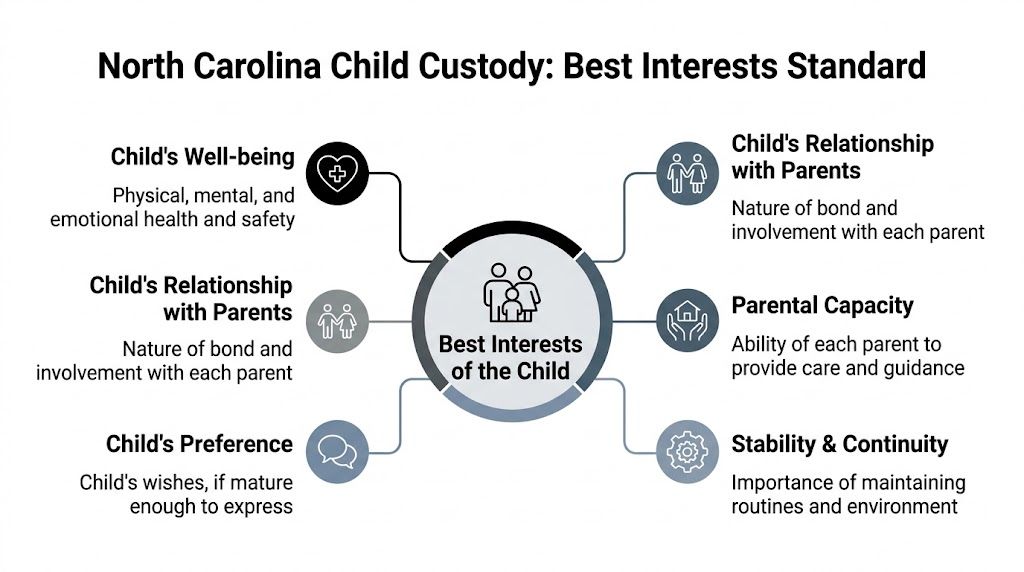
North Carolina courts decide custody under the best interests of the child standard. There is no statutory presumption that mothers should win, fathers should win, or that joint custody should happen automatically. A summary of that point, including a commonly cited parenting-time figure for fathers in North Carolina, appears in this discussion of North Carolina child custody determinations, which notes that NC fathers average 27.9% parenting time compared with a 35% national average in a 2018 CustodyXChange study.
That number gets attention, but in court, statistics don't decide your case. Evidence does.
If you want a broader overview of how these rules fit together, this guide to North Carolina child custody laws is a useful companion.
The standard is broad, but the evidence is concrete
Judges don't decide custody based on who sounds more emotional in court. They look for facts tied to the child's actual life. In practice, that means your case rises or falls on routines, records, conduct, credibility, and whether your proposed plan makes sense.
North Carolina courts evaluate multiple factors. These often include caregiving history, home stability, health and safety concerns, school adjustment, sibling relationships, and each parent's willingness to support the child's relationship with the other parent.
The factors judges commonly weigh
1. Each parent's caregiving history
Who has been handling the ordinary work of parenting matters. Judges look closely at who wakes the child up, handles meals, gets the child to school, schedules appointments, helps with homework, and manages the child's routines.
A parent who says, "I can do all of that now," may face a harder road than a parent who can show, "I've already been doing it."
2. Stability in the home
Stability isn't luxury. It's consistency. A modest but calm household often presents better than a larger home with chaos, frequent moves, or constant conflict.
Examples that often help:
- Reliable routines: bedtime, homework, meals, transportation
- Practical housing: enough space, safe conditions, predictable residence
- Follow-through: attending school events and keeping appointments
3. Safety concerns and parental fitness
Courts take domestic violence, substance abuse, neglect, and serious mental health concerns seriously. If a parent raises these issues, the court will expect objective evidence where possible, not just accusations.
Police reports, treatment records when available, photographs, messages, witness testimony, and prior court findings can carry weight. Unsupported claims often damage the accuser as much as the accused.
4. The child's adjustment
Judges consider how a proposed custody arrangement affects school, social life, and emotional well-being. A child who is doing well in a current routine may not benefit from a dramatic restructuring unless there's a strong reason for it.
This is one reason courts often pay attention to the existing status quo. If one parent has already been carrying most of the daily routine successfully, that history may matter.
5. Ability to co-parent
A judge isn't looking for perfect warmth between former partners. The court is looking for whether parents can exchange information, follow schedules, and keep the child out of adult conflict.
Parents don't need to like each other to share custody well. They do need to stop using the child as a messenger, witness, or bargaining chip.
A parent who constantly blocks communication, withholds information, or undermines the other parent can hurt their own custody position.
6. Child preferences in the right case
North Carolina courts may consider a child's wishes when the child is mature enough, but there isn't a fixed age where the child gets to decide. Preference is one factor, not the whole case.
A teenager's reasoned view may carry more weight than a younger child's reaction to looser house rules or fewer chores.
Myths that hurt custody cases
Some beliefs keep parents from preparing correctly:
- "Mothers always get primary custody." North Carolina no longer uses automatic maternal preference.
- "The higher earner wins." Income alone doesn't determine primary physical custody.
- "If I ask for 50/50, the judge has to consider me more involved." The court will look at whether the schedule is realistic and child-centered, not whether it sounds fair to the adults.
- "If the other parent has made mistakes, I automatically win." The issue is whether those facts affect the child's best interests.
The strongest custody arguments are specific. They answer why your proposed arrangement serves this child, in this county, with this school schedule, these work demands, and these family circumstances.
Primary Physical vs Legal Custody and Parenting Time
One of the biggest sources of confusion in any custody case is the difference between physical custody, legal custody, and parenting time. These terms overlap, but they don't mean the same thing.
North Carolina Chapter 50A defines physical custody as "the physical care and supervision of a child." That distinction matters because courts can separate where the child primarily lives from who has authority over major decisions. A summary of that framework appears in this North Carolina custody analysis, which states that approximately 70-80% of North Carolina custody awards use this split structure, with one parent having primary physical custody and both parents sharing joint legal custody.
Why that distinction matters
Parents often hear "primary physical custody" and assume the other parent loses meaningful authority. In many cases, that's not true.
If the order grants joint legal custody, both parents may still share authority over major decisions involving education, healthcare, and other substantial issues. The parent with primary physical custody usually handles the flow of ordinary daily decisions because the child is in that home most of the time. But major decisions may still require both parents to participate.
North Carolina custody types explained
| Custody Type | Primary Responsibility | Example Decisions |
|---|---|---|
| Primary Physical Custody | One parent provides most day-to-day care because the child lives with that parent most of the time | School-night routine, meals, transportation, bedtime, ordinary daily supervision |
| Joint Physical Custody | Both parents share substantial physical time with the child under a defined schedule | Alternating weeks, extended weekday blocks, shared holiday schedule |
| Joint Legal Custody | Both parents share authority over major decisions affecting the child's welfare | Choice of school, non-emergency medical care, counseling, religious upbringing |
If you don't have primary custody, do you lose your rights
Usually, no.
A parent with secondary physical custody may still have substantial parenting time and may still hold equal legal authority over major issues if the order says legal custody is joint. That parent is still a legal parent with enforceable rights and responsibilities.
Here is the practical breakdown:
- Day-to-day calls: the parent caring for the child at that moment usually handles immediate routine matters.
- Major long-term decisions: these may require joint discussion and agreement if legal custody is shared.
- Parenting time rights: the visitation or custodial schedule in the order is enforceable, not optional.
The words in the custody order matter more than the label parents use in conversation.
What parenting time really means
Parents often use "visitation" as if it means a lesser role. In many modern cases, parenting time is substantial, active, and central to the child's life even if one parent remains the primary physical custodian.
A father who has midweek overnight time, alternating weekends, holidays, school breaks, and summer time may still play a major parenting role. The same is true for a mother in a secondary physical custody arrangement. What matters is the actual order, the actual schedule, and how those terms function in practice.
The best way to read a custody order is not to focus on pride or labels first. Start with three questions. Where does the child sleep most nights. Who decides major issues. What does the weekly schedule require.
The Real-World Impact of a Primary Custody Order
A signed custody order changes daily life immediately. Parents often expect the biggest effect to be emotional or legal. In practice, the first changes are usually logistical.
The court will generally require one residence to be treated as the child's primary residence for administrative purposes such as school enrollment and medical records. Guidance summarized in this North Carolina custody publication also notes that parents seeking a true 50/50 arrangement must show a workable schedule, caregiving capacity, and a history of involvement, and that primary/secondary custody awards result in an estimated 60-70% of cases where that proof is incomplete.
School, doctors, and the ordinary paperwork of childhood
After an order is entered, someone has to list the child's address for school forms, emergency contacts, and healthcare administration. That's where the "primary residence" concept becomes very real.
Consider a common scenario. Parents share legal custody, but the child lives primarily with one parent during the school week. That primary residence often becomes the anchor point for registration, district assignment, notices from school, and ordinary institutional records. Even in cases with generous time to the other parent, one address usually carries more administrative weight.
Decision-making after the order
Many parents are surprised by the split between major decisions and routine decisions. The primary physical custodian often handles the hundreds of small choices that happen because the child is physically in that parent's care more often.
That may include:
- Routine daily matters: meals, bedtimes, homework supervision, transportation, and ordinary discipline
- On-the-ground judgment calls: whether the child needs rest, a pickup from school, or a change in evening plans
- Coordination tasks: getting uniforms washed, medication packed, and permission slips signed
If legal custody is joint, larger decisions usually still require both parents to be involved. Trouble starts when one parent treats primary physical custody like unrestricted control. Courts often look badly on a parent who freezes the other out of major school or medical decisions when the order requires shared authority.
Child support usually follows the custody structure
Primary physical custody also affects child support. In many cases, the parent with less physical time pays support to the parent who carries more of the child's daily expenses. That's because the primary household often absorbs more of the repeating costs tied to housing, food, school needs, and routine care.
The exact support amount depends on the applicable North Carolina child support framework and the facts of the case. The important practical point is this: custody labels don't just affect time. They often affect money, records, transportation, and how every week is organized.
A custody order isn't finished when the judge signs it. That's when the real test begins. Can the schedule actually work on a school morning, during flu season, or when a parent has to adjust for a delayed pickup?
Parents who do best under primary custody orders usually treat the order as an operating system for the child, not a trophy.
How to Request or Modify a Custody Order in NC
Parents usually come to court in one of two positions. They either need an initial custody order, or they already have one and need it changed. The strategy is different in each situation, but the same principle applies. Judges want evidence tied to the child's welfare, not generalized complaints.

Starting an initial custody case
An initial case usually begins with a filing asking the court to enter a custody order. The other parent must be served properly. In many North Carolina custody disputes, mediation is part of the process before a judge decides unresolved issues.
Parents often make the mistake of filing first and organizing proof later. That's backwards. Before asking the court for primary physical custody NC, gather the facts that show why your requested schedule is workable and child-centered.
Useful evidence often includes:
- School records: attendance issues, contacts, teacher communication, and who handles school responsibilities
- Medical records and appointment history: who schedules care, attends visits, and follows treatment instructions
- Communication logs: texts, emails, and parenting-app messages that show cooperation or the lack of it
- Calendar evidence: overnights, pickups, extracurriculars, and who shows up
- Third-party witnesses: teachers, caregivers, relatives, coaches, or counselors with firsthand knowledge
Asking to modify an existing order
Once a custody order is in place, you don't get a new hearing just because you want a different arrangement. You typically need to show a substantial change in circumstances affecting the child's welfare before the court will reconsider custody.
That might involve a parent's relocation, ongoing schedule violations, new safety concerns, major school problems, or a significant shift in the child's needs. The point isn't that life changed for the adults. The point is whether the change matters to the child.
If you're dealing with an existing order, this guide on how to modify a custody agreement in North Carolina may help frame the process.
What works and what usually fails
The court responds best to organized, objective proof. It responds poorly to grievance lists.
Strong approaches often include:
- Documenting your caregiving role carefully: keep calendars, appointment records, and school involvement organized
- Showing a detailed parenting plan: exchanges, transportation, holidays, and school-week logistics should make sense
- Using objective evidence for serious concerns: police reports, treatment history, or other reliable proof carry more weight than broad accusations
Weak approaches usually include:
- Relying on emotional appeals alone: "I'm the better parent" is not evidence
- Attacking the other parent over every flaw: judges expect imperfect adults, not perfect ones
- Asking for a schedule you can't realistically maintain: courts notice when a proposal doesn't fit your work hours, commute, or history
Later in the process, it helps to hear the issues explained visually and practically:
A practical note for fathers seeking primary custody
Fathers often worry that neutral statutes don't always mean neutral assumptions in practice. That concern isn't baseless. This North Carolina fathers' custody overview notes that fathers may need to proactively overcome implicit bias and should document their caregiving role carefully, using objective proof rather than emotional arguments alone.
The best strategy for fathers, and really for any parent facing assumptions, is to make the record hard to ignore. Show who handled morning routines. Show who attended school meetings. Show who took the child to the pediatrician. Show how your proposed plan serves the child better.
Your Next Steps in a North Carolina Custody Case
Primary physical custody can sound like a label issue. It isn't. It affects where your child sleeps most nights, how school and medical logistics are handled, how parenting time is structured, and how future disputes are likely to play out.
The strongest custody cases in North Carolina usually have three things in common. A realistic parenting plan. Evidence tied to the child's actual life. A parent who stays focused on stability instead of punishment.
If you're facing a custody dispute, trying to establish a first order, or considering whether an existing order can be changed, get case-specific advice before taking the next step. Small decisions early in a custody case can shape the result for a long time.
Working with an experienced North Carolina child custody lawyer can help you evaluate your options, prepare the right evidence, and avoid the mistakes that often damage otherwise valid cases. If your child's routine, your parenting time, or your legal rights are at stake, schedule a consultation and get a plan built for your family and your county.
Frequently Asked Questions About NC Custody
Can I move out of state if I have primary physical custody in NC
Maybe, but you shouldn't assume primary custody gives you unrestricted authority to relocate with the child. A move that affects the other parent's time or changes the existing custody arrangement can trigger a court dispute. Before relocating, have the custody order reviewed and get legal advice about whether court approval or a modification request is needed.
Does 50 50 custody eliminate child support
Not always. Shared physical time does not automatically mean no support. Child support can still be an issue in a shared arrangement, especially when one parent pays more of the child's direct expenses or there is a significant income difference. The exact outcome depends on the facts and the applicable child support framework.
What happens if the other parent violates the custody order
A court order is enforceable. If the other parent refuses exchanges, withholds the child, blocks communication required by the order, or repeatedly ignores the schedule, you may be able to seek enforcement through the court. The best first step is usually to preserve records of each violation, including dates, messages, missed exchanges, and any impact on the child.
At what age can a child choose which parent to live with in North Carolina
There is no fixed age in North Carolina when a child gets to choose. A judge may consider a child's preference if the child is mature enough, but that preference is only one factor in the custody analysis. The court still decides based on the child's best interests.
If I don't get primary physical custody, can I still share legal custody
Yes. In many cases, one parent has primary physical custody while both parents share joint legal custody. That means the child may live primarily in one home, but both parents still participate in major decisions such as education and healthcare, depending on the wording of the order.
If you're dealing with a custody dispute in North Carolina, the Law Office of Bryan Fagan can help you assess your position, understand your options, and build a strategy grounded in your child's best interests and the realities of North Carolina family court. Schedule a consultation to discuss your case.