When you’re facing a child support case in North Carolina, it's easy to feel overwhelmed by legal jargon and complex paperwork. At its core, the system is built on a single, guiding statute: North Carolina General Statute § 50-13.4. This law establishes the guidelines judges must follow when setting child support amounts.
The law treats child support as a shared parental duty. It’s not a penalty for one parent or a reward for the other. Instead, it’s a legal framework designed to ensure children continue to benefit from the financial resources of both parents, even after a separation or divorce. This perspective is vital because it shapes every part of your case.
The Core Principle: The Income Shares Model
The engine driving every calculation in North Carolina is the "income shares model." The court doesn't just look at one parent's salary. It starts by combining both parents' gross monthly incomes to determine what their total household income would be if they were still a single family unit.
From there, the court uses a state schedule to find the basic support amount needed for a child in that income bracket. This amount is then divided between the parents based on their percentage share of the combined income. For example, if you earn 60% of the combined income, you can generally expect to be responsible for 60% of the basic support obligation.
Practical Example: If Parent A earns $3,000/month and Parent B earns $7,000/month, their combined income is $10,000. Parent A earns 30% of the total, and Parent B earns 70%. Therefore, Parent B will be responsible for 70% of the child's basic support obligation as determined by the state guidelines.
The Child’s Right to Support
One of the biggest misconceptions is that parents can simply agree to waive child support. North Carolina law is crystal clear on this: child support is the right of the child. Parents cannot legally bargain this right away, not even in exchange for more parenting time or other assets.
Any agreement you and the other parent make must be:
- In writing and signed by both parties.
- Submitted to a judge for official approval.
- Found by the judge to be fair and adequate for the child's needs.
This judicial review exists to protect the child’s best interests. It's also important to understand how your custody arrangement affects these calculations. You can learn more about what primary physical custody means and how it factors into the official worksheets. Grasping this framework is the first step toward confidently navigating your case and securing a fair outcome for your child.
How North Carolina Calculates Child Support
When a North Carolina court orders child support, the amount isn’t a random number. The decision is driven by a precise formula outlined in the official North Carolina Child Support Guidelines. The core idea is to estimate what parents would have spent on their child if the family had remained together, ensuring the child receives a consistent level of financial support.
The process starts by looking at both parents’ gross monthly incomes. This isn't just take-home pay; it includes nearly everything—salary, wages, bonuses, commissions, retirement pay, and even severance. However, means-tested public assistance benefits like SNAP or TANF are not included in this figure.
From there, the court adds certain essential, child-related expenses to the base support amount. These typically include:
- Work-related childcare expenses.
- Health insurance premiums paid for the child.
- Extraordinary expenses, like costs for special education needs or long-distance travel for visitation.
The total support obligation is then divided between the parents based on their share of the combined income. For example, if you earn 60% of the total household income, you will generally be responsible for 60% of the total child support obligation.
Choosing the Correct Child Support Worksheet
Getting the calculation right begins with one critical step: selecting the proper worksheet. North Carolina provides three different worksheets, and the one you use depends entirely on your physical custody arrangement—specifically, how many nights the child spends with each parent over the course of a year.
North Carolina law follows an “income shares model,” which is detailed in N.C.G.S. § 50-13.4. This process is guided by the Schedule of Basic Child Support Obligations, last updated on January 1, 2023. The schedule provides standard support amounts for combined gross incomes up to $40,000 per month ($480,000 annually). For families with higher incomes, judges have the discretion to set support based on the child's actual needs and standard of living.
With a high percentage of child support cases in North Carolina having a formal court order, understanding these guidelines is essential. You can find more detail on the formulas in this guide to the NC child support calculator and its guidelines. The first step is always identifying the right worksheet for your family.
Choosing Your North Carolina Child Support Worksheet
Use this table to find the correct worksheet for your custody situation. This is the essential first step for an accurate calculation.
| Worksheet | Custody Arrangement | Overnight Schedule for Each Parent |
|---|---|---|
| Worksheet A | Primary Custody | The child lives with one parent for at least 243 nights per year. The non-custodial parent has the child for fewer than 123 nights. |
| Worksheet B | Joint or Shared Custody | Each parent has the child for at least 123 nights per year. |
| Worksheet C | Split Custody | Each parent has primary physical custody of at least one of the children (e.g., Parent A has the son, Parent B has the daughter). |
Selecting the wrong worksheet is a common mistake that leads to incorrect support amounts, so it’s critical to count the overnights accurately before you begin.
A Practical Example Using Worksheet B
Let's walk through a common scenario. Imagine Sarah and Tom, who have two young children and a joint physical custody schedule. The children spend 155 nights a year with Tom and 210 nights with Sarah. Because each parent has the children for more than 123 nights, they must use Worksheet B.
- Calculate Income: Sarah has a gross monthly income of $4,000, and Tom’s is $6,000. Their combined gross monthly income is $10,000. Sarah’s income represents 40% of the total, while Tom’s is 60%.
- Find the Basic Obligation: Using the state’s schedule, the basic child support obligation for two children at their income level is $2,171 per month.
- Add Shared Expenses: They spend $300 a month on the children's health insurance and $800 on work-related childcare. This raises the total support need to $3,271 ($2,171 + $300 + $800).
- Prorate and Adjust for Parenting Time: Tom’s initial share would be $1,962.60 (60% of $3,271). However, because they use Worksheet B for joint custody, the formula gives him credit for the significant time the children spend in his care. This adjustment acknowledges the costs he covers during his 155 overnights and reduces his final monthly payment to Sarah.
This flowchart shows how the process moves from the initial calculation toward a final court order, either through a mutual agreement or a judge's decision.
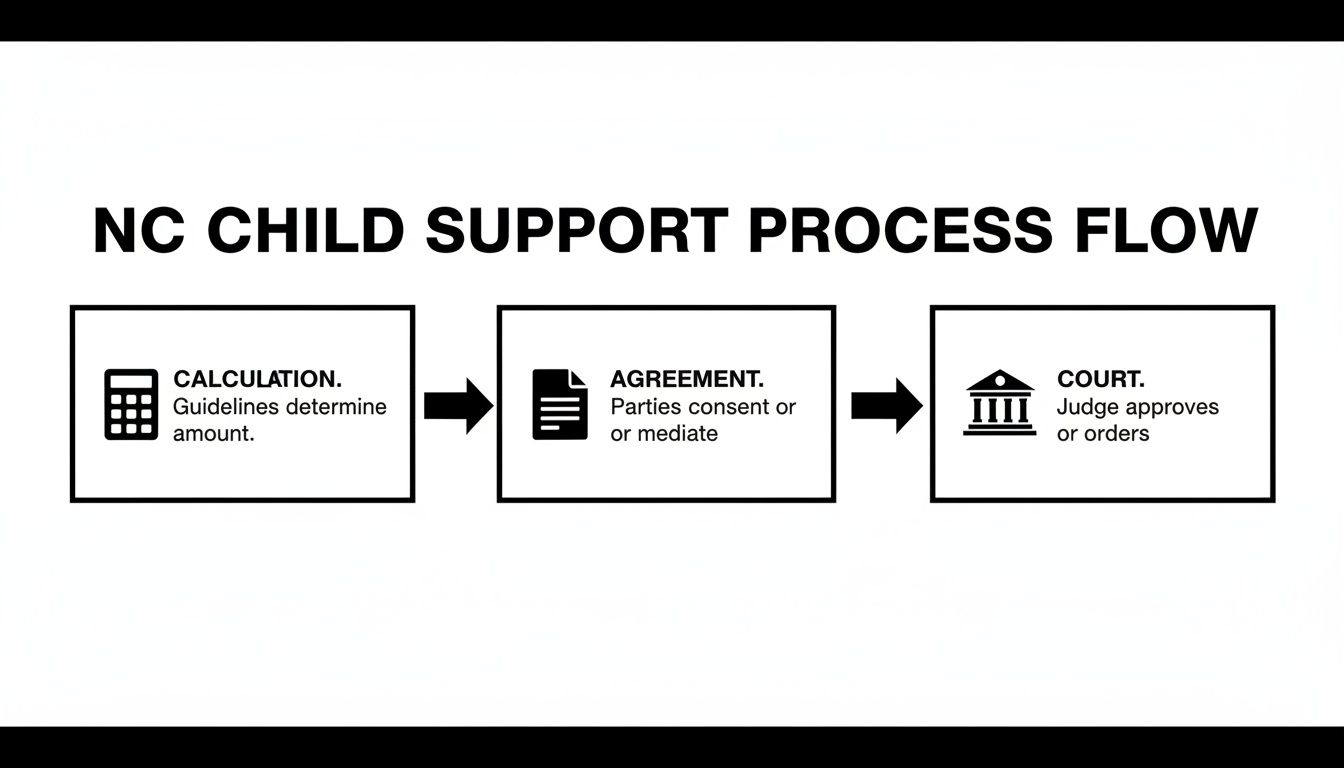
The number of overnights each parent has is a powerful factor in the final calculation. The more time you spend directly caring for your child, the more the guidelines recognize your direct financial contributions, which typically lowers the amount of support that changes hands.
It’s also important to know that support can sometimes be ordered for past periods. To learn more about this, take a look at our guide on retroactive child support in North Carolina. Getting the numbers right from the start is absolutely essential, as errors can be expensive and difficult to correct down the road.
Deviating from the NC Child Support Guidelines
While the North Carolina child support worksheets provide a solid, formula-based starting point, they aren’t the final word in every family’s story. The law understands that a rigid mathematical formula can't possibly predict the unique realities of every family. Because of this, judges have the power to deviate from the guideline amount, but only when there's a compelling, well-documented reason.
This isn't something that happens easily. To convince a judge to order a different amount, a parent must bring strong evidence showing the guideline calculation either fails to meet the child's reasonable needs or is simply "unjust or inappropriate" under the circumstances. The burden of proof falls squarely on the parent asking for the change.
The Legal Standard for Deviation
A judge won't consider moving away from the guidelines without first making specific, written findings of fact. These findings must clearly state:
- The amount of child support that would have been ordered by following the standard guidelines.
- A clear statement that the guideline amount is either too little or too much to cover the child’s actual needs, or is otherwise unfair.
- The specific facts and circumstances of your case that justify ordering a different amount.
Simply wanting to pay less or hoping to receive more won't be enough. You must build a solid case demonstrating that the formula’s result is genuinely unfair for your specific situation.
Common Reasons for a Deviation
Some situations are more likely to persuade a court that a deviation is the right call. These usually involve special circumstances that the standard worksheets don’t account for.
A common reason for an upward deviation—ordering more support—is when a child has extraordinary needs. For example, a child with a serious medical condition might need expensive therapies, specialized equipment, or private tutoring that insurance doesn't cover. In those cases, the standard guideline amount would fall short of covering these essential costs.
On the other hand, a court might grant a downward deviation, ordering less support. This can happen if the paying parent has an extremely low income and the court-ordered support payment would make it impossible for them to meet their own basic needs.
Practical Example: A parent who earns minimum wage is ordered to pay guideline support. If that payment leaves them unable to afford rent and gas to get to work, a judge might find the guideline amount unjust. They could temporarily reduce it to ensure the parent can stay employed and continue making consistent, affordable payments. This is often more beneficial in the long run than ordering an amount that leads to default.
The Myth of Waiving Child Support
There’s a common misconception that parents can just agree to "waive" child support or set the amount to zero. In North Carolina, this isn't legally possible because child support is considered the right of the child, not the parents. You cannot sign that right away.
You and the other parent can certainly agree on a support amount that’s different from the guidelines. However, that agreement isn’t final until a judge reviews and approves it. The judge must be convinced that your agreement is fair, reasonable, and adequately provides for the child before signing it into a court order. An agreement for $0 in support will almost never get a judge’s approval unless there are truly extraordinary circumstances to back it up.
Modifying and Enforcing Child Support Orders in NC
A child support order isn’t set in stone. Life moves on, and North Carolina law recognizes that what worked a year ago might not work today. This is where a modification comes in.
On the other hand, when a parent doesn't follow the order, the law provides powerful tools to compel compliance through enforcement. Understanding both processes is key to maintaining your child's financial stability, whether you are paying or receiving support.
How to Modify a Child Support Order
You can’t just change the payment amount on your own, even if you and the other parent agree. To officially change your child support, you must file a Motion to Modify with the court. A judge will only grant it if you can prove there has been a "substantial and material change in circumstances" since the last order was entered.
This is a significant legal bar to clear. A minor pay cut or a slight change in the parenting schedule usually won't be enough. The change must be significant enough that the current support amount is no longer reasonable or fair.
Common situations that may qualify include:
- Significant Income Changes: An involuntary job loss, a major promotion, or a new disability that limits your ability to earn. A voluntary job change to a lower-paying position may not qualify.
- Changes in the Child's Needs: A new medical diagnosis that requires expensive treatments or therapies.
- New Custody Schedule: A major shift in the number of overnights each parent has with the child, such as moving from a primary to a joint custody arrangement.
- Childcare or Insurance Costs: A child aging out of daycare or a significant jump in health insurance premiums.
Real-World Scenario: A parent paying support is laid off from their job. They can file a Motion to Modify and provide evidence of their job loss and their efforts to find new work. A judge might temporarily reduce their support obligation while they get back on their feet. Waiting to file can cause large debts to accumulate, so it's crucial to act quickly.
Enforcing an Unpaid Child Support Order
When a parent falls behind on court-ordered payments, the overdue amount is called "arrears." If this happens, you have strong legal options. You can file a Motion for Contempt directly with the court or seek help from North Carolina Child Support Services (CSS).
It's important to know that a parent can't be automatically jailed for missing a payment. A judge must first hold a hearing to determine if the failure to pay was willful and if the parent has the present ability to pay or take other measures to comply. This process protects parents from being incarcerated simply because they cannot afford to pay.
Consistent financial support is vital for many families. Data shows that child support's financial impact on families in North Carolina is substantial, often making up a significant portion of the receiving household's income and helping to keep children out of poverty.
Common Enforcement Tools in NC
When a judge finds that a parent is willfully refusing to pay, the court and CSS can use several powerful methods to collect arrears:
- Wage Garnishment: An order is sent directly to the paying parent’s employer, who then withholds the support amount from their paychecks.
- Tax Refund Intercept: Both state and federal tax refunds can be seized to pay off past-due support.
- License Suspension: This can include driver’s licenses, professional licenses (like for a nurse or contractor), and even hunting or fishing licenses.
- Bank Account Liens: The court can order funds to be frozen in and seized from the non-paying parent's bank accounts.
- Contempt of Court: This can result in fines or even jail time for a parent who has the ability to pay but willfully refuses to do so.
Whether your income has dropped or you're owed back support, it's critical to act fast. Proactive steps can keep arrears from piling up and ensure your child's financial security is protected. To learn more about the legal strategies involved, you can read our detailed guide on the child support modification process in NC.
When Does Child Support End in North Carolina
For both the parent paying and the parent receiving support, knowing when that financial obligation finally ends is key to planning for the future. It’s one of the most common questions we hear, and thankfully, North Carolina law provides a clear answer.
The general rule is straightforward: your duty to pay ongoing child support automatically ends when your child turns 18 years old. Once they reach the age of legal adulthood, the obligation stops. But there’s a critical exception that every parent of a teenager needs to understand.
The High School Graduation Exception
What happens if your child turns 18 but is still a senior in high school? North Carolina law recognizes that most kids are still financially dependent while finishing their education. The support obligation does not just stop on their 18th birthday.
Under the statute N.C.G.S. § 50-13.4(c), if your child is still enrolled in a primary or secondary school and making good progress toward their diploma when they turn 18, support continues. The payments will run until one of these things happens first:
- The child graduates from high school.
- The child stops attending school on a regular basis.
- The child reaches the age of 20.
Real-World Scenario: Your daughter’s 18th birthday is in March of her senior year. Because she is still enrolled in school and on track to graduate in June, child support does not end on her birthday. It continues until she graduates. If she were to drop out in April, support would terminate then.
Other Events That Terminate Child Support
Besides reaching a certain age, a few other major life events can legally terminate a child support obligation, even before a child turns 18. These events include:
- Emancipation: If a minor successfully petitions the court to become legally emancipated, they are considered an adult for most purposes. This court order ends the parent's support duty.
- Marriage: When a child gets married before turning 18, they are automatically considered emancipated by law, which also terminates the support obligation.
- Death: The support obligation ceases upon the death of either the child or the parent responsible for the payments.
What About Past-Due Support (Arrears)?
This is a crucial point that often causes confusion. The termination of your current child support obligation does absolutely nothing to erase any past-due payments.
Any unpaid support, known as arrears, remains a legally enforceable debt. The state or the receiving parent can continue using enforcement tools—like wage garnishment, driver’s license suspension, or intercepting tax refunds—to collect the full balance owed, no matter how much time has passed or how old the child is.
Frequently Asked Questions About NC Child Support
Navigating a child support case can be stressful and filled with uncertainty. To help provide some clarity, here are answers to some of the most common questions we hear from parents across North Carolina.
Can we agree to zero child support in NC?
No, parents cannot unilaterally agree to waive child support. In North Carolina, financial support is considered a right of the child, not a bargaining chip for the parents. While you can create an agreement outside of the standard guidelines, it must be submitted to a judge for review and approval. A judge will only approve an agreement for $0 child support if there are extraordinary circumstances that prove it is in the child's best interest, which is very rare.
Does 50/50 custody eliminate child support in North Carolina?
This is a common misconception. Even with a true 50/50 custody schedule (equal overnights), child support is not automatically eliminated. The calculation still begins by looking at both parents' gross monthly incomes. If one parent earns significantly more than the other, they will likely still have a child support obligation. The law's goal is to provide the child with a similar standard of living in both homes, and a support payment helps bridge the gap between different parental incomes.
What if my ex is hiding income to avoid paying child support?
If you believe the other parent is voluntarily unemployed or underemployed to reduce their child support obligation, a judge can impute income. This means the court can calculate support based on the parent's potential earning capacity, not their actual current earnings. To do this, the court must find that the parent is acting in bad faith. For example, if a master electrician quits their job to work part-time at a coffee shop right before a support hearing, a judge can use their previous income history to set a fair support amount.
How are child support arrears calculated in NC?
Child support arrears are the total amount of unpaid, court-ordered child support. The amount is a simple calculation: the total support owed minus the total support paid. Interest may also be added to the judgment. It's crucial to understand that arrears are a legal debt that does not go away. They can be collected at any time, even after the child is an adult, through methods like wage garnishment, tax refund interception, and license suspension.
Secure Your Family's Future with an NC Child Support Lawyer
Trying to make sense of North Carolina's child support system on your own can be daunting. While online calculators and guides offer a general overview, they cannot account for the specific details that can make or break a case. When your child's financial well-being is on the line, the nuances of child support in NC laws are far too important to leave to chance.
An experienced North Carolina family law attorney does much more than just fill out forms. They delve into the details—verifying income, ensuring the correct worksheet is used, and building a case that tells your story. Whether you need to argue for a deviation from the guidelines or enforce an existing order, professional legal guidance can make all the difference.
Why You Need an Attorney for Your NC Case
Child support cases are emotionally and financially taxing. A lawyer acts as your advocate and guide, protecting your rights when you need it most. They can:
- Verify Income: Uncover hidden income or challenge claims of underemployment by moving to impute income based on actual earning potential.
- Ensure Accuracy: Prevent costly miscalculations by confirming the correct worksheet (A, B, or C) is used for your specific custody arrangement and that all expenses are properly documented.
- Build a Strong Case: Collect the financial records and evidence needed to present a compelling argument, whether in negotiations or before a North Carolina judge.
- Manage Enforcement: When payments stop, a lawyer knows how to take swift action. They can file the right motions to enforce an order, using tools like wage garnishment or contempt proceedings.
- Handle Modifications: Life changes. An attorney can help you file for a modification when a job loss, promotion, or change in the child's needs requires adjusting the support amount.
An attorney ensures your side of the story is heard, backing it up with the legal arguments needed to secure a fair and just result under North Carolina law. Please remember that every case is unique, and this article should not be taken as legal advice for your specific situation.
Key Insight: The child support order set today will shape your family's financial reality for years, sometimes even decades. Investing in solid legal advice from a North Carolina attorney isn't just an expense—it's an investment in your child's future and your own peace of mind.
The North Carolina court system has its own unique procedures, and the laws are constantly evolving. Having someone on your side who understands the statutes, the local courts, and how to build a persuasive case is invaluable.
If you are a North Carolina resident dealing with a child support issue—whether establishing an initial order, seeking a modification, or enforcing a delinquent payment—don't go it alone. Your family's financial security is too important to risk.
At the Law Office of Bryan Fagan, we are committed to helping North Carolina families achieve fair and sustainable outcomes. Contact us to schedule a consultation and get the dedicated legal guidance your case deserves.