If you've just been named executor for a parent's estate in North Carolina, you may already be hearing family questions that feel bigger than the grief you're carrying. One person wants to know when the house can be sold, another wants to know whether you get paid, and someone else is worried you'll take too much. That's where NC estate executor commission and fees stops being an abstract probate topic and becomes a real money issue for the people waiting on their inheritance.
North Carolina does not use a simple nationwide-style rule for executor pay. The state gives the clerk of superior court discretion to approve a personal representative commission under N.C.G.S. 28A-23-3, and that commission is tied to qualifying estate activity rather than a flat fee everyone can predict in advance (N.C.G.S. 28A-23-3). That matters because the amount can affect what beneficiaries ultimately receive, and it can also become a source of conflict if nobody understands how the calculation works.
Practical rule: the legal maximum is only the starting point. The clerk still has to decide what's reasonable in light of the work done.
What North Carolina Actually Pays an Executor
A widow dies, her adult son is named executor, and the family assumes he'll either get nothing or automatically take a full percentage of the estate. Both assumptions are off. In North Carolina, executor pay is not a fixed percentage schedule, instead the clerk of superior court has discretion to approve a personal representative commission up to 5% of qualifying estate receipts and expenditures under N.C.G.S. 28A-23-3 (N.C.G.S. 28A-23-3).
That distinction matters in real life. A family executor may spend months gathering records, paying claims, listing property, answering questions, and keeping the estate on track. Another estate may be simple enough that the clerk approves a smaller amount. The law leaves room for judgment because the work can look very different from one file to the next.
For beneficiaries, the key point is simple. The executor's commission comes out of the estate, so it affects the net amount that passes to heirs. For executors, the lesson is just as direct. If you want compensation, you need to be able to show the clerk what you did, when you did it, and why it was reasonable.
The confusion often starts because people hear “5%” and think it means “5% of everything.” That's not how North Carolina frames it. The statute ties the commission to qualifying receipts and lawful expenditures, and that formula is narrower than the total value of every asset someone ever owned.
How the Commission Is Calculated Under NC Law
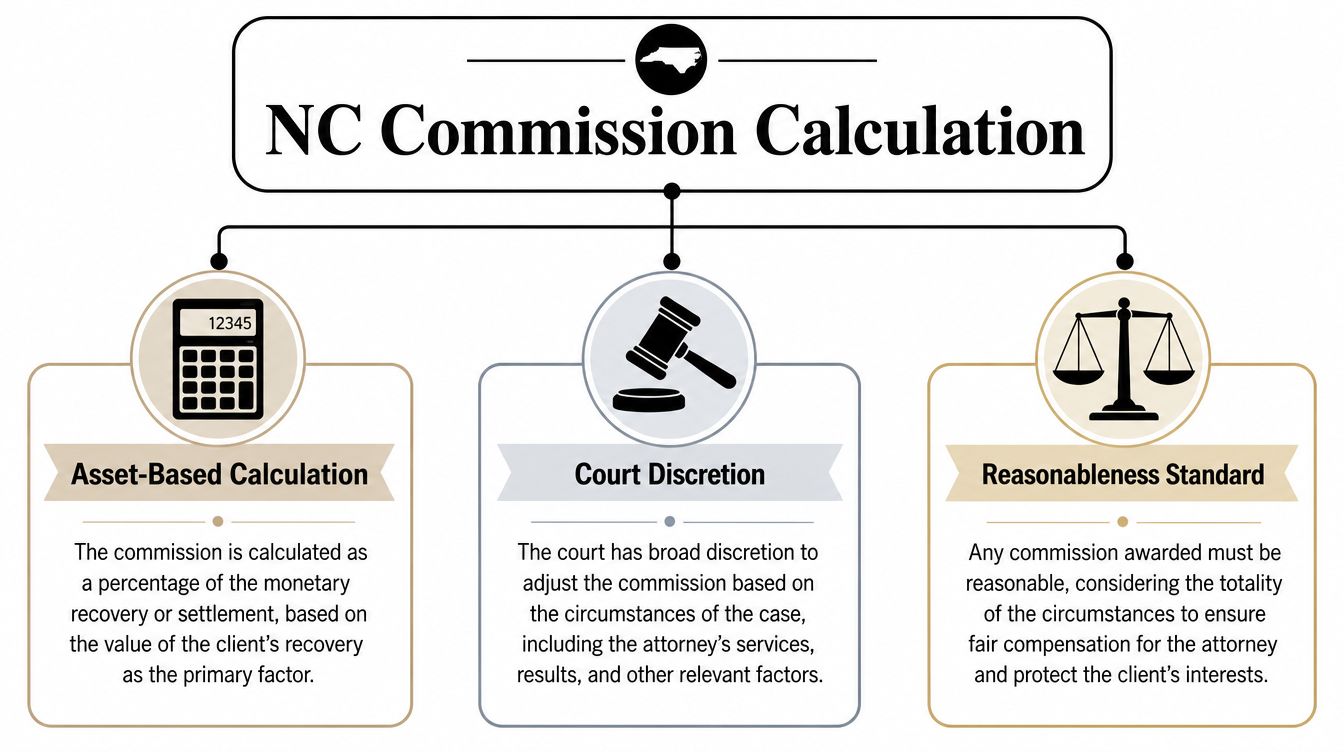
A North Carolina executor commission starts with the estate accounting, not with a flat percentage pulled out of thin air. The clerk of superior court looks at the money and property that passed through administration, then decides what amount is reasonable under N.C.G.S. 28A-23-3. That statute ties the commission to qualifying receipts and lawful expenditures, which means the base is narrower than the total value of everything the decedent owned.
What usually counts
The easiest way to understand the formula is to separate what came into the estate from what went out. Receipts are the assets or funds the personal representative collected and handled during administration. Expenditures are the estate payments made for proper probate purposes, such as settling claims, paying administration costs, or carrying out required distributions.
That is why a house is often treated differently from a checking account. If real estate stays in the estate and is never sold through administration, its value is usually outside the commission base. If the property is sold because the estate needed cash to pay debts or to carry out a bequest, the sale may be treated differently, because the executor had to take an active role in that transaction.
| Item | Counts Toward Commission? | Notes |
|---|---|---|
| Cash received by the estate | Yes | Part of qualifying receipts |
| Personal property received | Yes | Statute includes its value when received |
| Lawful estate expenditures | Yes | Part of the commission base |
| Real estate kept in the estate | Usually no | Generally excluded |
| Real estate sold to pay debts or fulfill bequests | Often yes | Treated differently because it is sold |
A practical example makes the rule easier to see. If an estate includes a bank account, household goods, and a home, the executor does not automatically earn a commission on every dollar of the home's market value just because the home exists. The clerk looks at what the executor received, sold, or paid during administration, and whether those transactions fit the statutory base.
Families sometimes compare probate rules to other North Carolina legal requirements, such as the residency rules for filing divorce in North Carolina Divorce Residency Requirements. The point is similar in both settings. A rule may sound simple at first, but the legal result depends on the statute and the facts, not on a shorthand description.
The Statutory Cap and the Practical Range
A family often hears the same shorthand and assumes it is the whole rule, but the precise point is more specific. 5% is the outer limit, not the automatic payout. North Carolina probate clerks look at the size of the estate and the work completed, then decide whether the request is reasonable. That is why the number approved by the court often falls somewhere below the top end.
What that looks like in dollars
The numbers become easier to understand when you convert them into actual estate activity. A published North Carolina estimator gives examples of about $14,500 on $300,000 of receipts and expenditures, $34,500 on $800,000, and $57,500 on $1.5 million. Those examples show why the ceiling matters in larger estates, even when the clerk approves less than the maximum.
| Qualifying Receipts and Expenditures | 2% Commission | 3% Commission | 5% Commission (Statutory Cap) |
|---|---|---|---|
| $300,000 | $6,000 | $9,000 | $15,000 |
| $800,000 | $16,000 | $24,000 | $40,000 |
| $1.5 million | $30,000 | $45,000 | $75,000 |
The practical range usually follows the amount of work. A small estate that is orderly and easy to close may support a lower figure. A contested estate, a business estate, or one with tax and property issues may justify more. The clerk still has to see that the request reflects real administration work, not just the size of the inheritance.
Families often find it helpful to separate the commission question from the overall probate process itself. A clear overview of that process is available through the Law Office of Bryan Fagan's North Carolina probate process guide.
A simple way to remember the rule is this. The commission is pay for documented estate work, and the paperwork has to support the amount requested. If beneficiaries believe the request is too high, they can ask the clerk to look closely at whether the services and the fee match.
Court Fees Versus Executor Compensation
The court fee and the executor's commission are different costs, and families often mix them up. The estate administration fee is a charge for the probate court's work, while the executor commission is payment for the person handling the estate. Those two items should be separated from the start, because they are calculated and reviewed differently.
A family can open a file, pay the court's fee, and still owe the executor nothing if no compensation is approved. The court fee belongs to the administration process itself, while the commission belongs to the work of collecting assets, paying valid debts, and closing the estate. That is why one expense does not answer the other.
A simple way to keep them straight is this. The clerk charges the estate for using the probate process, then separately reviews whether the personal representative should be paid for services performed. The clerk does not treat those two amounts as one combined request, and the paperwork for each has to support a different purpose.
Families also need to understand that the commission question is not just about a filing fee. The court charge may be modest compared with the time and responsibility involved in administering an estate, especially where assets must be gathered, records sorted, and beneficiaries kept informed. A practical overview of the larger administration timeline is available in the North Carolina probate process guide, which helps show where the court's fee fits within the overall proceeding.
The commission side is where disputes usually arise. Some beneficiaries assume the executor should receive a fixed percentage just because the estate is large. In practice, the amount depends on the work done, the records kept, and whether the request fits the receipts-and-disbursements formula under North Carolina law. A published North Carolina example shows how a midsize estate can produce a meaningful commission even when the clerk approves less than the ceiling, which is why families should review both buckets, not just the filing charge.

When Commissions Are Paid and Who Approves Them
Commission requests don't usually get paid the moment an executor starts working. In North Carolina, commissions are generally approved with the final account, and interim payment usually requires prior clerk approval. That timing catches a lot of family executors off guard because the work starts immediately, but the compensation often waits until later.
Why the paperwork matters
If you want the clerk to approve a fee, keep the record straight from day one. Time logs, receipts, bank statements, letters to beneficiaries, and proof of expenses all help show the work was real and the request was reasonable. Without that paper trail, the clerk has less to evaluate.
Keep the estate's records as if you expect someone else to review every entry, because eventually someone probably will.
There's also a threshold question that families miss. A personal representative commission is tied to formal appointment. If the estate is handled through a small-estate affidavit process, there usually isn't a formally appointed executor, so the commission issue may not arise at all. That's one reason small estates and formal administrations should not be treated like the same thing.
Executors who think they may ask for compensation should also watch for behavior that could look like self-dealing or a breach of fiduciary duty. The obligations of a personal representative are serious, and what is breach of fiduciary duty is a useful reminder that the clerk can question conduct if records don't line up with the request.
For a step-by-step view of the broader administration process, what is probate in North Carolina can also help put the commission issue in context, though the key point here is narrow. No formal appointment usually means no executor commission, and no documentation usually means no strong basis for asking the court to approve one.

Common Misconceptions About NC Executor Fees
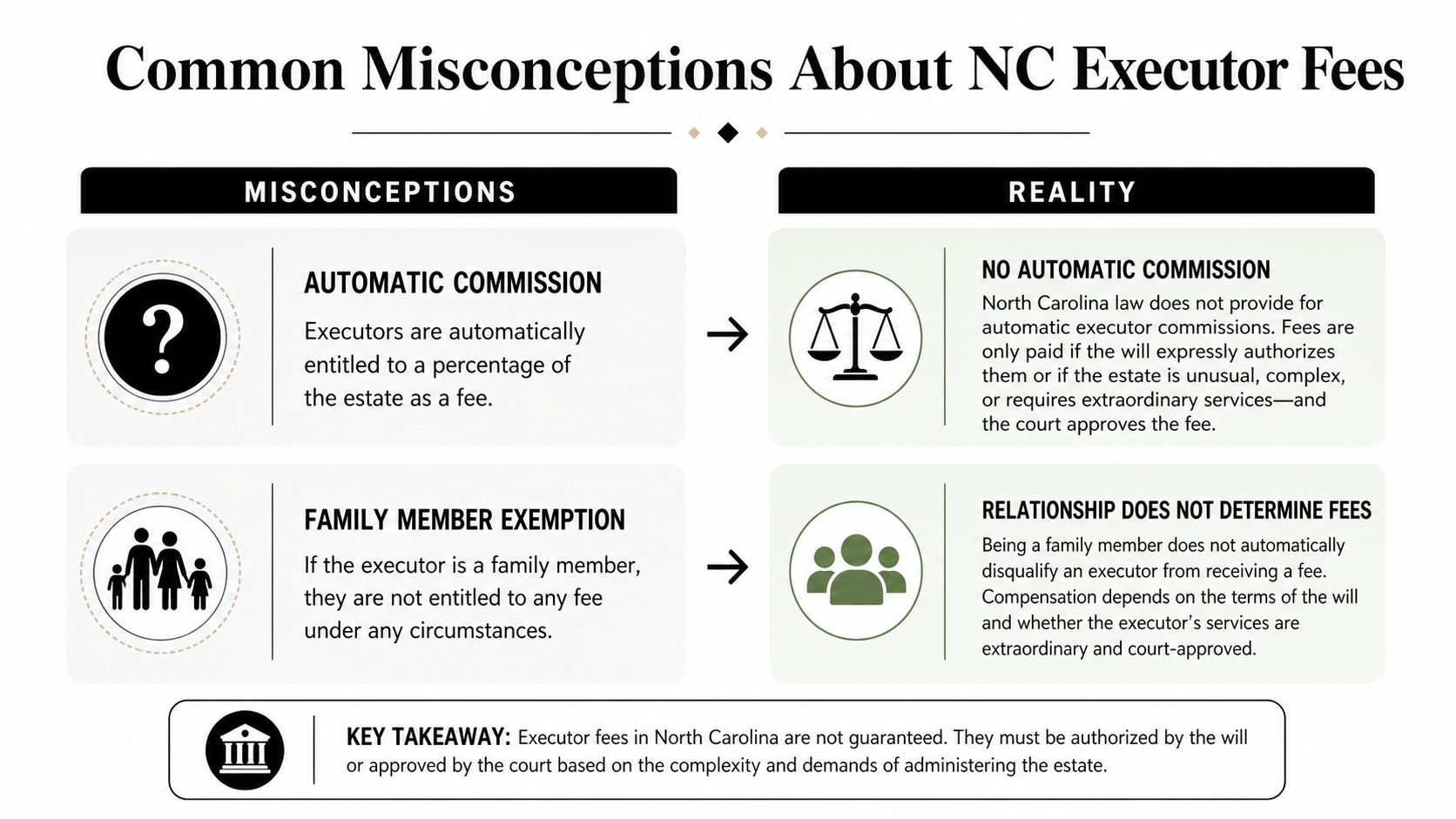
The biggest myth is that every executor gets paid automatically. North Carolina law doesn't work that way, and family status doesn't create a separate fee rule. A spouse, adult child, sibling, or outside fiduciary all have to deal with the same basic issue, whether the clerk approves a commission and, if so, how much.
What families often get wrong
One frequent misunderstanding is that attorney fees come out of the executor's commission. They don't. Attorney fees are a separate expense of administration, and the clerk doesn't treat them as part of the personal representative's compensation.
Another mistake is assuming a family member should waive compensation because they're related. Sometimes that happens. Sometimes the work is heavy enough that a fee request is reasonable, especially if the estate has real property, contested assets, or a long creditor process. The relationship alone doesn't decide the issue.
For beneficiaries, the law provides a path to challenge a fee they believe is excessive. They can object to the final account or ask the clerk to review the request. The question becomes whether the executor can document the services performed and show that the amount sought fits the work done.
The practical advice is simple. Ask for the records before conflict hardens. A well-documented commission request is easier to review, and a vague request is easier to attack.
A related planning issue often comes up when families compare probate to other forms of legal streamlining, including how to avoid probate in North Carolina. Probate isn't always avoidable, but once you're in it, the fee question becomes much easier to manage when the executor has maintained clean documentation.
A Worked Example on a North Carolina Estate
A $1,000,000 estate gives the numbers real shape. Start with the court fee, then separate the executor commission from that amount. In a practical North Carolina example, the commission on that estate can land around $30,000 at a 3% level, while the statutory ceiling remains 5%.
Now add the court's administration fee. Under the state fee schedule, the estate administration charge is $106 plus 40 cents per $100 of the gross estate, with a total cap of $6,000. On a larger estate like this, the cap is the figure that matters, not the base formula.
What the Family Experiences
The beneficiaries do not write a separate personal check for the executor commission. The estate pays it. That means the inheritance pool shrinks before distribution, which is why commission disputes can turn emotional fast.
A family executor can face the same commission issue as a corporate or professional fiduciary, but the review often feels different because the work happens inside the family. If one child spent months making phone calls, coordinating repairs, and tracking down documents, the other children may expect that effort to be recognized. If no records exist, the argument usually gets messy.
The same estate can look very different when the administration is documented well. Receipts are organized, expenditures are clear, and the final account shows a trail the clerk can follow. That is usually the easiest path to a reasonable fee request and the least painful path for beneficiaries who are waiting for closure.
Common Questions About NC Estate Executor Commission and Fees
Can an executor in North Carolina always get paid
No. The clerk has discretion, and the request has to be tied to actual estate administration work. Formal appointment and documentation both matter.
Is the executor commission the same as the court fee
No. The court fee is the estate administration charge, while the commission is compensation for the personal representative's work.
Can beneficiaries object to the fee
Yes. Beneficiaries can challenge the request through the final account process or seek clerk review if they believe the amount is too high.
Do small estates usually pay executor commissions
Not always. If the estate uses a small-estate affidavit process, there may be no formally appointed executor at all, so the commission issue may not apply.
Do family executors get special treatment
No special rule changes the legal standard just because the executor is related. The clerk still looks at the work performed and whether the request is reasonable.
Practical Next Steps and Scheduling a Consultation
If you're serving as executor, keep your records from the first day. Save receipts, document time spent, keep beneficiaries informed, and don't ask for compensation until the work can be shown on paper. If you're a beneficiary, read the inventory and final account closely, ask questions early, and raise objections through the court process if something doesn't add up.
The biggest mistakes happen when families let the fee question drift into an argument instead of a documented legal issue. North Carolina gives the clerk room to approve a fair commission, but that room depends on proof, timing, and the quality of the estate records. That's why the difference between 2% and 5% can matter so much in a sizeable estate.
If you're unsure whether an executor fee request is reasonable, or you're worried about whether the estate should pay one at all, talk with a North Carolina probate lawyer before the final account is filed. A careful review now can prevent a fight later and help everyone understand what the clerk is likely to approve.
The Law Office of Bryan Fagan helps North Carolina families sort out probate questions, including executor compensation, estate administration steps, and beneficiary objections to fees. If you want clear guidance on NC estate executor commission and fees, visit Law Office of Bryan Fagan to schedule a consultation and get practical help with your estate matter.