Last week, a daughter sat at her kitchen table with her father's unpaid bills spread beside his pill organizer and bank statements. He could still have a conversation, but he was missing due dates, repeating questions, and getting upset when she tried to help with money. She wanted to know the question North Carolina law forces families to answer first: do we need a court case at all, or can we solve this with a private tool and avoid taking away more rights than necessary?
That question sits at the center of every incompetency proceeding vs guardianship NC conversation. In North Carolina, the legal path isn't a single switch, it's a two-step structure under Chapter 35A, and the difference matters for privacy, control, and the person's remaining independence. The wrong first move can create more conflict than protection, while the right one can keep a family out of court altogether.
| Decision point | Incompetency proceeding | Guardianship appointment |
|---|---|---|
| Main question | Does the adult lack legal capacity under Chapter 35A? | If the adult is incompetent, who should make decisions and how broad should that authority be? |
| Practical purpose | Threshold finding | Downstream court appointment |
| Rights impact | No guardian is appointed unless the threshold is met | A guardian can control person, estate, or both |
| Less restrictive options | Can defeat the finding if they work well enough | The court still chooses the least restrictive authority needed |
| Ongoing burden | The case ends with the finding unless appealed | Ongoing court supervision may follow, especially for estate matters |
When North Carolina Families First Face This Decision
A lot of families reach this point long before anyone uses the word “guardianship.” Maybe it's a son in Greensboro noticing his mother is paying the same bill twice and refusing help. Maybe it's a sister in Charlotte whose brother had a traumatic brain injury and now can't manage his medications, but still insists he doesn't want “the court involved.” The law doesn't ask families to guess in the abstract, it asks whether the person can still make or communicate important decisions about person, family, or property.
That's why people search for incompetency proceeding vs guardianship NC. They're usually trying to figure out whether they need a courtroom remedy or whether a private tool will handle the problem better. The answer depends on whether the adult still has enough capacity for a less restrictive alternative to work.
If the person can still function with the right support, court control may be more than the family needs.
The decision families are really making
The practical choice is not “care versus no care.” It's whether existing documents and supports already solve the problem, or whether the law has to step in. North Carolina presumes adults are competent until the Chapter 35A standard is met, so concern alone doesn't justify a petition.
A family may be dealing with dementia, severe mental illness, substance use, autism, or brain injury. North Carolina materials recognize that these issues can affect adults of any age, so this isn't only an elder-law question. For some younger adults, the best first move is a support system, not a petition.
That's also why many families end up comparing guardianship with tools like powers of attorney and supported decision-making. If a parent already signed a valid financial power of attorney years ago, the agent may already have the authority needed to pay bills and manage accounts. If not, court may be unavoidable, but it still shouldn't be the first assumption.
What Incompetency and Guardianship Actually Mean Under Chapter 35A
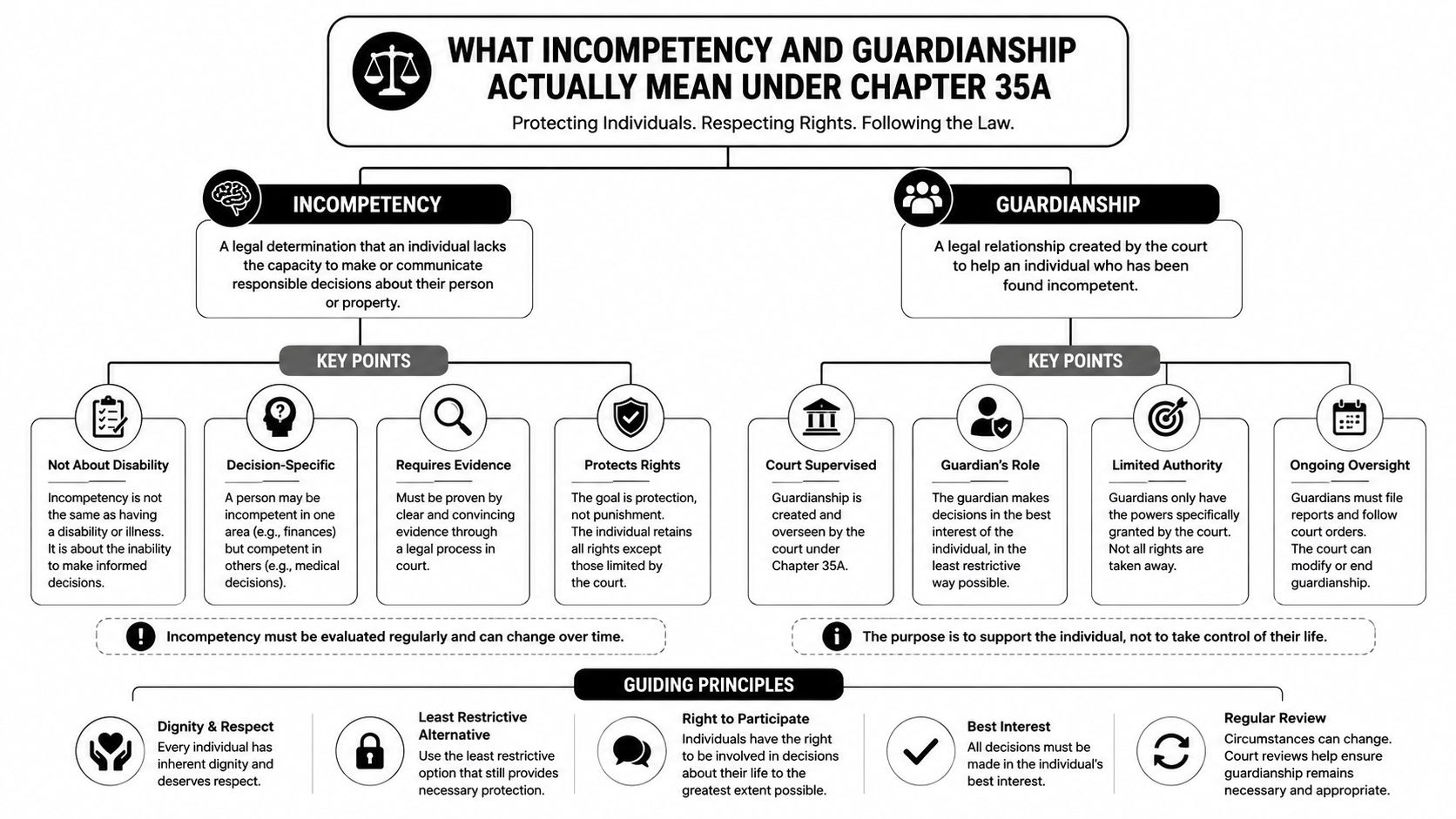
North Carolina law keeps these concepts separate on purpose. Incompetency is the gateway finding, and guardianship is the later appointment that follows only if the clerk first finds the adult incompetent. The statute defines an incompetent adult as someone who lacks sufficient capacity to manage personal affairs or to make or communicate important decisions about person, family, or property. The petitioner has to prove that by clear, cogent, and convincing evidence.
That burden matters. It means the court doesn't start with a blank slate, and it doesn't take away rights because a family member is worried or frustrated. The adult is presumed competent unless the evidence shows otherwise.
Why the words matter in practice
Once incompetency is found, the clerk can appoint a Guardian of the Person, a Guardian of the Estate, or a General Guardian. Those aren't just labels. They determine who gets to decide about medical care, placement, custody, money, and property.
The distinction also explains why these proceedings are separate. A family can prove someone needs help without proving that one person should control everything. The court has to decide scope, not just status.
North Carolina's 2024 amendments added another safeguard. UNC School of Government materials note that less restrictive alternatives can defeat a finding of incompetency if they let the person manage affairs and communicate important decisions sufficiently. That means the court is supposed to ask whether the person can function with support before moving to guardianship.
That approach fits the broader planning mindset families often already use. A parent's estate plan may address one problem but not another, which is why I often look at documents like Alimony in North Carolina: Dependent and Supporting Spouses only as a reminder that North Carolina law routinely separates related but distinct legal issues instead of collapsing them into one answer.
Side-by-Side Comparison of the Two Proceedings
The easiest way to understand the difference is to compare the two steps head-on. The first proceeding asks whether the adult legally lacks capacity. The second asks who should act for that person, and how much authority that person should have. That is the core of incompetency proceeding vs guardianship NC.
| Criterion | Incompetency Proceeding | Guardianship Appointment |
|---|---|---|
| Who may file | A petitioner seeking a court finding | The same or another proper party after incompetency is found |
| Where it is heard | Special proceedings division of the clerk of superior court | Special proceedings division of the clerk of superior court |
| Burden of proof | Clear, cogent, and convincing evidence | Follows the incompetency finding |
| Who decides | Clerk or assistant clerk decides competence | Clerk decides who will serve as guardian |
| Main question | Does the adult lack sufficient capacity? | What type of guardian, if any, should be appointed? |
| Authority granted | No guardian yet | Person, estate, or both, depending on need |
| Appeal | Either competence or guardianship decision may be appealed to superior court | Either competence or guardianship decision may be appealed to superior court |
The single most important point is this. Incompetency is about capacity, and guardianship is about control. A family can prove a real need for help and still end up with a limited appointment instead of full authority.
A good example is an adult who can still choose where he wants to live but cannot manage checkbooks or understand financial contracts. The court may not need to hand over every decision. It may need only a Guardian of the Estate, or only a Guardian of the Person, depending on what the evidence shows.
The more precise the problem, the more carefully the court should match the remedy.
That's also why appeals matter. If the clerk gets the competence question wrong, or if the chosen guardian is too broad or the wrong person, the matter doesn't end there. Superior court review is part of the process, not an afterthought.
How the Court Process Actually Works in North Carolina
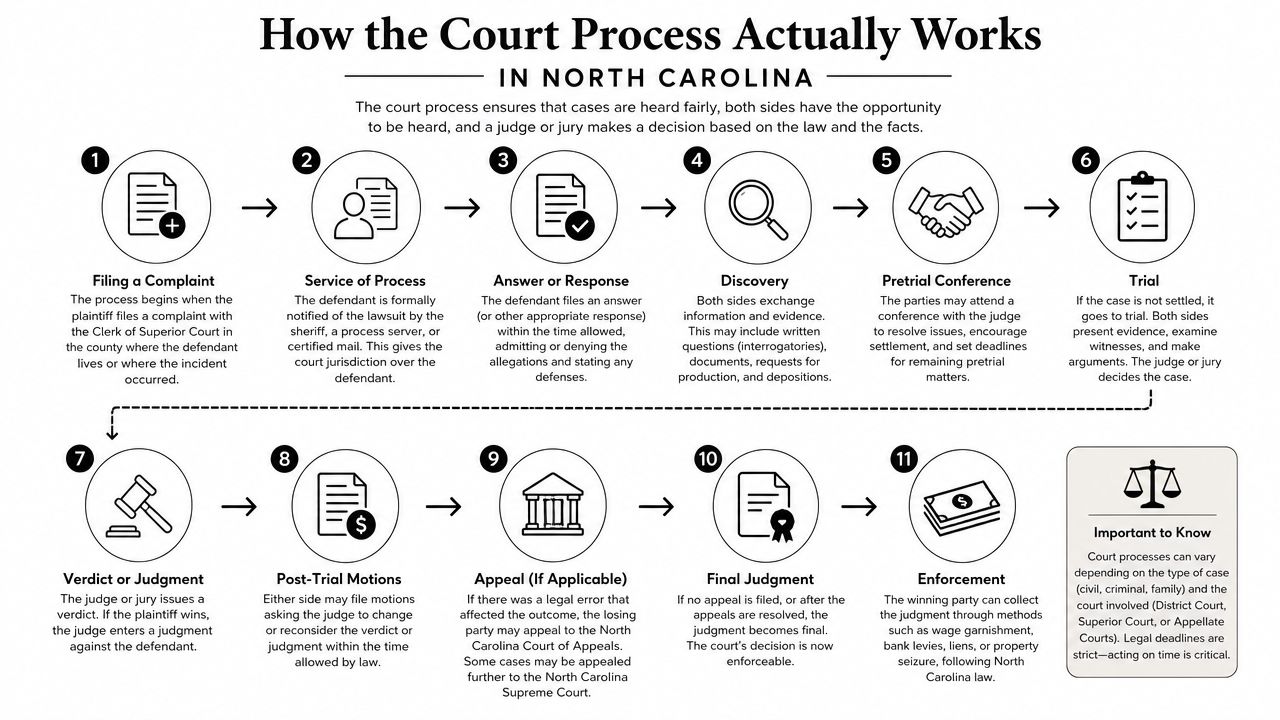
A family usually starts in the special proceedings division of the clerk of superior court in the county where the respondent lives. That's not a normal civil trial. It's a formal courthouse process with pleadings, notice, a hearing, and a decision by the clerk or assistant clerk.
The North Carolina Judicial Branch says the clerk or assistant clerk presides, and a guardian ad litem may be appointed to protect the respondent's interests. The respondent or guardian ad litem may also request a jury on the competence question, but only the clerk decides who will serve as guardian if incompetency is found.
What happens after the clerk rules
If the clerk finds incompetency and then appoints a Guardian of the Estate, that guardian takes on real administration duties. North Carolina court materials say the guardian must post a surety bond, file an inventory within 90 days, and submit annual accountings that are audited and approved by the clerk.
A Guardian of the Person has a different job. That role focuses on medical care, placement, and custody or control issues, not financial administration. A General Guardian combines both.
Here's the real-world point. A daughter may come to court asking for help because her father is unsafe handling cash and also refusing needed medical care. The clerk can appoint one person to manage both domains, or split the authority if that better fits the evidence. The court is supposed to match the appointment to the need, not use a one-size-fits-all order.
If the family or respondent disagrees, either the competence ruling or the guardianship ruling can be appealed to superior court. That makes preparation critical, especially when medical records, witness testimony, and the existing documents in the file don't all point the same way.
When Guardianship Is the Wrong Tool for the Job
A lot of families think guardianship is the cleanest answer because it sounds decisive. In practice, it can be too blunt. North Carolina's framework pushes families to look first at options that preserve more independence, and that often changes the outcome.
The alternatives that may solve the problem first
A durable power of attorney can let a trusted agent handle finances if the person signed it while still competent. A health care power of attorney and living will can address medical decisions and end-of-life wishes. A supported decision-making agreement can help the person keep deciding while getting help understanding options. A representative payeeship can manage benefits without a full court guardianship.
North Carolina now recognizes less restrictive alternatives as part of the incompetency analysis, so these aren't just informal family arrangements. If they let the person manage affairs and communicate important decisions sufficiently, they may defeat the finding that the person is legally incompetent.
If you already have a valid financial document in place, the question may be whether the agent can act. If the answer is yes, a petition may be unnecessary even if the person's capacity has started to slide. That's why families should review the paperwork before they head to court, not after.
One practical resource for that kind of planning is durable power of attorney in North Carolina, because the document may already cover the very job the family thinks guardianship would solve.
Courts look more favorably on tailored support than on unnecessary loss of rights.
That doesn't mean guardianship is never needed. It means it should be the last resort when the support system, the documents, or the benefits structure can't do the job. For some families, that line is obvious. For others, it takes a careful review of the person's actual abilities, not just a diagnosis.
Costs, Timing, and Ongoing Court Oversight
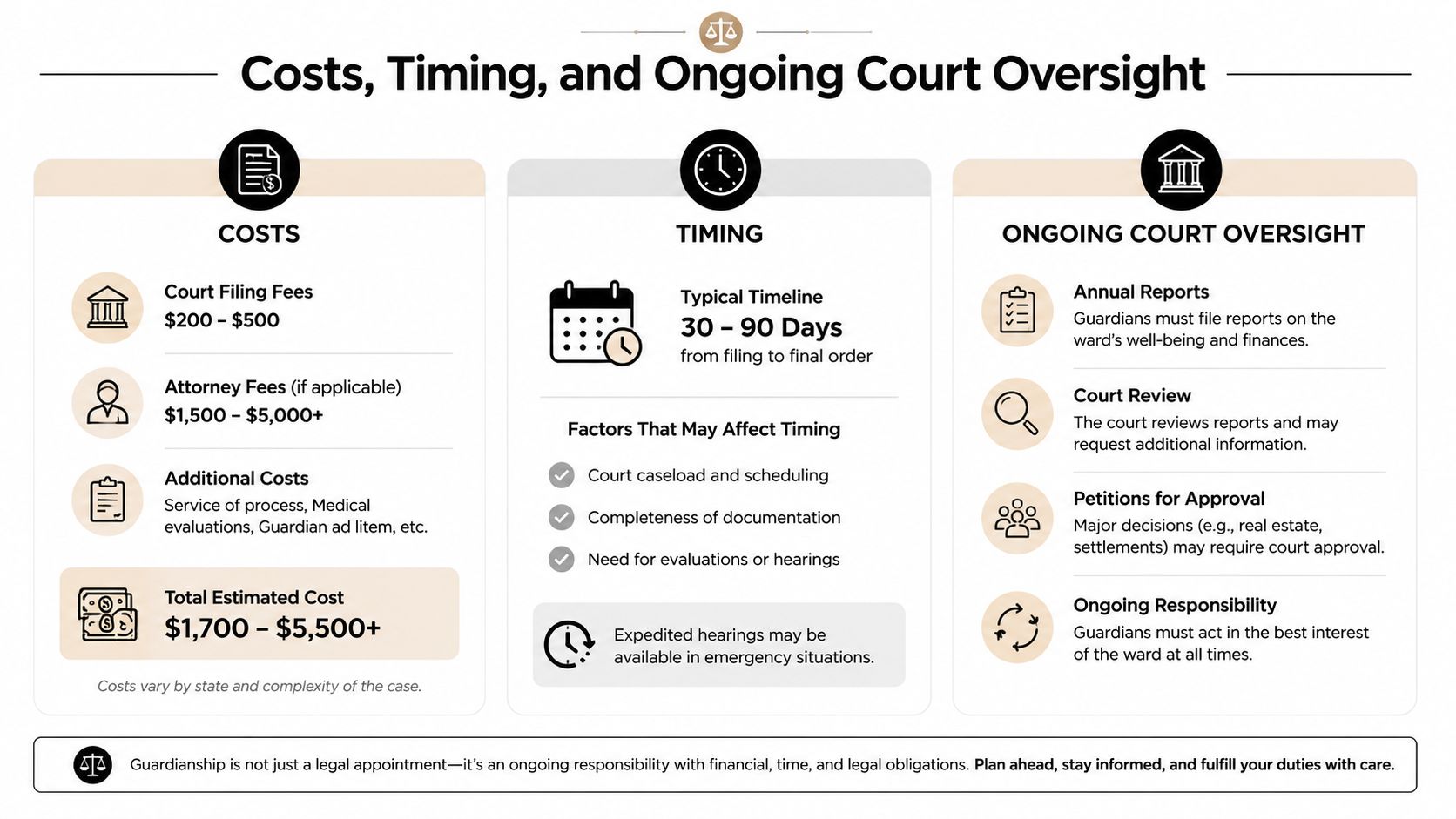
Guardianship is expensive in ways families often don't expect. There are filing fees, attorney fees for preparing and presenting the petition, possible guardian ad litem costs, and sometimes medical or psychological evaluations used as evidence. If the clerk appoints a Guardian of the Estate, the bond premium and ongoing accounting work add another layer of expense.
The administrative burden is different too. A person under estate guardianship doesn't just need day-to-day management, the guardian has to keep filing and defending records. That creates continuing court oversight long after the hearing is over.
The long view matters
North Carolina guardianship generally stays in place until competency is restored or the ward dies, which is why families should slow down before filing. A quick petition can solve an urgent crisis, but it can also lock the person into court supervision for a long time.
A contested case takes longer than an uncontested one because the evidence has to be tested, and a jury request adds even more process. That's why I tell families to think about the cheapest permanent mistake they can avoid, not just the fastest short-term fix.
For a broader look at the court side of the process, families can also review North Carolina probate process guidance to understand how court supervision tends to work when legal control shifts from the family to the clerk.
The financial question is rarely “Can we afford a petition?” It's “Can we afford the wrong petition, or a broader guardianship than the evidence really supports?”
Practical Next Steps for North Carolina Families
Start with the documents already in the house. Look for a durable power of attorney, health care power of attorney, living will, trust, or other papers that may already authorize help. If those documents exist and still work, a court case may not be needed.
Next, talk with the person's doctors or other treating providers about capacity. If court action looks likely, ask whether they can give a written clinical opinion that addresses decision-making, not just diagnosis. The court needs evidence tied to function.
Then contact the clerk of superior court in the respondent's county. Ask where the special proceeding is filed, what local forms are required, and whether the clerk's office has any orientation material for guardianship matters. Procedures can vary in practical details from county to county.
Finally, sit down with a North Carolina lawyer who handles Chapter 35A cases. A consultation can help you decide whether to file, whether to rely on a less restrictive alternative, or whether both steps should be taken in sequence. If you're also trying to understand how court planning overlaps with avoiding unnecessary probate, this resource on how to avoid probate in North Carolina can help you think through the broader planning picture.
The important part is this. Asking the question doesn't commit the family to filing. It just means you're taking the first responsible step.
Frequently Asked Questions for North Carolina Families
Can guardianship be reversed if the person gets better?
Yes. North Carolina has a restoration-to-competency process, and the ward, guardian, or another interested person can seek it. The court still has to find that competency has been restored.
Can the respondent ask for a jury trial?
Yes. The respondent or the guardian ad litem may request a jury on the competence question. Even then, the clerk still decides who serves as guardian if incompetency is found.
How do we contest an unwanted petition?
Appear at the hearing, present contrary medical or factual evidence, and ask for a jury if that makes sense for the case. If the clerk rules against you, either the competence ruling or the guardianship ruling can be appealed to superior court.
What if the family cannot agree on who should be guardian?
The clerk has authority to choose among qualified applicants based on the ward's best interests. When families are divided, the paper trail and the hearing matter a lot more than good intentions.
If you're trying to decide whether a North Carolina petition is necessary, or whether a power of attorney, supported decision-making, or another option should come first, Law Office of Bryan Fagan can help you sort through the Chapter 35A process with a practical plan. Visit Law Office of Bryan Fagan to schedule a consultation and talk through your next step before you file.