Imagine you’ve left your house keys with a trusted neighbor while on vacation. You’re counting on them to look after your home, not to throw a massive party or sell your belongings. In the legal world, this special kind of trust is known as a fiduciary duty, and under North Carolina law, it’s the highest standard of care one person can owe another.
When someone has this duty, they are legally and ethically bound to act in your best interests, no matter what. If they fail, you have legal rights.
Understanding Fiduciary Duty in North Carolina
A fiduciary duty isn’t just a handshake agreement; it's a strict legal obligation that requires one person (the fiduciary) to act with complete loyalty and good faith toward another person (the beneficiary). This relationship is created anytime someone is placed in a position of special trust and confidence, whether through a formal legal document like a will or trust, or by the very nature of the relationship itself.
Think of it as a one-way street of loyalty. The person who holds the power—whether over finances, property, or healthcare decisions—must always put the beneficiary's needs first. Their own interests simply don't enter the equation. This concept is a cornerstone of many areas of law in North Carolina, from estate planning to business partnerships.
At its heart, a fiduciary’s role is built on two core principles: a Duty of Loyalty and a Duty of Care. When you suspect a fiduciary has let you down, understanding these pillars is the first step in figuring out if a legal breach has occurred.
The table below breaks down these core duties in plain English.
The Core Elements of Fiduciary Duty in NC
| Duty | What It Means for a Fiduciary in North Carolina | Practical Example in North Carolina |
|---|---|---|
| Duty of Loyalty | You must act solely in the beneficiary's best interest. No self-dealing, no conflicts of interest, and no personal gain at the beneficiary's expense. | An executor cannot sell an estate's property to themselves for a below-market price just to get a good deal. |
| Duty of Care | You must manage the beneficiary's affairs with the same skill and prudence a reasonable person in North Carolina would use for their own affairs. This means being diligent and making informed decisions. | A trustee must properly investigate investment options for a trust, not just pick a stock based on a friend's tip at the golf course. |
These duties create a high bar for anyone acting in a position of trust. It's not about being perfect, but it is about being loyal, careful, and putting the beneficiary first, always.
A fiduciary relationship is not an ordinary business relationship. It is a relationship in which one person is under a duty to act for the benefit of another on matters within the scope of the relationship.
Common Fiduciary Roles in North Carolina
These relationships are more common than you might think, and it’s possible to be involved in one without fully grasping its legal importance. Some of the most frequent fiduciary roles we see in North Carolina include:
- Executors or Administrators of an estate, who are responsible for managing a deceased person’s assets for their heirs under the supervision of the Clerk of Superior Court.
- Trustees, who manage assets held in a trust for the benefit of the beneficiaries, following the terms of the trust and North Carolina law.
- Agents under a Power of Attorney, who are given legal authority to make financial or healthcare decisions for someone else. You can explore this role further in our guide to the durable power of attorney in North Carolina.
- Guardians, who are appointed by a court to manage the personal and financial affairs of a minor or an incapacitated adult.
- Business Partners, who legally owe one another a duty of loyalty and must act in the best interest of the partnership.
- Corporate Officers and Directors, who have a fiduciary duty to act in the best interests of the corporation and its shareholders.
When a person in one of these critical roles fails to live up to their obligations, they have committed a breach of fiduciary duty. This betrayal of trust can cause devastating financial and personal harm, but North Carolina law provides a legal path to hold them accountable and seek recovery.
The Three Pillars of a Fiduciary Breach Claim in NC
When you suspect a fiduciary has broken your trust, North Carolina law offers a way to pursue justice. But it’s not as simple as feeling let down or wronged. To bring a successful claim for a breach of fiduciary duty, you must prove three specific legal elements.
Think of it like building a case with three foundational pillars. If even one pillar is weak or missing, your entire claim can come crashing down. Let's walk through what it really takes to build a strong case by looking at each pillar one by one.
This visual simplifies the very first question in any fiduciary duty case.
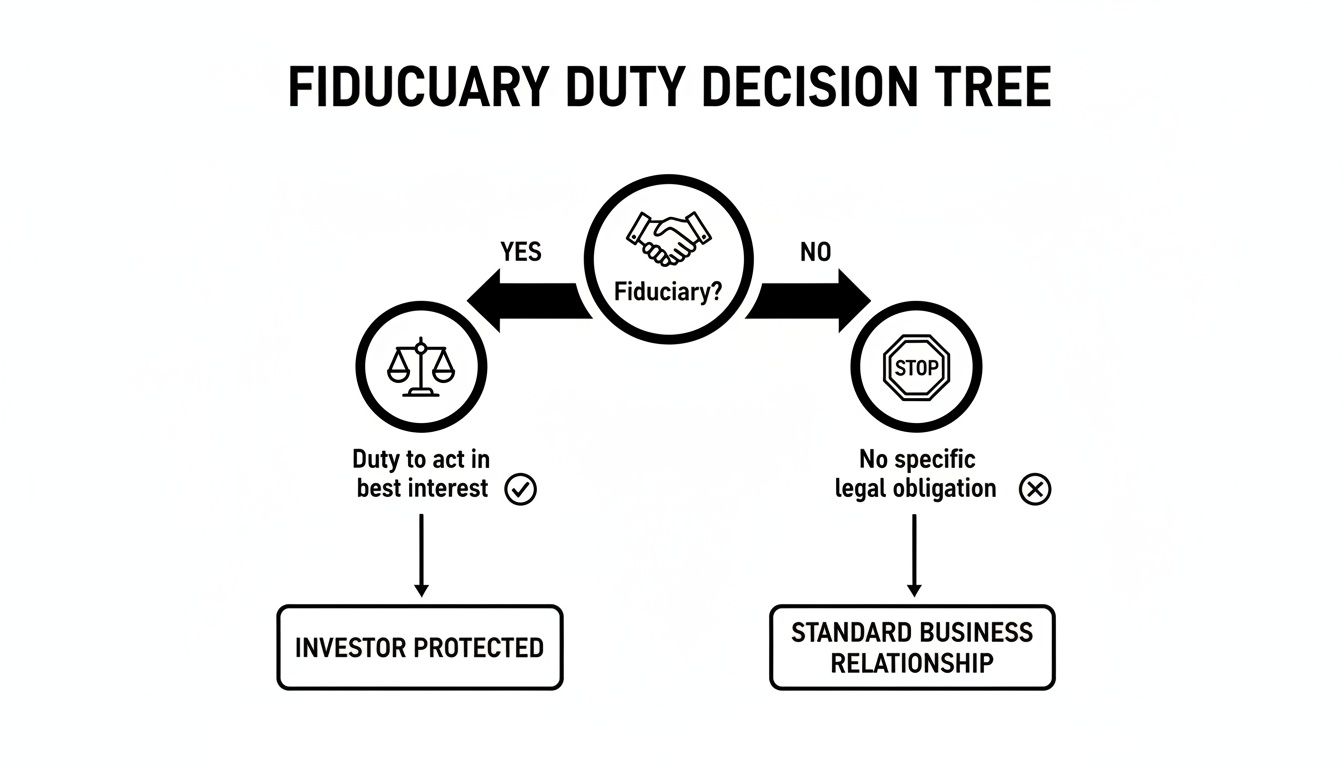
As the decision tree shows, the first and most critical step is proving a fiduciary relationship even existed. Without it, there’s no case to be made.
Pillar 1: The Existence of a Fiduciary Duty
First, you have to prove that a fiduciary relationship was actually in place. This isn't something the court just assumes; it needs to be established with clear evidence. The duty can be created formally, through a legal document, or it can be implied by the unique circumstances of your relationship.
Common ways to prove this duty in North Carolina include:
- Written Agreements: Presenting a will that names an executor, a trust document appointing a trustee, or a signed power of attorney.
- Business Records: Showing a partnership agreement or corporate bylaws that outline the duties between partners or directors.
- Circumstantial Evidence: Demonstrating a relationship of special trust and confidence where you justifiably placed your faith in the other person to act in your best interest, and they accepted that trust.
Without this foundational proof, any claim stops dead in its tracks. You must show the court that the person had a legal obligation to put your interests first.
Pillar 2: The Breach of That Duty
Once the duty is established, the next step is to show exactly how the fiduciary violated it. This is the "breach"—a specific action, or even a failure to act, that went against their core obligations of loyalty and care. It’s not enough to say they made a bad call; you must prove they acted improperly.
A breach happens when a fiduciary puts their own self-interest first, fails to act with reasonable care, or otherwise violates the high standard of trust you placed in them. It's the moment that one-way street of loyalty is broken.
A breach could be an executor using estate funds for a personal vacation (self-dealing). Or it could be a trustee throwing all of a beneficiary's money into a single, high-risk penny stock without doing any research (negligence). The key is to pinpoint the specific wrongful conduct.
Pillar 3: Damages Caused by the Breach
Finally, you must draw a direct line from the fiduciary’s wrongful act to the harm you suffered. This harm, known in legal terms as damages, is usually a financial loss, but it can include other concrete harm as well.
You have to prove that "but for" the fiduciary's breach, you would not have suffered the loss. For example, if your business partner secretly launched a competing company and poached your clients, your damages would be the profits you lost as a direct result of that disloyal act. Proving this causal link is absolutely essential to recovering what you are owed.
Real-World Examples of Fiduciary Breach in North Carolina
The term ‘breach of fiduciary duty’ can sound cold and legalistic. In reality, it describes a deeply personal and damaging betrayal of trust that happens far too often in North Carolina families, businesses, and financial relationships.
To understand what a breach of fiduciary duty really looks like, it helps to move beyond legal definitions and see how these situations play out in the real world. The scenarios below reflect common situations we see, and they may help you recognize if you are facing a similar violation.

Estate and Trust Mismanagement
After a loved one passes, emotions run high. Families must place their complete trust in the person named to manage the estate or trust. When that person puts their own interests first, the betrayal is devastating.
Scenario: The Executor Playing Favorites
A mother in Raleigh passes away, leaving her estate to be split equally between her two children, Sarah and David. The will names Sarah as the executor. Because David lives out of state, he trusts his sister to handle everything fairly.
Instead, Sarah sells their mother’s home—the estate's primary asset—to her own son for $100,000 below its appraised market value. She claims she's just "keeping the house in the family," but she has clearly violated her duty of loyalty. Her job was to maximize the estate's value for both beneficiaries, not to give her own child a sweetheart deal at David's expense.
Financial Abuse via Power of Attorney
A Power of Attorney (POA) gives an "agent" incredible control over another person's affairs. This power must be used only for the benefit of the person who granted it (the "principal"). Sadly, this is a common area of abuse.
Scenario: The Self-Serving Son
An elderly father in Charlotte gives his son, Mark, a durable power of attorney to manage his finances after a dementia diagnosis. His father has significant savings set aside specifically for his long-term care.
A few months in, Mark uses his father’s checkbook to pay off his personal $25,000 credit card bill and put a down payment on a new truck. He tells himself he’ll pay it back eventually. This is a classic case of self-dealing and a blatant breach of his fiduciary duty under North Carolina General Statute § 32C-1-114, which explicitly prohibits an agent from acting for their own personal benefit. He was required to preserve his father's assets for his father's well-being, not treat them like a personal piggy bank.
Business Partnership Betrayal
In North Carolina, business partners legally owe each other a fiduciary duty. This means they must act with complete loyalty and always put the partnership's interests ahead of their own.
A partner cannot secretly compete with their own business or divert opportunities for personal enrichment. Doing so fundamentally breaks the trust that underpins the partnership.
Scenario: The Secret Competitor
Emily and Ben run a successful marketing agency together in Asheville. Unbeknownst to Emily, Ben starts a new, competing agency on the side. He starts funneling potential clients from their shared business to his new solo venture, telling them his new firm can offer "better rates."
By diverting opportunities and directly competing with the partnership, Ben breached his fiduciary duty of loyalty. Emily has the right to sue him for the profits the partnership lost because of his actions. These same duties apply to corporate officers and directors, who must act in the best interests of the corporation and its shareholders.
The consequences of such a breach can be severe. For instance, BMO Capital Markets settled SEC charges for $40.7 million after employees misled investors about mortgage-backed bonds, violating their fiduciary duty. While a major corporate case, it highlights how these breaches lead to huge losses and steep penalties, reinforcing how seriously these duties are taken in all contexts. You can discover more insights about this case and its implications on Tempus Fugit Law.
Hiding Assets in a North Carolina Divorce
Spouses in North Carolina also have a fiduciary-like relationship when it comes to their marital property. During a separation, they have a duty to be completely honest and transparent about their finances. Hiding assets is a direct violation of that trust.
Scenario: The Hidden Bonus
During a difficult divorce in Wilmington, a husband intentionally fails to disclose a $75,000 work bonus he received right before the date of separation. He quietly moves the money into a brand-new bank account, hoping his wife won't find it during the property division process.
This is a clear breach of his duty to provide a full and honest accounting of all marital assets. When the hidden money is discovered, a North Carolina judge has the power to award an unequal (and larger) portion of the marital estate to the wife to make up for his misconduct.
Legal Remedies When a Fiduciary Breach Is Proven
When a North Carolina court confirms that a fiduciary has broken their trust, the next question is always: how do we make it right? The legal system’s goal isn’t just to pick a winner; it’s about making the wronged person “whole” again by undoing the damage and, if needed, holding the wrongdoer accountable.
If you’ve successfully proven a breach of fiduciary duty, the court has a number of powerful options, known as remedies, to deliver justice. Knowing what these are helps clarify what you’re fighting for and what you can realistically expect to recover.

Restoring Your Financial Losses
Most remedies focus on restoring the financial health of the trust, estate, or person who was harmed. The court will calculate the exact monetary damage caused by the breach and order the fiduciary to pay it back.
The primary forms of financial relief are:
- Compensatory Damages: This is a straightforward payment meant to cover the actual financial losses you suffered. For instance, if a trustee’s reckless investment cost the trust $50,000, the court can order them to personally pay that money back into the trust.
- Disgorgement of Profits: This powerful remedy forces the fiduciary to surrender any profits they made from their misconduct. If an executor sold estate property to himself for a low price and flipped it for a $75,000 profit, the court will force him to “disgorge” that entire profit and return it to the estate.
The principle here is simple: a fiduciary can never be allowed to profit from their own wrongdoing. Disgorgement makes sure any ill-gotten gains are returned to their rightful owner.
These financial remedies are the foundation of making you whole. But sometimes, money alone can’t fix the situation, which is when the court turns to equitable remedies.
Equitable Remedies That Go Beyond Money
North Carolina courts also have the authority to issue non-monetary orders, called equitable remedies, to ensure justice is fully served. These are actions aimed at fixing the problem in a more direct, structural way.
Common equitable remedies include:
- Removal of the Fiduciary: If a trustee, executor, or agent has proven they can’t be trusted, the court can strip them of their role. This is a critical step to prevent any more harm from being done.
- Voiding a Transaction: A court has the power to simply cancel a transaction made in breach of a fiduciary duty. For example, if an executor sells a house to their own child for far below market value, that sale can be declared void, returning the property to the estate. Executors have a wide range of responsibilities, and it's vital to understand them fully. You can learn more in our guide on the North Carolina probate process.
- Imposing a Constructive Trust: This is a legal tool where the court treats the fiduciary as if they are holding improperly acquired property "in trust" for the true owner. It effectively freezes the assets and stops the fiduciary from benefiting from their breach while things get sorted out.
Punitive Damages in Severe Cases
In the most serious cases—those involving outright fraud, embezzlement, or malicious self-dealing—a North Carolina court may award punitive damages. These aren't designed to compensate you for your losses. Their sole purpose is to punish the fiduciary for their outrageous behavior and send a clear message that such betrayals of trust will not be tolerated.
Punitive damages are reserved for the worst-of-the-worst scenarios, acting as a powerful deterrent to others who might consider similar misconduct.
Common Defenses Against Fiduciary Breach Accusations
If you believe a fiduciary has betrayed your trust, don't expect them to simply admit it. The person you accuse has every right to mount a defense, and in North Carolina, they have several powerful arguments they can use. Understanding these defenses is not just for lawyers—it's crucial for you to anticipate the other side’s strategy and build a stronger case.
When faced with a fiduciary breach claim, the accused party will work to justify their actions or challenge the very foundation of your accusation. This is a standard part of any legal fight.
The Business Judgment Rule
One of the most common and effective defenses is the business judgment rule. This legal concept shields fiduciaries—like corporate directors, trustees, or business partners—from liability for honest mistakes made in good faith.
The rule basically says that courts shouldn't play Monday-morning quarterback with a fiduciary’s decisions just because they didn't pan out. As long as the fiduciary can prove they acted in good faith, did their homework, and genuinely believed their choice was in the best interest of the person they were serving, they can often avoid liability. It's a shield for reasonable, informed decisions that go wrong, not a cover for carelessness or self-serving actions.
Consent of the Beneficiary
Another go-to defense is claiming the beneficiary knowingly consented to the challenged action. If a fiduciary can show they fully disclosed all the material facts and potential risks, and you still gave them the green light, they can argue they shouldn't be held responsible.
For this defense to work, the consent has to be truly informed. A fiduciary can’t just give you a partial story and get your signature. They must prove they laid out the whole picture—the good, the bad, and the ugly—before you agreed. A half-truth won't protect them.
For instance, if a trustee walks you through the high risks of a specific investment, you acknowledge those risks in writing, and then the investment fails, the trustee will almost certainly use your consent as their defense.
Expiration of the Statute of Limitations
In law, the clock is always ticking. North Carolina has a strict deadline for filing a breach of fiduciary duty claim, known as the statute of limitations. You generally have only three years to file a lawsuit from the date the breach happened or the date you reasonably should have discovered it.
If you wait too long, the court can throw out your case completely, no matter how strong it is. This deadline is unforgiving, which is why it’s so important to act quickly as soon as you suspect something is wrong.
Other Potential Defenses
Beyond those main arguments, a fiduciary might try to poke other holes in your claim. Common strategies include:
- Authorization by the Governing Document: Arguing that the trust agreement, will, or business contract specifically allowed the action they took.
- Lack of Damages: Claiming that even if they made a technical mistake, it didn't cause any actual financial harm.
- No Fiduciary Relationship: Trying to prove that no formal fiduciary relationship existed between you in the first place, which would mean no duty was ever owed.
Courts take these duties incredibly seriously. In one landmark case, a $36.9 million judgment was awarded against a pension fund for a series of fiduciary breaches, like failing to monitor costs and selecting overpriced investments. This case reinforces the high "prudent expert" standard fiduciaries must meet—a standard that heavily influences North Carolina courts. You can read the full analysis of this pivotal fiduciary duty case to better understand how courts enforce these powerful obligations.
How to Protect Your Rights and Move Forward in North Carolina
Realizing that a trusted executor, business partner, or someone with power of attorney might have violated your trust is a deeply distressing experience. If you suspect a breach of fiduciary duty, it’s easy to feel overwhelmed and unsure of what to do next. In North Carolina, the law provides a path to hold them accountable, but you must act decisively.
The biggest mistake you can make is to ignore your suspicions or wait too long. As we've covered, the statute of limitations sets a firm deadline, and crucial evidence can be lost or destroyed over time. Taking that first step is essential to protecting your financial interests.
Your Path Forward Starts Here
Holding a fiduciary accountable isn’t just about knowing the law—it’s about taking strategic action. You need a clear-headed assessment of your case from a legal professional who understands the specific nuances of these complex claims in North Carolina.
This is not a fight you should handle on your own. Proving that a duty existed, that a specific breach occurred, and that you suffered damages as a result requires experienced legal guidance.
Betrayal of trust is not just a personal matter; it's a legal one. Taking proactive steps is the only way to seek justice and recover the assets that are rightfully yours. Don't let uncertainty or fear prevent you from protecting your interests.
Key Steps to Protect Yourself
If you believe you’re the victim of a fiduciary breach in North Carolina, the steps you take next are critical. A structured approach will help preserve your rights and start building a strong foundation for your claim.
Here’s what you can do right now:
- Document Everything: Gather every relevant document you can find—wills, trust agreements, bank statements, emails, letters, and any other correspondence. Create a detailed timeline of events, noting when you first became suspicious and the specific actions that seemed improper.
- Do Not Confront the Fiduciary Directly: It’s tempting to demand an explanation, but a direct confrontation could alert the person you suspect. This might cause them to destroy evidence or take other steps to cover their tracks. It is always better to let a legal professional guide this communication.
- Seek a Legal Consultation Immediately: Your most important move is to speak with an attorney who specializes in fiduciary litigation in North Carolina. An initial consultation will help clarify your legal standing, the strength of your claim, and the options available to you.
Remember, probate and trust administration can be complex even when there is no misconduct. For more context, you can read about how to avoid probate in North Carolina, which helps illustrate why these fiduciary roles are so critical.
Frequently Asked Questions About Fiduciary Duty Claims in NC
When you suspect a betrayal of trust, you need clear answers, and you need them now. We've compiled some of the most common questions our North Carolina attorneys hear about breach of fiduciary duty claims to give you practical guidance on your rights and next steps.
How long do I have to sue for breach of fiduciary duty in North Carolina?
In North Carolina, the statute of limitations for bringing a breach of fiduciary duty claim is generally three years. This is a critical deadline. The clock usually starts ticking from the date the breach occurred or from the date you reasonably should have discovered it. This is why it’s so important to speak with an attorney as soon as you suspect something is wrong, as waiting too long could mean losing your right to file a lawsuit and recover your losses.
What if I only suspect a breach but have no proof?
A strong suspicion is more than enough reason to seek legal advice. You aren't expected to be a legal expert or have a folder full of evidence before you can talk to an attorney. An experienced lawyer will listen to your concerns, explain your rights, and help you figure out the first steps to uncover the truth. In many North Carolina cases, you have a legal right to demand information—like a formal accounting from a trustee or executor. If they refuse, our firm can use the legal discovery process to obtain the financial records and other documents needed to find out if a breach occurred.
Can a spouse breach a fiduciary duty during a NC divorce?
Yes, absolutely. While not fiduciaries in the same way as a trustee, spouses in North Carolina owe each other a duty of good faith and fair dealing with their marital property, especially during separation. Actions that may qualify as a breach include hiding assets (like a secret bank account), intentionally running up joint debt, or selling marital property for less than it's worth to a friend. If a judge finds that a breach occurred, they have the power to award a larger share of the marital estate to the wronged spouse as part of the equitable distribution.
Is breach of fiduciary duty a criminal offense in North Carolina?
A breach of fiduciary duty claim is a civil matter, not a criminal one. This means the legal process involves filing a lawsuit in civil court to recover financial damages or seek other corrective actions, like removing the fiduciary. However, the actions that constitute the breach can sometimes also be criminal. For instance, if an executor’s misconduct involves embezzlement or fraud, they could face separate criminal charges brought by a prosecutor. The focus of your civil attorney, however, remains on helping you recover your financial losses through the court system.
Take Control and Protect Your Rights in North Carolina
You don’t have to navigate the stressful and complicated process of a fiduciary breach by yourself. At the Law Office of Bryan Fagan, we are committed to helping North Carolina residents protect their rights and seek justice when a fiduciary breaks their trust.
We understand the financial and emotional toll these situations take. Our firm is here to provide the clear, empathetic guidance and determined advocacy you need to move forward. Contact us to schedule a confidential consultation. Let’s discuss the specifics of your circumstances and build a plan to protect your interests and secure your future. Call us or visit https://bryanfaganlaw-nc.com to get started.