Three alimony payments have failed to arrive. You've checked the bank account, sent messages, and tried to stay patient, but the missed support is now affecting ordinary bills. Whether you live in Charlotte, Raleigh, Fayetteville, or another North Carolina community, the question is the same: can the court force an ex-spouse to follow an alimony order?
North Carolina law provides a serious enforcement remedy called contempt. It treats unpaid alimony as a violation of a court order, not merely as a private debt. But a missed payment doesn't automatically prove contempt. The central issue is often whether the paying spouse had the present ability to comply and willfully chose not to do so.
When Missed Alimony Becomes a North Carolina Court Problem
Suppose a separation agreement or court order requires monthly alimony. Your former spouse pays for a period, then stops. You ask about the missing payments and receive vague explanations, partial transfers, or no response. The balance grows while rent, utilities, and other obligations still come due.
That problem may become a court matter because a North Carolina alimony order carries the court's authority. Under North Carolina's alimony enforcement statute, G.S. 50-16.7(j), an alimony or postseparation support order may be enforced through civil contempt and punished through criminal contempt under Chapter 5A. Our guide to North Carolina alimony laws explains how these orders are structured and enforced.
Contempt addresses an alleged violation of an existing order. The court is not being asked to create a new support obligation. It is being asked to enforce the obligation already entered.
Practical rule: A payment ledger is more useful than a general statement that your former spouse “hasn't paid in a long time.”
The unpaid balance alone does not establish a workable contempt case. The judge must examine whether the paying spouse had the present ability to pay, or could take reasonable steps to comply, and whether the failure was willful. Owing money and being able to satisfy an order are related questions, but they are not the same question.
Income withholding under G.S. 50-16.7(l1) offers another enforcement option for current or delinquent alimony. It can help address future payment flow, while contempt focuses on the past nonpayment, the spouse's ability to comply, and whether that ability was deliberately disregarded.
The facts may point in different directions. Job loss, serious illness, and no access to funds may support a defense. Leaving work to avoid withholding, moving money out of reach, or continuing discretionary spending while refusing the ordered payment may support a finding of willfulness.
A North Carolina family law attorney can review the order, payment history, income information, and available remedies before recommending a filing. North Carolina Divorce Lawyer services may address divorce and related claims, while an alimony contempt matter may require a focused enforcement strategy.
What Contempt Means Under North Carolina Law
Think of contempt as a court response to disobedience. The order is the court's instruction, and contempt gives the judge a way to address a failure to follow it.
North Carolina recognizes two different contempt concepts in alimony cases.
Civil contempt seeks compliance
Civil contempt is coercive. Its purpose is to encourage the paying spouse to comply with the order or take reasonable steps toward compliance. The court examines whether the order remains valid, whether its purpose can still be served, whether the failure was willful, and whether the person can comply.
The phrase “can comply” is key. A court isn't supposed to use civil contempt just because money is owed. It must determine whether the person has the present ability to pay or can take reasonable measures to meet the obligation.
North Carolina's civil contempt framework is addressed through Chapter 5A. UNC School of Government materials explain that imprisonment is the authorized sanction for civil contempt under G.S. 5A-21(b), subject to the statute's requirements and limits. The confinement is intended to pressure compliance, not to impose a fixed punishment for a completed act.
Criminal contempt punishes disobedience
Criminal contempt is punitive. It addresses willful disobedience as wrongdoing and can result in sanctions under Chapter 5A. G.S. 50-16.7(j) expressly allows alimony and postseparation support orders to be punished through criminal contempt.
The general criminal contempt limits are set out in Chapter 5A. The cited statute provides for censure, jail, a fine, or both, and contains a special child-support exception that doesn't create a parallel special exception for unpaid alimony. That means an alimony case generally requires careful analysis under the ordinary criminal contempt rules.
An appeal doesn't automatically make the alimony order unenforceable. Under G.S. 50-16.7(j), the trial court may continue enforcing a periodic alimony order through civil contempt during an appeal, unless an appellate court stays the contempt order when justice requires. That rule prevents an appeal from becoming an automatic escape from ongoing support obligations.
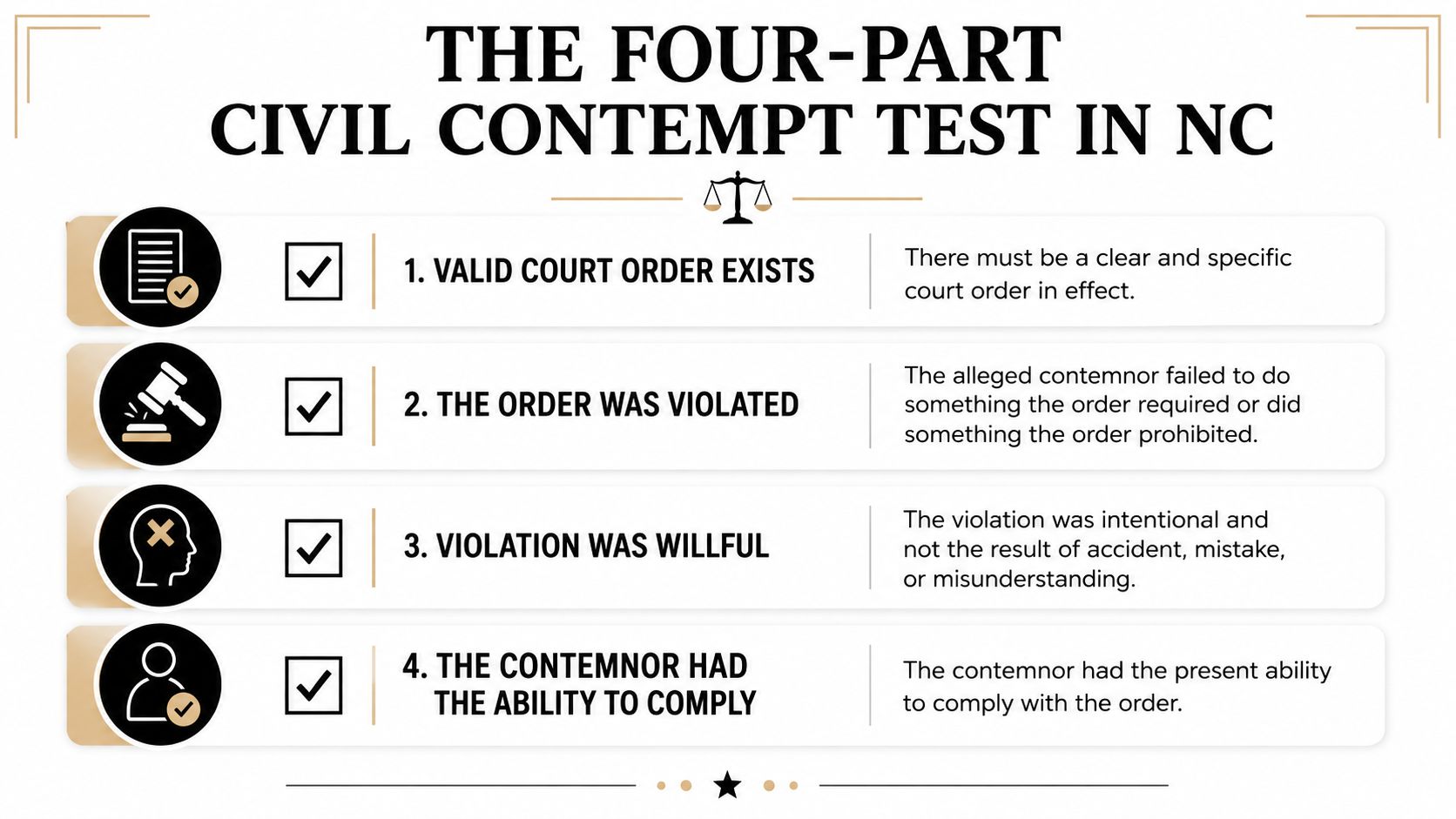
The Four-Part Test That Decides a Civil Contempt Case
A missed payment is evidence of noncompliance, but it isn't the complete legal test. North Carolina civil contempt requires a court to find that the contempt is continuing and that compliance remains possible and useful.
The order must still be in force
First, the court needs a valid order that applies to the paying spouse. The order must identify the support obligation clearly enough for the court to determine what was required and when.
If the order has been terminated, superseded, or otherwise lost its legal force, civil contempt may fail even if payments were missed in the past. The court must be enforcing an obligation that still exists.
Compliance must still serve the order's purpose
Civil contempt is designed to accomplish something. If compliance can no longer serve the purpose of the order, the court may not have a basis to continue civil confinement.
For example, the court may examine whether paying current support, addressing arrears, or following a payment schedule can still carry out the order's support function. This is different from deciding whether the arrears exist.
The failure must be willful
Willfulness means more than inability. A judge may look at conduct, communications, financial choices, and efforts to comply.
A paying spouse who loses employment through no fault of their own, promptly documents the change, seeks work, and communicates about payment may present a stronger defense. A spouse who voluntarily quits a well-paid position, rejects available work, conceals income, or spends on discretionary items while refusing alimony may face a stronger willfulness finding.
The spouse must be able to comply
This is the overlooked gap in many contempt discussions. Money owed and contempt that can be proven aren't always the same thing.
The court must find a present ability to pay or the ability to take reasonable measures to comply. Bank statements, employment information, business records, spending evidence, and communications may help establish that issue.
The strongest contempt case usually connects the arrears to evidence showing both deliberate nonpayment and a realistic path to compliance.
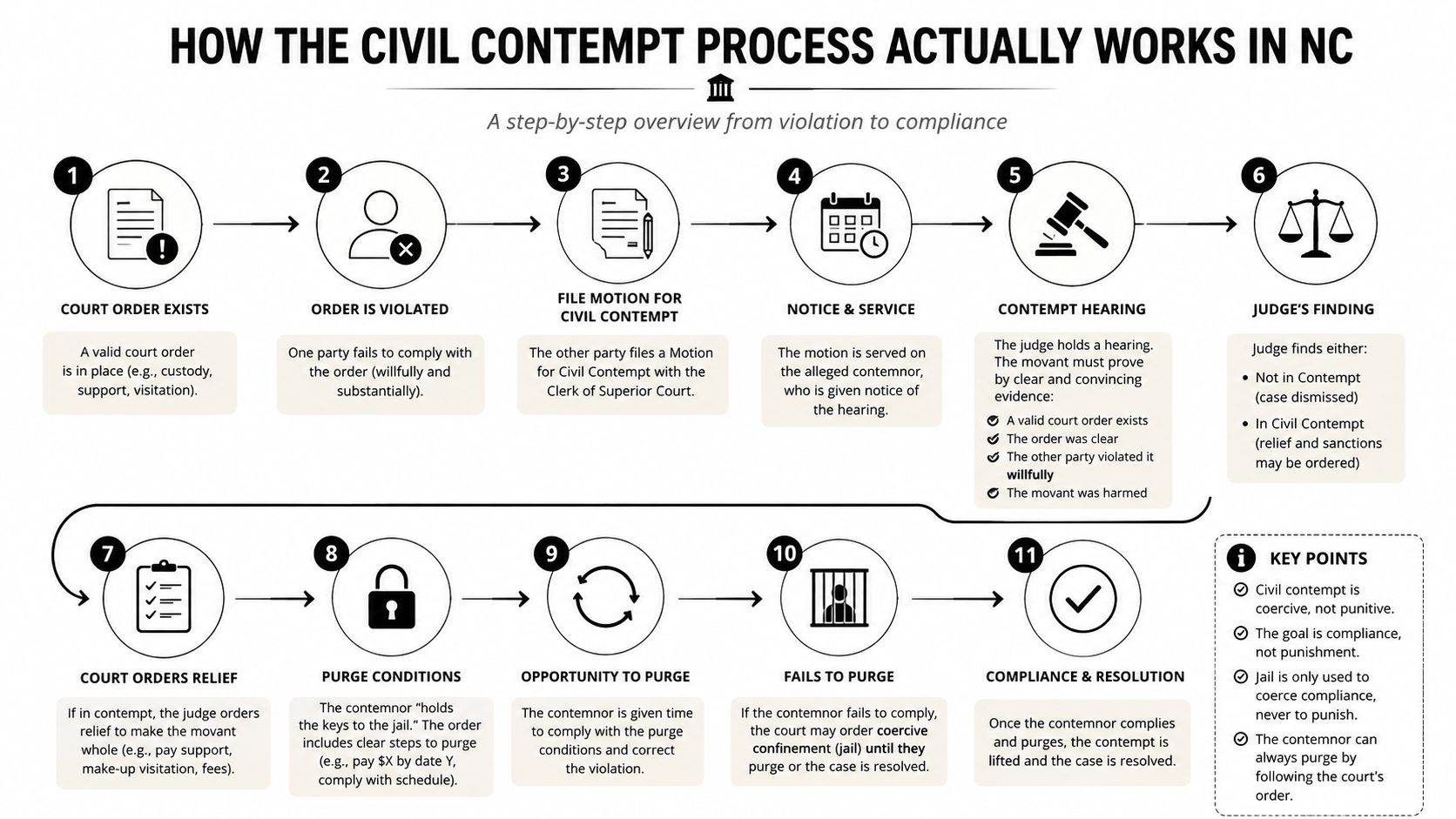
A court may use civil contempt to encourage payment or impose a purge condition. The purge is the action the person must take to end the contempt, such as making a required payment or following a court-approved plan. The judge must still make the required findings rather than treating jail as an automatic consequence of arrears.
How the Civil Contempt Process Actually Works in NC
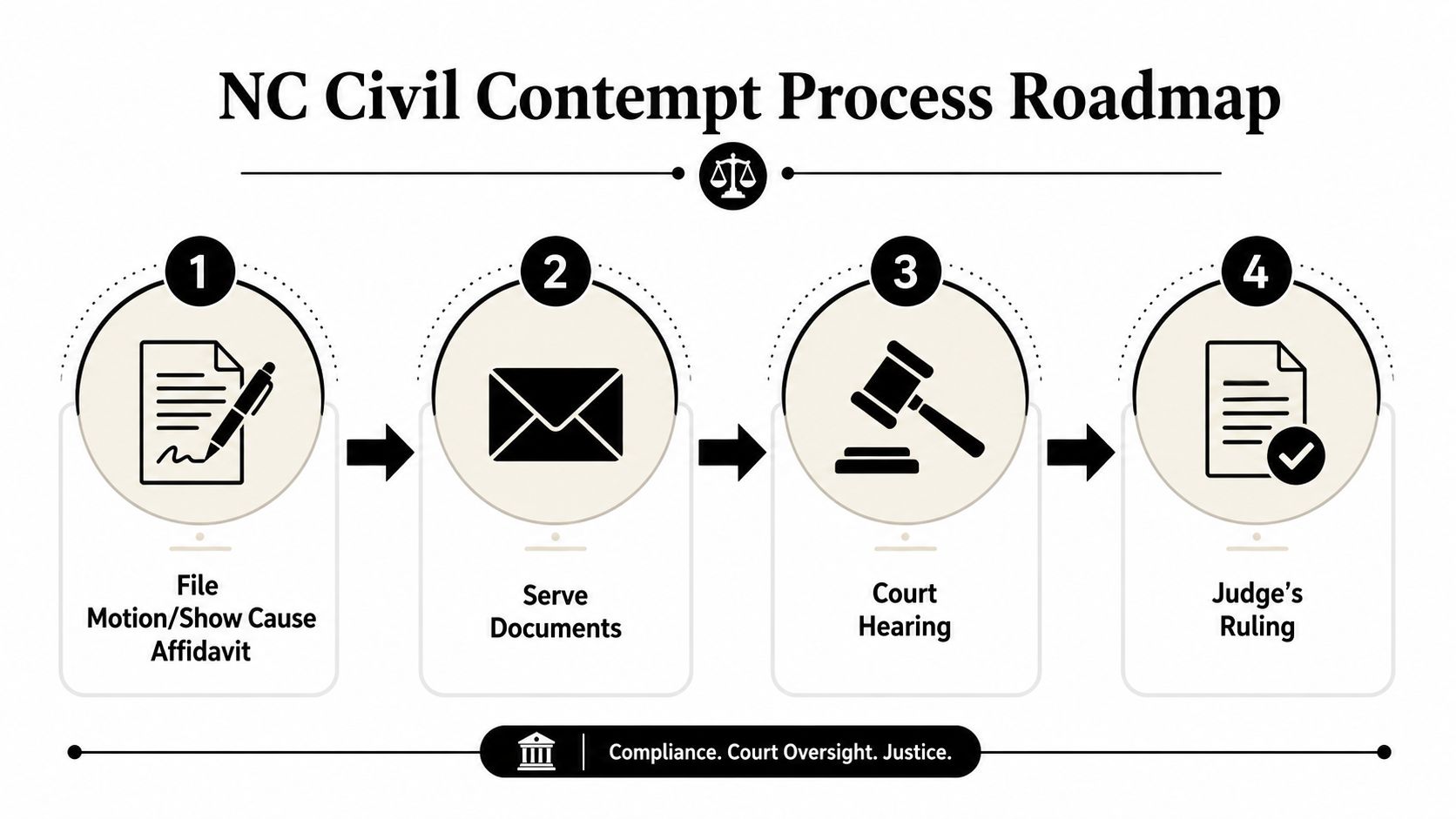
The process normally begins with a motion or request for an order to show cause. The filing should identify the existing alimony order, explain the alleged violations, and give the court a usable account of the arrears.
Start with a precise record
A receiving spouse should organize:
- The controlling order: Include the version that states the payment obligation and effective terms.
- Payment history: List what was due, what was received, and the dates of any missed or partial payments.
- Financial evidence: Preserve bank statements, payment confirmations, and records showing the effect of nonpayment.
- Willfulness evidence: Save messages about refusing payment, employment changes, lifestyle spending, or statements about available funds.
- Income information: Gather lawful records that may show employment, business activity, or other income sources.
A judge needs more than a conclusion that the other spouse can pay. The filing should connect the facts to the legal requirements.
Notice and the hearing
After the matter is filed, the court addresses issuance and service of the show-cause paperwork. The paying spouse must receive legally sufficient notice and an opportunity to respond. A hearing then allows both sides to present evidence and explain their positions.
At the hearing, the judge may examine the order, payment records, income, employment history, and efforts to comply. The receiving spouse may testify about missed payments and authenticate records. The paying spouse may explain job loss, illness, debt, lack of access to funds, or other circumstances.
The court may find contempt, deny the request, continue the matter for additional proof, or establish a purge condition. A purge plan should be realistic enough to produce payment while addressing the arrears meaningfully.
Why documentation matters
Memory fades, but contemporaneous records preserve dates and amounts. A bank statement showing no transfer can be more persuasive than a general recollection. A message stating that payment will not be made despite available funds may matter more than a later argument about what was intended.
The North Carolina contempt process can involve technical filing, service, and evidentiary requirements. A carefully prepared record helps the judge focus on the legal questions instead of sorting through an unclear payment history.
Enforcement Tools Beyond Contempt
Contempt addresses a violation after it occurs. North Carolina law also provides tools designed to reduce future nonpayment and secure support before another dispute develops.
| Tool | Best Used When | Key NC Statute |
|---|---|---|
| Income withholding | The paying spouse has identifiable wages or recurring income | G.S. 50-16.7(l1) |
| Assignment of income | Wages, salary, or other income can be redirected by court order | G.S. 50-16.7(b) |
| Property security or liens | The paying spouse has property that may help secure arrears | North Carolina enforcement remedies, depending on the asset and judgment |
Income withholding
G.S. 50-16.7(l1) authorizes income withholding to secure future alimony payments and address delinquency. The mechanism can direct income from employment toward the support obligation rather than leaving the receiving spouse to request payment each month.
This is often useful when the paying spouse has regular wages but has shown that voluntary payments aren't dependable. It may be less straightforward when income is irregular, self-generated, or difficult to identify.
Assignment of wages or income
Under G.S. 50-16.7(b), a court may assign wages, salary, or other income due or to become due. This gives the court another way to secure the obligation when the financial structure calls for something more targeted than a simple reminder.
Assignment can be relevant when the paying spouse receives identifiable compensation from employment, contracts, or another recurring source. The precise remedy depends on the order, the income source, and the facts presented to the court.
Property-based remedies
A receiving spouse may also explore security connected to property, including judgment liens on real estate when the legal requirements are met. This approach doesn't necessarily create immediate cash flow, but it can protect the claim against an asset and affect what happens if property is sold or refinanced.
These remedies often work best together. Withholding addresses future support, while contempt addresses willful arrears. A lawyer can evaluate whether a combined approach is more practical than relying on one remedy alone.
Defenses and Remedies That Actually Matter
A paying spouse may owe alimony and still have a defense to civil contempt. The court's question isn't whether the ledger contains an unpaid amount. It must decide whether the person could comply and willfully failed to do so.
Financial hardship can be legally important
Job loss, illness, reduced income, and lack of access to funds may undermine a claim of present ability to pay. The defense becomes stronger when the paying spouse can document the event, show reasonable efforts to respond, and explain what payments were possible.
The receiving spouse can test those explanations with objective evidence. Employment records, bank activity, spending patterns, business records, and communications may show whether the hardship is genuine or overstated.
Modification is separate from enforcement
If the paying spouse believes circumstances have changed, the usual solution is a motion to modify future support when modification is legally available. Filing for modification doesn't automatically erase amounts that came due under the existing order.
A person generally shouldn't wait until a contempt hearing to argue that the obligation should have been lower. The existing order remains important until a court changes it. Information about modification of spousal support can help distinguish a request about future obligations from a defense to past nonpayment.
Purge plans may serve both sides
A negotiated purge plan can be practical when the paying spouse has some ability to pay but cannot immediately resolve all arrears. It may combine an initial payment, regular current support, an arrearage installment, and income withholding.
For the receiving spouse, the value is a concrete payment structure rather than another unfulfilled promise. For the paying spouse, a realistic plan may avoid unnecessary confinement while demonstrating compliance.

A Walkthrough of a Typical North Carolina Contempt Case
Consider a receiving spouse who has missed four ordered payments. The spouse prepares a motion to show cause with a verified arrears statement, payment ledger, bank records, and available employer information.
The filing might allege: “The Defendant has willfully refused to comply with this Court's Order dated [date] despite having the present ability to pay.” That language isn't enough by itself. The evidence must support the alleged order, missed payments, willfulness, and present ability to comply.
At the hearing, the receiving spouse may testify about the payment history and identify the bank records. The paying spouse may be questioned about employment, income, expenses, and communications concerning the missed payments. The judge then decides whether the civil contempt requirements have been proven.
One possible result is a purge order requiring payment by a specified date, along with continued current support. Another is a suspended contempt finding paired with income withholding and a structured arrearage plan. If the evidence doesn't establish present ability to pay or willful noncompliance, the court may decline to hold the spouse in civil contempt, even though the unpaid balance remains an issue.
The Law Office of Bryan Fagan helps North Carolina residents evaluate unpaid alimony, organize payment and financial records, and pursue enforcement or modification strategies suited to the facts. Visit Law Office of Bryan Fagan to schedule a consultation about your alimony order, arrears, and next legal step.