If you’re asking how to file for separation in North Carolina, you might be surprised by the answer. A common misconception is that you must file a specific document with the court to begin the process. That's not how it works here.
In North Carolina, legal separation begins the day one spouse moves out of the marital home with the clear intent to end the marriage. Your actions, not an initial court filing, are what start the one-year clock required for a divorce.
What Legal Separation Really Means In North Carolina
When clients ask us how to "file" for separation, their first assumption is always about paperwork. The reality in North Carolina is far more practical—legal separation is achieved by physically living "separate and apart."
This isn't just a suggestion; it’s the legal foundation for a no-fault divorce in our state. Under North Carolina General Statute § 50-6, you and your spouse must live in two completely different residences for at least one full year and a day before you can file a complaint for an absolute divorce. This is a strict, non-negotiable requirement.
The flowchart below outlines the two main paths you can take once you’ve decided to separate, showing how this initial decision point leads to very different outcomes.
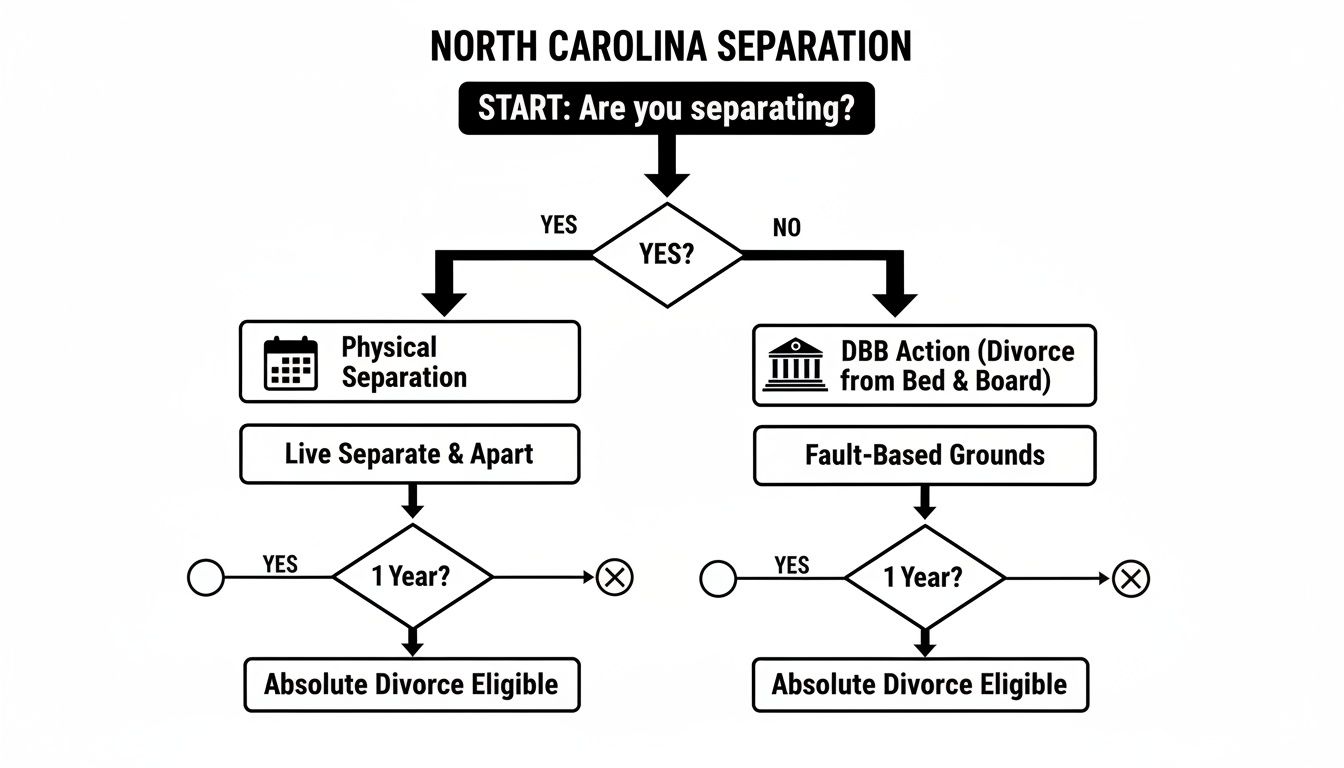
As you can see, the most common route is physical separation, which begins the one-year countdown for a no-fault divorce. The alternative, a court action called a 'Divorce from Bed and Board,' is a more aggressive legal step reserved for specific, fault-based situations.
What “Living Separate and Apart” Looks Like
So, what does "separate and apart" actually require? It means much more than just sleeping in different bedrooms under the same roof. The law demands that you maintain two entirely separate households.
Practical Example: Let's say a couple in Raleigh decides to separate. One spouse moves into a guest bedroom. This does not count as legal separation in North Carolina. For the one-year clock to start, one spouse must physically move out, lease a new apartment, or move in with family, establishing a separate residence.
In practice, this looks like:
- One spouse moves out, leasing a new apartment or staying with family.
- That spouse officially changes their mailing address with the U.S. Postal Service.
- You stop holding yourselves out to friends, family, and the public as a married couple.
It’s all about demonstrating a clear, unambiguous end to the marital relationship through your actions. Be aware that even spending a single night together at one of your homes with the idea of reconciling could be enough to reset that one-year clock. It's a critical detail that catches many people by surprise.
Two Paths to Separation: Physical vs. Court Action
While most separations begin with one person moving out, North Carolina law provides two distinct pathways forward. One is a private process driven by your actions, and the other is a formal court proceeding.
The table below compares these two approaches, helping you understand which path might be right for your situation.
| Feature | Physical Separation for No-Fault Divorce | Divorce from Bed and Board (Fault-Based) |
|---|---|---|
| How It Starts | One spouse moves out with the intent to separate. | One spouse files a formal lawsuit against the other. |
| Legal Basis | No fault is required. This is the first step toward a no-fault divorce under N.C. Gen. Stat. § 50-6. | Requires proving marital misconduct (e.g., abandonment, adultery, abuse) under N.C. Gen. Stat. § 50-7. |
| Court Involvement | No initial court filing is needed to be considered "separated." | Requires a judge's order. It is a court-ordered separation. |
| Primary Goal | To start the 12-month clock required for an absolute divorce. | To legally force a separation and get court orders for support or possession of the home. |
| Is It a Divorce? | No. It is a required waiting period before divorce. | No. It does not legally end the marriage. You still must wait one year to file for absolute divorce. |
Understanding these differences is key. Physical separation is the standard path, while a Divorce from Bed and Board is a legal tool used when one spouse's misconduct makes a voluntary separation impossible or unsafe. The time is crucial for addressing the key issues of your marriage, which is why it's so important to understand all the steps for divorce in North Carolina from the very beginning.
Taking the First Steps to Document Your Separation

Since there's no official form to "file" for separation in North Carolina, you must create your own proof. The date you begin living separate and apart is the single most important piece of evidence for your future divorce. Documenting it correctly from day one is essential to avoid disputes later.
This date isn’t just about moving belongings; it's about methodically untangling your lives to create a clear, provable record that your marital relationship has ended.
Building a Clear Record of Your Separation Date
Think of this process as creating a paper trail for the court. Each step you take reinforces that you are no longer living together as a married couple and provides third-party verification of your separation date.
Real-World Scenario: Let's say Sarah and Tom from Charlotte decide to separate, and Tom agrees to move out on October 1st. To create a strong record, Tom should:
- Sign a New Lease: Tom signs a one-year lease for a new apartment in Mecklenburg County. The signed lease is powerful evidence with a clear, verifiable date.
- Forward Official Mail: The day he moves, Tom completes a Change of Address form with the U.S. Postal Service, creating an official record of his new residence.
- Update Your Driver's License: Tom goes to the DMV to update the address on his driver's license. This government-issued ID now reflects his separate household.
- Open Separate Bank Accounts: Sarah and Tom go to their bank, close their joint accounts, and each open individual accounts. This signals the end of their shared financial life.
Each of these steps independently proves they established separate lives on or around October 1st, making it very difficult for either spouse to later contest the date of separation.
The Power of a Separation Agreement
While taking these physical and financial steps, there is another critical tool you should be using: a Separation Agreement. This is a private contract between you and your spouse that formally documents the terms of your separation without court intervention. It is the most effective way to address all major issues upfront.
A well-drafted Separation Agreement is your roadmap for the next year. It’s a legally binding document that allows you to decide on property division, child custody, and financial support on your own terms, providing clarity and preventing future conflict.
Instead of leaving critical decisions about your home, finances, and children to a judge, you and your spouse retain control by negotiating the outcomes yourselves.
This agreement can specify:
- The exact date of separation.
- Who will live in the marital home.
- How bills and debts will be handled during the separation period.
- A detailed plan for dividing marital property (equitable distribution).
- A complete child custody schedule and child support arrangements.
- Whether one spouse will receive post-separation support or alimony.
Once a Separation Agreement is written, signed by both parties, and properly notarized, it becomes an enforceable contract. It is the cornerstone of a smooth transition from separation to divorce, providing predictability during an otherwise uncertain time. This is a critical part of how to file for separation in NC effectively.
Crafting a Rock-Solid North Carolina Separation Agreement

While living apart starts the one-year separation period, the Separation Agreement is the single most critical legal document you'll create. Think of it as a private contract between you and your spouse—one that gives you the power to decide the terms of your future instead of leaving those life-altering decisions to a judge.
A well-written agreement is the blueprint for your separate lives and, eventually, your divorce. It provides clarity and control, turning what can feel like an overwhelming process into a series of clear, manageable steps.
What Goes Into a Separation Agreement?
A thorough Separation Agreement needs to cover every significant aspect of the life you built together. This isn't just a handshake deal; it’s a legally binding contract that spells out the "who, what, and when" of untangling your family and financial lives.
At its core, the agreement must address:
- Property and Debt Division: A detailed plan for how all marital assets (like real estate and bank accounts) and liabilities (like credit cards and loans) will be divided.
- Child Custody and Visitation: A clear, practical, and stable parenting schedule that is in the best interests of the children.
- Child Support: Calculations based on North Carolina's official guidelines to ensure your children's financial needs are met.
- Spousal Support: A determination of whether post-separation support or alimony is appropriate, including the amount and duration.
- Retirement and Investments: Specifics on how accounts like 401(k)s, pensions, and IRAs will be divided, often requiring a Qualified Domestic Relations Order (QDRO).
- The Marital Home: A decision on whether the home will be sold, if one spouse will buy out the other's interest, or how it will be handled.
The Non-Negotiable Rule: Full Financial Disclosure
Your Separation Agreement is only as strong as the information it’s built upon. North Carolina law is crystal clear: both spouses are required to provide full and honest financial disclosure. Every bank account, investment, debt, and income source must be put on the table.
Hiding assets or deliberately misrepresenting your financial picture carries serious consequences. If a judge discovers deception after an agreement is signed, they have the power to void the entire agreement, sending you right back to the beginning of a costly and emotionally draining process.
Real-World Example: Imagine one spouse "forgets" to disclose a brokerage account worth $50,000. If the other spouse finds out after the agreement is signed, they can take legal action to have the contract set aside due to fraud. A court could then reopen every single issue—from property division to alimony—forcing both of you to endure more legal fees and stress. Honesty isn't just the best policy; it's a legal requirement.
How Equitable Distribution Works in Practice
North Carolina is an equitable distribution state. This means marital property is divided fairly, which doesn't always mean a strict 50/50 split. The court’s goal is to achieve a fair outcome based on the unique circumstances of the marriage. You can get a deeper look into what equitable distribution means for you in our detailed guide.
Let's look at a common scenario: a couple married for 15 years. One spouse was the primary earner and built up a large 401(k), while the other was a homemaker and the children’s primary caregiver.
- The Marital Home: With $200,000 in equity, they might agree to sell it and split the proceeds. Alternatively, one spouse could refinance and buy out the other's share.
- Retirement Funds: The portion of the 401(k) that grew during the marriage is considered marital property. A special court order, known as a QDRO (Qualified Domestic Relations Order), would be drafted to transfer a fair portion to the other spouse's retirement account without tax penalties.
Making Your Agreement Legally Enforceable
For a Separation Agreement to be a valid and enforceable contract in North Carolina, it has to meet a few key legal standards. Simply writing down terms and agreeing to them isn't enough to make it stand up in court.
Your agreement must be:
- In Writing: Verbal promises regarding property, debt, or support are not enforceable.
- Signed by Both Parties: Both you and your spouse must sign the document voluntarily, without being forced or coerced.
- Properly Notarized: Your signatures must be acknowledged before a notary public. This step is non-negotiable, as it verifies your identities and confirms you signed the agreement of your own free will.
Without these formalities, your agreement is just a piece of paper. With them, it becomes a powerful legal tool that protects your rights and provides a clear path forward as you work through the details of how to file for separation in NC.
When to Use a Divorce from Bed and Board
While most couples in North Carolina start their separation simply by living in different homes, some situations are too volatile or contentious for a voluntary move-out. When your spouse’s behavior makes a peaceful separation impossible, you need a way to protect yourself and your finances right away.
This is exactly where a Divorce from Bed and Board (DBB) becomes a critical legal tool.
A DBB isn't a true divorce—it doesn't actually end your marriage. Instead, think of it as a court-ordered, fault-based separation. It's a lawsuit you file against your spouse to legally force a separation when they've committed serious marital misconduct.
Grounds for Filing a Divorce from Bed and Board
You can’t get a DBB just because you're unhappy. You have to prove to a judge that your spouse is at fault based on one of the specific grounds laid out in North Carolina General Statute § 50-7.
These are the only valid reasons for a judge to grant a DBB:
- Abandonment: Your spouse has moved out without a valid reason and without your permission.
- Maliciously Turning the Other Out of Doors: Your spouse has wrongfully kicked you out of the marital home.
- Cruel or Barbarous Treatment: Your spouse has endangered your life, either through physical violence or severe emotional abuse.
- Indignities: Your spouse has engaged in a pattern of behavior that makes your life an absolute burden (think constant humiliation, verbal abuse, or other intolerable actions).
- Excessive Use of of Alcohol or Drugs: Your spouse’s substance abuse is so extreme it makes your life unbearable.
- Adultery: Your spouse has cheated on you.
Filing for a DBB is a major step, and it's usually reserved for high-conflict cases where one spouse's actions have made court intervention the only safe option.
Scenarios Where a DBB is a Strategic Move
Imagine your spouse refuses to leave your home in Raleigh, creating a toxic and unsafe environment for you and the kids. Or maybe your spouse in Durham suddenly freezes your joint bank account, cutting you off from all financial resources. These are precisely the kinds of situations where a DBB isn't just helpful—it's necessary.
Real-World Example: Maria's husband has a severe gambling problem and has been secretly draining their joint savings. When she confronts him, he refuses to move out of their home and tells her she'll never see another dime. Fearing financial ruin, Maria files a complaint for Divorce from Bed and Board, alleging indignities. A judge can then issue an order that has powerful and immediate effects, such as ordering her husband to vacate the home and pay her post-separation support (a form of temporary alimony).
In a case like Maria's, a judge can grant Maria exclusive possession of the property and order her husband to provide financial support so she can cover her bills while the separation proceeds.
The DBB Filing and Hearing Process
The process kicks off when your attorney files a formal Complaint in District Court. This document lays out the specific fault grounds against your spouse. After it’s filed, your spouse has to be legally "served" with the lawsuit, and they then have 30 days to file a formal response.
From there, the case may move toward a court hearing where you will present evidence—like text messages, financial records, and witness testimony—to prove your claims. If the judge is convinced your spouse is at fault, they will grant the Divorce from Bed and Board.
This court order officially formalizes your separation and can include temporary relief on critical issues like child custody, child support, and who gets to live in the house. You can read more about NC divorce rates and trends to better understand these common paths.
From Separation to Final Divorce: Navigating the Courts
Once you’ve lived separate and apart for one full year and a day, you can begin the final stage: filing for an absolute divorce. While the most emotionally taxing parts may be over, this phase is all about administrative details. Getting these procedural steps right is critical to officially ending your marriage.
The first question is always where to file. In North Carolina, your divorce paperwork must be filed in the District Court of the county where either you or your spouse currently lives. This isn't a suggestion; it's a strict jurisdictional rule.
Meeting North Carolina's Residency Requirement
Before a court will even consider your divorce case, either you or your spouse must have been a resident of North Carolina for at least six months immediately before you file. It's important to understand this is a completely separate requirement from the one-year physical separation.
Practical Example: Imagine you lived in South Carolina, separated from your spouse, and then moved to Mecklenburg County. Even if your one-year separation period is complete, you still have to live in North Carolina for a full six months before you are legally eligible to file your divorce complaint.
The Essential Divorce Paperwork
Filing for divorce means submitting a specific set of documents to the court. While it's always a good idea to check your local county court’s website for any unique rules, you will almost always need to prepare these forms:
- Complaint for Absolute Divorce: This is the formal legal document that officially starts the lawsuit. It states the basic facts: your marriage date, your separation date, and confirmation that you’ve met both the one-year separation and six-month residency requirements.
- Summons: This is an official notice from the court to your spouse, letting them know they are being sued for divorce. It legally requires them to file a response to the Complaint, usually within 30 days.
- Domestic Civil Action Cover Sheet: This is an administrative form the court system uses to properly categorize and track your case.
A common client concern is thinking that once papers are filed, the divorce is final. This is not the case. The process is only complete when a judge signs the final Divorce Judgment. Missing a step can cause significant delays.
Understanding Service of Process
After you file the Complaint and Summons with the Clerk of Court, your spouse must be formally notified. This legal notification is called service of process, and it’s a non-negotiable step. The law requires you to use an approved method.
The most common ways to handle service in North Carolina are:
- Sheriff's Service: For a small fee, you can have the Sheriff’s Department in your spouse's county personally deliver the paperwork. This creates an official, verifiable record that they received it.
- Certified Mail, Return Receipt Requested: This involves mailing the documents via certified mail, which requires your spouse to sign for the package. That signed green card that gets mailed back to you is your proof of service.
- Acceptance of Service: If your separation is amicable, your spouse can sign a document called an "Acceptance of Service," acknowledging they’ve received the paperwork and waiving the need for a more formal service method.
Working through these final court procedures is the last major hurdle in securing your absolute divorce in North Carolina. Handling these administrative steps correctly ensures the process concludes smoothly.
Frequently Asked Questions About NC Separation
Can we live in the same house and still be separated in NC?
No. To satisfy the legal requirement for a no-fault divorce under N.C. Gen. Stat. § 50-6, you and your spouse must live in completely separate residences. Living in different bedrooms or on different floors of the same house does not count. One of you must physically move out with the intent for the separation to be permanent.
What happens if we separate without a written agreement?
Relying on a verbal promise is a significant risk, as spoken agreements are nearly impossible to enforce in a North Carolina court. Without a signed and notarized Separation Agreement, unresolved matters like property division or support will be left for a judge to decide during the divorce. This can be expensive, time-consuming, and removes your control over the outcome.
Does it matter who moves out of the marital home?
Moving out of the house does not mean you automatically forfeit your ownership rights. The home is still marital property, and its value will be divided through equitable distribution. However, moving out without a written agreement or court order can be risky. Your spouse could later try to claim you abandoned the marriage, which can complicate issues like alimony. It is always best to have a written agreement specifying who will live in the home before anyone moves.
Protect Your Future with a North Carolina Family Law Attorney
Navigating separation in North Carolina is more than a single court filing—it's a deliberate process of documenting your separation, untangling your finances, and creating an enforceable agreement to protect your future. Attempting this alone can lead to costly mistakes that jeopardize your financial stability and parental rights.
An experienced North Carolina family law attorney is your advocate, negotiator, and guide. We provide strategic counsel tailored to your unique circumstances, whether you are in Wake, Mecklenburg, or any other county in the state. We ensure that every decision is made with a clear understanding of North Carolina law and your long-term goals, protecting you from common pitfalls while fighting to secure a fair outcome. We cannot guarantee a specific result, but we can guarantee our commitment to you.
The Law Office of Bryan Fagan is dedicated to providing North Carolina residents with the clear, empathetic, and client-focused representation needed to navigate this challenging time. We are here to protect your rights, your assets, and your peace of mind.
Don't face this journey alone. Schedule a consultation with our team today to get your questions answered and build a clear plan for your new beginning. Learn more about how we can help at https://bryanfaganlaw-nc.com.