A probation violation notice usually hits at the worst possible moment. You may have missed one meeting because your ride fell through. You may have tested positive when you're already trying to get treatment. Or you may be dealing with a new charge and suddenly realizing that one problem can turn into two.
That fear is real. In North Carolina, a probation violation can put your freedom at risk even when the alleged problem isn't a new criminal conviction. Nationally, 23 percent of all state prison admissions in 2021 resulted from technical violations while on probation or parole, and 12 percent of the total state prison population, more than 120,000 people, was incarcerated solely for technical violations, according to Vera Institute reporting on Council of State Governments data. Those numbers show why it makes sense to take any alleged violation seriously from the start.
North Carolina has its own rules, its own hearing process, and its own strategic pressure points. That matters. A violation hearing isn't something you should treat like routine calendar court, and it isn't something you should try to explain away casually to a probation officer.
Legal trouble also tends to overlap with the rest of life. People facing criminal issues are often also trying to hold together work, family, transportation, and court obligations. If your household is dealing with multiple legal stresses at once, practical resources like this guide on steps for divorce in North Carolina can help you stay organized while you address the criminal side properly.
Facing a Probation Violation in North Carolina
The first question most clients ask is simple: "Am I going to jail?"
Sometimes the answer is yes. Sometimes the answer is no. Most often, the honest answer is that it depends on what type of violation is alleged, how well you responded, and whether the court believes the violation was willful.
What people are usually dealing with
In North Carolina, probation cases often start with ordinary life problems that turn into legal problems:
- Missed reporting: You were told to report and didn't appear.
- Failed drug screen: A test came back positive, or you missed the test entirely.
- New charge: You were arrested while already on supervised probation.
- Program noncompliance: You didn't complete treatment, classes, or community service on time.
None of those situations should be ignored. A small mistake can become a much bigger one once a violation report is filed.
Practical rule: If you've learned about an alleged probation violation, treat it like an active threat to your suspended sentence, not like a misunderstanding that will fix itself.
Why clarity matters early
People often assume that if they haven't been convicted of a new offense yet, the probation matter will wait. That's a risky assumption. A probation hearing follows different rules than a criminal trial, and the judge may act on the violation before the new case is fully resolved.
That doesn't mean the outcome is automatic. It does mean your response has to be organized. The strongest cases usually begin with fast fact-gathering, careful communication, and a defense strategy built around the exact allegation instead of general explanations about being under stress.
Technical Violations vs New Criminal Offenses
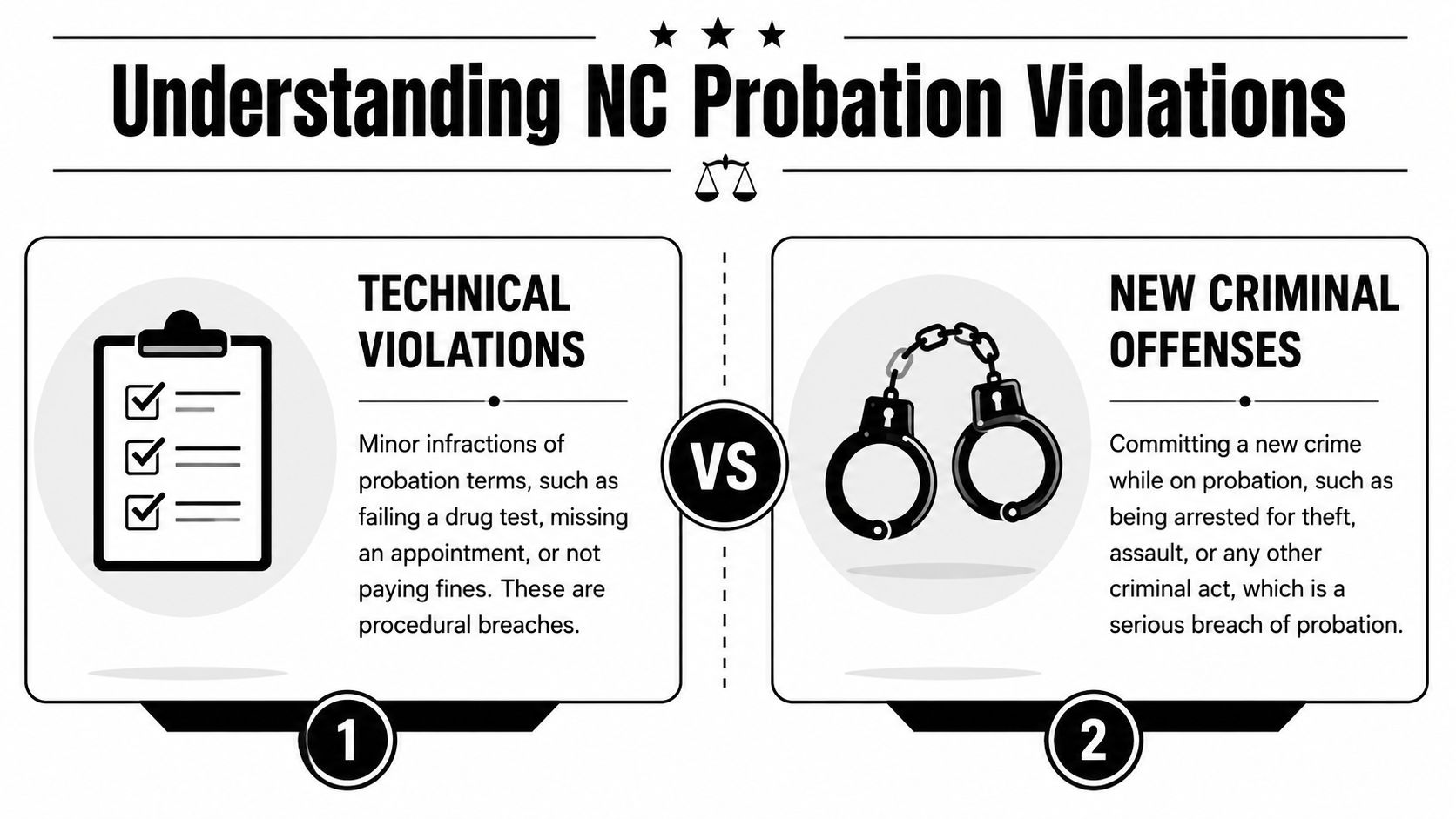
Not every violation is the same. In practice, this is the first distinction that matters because it shapes what the judge may be worried about and what kind of defense or mitigation approach makes sense.
What counts as a technical violation
A technical violation means you allegedly broke a rule of probation without necessarily committing a new criminal offense. Common examples include missing an appointment with your probation officer, violating a curfew, failing a drug test, failing to complete court-ordered treatment, or not following reporting instructions.
These cases matter because courts treat probation conditions as court orders, not suggestions. Nationally, 45% of state prison admissions in 2019 were the result of supervision violations, meaning many people entered prison for supervision-related problems rather than a new crime, based on the High Court summary of Council of State Governments findings.
A technical allegation also doesn't always mean the person is being reckless. Sometimes it's a transportation issue, unstable housing, confusion about dates, relapse during recovery, or a work conflict. The legal question becomes whether the court views the conduct as avoidable and serious enough to justify stronger sanctions.
What counts as a new criminal offense
A new criminal offense violation is more serious. This happens when someone on probation is accused of committing another crime during the probation period. In North Carolina, that might mean a new DWI, shoplifting charge, assault allegation, drug possession case, or any other misdemeanor or felony.
Here's the practical difference:
| Type of allegation | What it usually means in court | Common defense focus |
|---|---|---|
| Technical violation | The court looks at compliance and effort | Whether the violation occurred, and whether it was willful |
| New offense allegation | The court focuses on public safety and trust | Weaknesses in the new allegation, timing, and mitigation |
A common misconception is that "I haven't been convicted, so probation can't be violated." That's not how judges tend to analyze these hearings. The probation court may still consider the alleged conduct under a lower evidentiary standard than a criminal trial.
For some families, criminal court problems arrive while support and custody issues are also unfolding. Separate legal systems can run at the same time, and they use different standards. For example, North Carolina Child Support Guidelines Explained discusses how North Carolina calculates child support using the Worksheet system, which is a very different framework from the discretion and compliance issues that drive probation hearings.
A technical violation may sound minor. In court, it can still carry major probation violation consequences if the judge thinks you ignored the court's order.
The Range of Probation Violation Consequences
It's common to imagine only two outcomes. Nothing happens, or probation gets revoked. Real cases usually fall somewhere in between.
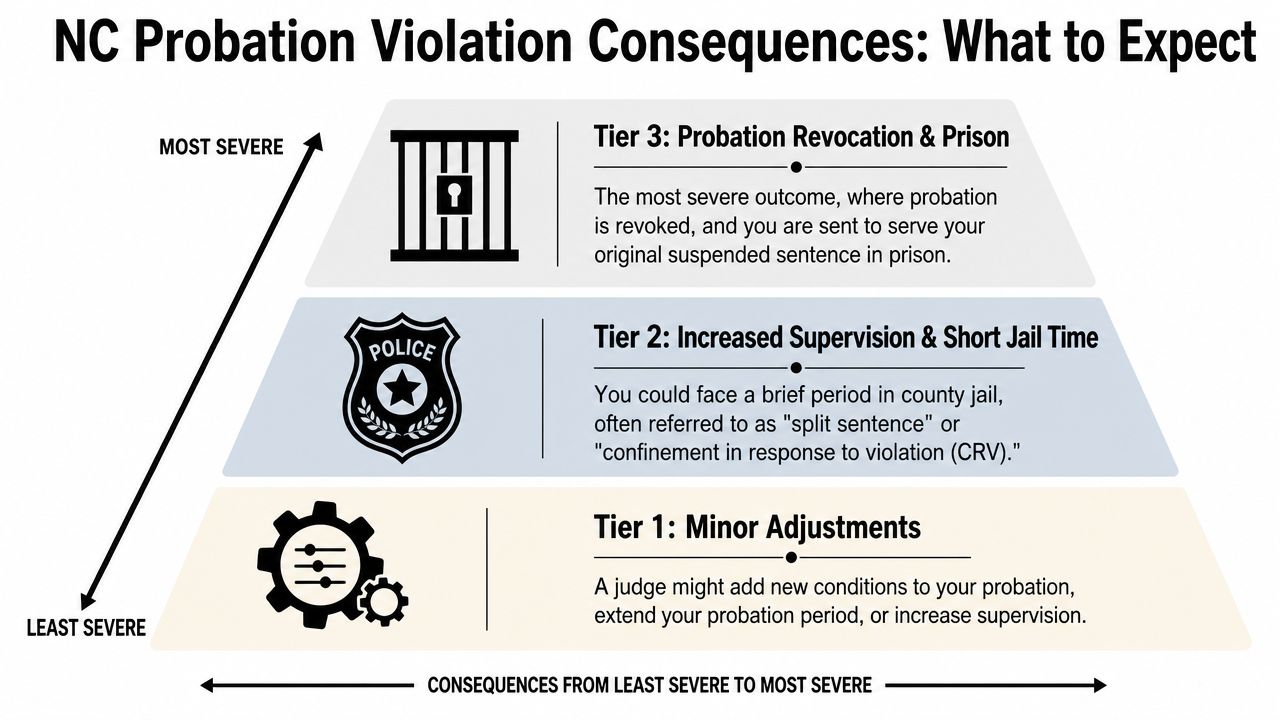
Lower-level responses the court may consider
Sometimes the judge decides that supervision should continue but under tighter conditions. That can mean more reporting, added treatment requirements, electronic monitoring, or another compliance-based adjustment. If the court thinks the problem can still be corrected, the sanction may be designed to pressure compliance rather than end probation altogether.
North Carolina judges also have authority to extend probation in some situations, which can leave a person under court supervision far longer than expected. That may not sound as severe as jail, but it keeps the case alive and creates more chances for future violations.
A realistic example: someone misses appointments after losing a job, then falls behind on treatment attendance. If the judge sees effort and supporting records, the court may decide to continue probation with stricter terms rather than revoke it.
Short custody sanctions and escalating pressure
In other cases, the court may use confinement as a warning shot. People often call this short jail time by different names, but the practical point is the same. The judge can impose a custodial sanction intended to force compliance without fully activating the entire suspended sentence.
That middle ground is where many cases are won or lost strategically. The defense goal may not be total dismissal of the allegation. It may be avoiding revocation and keeping the outcome contained.
- Modified supervision: More frequent check-ins or additional classes.
- Added conditions: Treatment, monitoring, or structured compliance terms.
- Extended oversight: More time on probation means more obligations and less margin for error.
- Short incarceration: A judge may use brief custody as a sanction short of full revocation.
If you're also dealing with a new charge, such as impaired driving, the probation case and the new criminal case can affect each other in practical ways. That's why it helps to understand the separate exposure involved in offenses like drunk driving in North Carolina.
Revocation and activation of the suspended sentence
The most severe result is revocation. In North Carolina, revocation means the court activates the sentence that had been suspended when probation was granted. As one North Carolina explanation puts it, if a person on probation for larceny has a suspended sentence of 90 days, revocation results in immediate incarceration for those 90 days, according to Stowe Law Firm's discussion of North Carolina probation violations.
When a judge revokes probation, the issue usually stops being "how do I fix this" and becomes "how much of the original sentence am I about to serve."
That is why probation violation consequences have to be evaluated in light of the original judgment. The danger isn't just the new allegation. The danger is the sentence waiting behind it.
Navigating the North Carolina Revocation Hearing
A revocation hearing moves faster and works differently than many people expect. Knowing the sequence helps you avoid preventable mistakes.
Early in the process, it helps to see the hearing path as a series of decision points, not one dramatic courtroom moment.
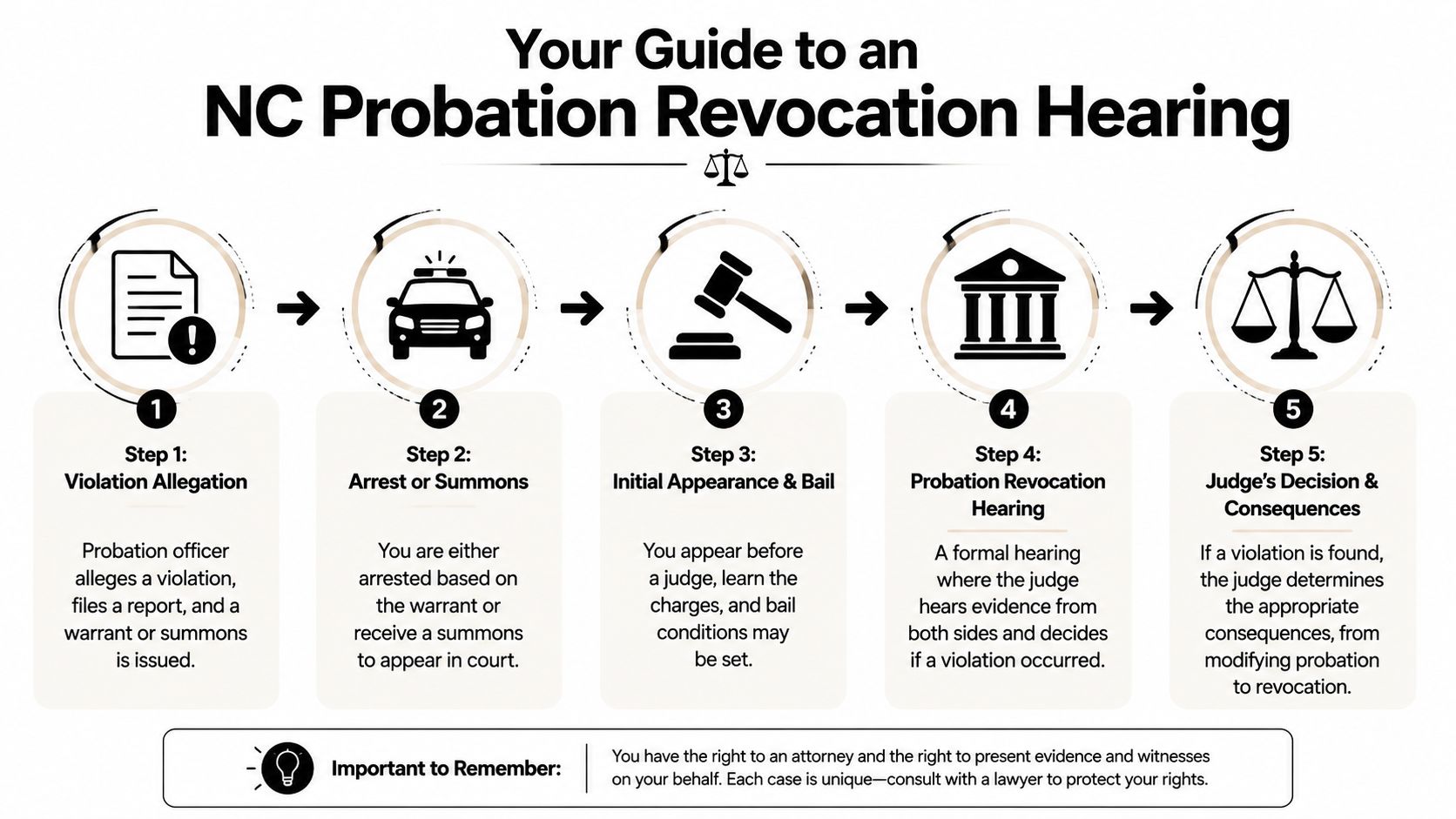
How the case usually reaches court
A probation matter often begins when the probation officer files a violation report alleging that a condition of supervision was broken. After that, the court may issue a summons or an order that leads to arrest. Which route happens often depends on the nature of the allegation and the person's history on supervision.
The first court date isn't usually the end of the matter. It may be only the point where the allegation is addressed formally and the next hearing is set.
Later, the court holds the probation violation hearing itself. That's the proceeding where the judge decides whether a violation occurred and, if so, what consequence should follow.
This overview can help you visualize the courtroom sequence before you appear:
The burden of proof is lower than at trial
This is one of the biggest surprises for clients. A probation violation hearing doesn't use the same burden of proof as a criminal trial. The judge isn't deciding guilt on a new criminal charge beyond a reasonable doubt. The court is deciding whether a violation has been shown under a lower standard.
That lower standard matters because weak or incomplete facts can still create risk in a violation hearing. An experienced defense approach often focuses on challenging reliability, context, and credibility instead of waiting for the state to meet the higher trial standard that doesn't apply here.
The hearing may feel informal compared to a trial. The consequences are not informal.
What the judge can do after the hearing
Once the judge finds a violation, the court chooses the response. In North Carolina, a judge can extend a defendant's probation period for up to five years if the violation occurs but doesn't justify revocation, according to Browning & Long's discussion of common violations and consequences.
That power changes settlement strategy. Sometimes the central question isn't just whether the judge believes a violation happened. It's whether the defense can persuade the court that continued supervision, with limits and structure, makes more sense than activating the suspended sentence.
Defenses and Mitigation Strategies in NC
A probation allegation is serious, but it isn't the same as a final result. Some cases can be defended directly. Others need a mitigation plan that gives the judge a reason not to revoke.
The willfulness standard matters
In North Carolina, G.S. 15A-1345 requires the judge to find that a probation violation was willful or that the defendant failed to make reasonable efforts to comply before revoking probation and activating the suspended sentence, as discussed in this summary of North Carolina probation law.
That word, willful, is where many cases turn.
If you missed a meeting because you chose not to go and made no effort to notify anyone, the state will argue the violation was willful. If you missed because you were hospitalized, jailed elsewhere, lacked notice, or were dealing with a documented emergency, the analysis changes. The same is true if you can show real efforts to comply even though you fell short.
Defense is different from mitigation
A defense argues that the violation didn't happen, or that the state can't prove it happened in the way alleged. A mitigation argument accepts some problem occurred but gives the court a lawful and practical reason to impose a lesser sanction.
Here are common strategic paths:
- Challenge the allegation itself: The report may be wrong, incomplete, or based on assumptions. Dates, testing procedures, reporting instructions, and witness credibility all matter.
- Show the violation wasn't willful: Medical records, work schedules, jail records, treatment records, text messages, and transportation problems can help explain why compliance failed.
- Prove reasonable efforts: Even if you didn't fully comply, partial completion, attempted reporting, rescheduled appointments, or efforts to enter treatment can influence the judge.
- Present a corrective plan: Courts often respond better when the defense brings a concrete solution, such as immediate treatment enrollment, updated reporting structure, or verified employment.
A practical example: if someone fails to complete community service because they lost child care and then stopped communicating, the case may be weak on mitigation. If that same person has messages asking for rescheduling, records showing work conflicts, and proof that some hours were completed, the judge sees a different picture.
What doesn't work well
Excuses without documents usually don't carry much weight. Last-minute promises also tend to fall flat if there is no proof behind them.
It also doesn't help to argue with the probation officer emotionally in open court. Judges usually respond better to organized records, realistic accountability, and a clear compliance plan than to anger or denial.
Your Immediate Action Plan After an Allegation
The first few days matter. If you've been accused of violating probation, focus on protecting yourself, not explaining yourself to everyone around you.
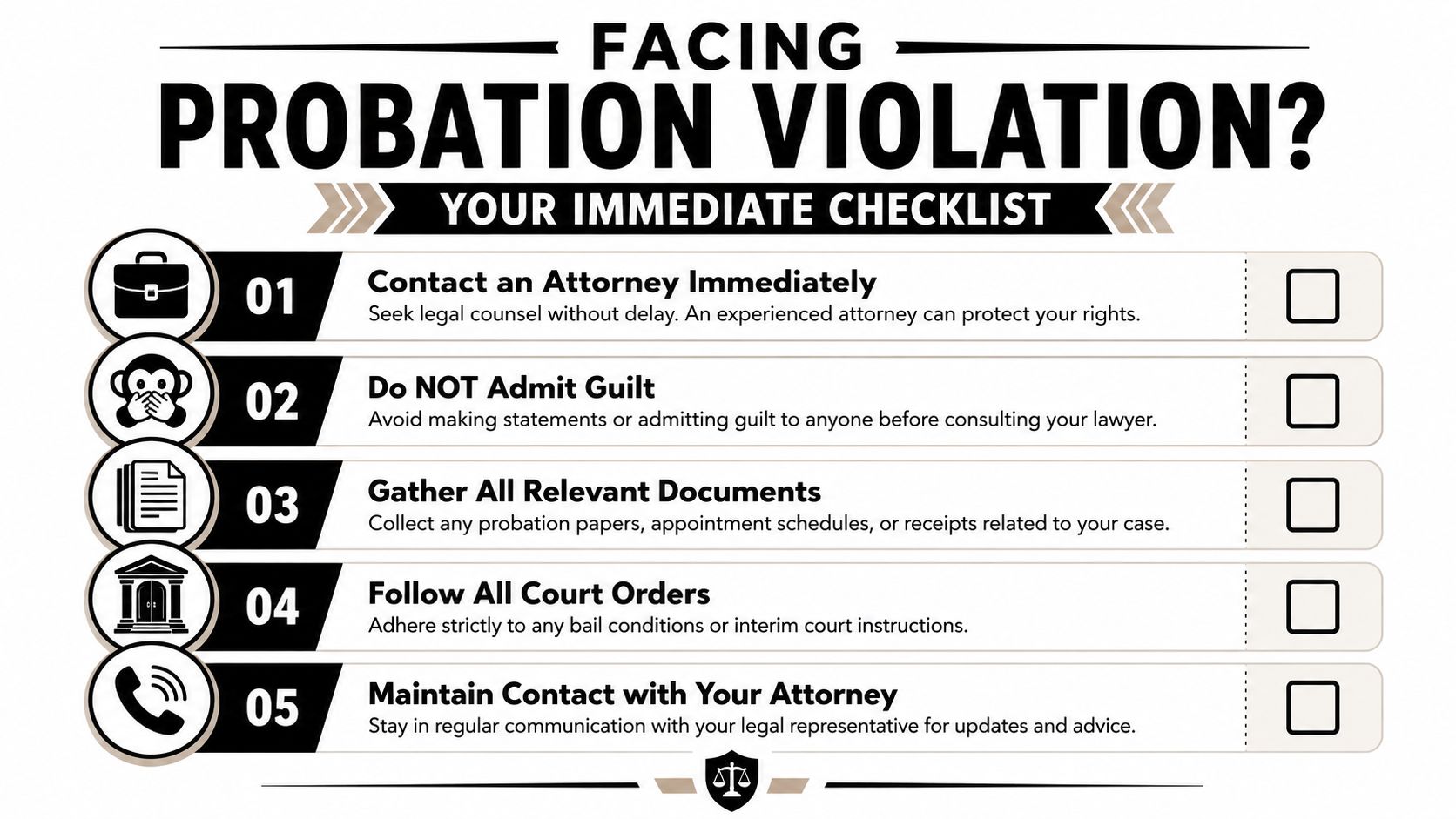
Five steps to take right away
Don't ignore the notice
If you've received a summons, warrant information, or any communication about a violation, respond immediately through counsel. Ignoring it usually makes the court view the situation as worse than it started.Gather your paperwork
Pull together your judgment, probation conditions, reporting records, treatment records, payment receipts, drug screen information, and any messages with your probation officer. Small details often decide whether a violation looks willful or explainable.Write down the timeline
Do this while events are still fresh. Include dates, times, transportation issues, work schedules, medical events, and names of witnesses. Memory gets less reliable once court dates start moving.Stop talking about the case casually
Don't try to talk your way out of it with law enforcement, the probation officer, or anyone else before you've received legal advice. Statements made in panic can box you into a bad position.Get North Carolina defense counsel involved quickly
Probation hearings reward preparation. Early legal help gives you more time to collect records, identify weaknesses in the allegation, and present a workable alternative to revocation.
Bring documents, not just explanations. Judges hear explanations every day. Documents give those explanations weight.
How the Law Office of Bryan Fagan Can Defend You
A probation violation case usually turns on details that don't show up clearly in the violation report. That is where defense work matters. An attorney can review the judgment, identify which conditions applied, compare the allegation to the record, and gather the documents that support a defense or mitigation presentation.
The legal issue in many North Carolina hearings isn't just whether something went wrong. It's whether the state can show a willful violation, and whether the court should respond with revocation rather than a lesser sanction. That requires focused preparation, not broad promises.
For people facing this kind of hearing, the Law Office of Bryan Fagan criminal defense team handles North Carolina criminal matters and can evaluate the probation allegation, the underlying sentence exposure, and the available courtroom strategy. In practical terms, that may include reviewing the probation officer's report, collecting medical or employment records, preparing witnesses, and presenting a compliance plan aimed at avoiding the harshest probation violation consequences.
If you're facing a probation violation in North Carolina, don't wait for the hearing date to get close. The earlier you act, the more options you may have.
FAQ
Can I go to jail for a technical probation violation in North Carolina
Yes. A technical violation can still lead to serious consequences, including custody and, in some cases, revocation depending on the allegation and the legal basis before the court.
Does a judge have to find that I violated probation on purpose
For revocation in North Carolina, willfulness matters. The court must find the violation was willful or that you failed to make reasonable efforts to comply before activating the suspended sentence.
What if I missed probation because of work or a medical emergency
That may be relevant to whether the violation was willful. The key is proof. Work records, medical records, hospital paperwork, and communication history can make a major difference.
Can probation be extended instead of revoked
Yes. In some cases, the judge may continue probation and extend the period of supervision rather than revoke it.
Should I talk to my probation officer first or a lawyer first
You should speak with a lawyer before making detailed statements about the allegation. A poorly framed explanation can hurt a defense that might otherwise have been strong.
North Carolina residents dealing with a probation violation often need immediate, practical guidance. If you're worried about jail, revocation, or how to explain what happened, schedule a consultation with the Law Office of Bryan Fagan to review your case, your probation terms, and your options under North Carolina law.