If you're searching for best interest of the child nc, you're probably not looking for a textbook definition. You're trying to answer harder questions. Will the judge care that you've handled school drop-off for years? Does your co-parent's new partner matter? Can you move for work and still keep a strong custody schedule? What happens if a grandparent files for custody?
Those questions usually come up when life already feels unstable. A separation, a pending divorce, or a sudden conflict over parenting time can make every decision feel urgent. Parents often walk into this process worried that one bad hearing will define their child's future.
North Carolina law does have a framework for these cases. It isn't built around rewarding one parent or punishing the other. It is built around the child's welfare. That framework is called the best interest of the child standard, and it sits at the center of custody decisions across the state.
The Guiding Principle in Every North Carolina Custody Case
A common fear in custody cases is that the court will reduce your family to a few labels. Mother. Father. Primary parent. Breadwinner. Stable home. New relationship. Real custody cases don't work that neatly, and North Carolina law recognizes that.
In 1977, the North Carolina General Assembly ended the old Tender Years Doctrine, which had favored mothers in custody disputes, and replaced it with the gender-neutral best interest standard in N.C. Gen. Stat. § 50-13.2. The law makes clear that no presumption applies between parents as to who will better promote the child's welfare, as described in this discussion of the North Carolina best interests doctrine.
That change matters in practical terms. A father doesn't start behind. A mother doesn't win by default. A judge looks at the child, the parents, the home environment, the evidence, and the day-to-day reality of the family.
What parents usually want to know first
Most parents aren't asking abstract legal questions. They're asking things like:
- Will the judge look at what I've done: school involvement, medical appointments, bedtime routines, and communication with teachers?
- Does conflict matter: especially if the child has seen arguments or one parent won't cooperate?
- Can the other parent use money against me: if one household earns more?
- What if safety is a concern: because of violence, substance abuse, or unstable behavior?
The best interest standard is the court's way of answering those concerns with evidence rather than assumptions.
Courts don't look for the parent who sounds better in a courtroom. They look for the arrangement that best supports the child's welfare in real life.
That doesn't mean the process feels simple. It rarely does. But it does mean there is a legal structure behind the judge's decision, and understanding that structure helps parents make better choices from the start.
Defining the Best Interest Standard in NC Law
Under N.C. Gen. Stat. § 50-13.2, the court must decide custody based on what will best promote the interest and welfare of the child. North Carolina courts must consider all relevant factors, including domestic violence, the safety of the child, and the safety of either party from violence by the other, with written findings supporting the ruling, as summarized in this guide to North Carolina child custody best interest factors.
That sounds broad because it is broad. There isn't a rigid scorecard. A judge is building a full picture of your child's life, not checking boxes on a form.
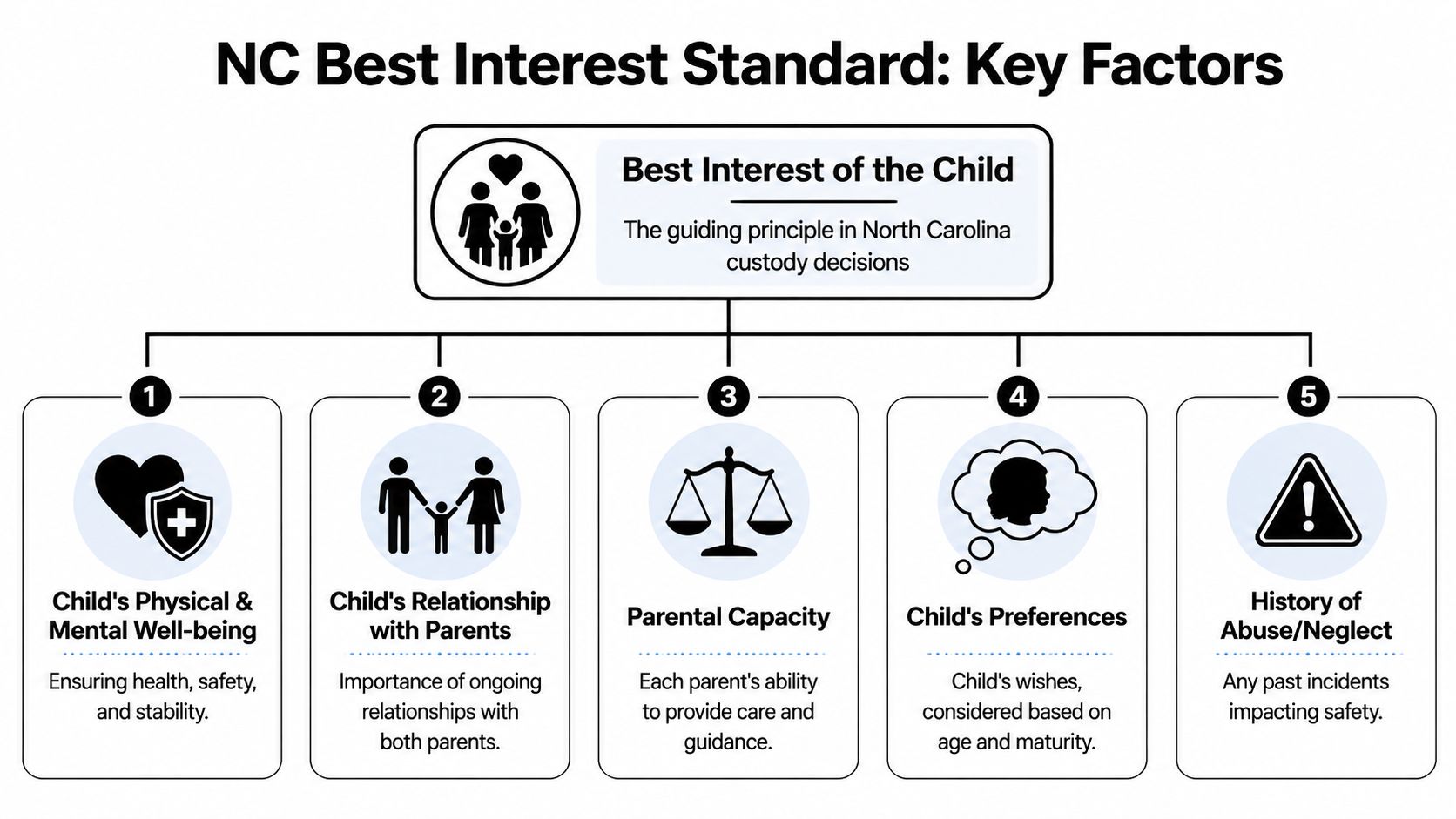
Think of it as a full-life review
The easiest way to understand the standard is to think of a judge assembling a mosaic. One tile might be school attendance. Another might be the child's bond with each parent. Another could be a history of missed exchanges, angry texts, or medical follow-through. No single tile always controls the result, but together they show the court what life is likely to look like for the child.
What matters most is rarely what a parent promises to do next month. It is what the evidence shows that parent has been doing over time.
Key factors in a North Carolina best interest determination
| Factor | What It Means in Practice |
|---|---|
| Child's safety | The court looks closely at violence, threats, unsafe supervision, neglect, or situations that put the child at risk. |
| Daily caregiving history | Judges often want to know who handles meals, school routines, doctor visits, therapy, and bedtime consistency. |
| Emotional and developmental needs | A child's mental health, behavior, special needs, and need for structure can shape the custody arrangement. |
| Each parent's judgment and reliability | Following court orders, communicating appropriately, and making sound decisions all matter. |
| Ability to support the child's relationship with the other parent | A parent who encourages healthy contact often presents better than a parent who blocks or undermines it without good reason. |
| Stability of each home | Judges weigh routine, predictability, school continuity, and the practical realities of each living arrangement. |
| Domestic violence concerns | If violence is part of the family history, the court must consider it directly, not treat it as background noise. |
| Child's preferences in some cases | A child's wishes may be considered, depending on age, maturity, and the circumstances. |
What this means in real life
A cleaner house doesn't automatically beat a warmer parent-child relationship. Higher income doesn't automatically beat stronger day-to-day involvement. A parent with a demanding work schedule may still do well if that parent has a reliable support system and a clear history of showing up for the child.
By the same token, a parent who says, "I can do more now," may struggle if the record shows years of inconsistency.
Practical rule: Judges tend to care more about patterns than performances.
Safety is not just one factor among many
When domestic violence or credible safety concerns are involved, those issues can reshape the entire case. Parents sometimes make the mistake of treating violence as a side issue because they don't want to seem dramatic or because the child wasn't the direct target. North Carolina law doesn't treat it that way.
If one parent has used violence, intimidation, or coercive behavior, the court may view communication problems, exchange disputes, and parenting conflict through a very different lens. That can affect physical custody, legal custody, decision-making authority, and the structure of visitation.
How a Judge Decides What Is in Your Child's Best Interest
A judge's decision isn't supposed to be guesswork. It is a legal judgment built on evidence, credibility, and written findings. In North Carolina, the standard has been described by the state Supreme Court as the "polar star" guiding judicial discretion in In re Peal (1982), meaning the court must decide which environment best supports the child's full development, as reflected in the statutory discussion at N.C. Gen. Stat. § 50-13.2.

Judges compare lived realities, not slogans
Parents often come into court with broad positions. "I'm the more stable parent." "She never cooperates." "He only wants custody to avoid support." Those statements may reflect real frustration, but they aren't enough by themselves.
Judges compare facts. They look at calendars, texts, school records, testimony, and behavior under pressure. They also watch how each parent presents in court. Not who is the most polished, but who appears reliable, grounded, and focused on the child.
A useful way to think about it is this:
- Money matters, but it isn't everything. A parent with more financial resources may still lose ground if that parent has little daily involvement.
- Love matters, but it isn't enough by itself. A strong bond helps, but the court also wants structure, judgment, and consistency.
- Cooperation matters a great deal. If one parent can support the child's relationship with the other parent without creating chaos, that often carries weight.
Findings of fact drive the order
One of the most important pieces of any North Carolina custody case is the judge's findings of fact. These are the written statements explaining what the court found to be true and how those facts support the custody ruling.
That matters for two reasons.
First, it forces the court to connect the evidence to the result. Second, if there is an appeal later, those findings become central. Appellate courts usually give trial judges wide discretion, especially in custody matters, because trial judges see the witnesses and hear the testimony directly.
Trade-offs judges often have to weigh
Custody cases rarely present one perfect parent and one terrible parent. More often, the court is choosing between imperfect options.
A few examples show how that balancing works:
- Parent A has a larger home and steadier income. Parent B has handled most of the child's school and medical needs.
- One parent lives closer to school. The other parent has been more flexible and child-focused during conflict.
- One parent wants strict equal time. The child may need a schedule built around therapy, special education, or emotional regulation.
The judge doesn't assign points and total them up. The judge asks which arrangement will serve the child best.
A custody hearing is often less about proving the other parent is bad and more about proving your proposed plan works for the child.
Credibility can quietly shape the outcome
Parents sometimes underestimate how much credibility matters. If a parent exaggerates, changes positions, hides inconvenient facts, or sends angry messages that contradict courtroom testimony, that can affect how the judge views everything else.
By contrast, a parent who admits imperfections but shows steady follow-through often appears more trustworthy. In close cases, that difference can be significant.
Building Your Case Presenting Evidence That Matters
Good custody cases are built, not announced. Saying you're a strong parent isn't the same as proving it. The evidence that tends to matter most is the evidence that shows a pattern over time.

Start with the daily record
The strongest custody evidence is often ordinary. It doesn't always look dramatic. It looks like consistency.
That can include:
- School involvement: attendance at conferences, emails with teachers, report cards, and records showing who handles school issues.
- Medical follow-through: appointment records, prescription management, therapy participation, and communication with providers.
- Parenting schedule history: calendars, exchange logs, and messages showing who exercised parenting time.
- Communication tone: texts and emails that show whether a parent problem-solves or escalates.
If you're dealing with a temporary arrangement, it may help to understand how courts approach short-term orders and immediate concerns in North Carolina temporary custody cases.
Witnesses can help, but the right witness matters
Friends and relatives often want to help. Sometimes they can. But judges usually find neutral third parties more persuasive than invested family members.
Useful witnesses may include:
- Teachers or school staff who have seen which parent handles school matters
- Counselors or therapists when appropriate and legally permitted
- Childcare providers who can speak to routines, drop-offs, and reliability
- Medical providers if health issues are central to the case
A witness should add facts, not loyalty. "She's a wonderful mother" is far less useful than "She attended the meetings about the child's educational plan and followed through with the recommended support."
Documents usually beat arguments
A parent may spend months preparing to tell the court a detailed story. Then one attendance record, one chain of texts, or one medical note becomes more important than the speech.
That doesn't mean testimony doesn't matter. It does. But testimony supported by records is usually stronger than testimony standing alone.
Bring proof of routines, not just proof of conflict.
What not to do
Some of the most damaging mistakes come from emotion rather than strategy.
Avoid these traps:
- Using the child as a messenger: Judges notice when parents pull children into adult disputes.
- Flooding the court with every insult ever texted: Not every ugly message proves something legally useful.
- Attacking the other parent's character in broad terms: Focus on conduct that affects the child.
- Making promises you can't realistically keep: Proposed schedules must fit work, school, distance, and the child's actual needs.
Evaluations and child-focused professionals
In some cases, a guardian ad litem, custody evaluator, therapist, or other professional may shape the evidence in important ways. These cases often become less about what each parent says and more about what a trained third party observed.
This overview may help if you want a general explanation of the issues parents should prepare for before court:
When families need help organizing evidence and presenting a child-focused position, one option is working with a firm such as the Law Office of Bryan Fagan, which handles North Carolina custody proceedings and related family law matters.
The Standard in Action Complex Custody Scenarios
The best interest standard becomes harder to apply when the facts don't fit a simple parenting dispute. Relocation, grandparent claims, major life changes, and termination cases force courts to weigh competing risks and competing goods.

Relocation cases
A relocation case often starts with a parent saying the move is necessary. Maybe there is a job offer, family support in another city, or a safer and more affordable living situation. The other parent hears something different. Less time with the child. More travel. Harder school coordination. A weaker relationship.
North Carolina courts don't treat relocation as automatically good or automatically bad. The judge will usually look at why the move is happening, whether it improves the child's life in concrete ways, and what it does to the child's relationship with the non-moving parent.
A parent asking to relocate usually needs more than "this is a better opportunity for me." Judges tend to look for a plan that is detailed and realistic. How will transportation work? How will school breaks be divided? How will frequent contact be preserved? What happens to extracurricular activities and medical care?
Parents facing that issue often benefit from reviewing how courts analyze relocation and custody disputes in North Carolina.
A relocation request is usually strongest when the parent can show both a legitimate reason for the move and a practical plan to preserve the child's important relationships.
Grandparent and third-party custody claims
Many parents assume a grandparent can ask the court for custody because the grandparent has been involved. Many grandparents assume their close bond with the child is enough. Neither assumption is safe.
In North Carolina, these cases involve a higher hurdle because parental rights carry substantial weight. That is one reason these cases feel so fact-heavy and emotionally charged.
There has been a 15% rise in grandparent or third-party filings in North Carolina family courts from 2023 to 2025, yet the grant rate remains low at around 22%, according to this discussion of proving a child's best interests in North Carolina. Those figures reflect how difficult it is to overcome a parent's position without strong evidence.
In practice, these cases often turn on questions such as:
- Has a parent become unable to provide safe care
- Did a parent leave the child primarily in someone else's care for an extended period
- Is there evidence of instability, neglect, or serious impairment in the home
- Can the third party prove more than affection and concern
For parents defending against a third-party claim, overreaction can backfire. A judge may pay attention to whether the parent acted reasonably, maintained boundaries, and stayed focused on the child's welfare rather than personal anger.
Modifying an existing custody order
Once a custody order is in place, changing it is not as simple as saying the old arrangement no longer feels fair. Modification cases usually require a meaningful change in circumstances affecting the child.
That can involve a parent's move, a serious decline in cooperation, emerging educational or medical needs, or a pattern of missed parenting time. The court won't want to re-litigate old issues just because one parent is unhappy. It will want to know what has changed and why the current order no longer serves the child well.
A parent seeking modification usually does better with a timeline than with conclusions. Dates. Records. Messages. School issues. Missed exchanges. Specific changes in the child's functioning.
Termination of parental rights
Termination of parental rights is a different kind of case altogether. The stakes are extreme because the legal relationship between parent and child may be permanently severed.
In those proceedings, the court still asks whether termination is in the child's best interests, but the context is narrower and more severe. Judges look closely at issues like the child's bond with the parent, the need for permanence, and whether termination serves a stable long-term plan for the child.
These are not cases for assumptions or informal preparation. The factual record matters at every stage.
Frequently Asked Questions About NC Custody
Does North Carolina automatically favor mothers
No. North Carolina moved away from that approach decades ago. In custody disputes between parents, the court applies a gender-neutral standard focused on the child's welfare rather than a default preference for one parent based on sex.
Does a child get to choose where to live
Not in a simple yes-or-no way. A child's preference can matter, but it isn't automatic control over the outcome. Judges tend to consider maturity, age, the reasons behind the preference, and whether the child's choice reflects independent judgment or outside pressure.
Is there a presumption of 50 50 custody in North Carolina
Parents often believe there is. The safer answer is that custody is decided under the best interest standard, not by an automatic equal-time rule. In some families, equal time fits well. In others, school demands, distance, conflict, or a child's needs may make a different schedule more appropriate.
What is the difference between legal custody and physical custody
Legal custody refers to decision-making authority over major issues such as education, healthcare, and religion. Physical custody refers to where the child lives and how parenting time is shared.
A parent can have joint legal custody and still have a physical schedule that is not equal. Those are separate questions, and parents often confuse them.
Will a new boyfriend or girlfriend affect custody
Sometimes, but not just because the relationship exists. Courts usually care about whether the new relationship affects the child in a meaningful way. That could include unsafe behavior, instability, poor judgment, conflict in front of the child, or sudden disruptions to routine.
A new partner who is respectful, stable, and kept in proper perspective may not matter much. A new partner who creates chaos can matter a great deal.
Most custody problems tied to a new relationship are really problems about judgment, timing, and the effect on the child.
Schedule a Consultation to Protect Your Child’s Future
The phrase best interest of the child nc sounds simple until it lands in your own life. Then it becomes personal. It touches where your child sleeps, who handles school decisions, whether a move is possible, how conflict gets managed, and how much stability your child will have after separation.
North Carolina judges have broad discretion in custody cases, but that discretion is tied to facts. That means preparation matters. Documentation matters. Credibility matters. The details of your family's routine matter.
If you're in a dispute over custody, visitation, relocation, or a possible modification, early decisions can shape the rest of the case. The texts you send, the schedule you follow, the evidence you preserve, and the positions you take can either support your credibility or weaken it.
When a consultation can help most
A legal consultation is especially useful when:
- You expect a contested hearing: because the other parent wants a very different custody arrangement
- Safety is an issue: involving domestic violence, threats, substance abuse, or concerning behavior
- A move is on the table: whether you want to relocate or stop a proposed relocation
- A grandparent or third party is involved: and the case may go beyond a typical parent-versus-parent dispute
- You already have an order: but your child's needs or the family situation have changed
What strong preparation usually looks like
Strong custody preparation often includes:
- A clear timeline of caregiving, school involvement, and major events
- Organized records rather than scattered screenshots and emotional summaries
- A workable parenting proposal that reflects your child's actual needs
- A realistic view of your case including both strengths and weak points
If you need case-specific guidance, it helps to speak with a North Carolina child custody lawyer who can evaluate the facts, explain how the court may view them, and help you prepare for the next step.
No article can tell you exactly how a judge will rule in your case. Custody decisions are too fact-dependent for that, and any attorney who suggests otherwise isn't giving you a realistic picture. What a good consultation can do is help you understand the legal standard, identify the evidence that matters, and avoid mistakes that hurt parents in court.
When your child's stability is at stake, guessing isn't a strategy.
If you're dealing with a North Carolina custody dispute and need guidance specific to your family, schedule a consultation with Law Office of Bryan Fagan. A focused case review can help you understand how the best interest standard may apply to your situation, what evidence may matter most, and what next steps make sense under North Carolina law.