When your ex violates a North Carolina custody order, it’s not just a frustrating inconvenience—it’s a serious legal issue that undermines your child's stability. Thankfully, North Carolina courts provide clear and powerful ways to enforce these orders. A judge can compel your ex to follow the rules through a Motion for Contempt, which could lead to make-up parenting time, fines, or even jail time for willful violations.
Dealing with a custody order violation is incredibly stressful. You rely on that court-ordered schedule to provide consistency for your child, and when your ex disregards it, it can feel like your hands are tied. The good news is that you have legal options. North Carolina law provides strong tools to protect your rights and, most importantly, your child’s best interests.
A custody order is not a suggestion; it's a direct command from a judge. When a parent ignores its terms, they are in contempt of court. This means you don't have to tolerate denied visits, consistently late returns, or unilateral decisions. You have the right to ask the court to step in and enforce the order.
First Steps: What Counts as a Violation in North Carolina?
The first step is understanding what constitutes a violation and what a North Carolina court can do about it. A violation occurs anytime a parent willfully fails to follow the terms of a legally binding custody order. These aren't minor disagreements or being a few minutes late once; they are clear, repeated, or significant breaches of the court's mandate.
Practical Example: Your order states that exchanges happen at the local library at 6:00 PM on Fridays. For the last month, your ex has insisted you drive to their new apartment 30 minutes away, making you late for dinner and disrupting your child’s evening routine. This is a willful violation because they are intentionally ignoring the order's specific terms.
To hold your ex accountable, you can file a Motion for Order to Show Cause, more commonly known as a Motion for Contempt. This legal action requires your ex to appear in court and explain to a judge why they failed to follow the order. If the judge finds the violation was willful—meaning it was done on purpose and without a valid excuse—they can impose several remedies to fix the situation and discourage future non-compliance.

Common Violations and Potential Court Remedies
| Common Custody Violation in NC | Potential Court-Ordered Remedy (NC General Statute § 5A-21) |
|---|---|
| Denying Scheduled Visitation | Ordering compensatory or "make-up" parenting time for the time you lost. |
| Returning the Child Late Repeatedly | Awarding you attorney's fees to cover the cost of having to enforce the order. |
| Ignoring Holiday Schedules | Modifying the custody schedule to clarify terms and prevent future disputes. |
| Making Unilateral Decisions (e.g., changing schools without consent) | Fining the non-compliant parent or, in serious or repeat cases, ordering jail time. |
Understanding Contempt of Court in North Carolina
When your ex ignores a court-ordered custody schedule, the frustration is immense. But in the eyes of the North Carolina legal system, it’s more than just a broken promise—it's a direct violation of a judge's command. The legal tool used to address this is contempt of court.
Think of your custody order as a set of legally enforceable rules for co-parenting. When one parent intentionally breaks those rules, they are essentially showing disregard, or contempt, for the court's authority. Understanding this concept is crucial for enforcing your parental rights.
The Two Types of Contempt: Civil vs. Criminal
North Carolina law distinguishes between civil and criminal contempt, which serve different purposes in a custody dispute. The one most commonly used to enforce a custody order is civil contempt.
Civil Contempt is coercive. Its goal is not to punish but to persuade the other parent to comply with the court order. It's about fixing the problem now and compelling future compliance.
Criminal Contempt is punitive. It is meant to punish the other parent for their past willful disobedience and disrespect for the court's authority. This is less common for initial enforcement actions and is typically reserved for more serious or repeated violations.
Plain English Explanation: Think of civil contempt like this: the non-compliant parent "holds the keys to their own jail cell." This means that as soon as they comply with the judge's directive—for example, by returning the child for a scheduled visit—the contempt is resolved, and any penalty like jail time immediately ends.
How Contempt Works: A Real-World Scenario
Let's say your custody order states your ex must return your child every Sunday at 6:00 PM. For three weeks in a row, they've refused, only bringing the child back on Monday morning. Their actions are intentional and create a clear pattern of violation.
When you file a motion for contempt, a judge has several options under North Carolina law. They can order make-up parenting time, require your ex to pay your attorney’s fees, impose fines, or even order jail time until they comply.
A key factor in civil contempt is that the other parent must have the present ability to comply. The court focuses on whether they can fix the violation now. This is why judges act quickly when a child’s stability is at risk. As explained in resources from the UNC School of Government, a custody order is a binding command. If the interference continues, it can even lead to more significant remedies, like a full modification of the custody arrangement.
Building Your Case: How to Document Custody Violations
When your ex-partner violates your custody order, your frustration is understandable. But to get a North Carolina judge to take action, feelings aren't enough—you need clear, undeniable proof. Strong documentation is the absolute foundation of any successful motion to enforce a custody order.
Think of it as building a case that shows a clear pattern of non-compliance. Your goal is to turn your frustration into a productive, factual record that a judge can easily understand and act upon.
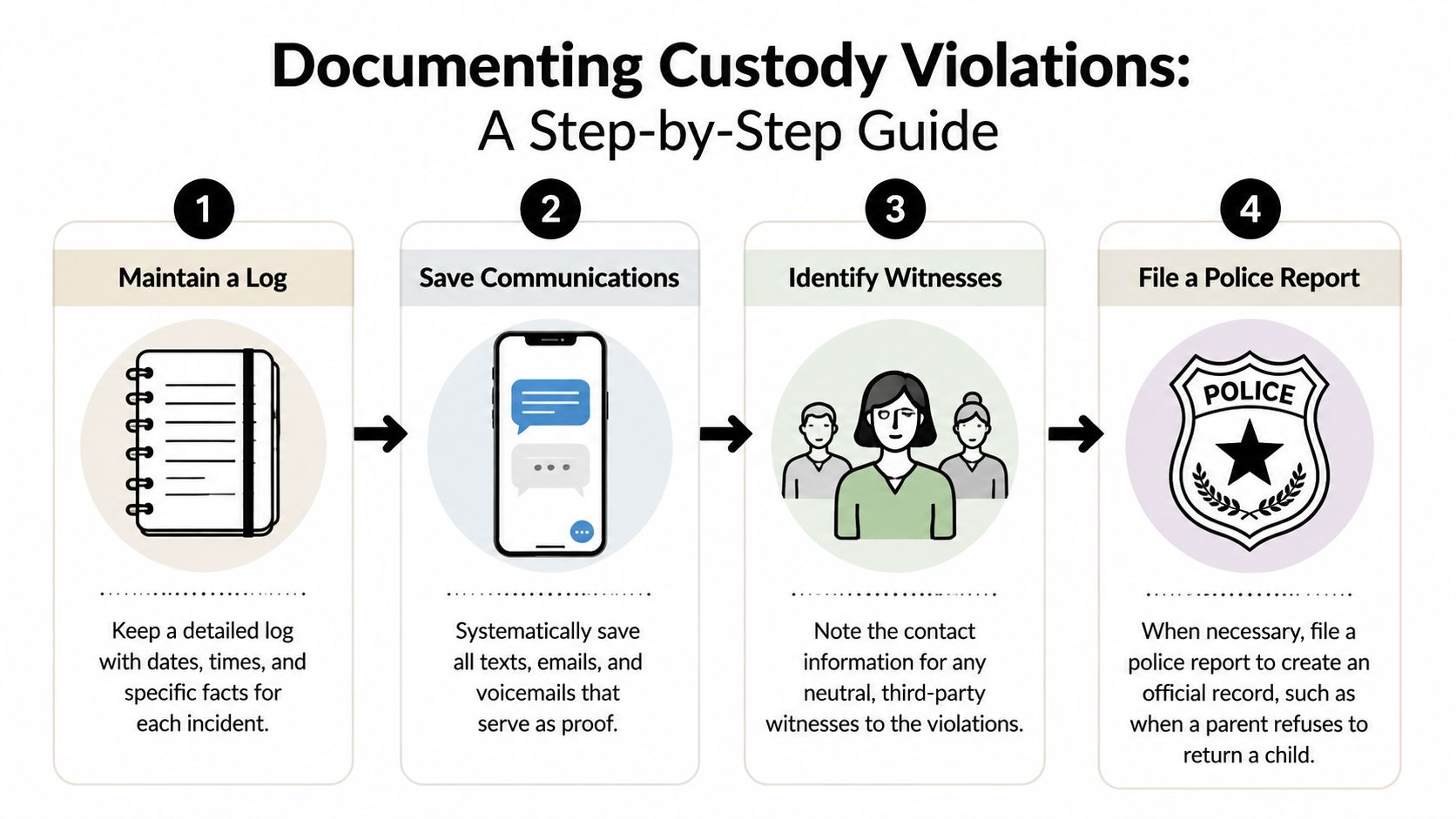
1. Create a Detailed Violation Log
Your first and most important task is to create a detailed, ongoing log of every single violation. This is not a diary for your emotions; it’s a factual record that will serve as your primary evidence.
For every incident, write down:
- Date and Time: Be precise. Note the exact date and scheduled time versus the actual time. Example: “Sunday, October 26, 2026. Scheduled 6:00 PM exchange. The other parent arrived at 8:15 PM.”
- Specific Facts: Stick to objective facts. Instead of, "He was being difficult," write, “He refused to bring our daughter to the agreed-upon exchange point and demanded I drive 45 minutes to his house, which is not what the order says.”
- Impact on the Child: Judges need to see how the behavior affects the child. Briefly note what happened. Example: “Our child was visibly upset and crying, asking why Daddy was so late.”
2. Preserve All Communications as Evidence
So much of our co-parenting communication happens via text and email. You must be systematic about saving every text, email, and voicemail related to the custody order and the violations.
Common Client Misconception: Many people delete angry text messages in a moment of frustration. Do not do this. Every piece of communication is a potential court exhibit. Screenshot everything and back it up to a secure cloud drive or computer folder.
This digital trail creates a timestamped, word-for-word account of your ex's actions and intentions, making it difficult for them to deny their behavior in front of a judge.
3. Identify Neutral Third-Party Witnesses
A violation that only you witnessed can quickly become a "he said, she said" argument. When a neutral third party sees the violation, your case becomes much more compelling.
Think about who else may have seen what happened. Did a teacher know your ex was consistently late for pickup? Did a family friend witness a heated exchange at the exchange point? Did you have to call the police to document an incident? Keep a list of these individuals with their contact information. Their objective testimony can add significant weight to your case.
This infographic gives you a simple, four-step guide to documenting the evidence you'll need before filing a motion.
How to File a Motion to Enforce Your Custody Order in NC
Once you have a solid record of your ex’s violations, it’s time to ask the court to step in. Taking formal legal action is not about retaliation; it’s about asking a North Carolina judge to enforce their own order and protect your child’s right to a stable routine.
The primary tool for this is a Motion for Order to Show Cause, often called a Motion for Contempt. Filing this document officially notifies the court and the other parent that you believe they have willfully violated the custody order and sets the legal process in motion.
The Steps to Initiate Legal Action
Filing a Motion for Contempt is a specific, formal process. While an experienced attorney is best equipped to manage these steps, understanding the process is helpful.
- Drafting the Motion: The motion is a formal legal document that must lay out the specific terms of your original custody order, list the exact violations with dates and details, and clearly state the relief you are requesting from the court.
- Filing with the Clerk of Court: The completed motion is filed with the Clerk of Court in the same North Carolina county where the original custody order was issued. This officially places your case on the court's calendar.
- Serving the Other Parent: Your ex must be legally notified about the motion and the court date through "service of process." This is a critical step; if it isn't done correctly, the entire case can be dismissed.
Ethical Warning: A common mistake is engaging in "self-help" by violating the order yourself (e.g., withholding visitation because child support hasn't been paid). A North Carolina judge will see this as two wrongs. The only proper remedy is through the court, not by taking matters into your own hands. You might find it useful to understand how these initial court orders are created by learning more about a temporary custody order in NC.
What to Expect at the Court Hearing
At the hearing, you and your ex will both get a chance to tell your side of the story. This is where your careful documentation becomes your most powerful tool. You will present your log, text messages, emails, and any witness testimony to prove the violations were willful. Your ex will then have an opportunity to offer a defense. The judge will make a decision based on the evidence and North Carolina law.
When Can Violations Justify a Custody Modification?
While a contempt motion addresses specific violations, you may wonder if a pattern of non-compliance can lead to a permanent change in the custody schedule itself. The answer in North Carolina is yes, but it requires meeting a specific legal standard.
A single, minor violation is unlikely to convince a judge to modify custody. However, when violations become a persistent pattern that negatively affects your child, they can rise to the level of a “substantial change in circumstances.”
The "Substantial Change in Circumstances" Standard
Under North Carolina General Statute § 50-13.7, a judge can only modify a permanent custody order if they find there has been a substantial change in circumstances that affects the child’s welfare. Your ex’s repeated failure to follow the order can absolutely qualify as this kind of change.
Practical Example: If a parent consistently fails to show up for their scheduled weekends, leaving the child disappointed and the other parent scrambling for last-minute care, a judge may see this as creating harmful instability. This pattern demonstrates that the current order is not working and may justify a modification to better serve the child's best interest.
A judge’s primary focus is always the child’s best interests. A pattern of violations is not just an inconvenience to you; it's about the emotional harm and instability it causes your child. The court may see this pattern as proof that the current order is no longer working and a change is necessary.
To succeed with a custody modification in NC, you must show how the violations have created a substantial change harmful to your child. An experienced attorney can help you frame these violations into a compelling legal argument.
FAQ: Common North Carolina Custody Violation Questions
When a custody order is violated, you need straightforward answers grounded in North Carolina law. Here are some of the most common questions our attorneys hear.
1. Can I stop visitation if my ex stops paying child support in NC?
No. This is a critical point and a common misconception. In North Carolina, child custody and child support are entirely separate legal orders. Withholding court-ordered visitation because your ex failed to pay support is also a violation of the court order. A judge will see this as contempt on your part. The correct action is to file a separate motion to enforce the child support order.
2. What happens if the violation involves taking my child out of state?
If your ex takes your child out of North Carolina in violation of the custody order, you must treat it as an emergency. Your North Carolina order is protected across state lines by the Uniform Child Custody Jurisdiction and Enforcement Act (UCCJEA). This law requires other states to recognize and enforce your NC order. Contact an attorney and law enforcement immediately to take swift action to have your child returned.
3. Do I really need a lawyer to file for contempt in North Carolina?
While you can legally represent yourself, enforcing a custody order is complex. The legal process for filing a Motion for Contempt has very strict procedural rules for drafting, filing, and serving the other parent. A simple mistake can get your case dismissed. An experienced family law attorney knows how to build a compelling case, present evidence effectively, and counter the other side's defenses, giving you the best chance of success.
4. Is there a time limit for filing a contempt motion in NC?
While there isn't a strict "statute of limitations" for a contempt motion, waiting too long is a significant strategic mistake. The longer you wait, the more it can appear to a judge that the violation wasn't serious. Acting quickly shows the court that the violation disrupted your child's stability and that you took the matter seriously, strengthening your argument for immediate court intervention.
Take Control: Protect Your Rights and Your Child’s Best Interests in North Carolina
It is incredibly overwhelming when a co-parent ignores a custody order, but you don't have to face this challenge alone. A North Carolina custody order is a binding legal command from a judge—not a friendly suggestion. Violations carry serious legal consequences, and the law gives you clear options to hold the other parent accountable.
Your first line of defense is meticulous documentation. Every missed exchange, late pickup, or broken agreement needs to be logged with dates, times, and objective details. This record is the foundation of any successful enforcement action. With solid proof, you can file a Motion for Contempt and ask a judge to step in and restore order for your child.

Why You Need a North Carolina-Focused Attorney
Navigating the enforcement process without a lawyer is not just difficult—it can actively harm your case. The court system has strict procedural rules, and even a small misstep can have big consequences. An experienced North Carolina family law attorney ensures your motion is filed correctly, your evidence is presented effectively, and your arguments are framed to protect your parental rights. You can learn more about when to hire a custody lawyer in NC to help decide if now is the right time.
At the Law Office of Bryan Fagan, our attorneys are experienced, empathetic advocates for parents across North Carolina. We understand the stress you’re feeling, and we are committed to protecting your rights and your child’s stability. We have specific experience in NC family courts and will develop a clear strategy tailored to your unique situation. We never guarantee an outcome, but we do guarantee our dedicated and professional representation.
If your ex is violating your custody order, don’t wait for things to get worse. Taking swift, strategic action is the best way to safeguard your child's well-being and enforce the court's order.
If you are dealing with a custody order violation in North Carolina, do not wait. Contact the Law Office of Bryan Fagan today for a consultation to discuss your specific situation and learn how we can help. Schedule your consultation now.