A court date for divorce can make even calm, organized people feel unsteady. Most clients don't walk into this process worried about legal vocabulary. They worry about practical things. Will the judge ask me questions? Do I have to tell my whole story in open court? What if my spouse argues with everything? What happens at divorce court hearing in NC is often less dramatic than people fear, but it still matters significantly because the orders entered there can shape your finances, parenting schedule, and property rights.
In North Carolina, there usually isn't just one hearing that handles everything. A case may involve temporary hearings, custody or support hearings, a separate property division trial, and a final hearing for the absolute divorce itself. Some are short and procedural. Others are more formal and evidence-driven. Knowing which kind of hearing you're facing changes how you prepare, how you testify, and what the judge will care about.
Demystifying Your Day in North Carolina Divorce Court
The most common mistake people make is assuming every divorce hearing is a full trial about who caused the marriage to end. In North Carolina, that usually isn't how it works.
A typical example looks like this. A spouse receives a file-stamped complaint and hearing notice, loses sleep for a week, and arrives expecting a long public fight. Then they learn the hearing set that day is only about a narrow issue, such as temporary support, custody scheduling, or the final entry of an absolute divorce. The court is usually focused on the issue on the calendar, not every grievance that built up during the marriage.
What the courtroom often feels like
Most North Carolina family courtrooms move quickly. Dockets are busy. You may wait longer than you speak. When your case is called, the judge will usually expect the lawyers and parties to be organized, concise, and respectful.
That matters emotionally as much as legally. People often expect a chance to say everything they've been holding in for months. Court rarely works that way. The judge isn't there to provide closure. The judge is there to decide a defined legal question based on evidence.
A hearing can feel personal because your life is being discussed. But the judge is listening for proof, dates, documents, and credibility.
The kinds of hearings people see in NC divorce cases
Some hearings are designed to create stability early. Others are designed to resolve a disputed issue. Others are mostly administrative.
Here's a practical way to think about them:
| Hearing type | Main purpose | What the judge usually wants |
|---|---|---|
| Temporary hearing | Short-term stability | Immediate facts, budgets, basic parenting needs |
| Custody or support hearing | Child-focused decision-making | Reliable evidence about the child's needs and each parent's situation |
| Equitable distribution hearing | Division of property and debt | Documents, valuations, classification of assets |
| Absolute divorce hearing | Legal end of the marriage | Proof of statutory requirements |
What helps and what doesn't
What works in court is usually simple:
- Clear documents: pay records, account statements, calendars, messages, and organized exhibits.
- Straight answers: judges notice when a witness answers the question directly.
- Issue discipline: staying focused on the hearing scheduled.
What usually fails:
- Recycling relationship arguments: unfair behavior matters only when it connects to a legal issue before the court.
- Interrupting or reacting visibly: even understandable frustration can hurt credibility.
- Assuming your story speaks for itself: if it isn't supported by testimony or documents, the court may not rely on it.
The First Steps Temporary Hearings for Support and Possession
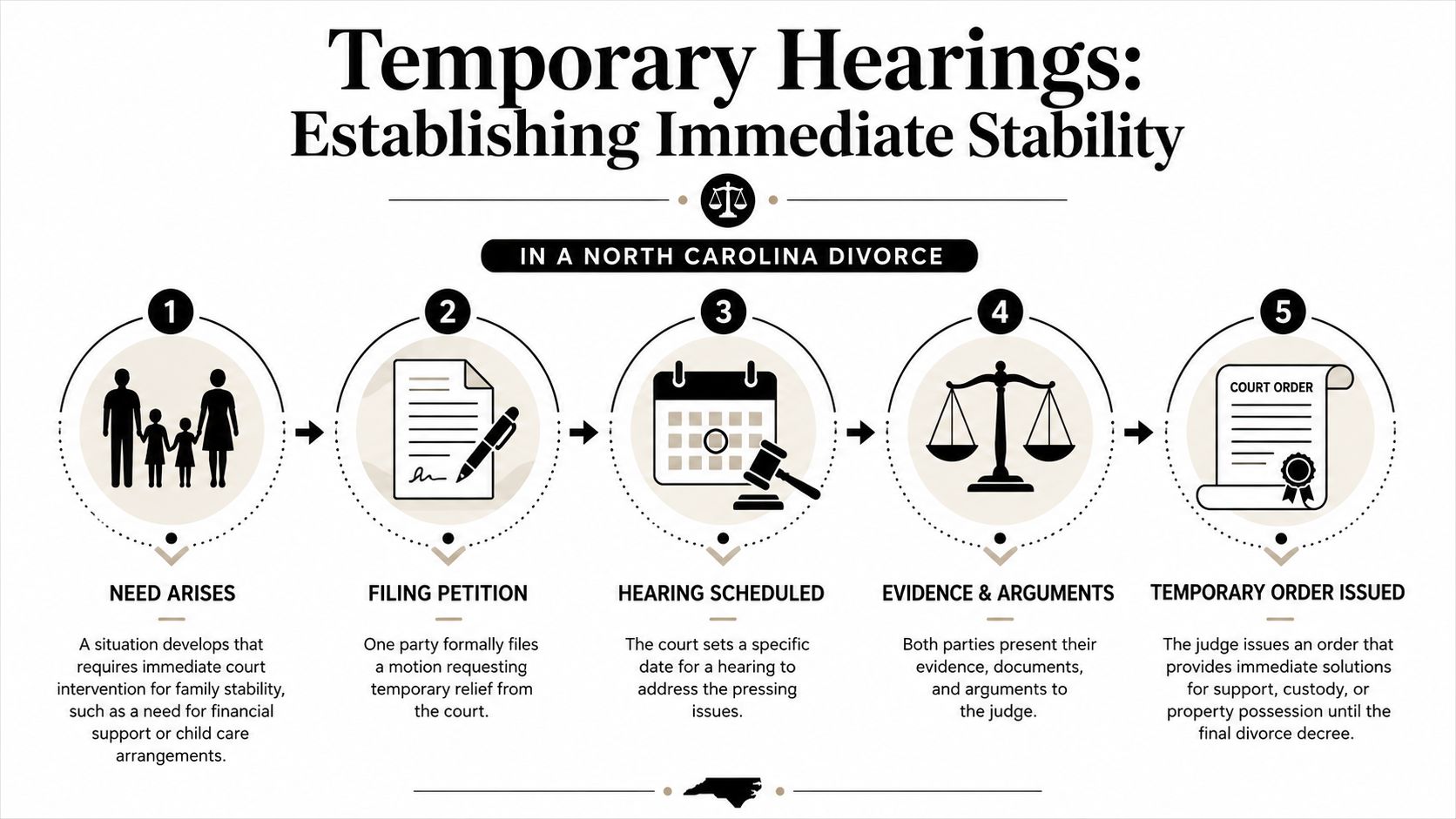
Temporary hearings exist because life doesn't pause while a divorce case moves through court. Mortgage payments still come due. Children still need routines. One spouse may need help paying basic expenses before the final issues are resolved.
In contested cases, these early orders often arrive faster than a final trial. One North Carolina resource notes that temporary orders are often addressed within 30 to 60 days, while the final hearing may follow 2 to 4 months of discovery in a contested case, as explained in this North Carolina divorce timing overview.
What temporary hearings are for
A temporary hearing is about stability, not final victory. The court may address who stays in the home, who pays which bills, whether temporary spousal support should be paid, and what short-term arrangements are necessary until broader issues are decided.
Under North Carolina law, temporary support issues can arise under statutes governing spousal support and related relief, including N.C. Gen. Stat. § 50-16.2A. The judge is not deciding whether one spouse was the better husband or wife in a moral sense. The judge is deciding whether there's a legal basis for temporary relief and what amount or arrangement is appropriate based on the evidence presented.
What you need to bring to a temporary hearing
Temporary hearings are often won or lost on preparation. Clients sometimes think they only need to “tell the judge what happened.” That's rarely enough.
Bring structure to your case:
- Income proof: recent pay stubs, tax records if available, and evidence of other income.
- Monthly expenses: a realistic budget, not an exaggerated one prepared the night before court.
- Household bills: mortgage or rent statements, utilities, insurance, and recurring family expenses.
- Parenting facts: school schedules, childcare arrangements, transportation responsibilities, and medical needs if children are involved.
A practical scenario helps. One spouse may have spent years primarily caring for children while the other handled most of the earned income. After separation, the caregiving spouse may need temporary support to keep housing and necessities in place while the larger claims move forward. That request is stronger when backed by documents showing actual expenses and a credible explanation of current need.
Practical rule: Judges are more persuaded by a clean financial affidavit and supporting records than by a long account of who behaved badly in the marriage.
What the hearing itself looks like
These hearings are usually shorter than people expect. The judge may hear brief testimony, review affidavits and financial materials, listen to argument from counsel, and enter a temporary order.
That order is not the end of the case. It's a stopgap measure designed to keep things functioning.
A temporary order can cover:
- Support while the case is pending
- Use of the home or specific property
- Interim parenting structure if children are involved
What doesn't work is treating a temporary hearing like the final chapter. If you overreach, ask for unsupported amounts, or arrive with incomplete records, you make the judge's job harder and your request weaker.
Navigating Child Custody and Child Support Hearings
When children are involved, the emotional temperature in court rises quickly. Parents don't just hear legal arguments. They hear judgments, or what feels like judgments, about their routines, priorities, and homes. That's why preparation matters even more in custody and support cases.
The court's central concern is the best interests of the child. That phrase can sound vague, but in practice judges look for concrete facts. Who gets the child to school? Who follows through on medical care? Who supports consistency? Who can communicate about the child without turning every exchange into a fight?
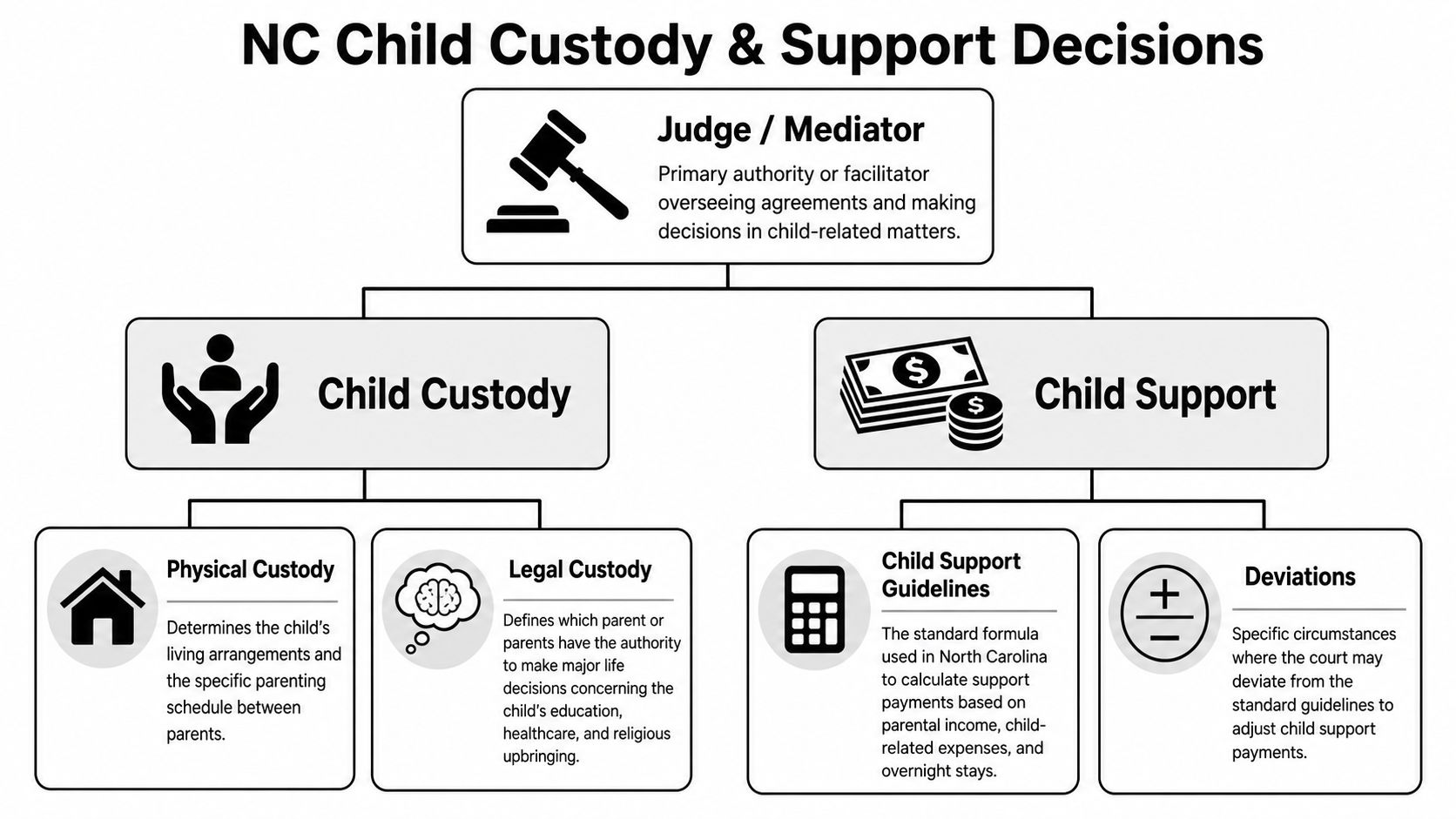
What the judge is looking for in a custody hearing
North Carolina custody hearings are not supposed to be referendums on who is more likable. The judge is weighing the child's needs against the evidence each parent presents.
Useful evidence often includes:
- Living arrangements: where the child sleeps, studies, and spends school nights.
- Parental involvement: who handles homework, activities, appointments, and day-to-day care.
- Stability: consistent routines, reliable transportation, and a workable home environment.
- Co-parenting behavior: each parent's willingness to support the child's relationship with the other parent when appropriate.
A common mistake is making the case entirely about the other parent's flaws. If the testimony sounds like a character attack and doesn't connect back to the child's actual welfare, it usually lands poorly.
A stronger presentation sounds different. A parent might testify that the child has been following the same school-week routine for months, that the current schedule supports homework and therapy appointments, and that exchanges have gone better when they happen at a neutral location. That is useful. It gives the judge something practical to work with.
How child support is usually handled
Child support is more mechanical than custody. North Carolina courts generally use official child support guidelines and worksheets. The inputs matter. So do the documents.
If you're trying to understand the framework, North Carolina child support guidelines are the starting point for how support is calculated and presented. The hearing often turns on income information, child-related expenses, health insurance costs, and the parenting schedule reflected in the worksheets.
Here's the contrast clients need to understand:
| Approach | Usually helps | Usually hurts |
|---|---|---|
| Custody presentation | Child-focused facts and documentation | Personal attacks unrelated to the child |
| Support presentation | Complete financial records and accurate worksheet inputs | Guesswork, missing income data, inflated claims |
What testimony tends to sound credible
Credibility often comes from detail without drama. A parent who says, “I'm always there for my child,” isn't giving the judge much to use. A parent who says, “I handle school pickup on weekdays, I've attended the recent medical appointments, and I can continue the current after-school arrangement,” is giving the judge facts.
The parent who stays child-centered usually presents the stronger case, even when emotions are running high.
If a case is especially tense, the court may hear testimony from both sides, review records, and make decisions that neither parent loves completely. That's normal. Family court often produces structured compromises rather than emotionally satisfying ones.
The Final Divorce Hearing Understanding the Absolute Divorce
You arrive at the courthouse expecting a long, emotional hearing. Then your case is called, you answer a handful of focused questions, and it may be over faster than you expected.

That surprises many spouses. In North Carolina, an absolute divorce hearing is often one of the shortest court appearances in the entire case.
The judge is usually not deciding who was the better spouse or what caused the marriage to break down. The court is deciding whether the legal requirements for ending the marriage have been met. A helpful overview of the North Carolina divorce process explains that the hearing is generally brief because the court is confirming the statutory prerequisites, not hearing a full story about the relationship.
What the judge is actually looking for
At this stage, the hearing is narrow and procedural. The plaintiff has to prove the required facts for absolute divorce, not re-try the marriage.
North Carolina law requires proof of residency and the period of separation. Under this discussion of North Carolina absolute divorce requirements, the court will look for evidence that one spouse met the North Carolina residency requirement before filing and that the parties lived separate and apart long enough to qualify for divorce. The judge will also want to know that service was handled properly and the file is in order.
In practice, the questions are often straightforward:
- Residency: Did one spouse live in North Carolina long enough before the case was filed?
- Separation: Have the parties lived separate and apart for the full statutory period?
- Paperwork: Was the defendant served correctly, and is the case ready for judgment?
That is the lane.
What the hearing usually feels like
Clients often expect a dramatic courtroom moment. Absolute divorce usually feels more administrative than emotional. The legal effect is major, but the hearing itself may be calm, brief, and focused almost entirely on dates, residence, and procedure.
That can feel strange.
For some people, the short hearing is a relief. For others, it feels unsatisfying because there is no public accounting of what happened in the marriage. Both reactions are common. The court's job at this hearing is limited, and judges usually keep everyone within those limits.
What usually does not matter at this hearing
Details about betrayal, constant arguments, or years of resentment usually do not drive the decision on absolute divorce. Those facts may matter in related claims, but they generally do not decide whether the marriage can be legally dissolved.
What can matter, however, is a problem with the separation period or the paperwork. If the separation was interrupted by resuming the marital relationship, or if service was not completed correctly, the hearing can be delayed or the request can fail until the issue is fixed. That is why preparation matters even when the hearing itself is short.
A brief hearing does not mean a casual hearing.
The practical takeaway
The final divorce hearing often closes one chapter without resolving every issue between the spouses. It ends the marriage itself. It does not automatically resolve property division, support, or custody unless those issues were handled separately.
Clients do best when they treat this hearing for what it is. A focused legal checkpoint. If your documents are accurate, your dates are clear, and your testimony stays on the required points, the process is often straightforward.
Here is a short visual primer on the process:
Equitable Distribution The Trial for Dividing Marital Property
For many clients, this is the part of divorce that feels the most personal. You may be sitting in court while someone discusses your house, your retirement, your credit cards, or a business you spent years building. The judge is not looking for the better story. The judge is looking for proof, clear categories, and a workable division supported by the evidence.
North Carolina equitable distribution usually turns on three questions under N.C. Gen. Stat. § 50-20. What is marital property, what is separate property, what is the value, and what division is fair. That sounds orderly on paper. In practice, property cases often become document-heavy and detail-sensitive.
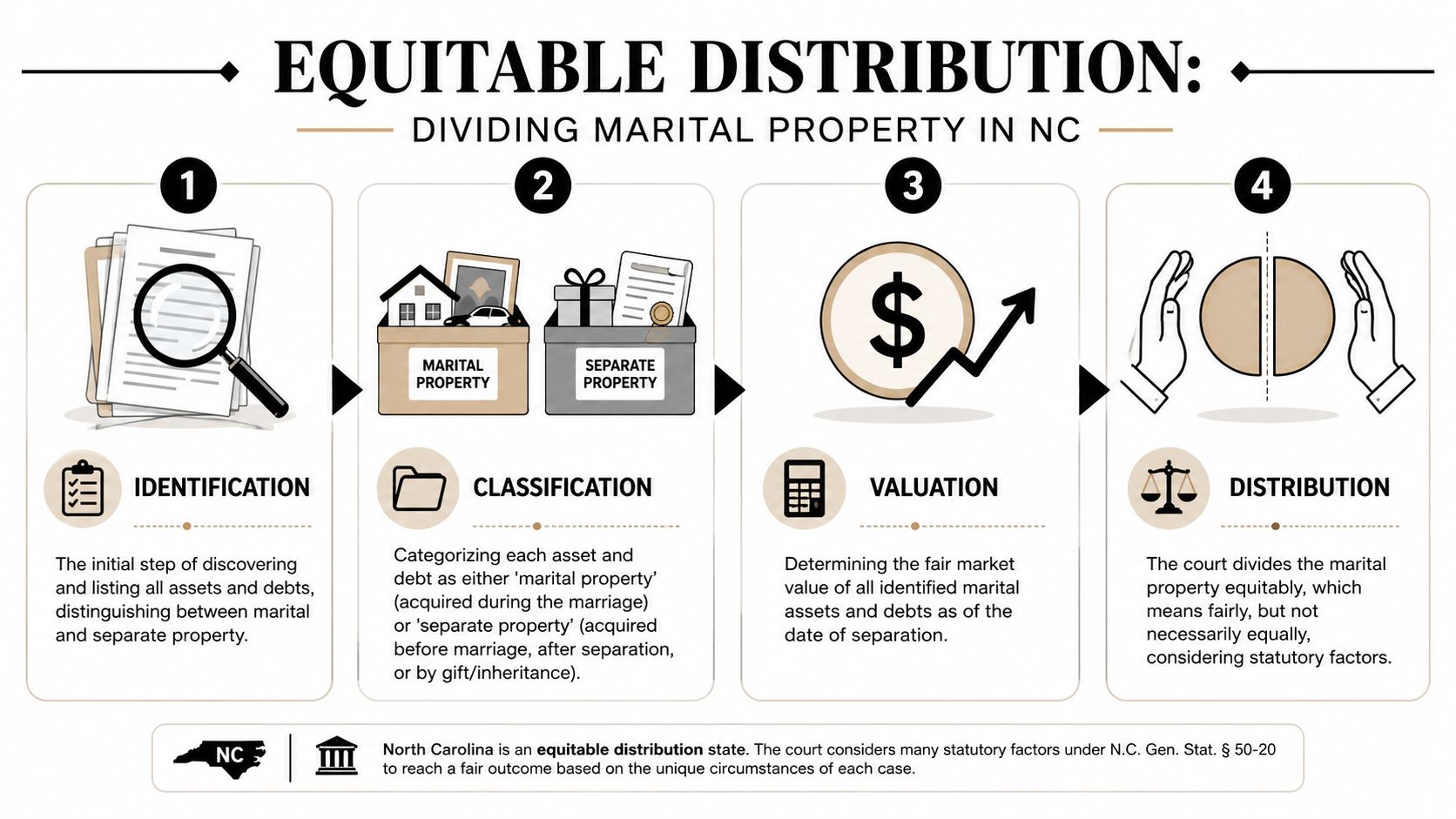
Classify first
The court usually starts by deciding what each asset and debt is. A home bought during the marriage may be marital. An inheritance kept separate may be separate. Some property falls into a mixed category and requires tracing, especially when marital funds and separate funds were both used over time.
That same analysis applies to debt. Judges often have to sort out whether a balance was incurred for the marriage, for one spouse's separate purpose, or after separation.
If you want a broader explanation of the framework, this guide to equitable distribution in North Carolina explains how these claims are handled.
Then value the assets and debts
Once the court knows what it is dealing with, the next fight is often value. At this point, cases can slow down. Bank records, retirement statements, deeds, tax returns, loan documents, and appraisals carry far more weight than guesses from either spouse.
A typical dispute may involve the marital home, a 401(k), a vehicle, and credit card debt. If one spouse says the house is worth far more than the other claims, an appraisal may matter. If a retirement account includes contributions made before marriage, statements from the right time period matter. If a spouse owns a business, valuation can become much more expensive and much more contested.
Property trials are often decided by paper. Good records give the judge something solid to rely on.
Then distribute fairly
After classification and valuation, the court decides what division is equitable. Equal is often the starting point, but it is not always the ending point. One spouse may keep the house and offset that value with retirement funds or other assets. Debt may be assigned unevenly if the evidence supports it. In some cases, a sale is the only practical answer.
Clients are often surprised by how long this part can take. The divorce itself may already be finished, but the property case can continue through mediation, expert review, pretrial preparation, and trial settings. That delay is frustrating, but it is common in contested property cases because the court cannot divide assets fairly without a reliable record.
Why preparation changes the outcome
Judges want organized proof, not broad complaints about fairness. The spouse who can show dates of acquisition, account balances, loan histories, and the source of funds usually has the stronger position.
Helpful preparation often includes:
- account tracing for assets that may be partly separate and partly marital
- deed, title, and statement review for real estate, vehicles, loans, and investment accounts
- retirement records that show balances at marriage, separation, and relevant contribution periods
- a clear pretrial outline of what is agreed, what is disputed, and what evidence supports each position
The Law Office of Bryan Fagan handles North Carolina family law matters that include divorce and property division, and a firm in that position can help gather documents, narrow the disputed issues, and prepare for mediation or trial. That work matters because judges can only divide what is properly identified, valued, and proved in court.
Frequently Asked Questions About NC Divorce Hearings
Clients usually ask the same practical questions before court. Those concerns are reasonable. Court has rules, but it also has human dynamics, and both matter.
What should I wear to divorce court in NC
Dress like you're appearing for serious business. Clean, conservative clothing is usually the safest choice. You don't need expensive clothes, but you do want to look respectful and prepared.
It generally means avoiding clothing that is overly casual, distracting, or confrontational. If you're unsure, ask your lawyer before the hearing.
Do I have to speak to the judge myself
Sometimes yes, sometimes no. In some hearings, your lawyer may handle most of the presentation and argument. In others, especially when facts are disputed, you may need to testify under oath.
If you testify, answer only the question asked. Don't argue with opposing counsel. Don't volunteer extra information unless your lawyer asks for it on redirect.
Can my divorce be granted if my spouse doesn't show up
It can happen, but only if the legal requirements have been satisfied and the court has proper proof. In some situations, a defendant's failure to answer or appear can allow the court to proceed by default after the necessary statutory elements are established.
That does not mean the court skips procedure. Service, timing, and proof still matter.
How common are divorce hearings in North Carolina
North Carolina courts handle a significant number of divorce-related matters. One statewide source reports a divorce rate of 3.2 divorces per 1,000 people, ranks North Carolina 18th in the nation, and notes that the reported national average was 2.7 per 1,000. The same source also says the state's rate declined from 5.1 divorces per 1,000 people in 2000 to 3.2 per 1,000 in more recent data, according to North Carolina divorce statistics compiled here.
Will the judge care that my spouse was unfair to me
Only if the unfair conduct is legally relevant to the issue being heard. That is the key point many people miss.
A custody hearing is about the child. A support hearing is about financial facts and legal standards. A property hearing is about classification, value, and equitable distribution. A final absolute divorce hearing is usually about statutory proof. Matching your evidence to the actual issue before the court is one of the smartest things you can do.
Protecting Your Future with a North Carolina Divorce Attorney
A North Carolina divorce hearing is rarely just a date on the calendar. It's the point where your documents, testimony, and legal strategy are tested in a formal setting. Temporary hearings can affect immediate stability. Custody hearings can shape your parenting life. Property trials can determine how major assets and debts are handled. Even the briefest hearing can carry lasting consequences if the paperwork or proof is off.
That's why preparation matters. A lawyer's role isn't limited to speaking in court. Good counsel helps identify what issue is being decided, what evidence belongs in front of the judge, what should be left out, and how to avoid preventable mistakes under North Carolina procedure.
If you're facing a divorce hearing in North Carolina, get legal advice specific to your county, your facts, and the claims in your case.
If you're preparing for a divorce, custody, support, or property hearing in North Carolina, schedule a consultation with Law Office of Bryan Fagan. A focused case review can help you understand what hearing is coming next, what the judge is likely to expect, and how to prepare in a way that protects your rights and your future.