
If you're trying to calculate child support and your children don't all live in the same home, you may already have run into one of the most confusing parts of North Carolina family law. Parents often assume that if custody is “split,” Worksheet C must apply. That isn't always true.
In practice, worksheet c child support nc split custody scenarios turn on details that seem small but matter a great deal in court. Which child lives primarily with which parent. How many overnights each parent has. Whether the schedule is formal, informal, temporary, or written into an order. Those details decide which worksheet the court expects to see.
A wrong worksheet can produce the wrong support number from the start. That leads to arguments, delays, and sometimes an order that has to be corrected later. If you understand when Worksheet C applies, what financial information belongs on it, and where parents usually make mistakes, you'll be in a much better position to protect yourself and your children.
When to Use NC Child Support Worksheet C for Split Custody
A common situation looks like this. Two parents have more than one child together. After separation, one child mainly lives with one parent, and another child mainly lives with the other parent. Both parents think that sounds like “shared custody,” but North Carolina treats that arrangement differently.

Under North Carolina child support rules, Worksheet C is for split custody, not a parenting plan that feels divided. The distinction matters. According to North Carolina child support worksheet guidance on overnight thresholds and worksheet selection, the primary physical custody threshold is 243 overnights annually, while shared custody requires at least 123 overnights per parent, and Worksheet C applies only when primary physical custody of two or more children is split between the parents, with each parent having sole custody of at least one child.
Physical custody controls, not legal custody labels
Many parents get tripped up by the words in their custody order. They may share legal custody and assume that means a shared custody worksheet applies. It doesn't.
For child support purposes, physical custody means overnight allocation. The court looks at where each child sleeps over the course of the year. If the children are divided between homes, Worksheet C may fit. If both parents share time with the same child or children, a different worksheet may be required.
Practical rule: Start with the overnight schedule for each child, not the title of the custody arrangement.
The basic worksheet choice in North Carolina
Here is a simplified explanation:
- Worksheet A applies when one parent has custody of all children and the other parent has fewer than 123 overnights per year.
- Worksheet B applies when both parents share custody of the same child or children and each parent has at least 123 overnights.
- Worksheet C applies when different children primarily live with different parents.
That last point is where people often go wrong. If one parent has Child 1 most of the time and the other parent has Child 2 most of the time, that is the type of arrangement Worksheet C is designed to address. If both children split time between both homes, even if the schedule is uneven, the analysis changes.
Why the correct worksheet matters so much
Worksheet selection isn't a paperwork technicality. It drives the formula the court uses. If you choose the wrong form, the support amount can be off before anyone even argues about income, insurance, or child care.
That's why the first question in any split custody case should be simple and specific: Which parent has primary physical custody of each child based on actual overnights? Once that answer is clear, the worksheet choice usually becomes much easier.
Gathering the Necessary Financial Information
Before anyone starts entering numbers, gather the documents. That sounds basic, but incomplete paperwork is one of the biggest reasons parents miscalculate support. A worksheet is only as reliable as the financial information behind it.
If you're preparing for mediation, settlement talks, or court, organize your records the way a judge or lawyer would want to review them. A good starting point is this overview of how child support is calculated in North Carolina, then build your Worksheet C file from there.
What gross monthly income usually includes
In North Carolina, the worksheet starts with gross monthly income. For many people, that means more than base salary. If your pay fluctuates, or if the other parent is paid in a less straightforward way, this step needs care.
Gather records that show:
- Regular wages or salary from employment
- Bonuses or commissions if they are part of ordinary compensation
- Self-employment earnings supported by business records, tax returns, and profit-and-loss statements
- Other recurring income that appears in reliable financial records
If you're self-employed, don't rely on memory or rough estimates. Courts want documentation. Bank statements, business ledgers, tax returns, and year-to-date income summaries often matter more than a parent's verbal explanation.
Expenses that can affect the worksheet
Worksheet C isn't just about income. It also depends on child-related costs that may be allocated or credited.
Collect proof of:
- Work-related child care costs such as daycare or after-school care
- Health insurance premiums for the children only
- Extraordinary expenses if they are part of the case, such as special educational or medical costs
- Existing support obligations if a parent is already paying support in another matter and the worksheet allows that information to be considered
Don't lump everything together. Separate the child's share from the parent's share. For example, if health insurance covers the whole family, identify the portion attributable to the children if the available records allow you to do so clearly.
Keep the backup documents with the worksheet. If the other parent questions a number, you'll want to show where it came from immediately.
A practical document checklist
When I prepare a split custody support file, I want to see organized proof, not a stack of unrelated papers. A useful checklist includes:
| Document | Why it matters | Common problem |
|---|---|---|
| Recent pay stubs | Shows current earnings | Overtime or bonuses left out |
| Recent tax returns | Helps confirm income pattern | Parents rely on old returns only |
| Child care invoices | Supports work-related costs | Informal cash payments with no proof |
| Health insurance records | Identifies children's premium cost | Family plan total listed without child portion |
| Business records | Important in self-employment cases | Gross revenue confused with income |
| Court orders in other cases | May affect support analysis | Parents forget prior obligations |
What works and what doesn't
What works is consistency. Use the same time frame across your records where possible. If you use monthly pay information for one parent, don't compare it to an annual estimate for the other without converting it carefully.
What doesn't work is guessing. Parents often round numbers, use take-home pay instead of gross income, or submit child-related expenses without receipts or statements. That creates avoidable disputes and weakens your credibility.
A Step-by-Step Guide to Completing Worksheet C
A common split-custody problem looks like this. One child primarily lives with one parent, two live with the other, both parents pay household expenses directly, and each parent assumes the worksheet will be simple until the numbers start offsetting each other in ways that do not feel intuitive. Completing Worksheet C is a sequential process, and it helps to understand what each line is trying to measure before you start writing in figures.
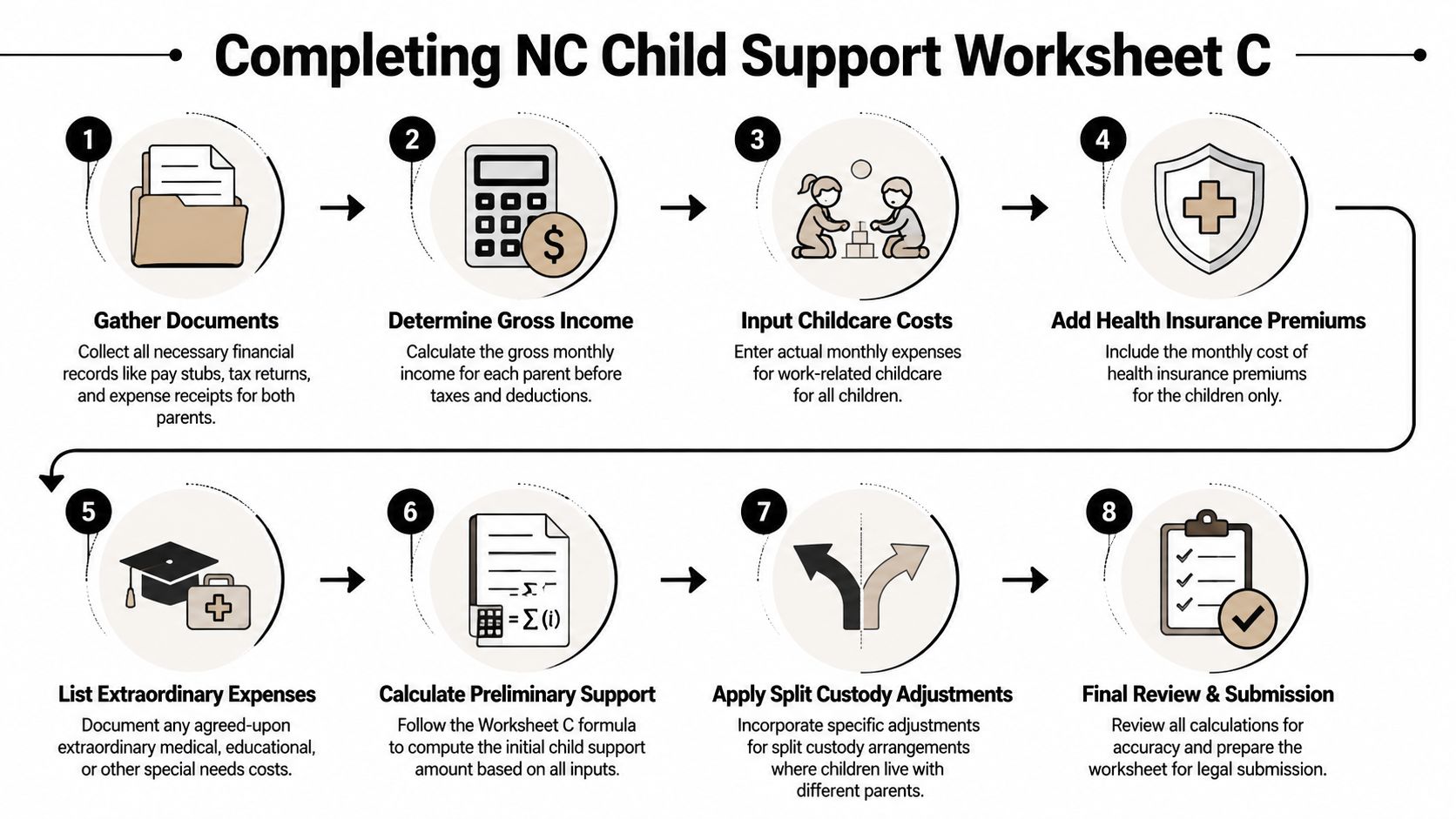
North Carolina's split-custody method is summarized well in Custody X Change's discussion of North Carolina child support calculations. The basic approach is to determine each parent's gross income, find the combined support obligation from the schedule, assign that obligation based on how many children primarily live with each parent, cross-multiply using the other parent's income percentage, and then offset the two amounts. If you have handled shared custody before, do not assume the math works the same way here. Worksheet B child support in NC follows a different method.
Step one, determine each parent's gross monthly income
Start with gross income, not take-home pay. Use the monthly gross figure for each parent, then add those numbers together.
This line drives the rest of the worksheet because the North Carolina child support schedule is based on combined gross income and the number of children. If one parent uses salary only and leaves out recurring commissions, bonuses, overtime, or self-employment income, the entire calculation shifts.
Step two, find the combined basic support obligation
Once you have the combined monthly income, use the North Carolina schedule to find the basic support obligation for the total number of children covered by the case.
Parents sometimes make a practical mistake here. They look up the number of children in each home instead of the total number of children subject to the order. Worksheet C starts with the full child count, then divides responsibility based on where the children primarily live.
Step three, identify which children belong on each side of the split
This is the point where many Worksheet C errors begin. The form is built for split custody, meaning one or more children primarily live with one parent and one or more different children primarily live with the other parent.
Count carefully. If two children primarily live with Mother and one primarily lives with Father, the worksheet allocates the base obligation by that split. If the same children spend substantial time in both homes instead, you may be using the wrong worksheet.
Before finishing the math, confirm that the custody arrangement is actually split custody under North Carolina practice and not a shared-custody schedule being forced into the wrong form.
Step four, allocate the basic support obligation by the number of children in each home
After you identify how many children primarily live with each parent, assign each parent the corresponding fraction of the basic support obligation.
For example, if there are three children total and one parent has one child while the other has two, the worksheet divides the base amount into one-third and two-thirds shares. This step reflects the direct day-to-day support each parent is already providing in that household.
Step five, calculate each parent's percentage share of income
Next, determine what percentage of the combined income each parent earns. One parent may earn less but still have primary custody of more children. Another may earn more and still receive support because of the way the offset works.
That result often surprises parents. Worksheet C is not a headcount exercise. It blends custody placement with income responsibility.
Step six, cross-multiply using the other parent's income share
This is the line clients question most often. Each parent's allocated child-support amount is multiplied by the other parent's percentage of income, not by that parent's own percentage.
The reason is practical. Worksheet C is measuring what each parent would owe toward the children living in the other home. If you reverse that step, the final number will be wrong even if every earlier figure was correct.
Step seven, subtract the smaller obligation from the larger one
Once both cross-multiplied amounts are entered, subtract the smaller from the larger. The parent with the higher resulting figure pays the difference.
That offset matters because both parents are already covering housing, food, utilities, transportation, and routine expenses for at least one child. Worksheet C does not treat either side as if only one home is carrying the daily cost of raising children.
Worksheet C sample calculation
| Calculation Step | Parent A | Parent B | Combined / Notes |
|---|---|---|---|
| Gross monthly income | Parent-specific input | Parent-specific input | Add both incomes together |
| Basic support obligation from schedule | Use the NC schedule for the total number of children | ||
| Proportion of children in sole custody | Based on actual split | Based on actual split | Example: 1 child with one parent, 2 with the other |
| Basic obligation allocated by child proportion | Calculated from schedule amount | Calculated from schedule amount | Divide the base obligation by child placement |
| Income share | Based on combined income | Based on combined income | Convert each parent's income to a percentage |
| Cross-multiplied amount owed | Multiply by other parent's income share | Multiply by other parent's income share | This is the line many parents reverse |
| Net monthly payment | Subtract the smaller amount from the larger |
Where additions and adjustments come in
The base calculation is only part of the worksheet. Work-related child care, health insurance premiums for the children, and other allowable adjustments can change the final number, and they often change it more than parents expect.
I see the same problems repeatedly. Parents use the full family health premium instead of the child-only portion. They estimate child care from memory rather than invoices. They enter a number that made sense six months ago, even though the job, insurance plan, or daycare arrangement has changed.
What this calculation is trying to accomplish
Worksheet C balances two facts that exist at the same time. Each parent is directly supporting at least one child in that parent's home. Income still matters because North Carolina does not calculate support based only on where the children sleep.
That is also why split custody does not use the shared-custody multiplier. The structure is different. The children are divided between homes, and the worksheet offsets what each parent would owe for the children living primarily with the other parent.
Navigating Different Split Custody Scenarios
Parents rarely live inside a perfect worksheet example. Families have three children, uneven schedules, informal arrangements, and changing incomes. The legal question stays the same, but the practical outcome depends on how the facts line up.

One parent has two children and the other has one
This is the classic Worksheet C fact pattern. Parents often understand it more easily once they stop thinking in terms of “equal parenting” and start thinking in terms of which child lives primarily where.
If three children are involved and two primarily live with one parent while one primarily lives with the other, the worksheet allocates the baseline support obligation by that split. The parent with the higher income may still owe support even if that parent has primary custody of more children. Income and custody structure both matter.
The schedule is informal and nobody has tracked nights carefully
Complications often arise at this stage. Many parents tell me they've been “doing split custody for months,” but they haven't counted overnights by child, and there is no detailed written order.
That can create a serious worksheet problem. According to The Law Corner's discussion of child support and Worksheet C confusion, a major ambiguity is the definition of primary physical custody per child, and parents often assume split custody applies in informal arrangements without meeting the implied overnight thresholds. That source notes that misapplication can lead courts to use a different worksheet and may cause a 15% or greater variance in support.
Informal parenting routines often feel settled to the parents long before they are clear enough for a court worksheet.
One child's arrangement looks split, but another child is truly shared
Some families don't fit neatly into one category. One child may primarily live with one parent, while another child rotates more evenly between both homes. That doesn't automatically mean Worksheet C applies cleanly across the board.
When that happens, worksheet selection becomes more technical. The overnight count for each child matters, and sometimes the legal answer is not what the parents expected. If you're comparing split custody to a shared arrangement, this explanation of Worksheet B child support in North Carolina with examples can help clarify why similar-sounding schedules may produce very different analyses.
One child ages out or the family structure changes
A split custody order is not static. If one child reaches the point where support is no longer owed, or the living arrangement changes, the worksheet may need to be recalculated.
That is especially important in larger families. A three-child split can become a two-child case with a completely different structure. Once that happens, parents shouldn't assume the old support amount still makes sense. The underlying math changes because the number of children and their placement changed.
Common Mistakes to Avoid on Worksheet C
Most Worksheet C errors are not math errors. They are classification errors, proof problems, and assumptions that never should have made it onto the form in the first place.

Using Worksheet C because the arrangement feels fair
Parents often choose Worksheet C because each parent has “some custody” of the children. That isn't enough. The issue is whether different children primarily live with different parents in a way that matches the split custody framework.
If the same child spends substantial time in both homes, you may be dealing with a shared custody analysis instead. A fair-sounding label won't fix a wrong worksheet.
Counting legal custody instead of overnights
Joint legal custody is common. It also doesn't answer the worksheet question. What matters is physical custody reflected by actual overnights.
This mistake usually shows up when parents bring in an order that says “joint custody” but the parenting schedule tells a more detailed story. The court will care about the schedule.
Using estimates for income when records exist
This is especially risky in cases involving commissions, bonuses, cash-based work, or self-employment. Parents sometimes write down what they think they make rather than what the documents support.
That approach creates two problems. The number may be wrong, and the court may view the presentation as unreliable. If you have pay records, tax returns, or business documents, use them.
Forgetting child-specific expenses or mislabeling them
Health insurance, child care, and extraordinary expenses can materially affect the final worksheet. But only if they are entered correctly and supported.
Common errors include:
- Using total family health insurance cost instead of the children's portion
- Including voluntary extras without proof that they belong in the calculation
- Claiming child care that isn't work-related when the worksheet requires a closer link to employment
Client warning: A support worksheet often looks simple after it's completed. The hard part is deciding which facts actually belong on it.
Treating the guideline number as untouchable
A worksheet result is important, but it is still part of a legal process. In some cases, a parent may argue that the guideline result should not control. In others, the primary dispute is over the facts that feed the worksheet, not the formula itself.
That's why accuracy on the front end matters so much. If the schedule, incomes, or overnight allocations are contested, the number on the page may not be the number the court ultimately accepts.
Frequently Asked Questions About NC Split Custody Support
Does Worksheet C apply if we have joint legal custody
Not by itself. Legal custody and physical custody are different concepts. Worksheet C depends on where each child primarily lives, not whether both parents share decision-making authority.
Do I still need a worksheet if we already agreed on support
Usually, yes, or at least you should expect the agreement to be reviewed against North Carolina child support rules if it will become part of a court order. A private agreement that ignores the proper worksheet can create enforcement problems later.
What if our schedule changed after the order was entered
A changed custody arrangement can justify revisiting child support. The same is true if income changed materially or one of the child-related expense categories changed in a meaningful way. The key issue is whether the existing order still reflects the present facts.
Can the court depart from the worksheet result
In some cases, yes. The worksheet is the starting point under the North Carolina guidelines, but a court may consider whether the guideline amount is appropriate under the facts of the case. That doesn't mean a deviation is automatic. It means the worksheet is powerful, but it is not the end of the legal analysis in every case.
Does split custody decide who gets tax benefits for the children
Not automatically. Child support and tax dependency issues often relate to the same children, but they are not the same legal question. Parents should deal with tax allocation clearly in a court order or agreement rather than assuming it follows whoever receives or pays support.
When You Need a North Carolina Family Law Attorney
Some parents can complete the basic worksheet process on their own. Many can't, especially when the schedule is disputed, income is irregular, or one parent is presenting numbers that don't match the documents.
You should strongly consider legal help if any of these apply:
- The overnight schedule is unclear and you're not sure whether Worksheet A, B, or C fits
- One parent is self-employed or controls a business
- The support figure changes sharply depending on which worksheet is used
- The other parent is asking the court to deviate from the guideline amount
- You need an existing order changed because custody, income, or expenses are no longer the same
A modification case deserves particular care because the old number may look official even when it no longer matches the family's reality. If that is your situation, review how child support modification works in North Carolina before assuming the current order will stay in place.
The worksheet is a tool. Applying it correctly is the legal work. In split custody cases, small factual mistakes can change the result in a way that follows your family for a long time.
North Carolina parents dealing with split custody, child support disputes, or post-separation changes can schedule a consultation with the Law Office of Bryan Fagan. If you need help identifying the correct worksheet, organizing financial records, or addressing a contested support issue, the firm can review your situation and discuss practical next steps under North Carolina law.