You've worked out a shared custody schedule. The children are sleeping at both homes regularly. Then the next question lands hard: Who pays child support, and how is that number calculated in North Carolina?
For many parents, the process starts to feel less like family law and more like accounting at this stage. That reaction is normal. A custody order can look balanced on paper, yet child support may still flow from one parent to the other. In North Carolina, that usually comes down to which worksheet applies and whether your schedule qualifies for Worksheet B.
Shared custody cases often turn on details that seem small until they affect support. One overnight can matter. So can how income is counted, who pays health insurance, and whether work-related child care is documented correctly. If you're trying to understand worksheet b child support nc explained with examples, the right place to start is the worksheet itself and the custody rule that triggers it.
Navigating Shared Custody and Child Support in North Carolina
A common situation looks like this. Parents finalize a schedule that feels close to equal. One parent has the children several school nights, the other has alternating weekends plus extended summer time, and both are covering groceries, clothes, transportation, and routine day-to-day costs. It feels like support should either be low or disappear altogether.
That's not always how North Carolina treats it.

North Carolina uses child support guidelines and different worksheets depending on the actual custody arrangement. In shared custody cases, the key form is Worksheet B. If you're trying to understand how courts look at support when both parents have substantial time, this overview of how child support is calculated with shared custody in NC is a useful companion to the rules discussed here.
Why shared custody still can mean one parent pays support
Parents are often surprised by this. Shared custody does not automatically mean no support is owed. The worksheet assumes both parents are spending money directly during their parenting time, but it also compares incomes and certain child-related expenses to reach a presumptive amount.
Shared custody changes the formula. It doesn't erase the child support obligation.
That distinction matters emotionally and financially. Many disputes start because one parent thinks, “We have the kids half the time, so nobody should pay.” North Carolina's guidelines don't work that way. They try to account for both parenting time and the difference in each parent's resources.
The first question to ask
Before anyone starts plugging in numbers, ask one thing first: Does the custody schedule qualify for Worksheet B?
If the answer is yes, the support calculation follows the shared custody model. If the answer is no, using the wrong worksheet can skew the result sharply. That's why the overnight count is often the first place attorneys, mediators, and judges focus.
Choosing the Right Form Worksheet B vs Worksheets A and C
A parent walks into my office with a calendar, a proposed custody schedule, and a child support estimate pulled from the internet. The income numbers are fine. The problem is the wrong worksheet. In North Carolina, that mistake can change support by hundreds of dollars a month before anyone argues about daycare, health insurance, or other adjustments.
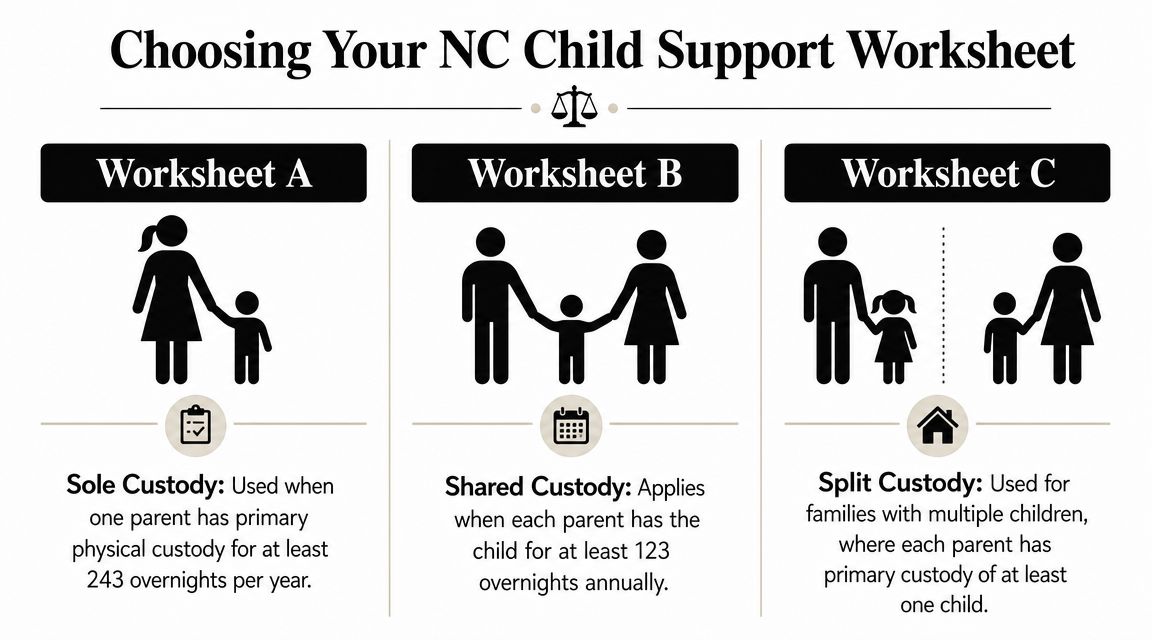
North Carolina uses three child support worksheets, and the right one depends on the actual custody structure. Worksheet A fits primary custody cases. Worksheet B applies in shared custody cases where each parent has at least 123 overnights a year. Worksheet C is for split custody, where each parent has primary custody of at least one child from the same family.
If you want a side-by-side look at the primary custody form, this guide on Worksheet A child support in NC and who uses it shows why a case can produce a very different result under Worksheet A than under Worksheet B.
Worksheet A for primary custody
Worksheet A usually applies when one parent has the children for most of the year and the other parent does not reach the shared-custody threshold. In practice, this is the form courts use in the more traditional arrangement where one home handles most overnight care, school-night logistics, meals, transportation, and routine household costs.
Parents sometimes focus on labels such as "joint custody" or "50/50 in principle." Those labels do not control the worksheet. The overnight schedule does.
Worksheet B for shared custody
Worksheet B is the form that gets the most attention in contested custody cases because the 123-night threshold can become a strategic fault line. A parent with 122 overnights is generally outside Worksheet B. A parent with 123 overnights may qualify for the shared-custody formula.
That single-night difference matters more than many parents expect.
I often tell clients to slow down here and count carefully. Do not rely on rough impressions like "almost equal" or "close enough." Count the actual annual overnights under the existing order, the temporary order, or the proposed parenting plan. If the schedule rotates, map it across a full year. If holidays and summer weeks shift the count, include them. Small calendar details can decide the worksheet, and the worksheet can drive the support result.
This is also where negotiation strategy enters the picture. Sometimes a proposed schedule is not really about parenting convenience alone. It is also about crossing, or staying below, the 123-night mark. That does not make the request improper, but it does mean the financial effect should be evaluated thoroughly.
Worksheet C for split custody
Worksheet C serves a narrower purpose. It applies when the children are divided between households, such as when one parent has primary custody of one child and the other parent has primary custody of another. It is not the form for "partly shared" custody, and it is not a backup choice for a case that misses Worksheet B by a few nights.
Why the worksheet choice matters
The worksheet choice sets the formula the court will use. That formula can change the outcome significantly even if the parents' incomes stay the same.
Worksheet B generally reflects two ideas at once. Each parent is paying some direct child-related costs during that parent's custodial time, and the parents may have unequal incomes. Worksheet A, by contrast, starts from a primary-custody model. Worksheet C addresses a different household structure altogether.
For that reason, I do not treat worksheet selection as a paperwork issue. I treat it as an early legal issue. If the wrong worksheet is used, every number that follows may look precise while still pointing to the wrong support amount.
A practical way to choose
Use this framework before running any calculation:
| Custody arrangement | Likely worksheet |
|---|---|
| One parent has the children most of the year | Worksheet A |
| Each parent has at least 123 overnights | Worksheet B |
| Each parent has primary custody of different children | Worksheet C |
Common points of confusion
Several misunderstandings come up repeatedly in North Carolina support cases:
- "We share legal custody." Legal custody does not decide the worksheet. Overnights and physical custody do.
- "Our time is nearly equal." Nearly equal is not a guideline category. The yearly overnight count is what matters.
- "If we split time, nobody should pay support." Shared custody can still produce a payment, especially when one parent earns more or pays more of certain child-related expenses.
- "Worksheet C works if Worksheet B is close but not quite right." It does not. Worksheet C is for split custody involving different children in different primary homes.
The practical takeaway is simple. Before arguing about line items, confirm the custody pattern, count the overnights, and make sure the form matches the family's actual arrangement. That is the foundation for every Worksheet B example that follows.
How to Complete NC Child Support Worksheet B Step by Step
The official form can feel dense at first glance. It becomes more manageable when you treat it as a sequence. Income goes in first, then adjustments, then child-related expenses, then the overnight-based shared custody calculation.
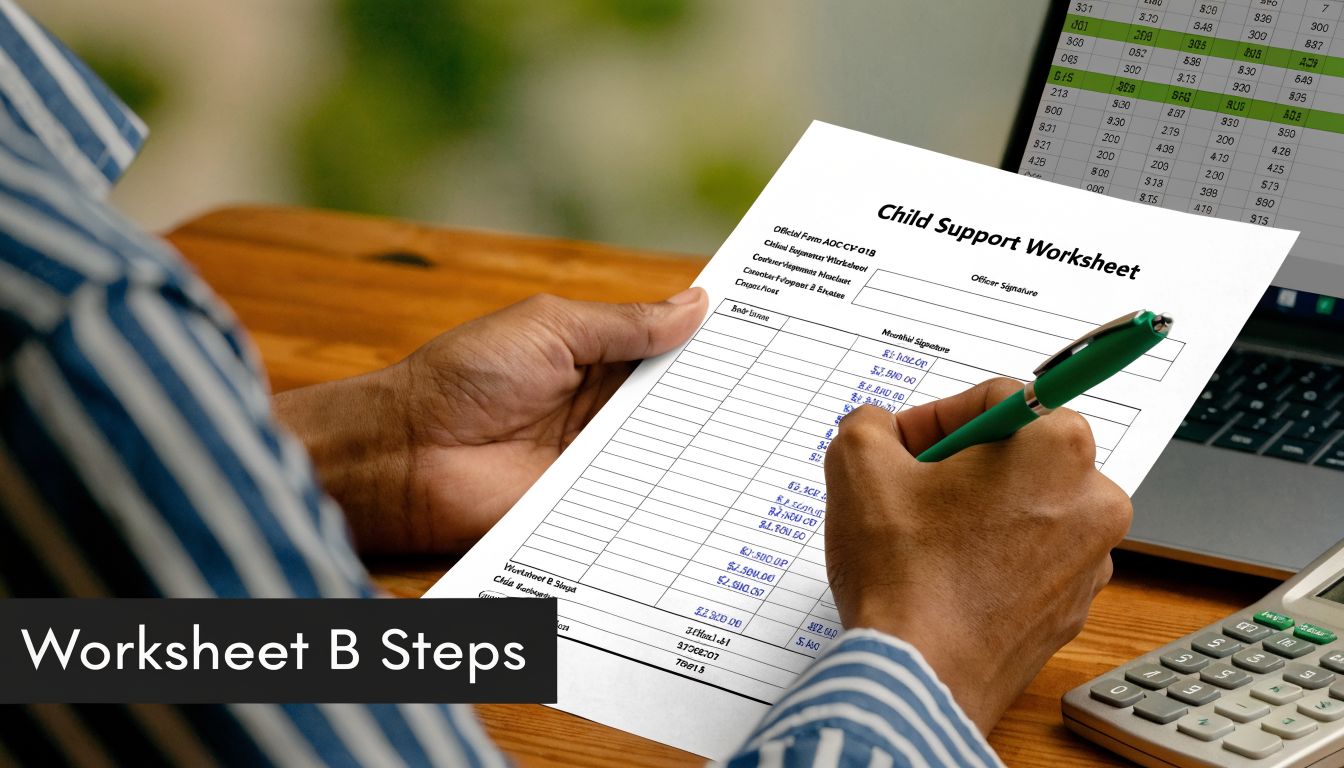
If you want to compare your entries against the official format, this overview of the NC child support worksheet can help you stay oriented while you review the form.
Start with gross monthly income
The worksheet begins with each parent's gross monthly income. In plain English, that means the income figure the court will use before the worksheet applies the guideline formula.
For salaried employees, this is often the easiest part. For parents with commissions, overtime, bonuses, fluctuating work, or self-employment income, this is usually where disputes begin. Accuracy matters because every later line builds on this one.
What works here is documentation. What doesn't work is rough memory, selective averaging, or unsupported claims that income “usually” looks a certain way.
Account for allowable adjustments
Some lines reduce the income used for the support calculation. One recurring example is pre-existing child support obligations. That means support a parent is already legally required to pay under another order.
The reason for these adjustments is straightforward. The guidelines are trying to measure actual available resources, not just the highest possible number on a pay record.
Courts care less about how a parent labels an expense and more about whether the expense fits the guidelines and can be proven.
Combine income and find the basic support figure
Once each parent's adjusted income is entered, the worksheet combines those figures and uses the guideline schedule to locate the basic child support obligation. That number is then adapted for shared custody.
This part is where many parents realize Worksheet B is not just Worksheet A with a discount. It uses a different structure because both households are assumed to be directly supporting the child during their custodial time.
Enter the number of overnights carefully
The overnight section deserves slow, careful attention. In shared custody cases, this line can decide whether Worksheet B applies at all, and it also affects how the support obligation is allocated.
The official examples discussed in North Carolina practice materials show how sensitive the worksheet is to overnight counts and related allocations. Keep calendars, school schedules, holiday plans, and any agreed revisions in one place so your count is defensible if challenged.
Add child-related expenses and credits
After the main support amount is developed, the worksheet accounts for certain additional expenses. Common examples include:
- Work-related child care costs that allow a parent to maintain employment
- Health insurance premiums for the child
- Extraordinary expenses when they fit the guidelines and are properly supported
These amounts matter because they can shift the final net result. A parent who pays a qualifying child expense may receive a credit within the worksheet calculation rather than being told to absorb it alone.
Here's a short explainer before the next part:
| Worksheet item | Plain-English meaning |
|---|---|
| Gross income | Monthly income used for the guideline calculation |
| Adjustment | A qualifying reduction applied before support is calculated |
| Work-related child care | Child care expense tied to a parent's employment |
| Health insurance premium | The child's share of health coverage cost |
| Overnight count | Number of nights the child sleeps with each parent |
A visual walkthrough can also help if you want to see the form discussed in real time.
Understand cross-proration
One feature that makes Worksheet B different is cross-proration. In simple terms, the worksheet recognizes that each parent supports the child during the other parent's custodial time under the formula. That's why the final number often surprises parents who expected a simpler split.
The shared custody model doesn't ask only, “What does one parent owe?” It also asks how each parent's share interacts with the actual overnight pattern. That makes the worksheet more nuanced, but also less forgiving of mistakes.
What usually causes trouble on the form
Three issues come up repeatedly:
- Overnight counts don't match the actual order. Parents rely on an informal routine instead of the written schedule.
- Income entries are incomplete. One party leaves out irregular earnings or uses a number that can't be backed up.
- Credits are requested without proof. Insurance and child care need records, not assumptions.
A practical way to approach the form
If you're gathering information for mediation, attorney review, or a court hearing, this sequence usually works best:
- Collect income records first. Don't start with estimates.
- Build a custody calendar next. Count overnights over a full year, including holidays and summer.
- Separate child-specific expenses from household spending. The worksheet doesn't give credit for every cost of parenting.
- Check the final form for internal consistency. If your schedule says shared custody but your overnight count doesn't support it, the problem will surface quickly.
Worksheet B is workable once the inputs are solid. Most bad outcomes I see don't come from the formula itself. They come from weak records, rushed assumptions, or an overnight count that was never verified against the actual parenting schedule.
Worksheet B Calculation Examples Simple and Complex Scenarios
A parent walks into my office convinced shared custody means no child support. Then we run Worksheet B, count the overnights carefully, add the child care and insurance figures, and the result says otherwise.
That is why examples matter.
Worksheet B is easiest to understand when you watch a few sets of numbers move through the form. The point is not to memorize a formula. The point is to see which facts change the result, especially when a case is close to the 123-night line.
Example one: 123 overnights changes the worksheet
Start with a common threshold problem. There is one child. Parent A earns $5,500 per month. Parent B earns $3,500 per month.
If Parent B has 122 overnights, the case usually falls outside Worksheet B and is handled under the primary-custody worksheet instead. If Parent B has 123 overnights, Worksheet B may apply. That one-night difference can change the support number materially, even though nothing else about the family changed.
Here is the practical lesson. In a close case, the overnight calendar is not a side issue. It can determine which worksheet controls the entire calculation.
I tell clients to slow down here. Holiday rotations, school breaks, and summer weeks often decide whether a parent is above or below the threshold.
Example two: equal overnights does not mean zero support
Now take a cleaner shared-custody setup. Two children. Each parent has 182 overnights. Parent A earns $7,000 per month. Parent B earns $4,000 per month. Parent B pays $450 per month for work-related child care. Parent A pays $180 per month for the children's health insurance.
Even with an even schedule, a support obligation may still exist because Worksheet B does not treat parenting time as the only variable. It also accounts for each parent's share of the combined income and for certain child-related expenses entered on the worksheet.
Parents are often surprised by that. They should not be.
Shared custody reduces support in many cases. It does not erase the income difference between households. If one parent earns substantially more, that parent may still owe support after the cross-calculation is done.
Example three: same incomes, different expense allocations
Take another two-child case. Each parent earns the same monthly income. They split overnights evenly. On first look, many parents expect little or no support.
Then the expense details come in.
Suppose one parent carries the children on a health insurance plan and pays the full child-related premium. Suppose the other parent pays all work-related child care. Worksheet B gives those items a defined role in the calculation. So even where incomes and overnights are nearly identical, the final number can still shift depending on who pays those child-specific costs and whether those costs are documented properly.
This is one of the most misunderstood parts of the worksheet. Grocery bills, gas, and ordinary household spending usually do not get entered. Child care and the child's portion of health insurance usually do.
Example four: a more complex case with uneven overnights
Now consider a schedule that is shared, but not equal. Three children. Parent A earns $9,000 per month. Parent B earns $4,800 per month. Parent B has 140 overnights. Parent A has the rest. Parent B also pays $600 per month in work-related child care for the youngest child.
That fact pattern often produces a result that surprises both sides. Parent B has enough overnights for Worksheet B to apply, but not enough parenting time to offset the income gap fully. The child care payment helps Parent B's side of the worksheet. It may reduce what Parent B would otherwise owe, or increase what Parent A owes, depending on the full calculation. But it does not override the larger income picture by itself.
In real cases, parties often argue about whether every claimed overnight is legitimate and whether the child care is work-related under the guidelines. Those are not technical disputes. They affect money.
What these examples show
Several patterns come up again and again:
- The 123-night threshold can change the entire worksheet used.
- Equal parenting time does not automatically eliminate support.
- Income differences still matter in a shared-custody case.
- Child care and health insurance entries can move the final number meaningfully.
- A slightly inaccurate custody calendar can produce the wrong result from the start.
The strategic issue is straightforward. If your case is near 123 overnights, count first and argue later. If your case clearly qualifies for Worksheet B, focus next on reliable income proof and documented child-related expenses. That is where I see the largest avoidable errors.
Worksheet B is not hard because the math is impossible. It is hard because small factual choices, especially around overnight counts, can change the legal framework before anyone reaches the last line.
Common Worksheet B Errors and Post-Order Modifications
A parent agrees to “about half the time,” signs an order, and months later learns the actual calendar never reached 123 overnights. Or the opposite happens. The children are now with that parent well over 123 nights, but support is still being paid under an order built on a different worksheet. I see both problems regularly, and both can cost real money.
Worksheet B cases usually go wrong in one of two places. The first is at the front end, while the numbers are being entered. The second is after the order is signed, when the family's actual schedule or finances change but nobody updates the court order.
Errors that create bad Worksheet B numbers
The common mistakes are not complicated. They are factual mistakes, proof problems, and assumptions that no one tests carefully.
Overnight counts that do not match the real schedule
Near the 123-night line, even a small counting error can put the case on the wrong worksheet. Parents often count evening visits, holiday blocks, or informal swaps inconsistently. In a close case, I want a calendar, not a memory.Using the wrong income figure
Worksheet B does not use a parent's take-home pay. It uses income under the guidelines, and that can look very different from a bank deposit. Bonuses, overtime, self-employment income, and irregular compensation deserve careful review.Claiming child-related expenses without clean proof
Health insurance should be broken down to show the child's portion. Child care should be work-related and documented. If the backup is vague, the other side or the court may reject the credit.Relying on the paper schedule when the children live on a different schedule
That issue becomes serious in modification cases. A custody order may say one parent has fewer than 123 overnights, while the actual arrangement has shifted well beyond that point.
The practical trade-off is straightforward. Informal flexibility may help co-parenting day to day, but informal flexibility creates problems when support is calculated from a schedule that no longer exists.
Why post-order modifications matter
Child support orders do not update themselves. If custody time, income, child care, or insurance changes in a meaningful way, the existing order remains enforceable until a judge changes it.
In shared custody cases, the biggest trigger is often the overnight count. A parent who crosses the 123-night threshold may move into Worksheet B territory, and that can change the support result substantially. The North Carolina child support guidelines are updated periodically, and the current guidelines are published on the North Carolina child support guidelines page.
That does not mean every schedule change justifies a motion. Some changes are temporary. Some are poorly documented. Some do not affect the number enough to justify the cost of litigation. Good advice here is strategic, not mechanical. Compare the likely change in support to the cost, time, and conflict involved in reopening the issue.
Signs it may be time to revisit the order
A review often makes sense if any of these facts are true:
- The children are now spending enough nights with each parent to support a different worksheet
- One parent's income has changed materially
- Work-related child care has started, ended, or changed significantly
- The cost of covering the child on health insurance has changed
- The current order no longer matches how the children live
One caution matters more than parents expect. An informal agreement does not replace a court order. If you have been following a new shared schedule for months, the old support amount usually stays in effect until the court enters a modified order.
That delay can create arrears on one side or overpayment on the other. In practice, both are harder to fix after the fact than before.
Gathering Your Documents for the Worksheet B Calculation
A clean Worksheet B starts with organized proof. If your documents are scattered, the calculation usually becomes slower, more expensive, and easier to challenge.
The good approach is simple. Gather income records, gather proof of child-related expenses, and build a custody calendar that reflects actual overnights. That gives your attorney, mediator, or the court something reliable to work from.
What to collect before anyone runs the numbers
Bring records that show current income and any qualifying credits or adjustments. In most cases, that means recent pay records, tax documents, health insurance information, child care statements, and a written overnight log or calendar.
For self-employed parents, organization matters even more. If income moves through multiple accounts or depends on irregular receipts, sort the records before trying to fill out the worksheet.
Required documentation for Worksheet B
| Document Category | Specific Examples | Purpose on Worksheet B |
|---|---|---|
| Income verification | Recent pay stubs, W-2s, tax returns, profit and loss records if self-employed | Supports the income entries used in the calculation |
| Existing support obligations | Prior court orders and payment records | Helps evaluate any allowable adjustment for pre-existing obligations |
| Health insurance | Policy statements, premium breakdowns, employer benefit records | Supports any claim for the child's share of health coverage cost |
| Child care | Daycare invoices, provider statements, payment history | Supports work-related child care entries |
| Custody schedule | Court order, parenting plan, calendar, app records | Supports the overnight count for Worksheet B |
| Extraordinary child expenses | Bills, invoices, treatment or service records | Helps evaluate whether a claimed expense fits the worksheet or related support analysis |
A practical filing system
Use one folder for income, one for child expenses, and one for custody records. Keep digital copies if possible. When the numbers are challenged, the parent with orderly records is in a far stronger position than the parent relying on memory.
Frequently Asked Questions about NC Worksheet B
What if our income is above the guideline schedule
Some cases fall outside the ordinary guideline range. When that happens, the worksheet may still provide a reference point, but the court may need to make a more individualized determination based on the child's reasonable needs and the parents' financial circumstances. Those cases deserve careful legal review because they don't fit neatly into a standard plug-in-the-box calculation.
Can parents agree to a different amount than the worksheet shows
Parents can reach agreements in child support matters, but an agreement should be properly formalized and approved through the court process. An informal side agreement is risky. If it isn't incorporated into an enforceable order, it may not protect either parent later.
How is income handled if one parent is self-employed
Self-employment cases usually require more documentation and closer analysis than W-2 employment. Courts look past labels and want reliable proof of actual income. If a parent is paid irregularly, in cash, or through a business structure, the paper trail becomes especially important.
Does a new spouse's income count on Worksheet B
In most cases, the focus stays on the parents' incomes and the child-related expenses that fit the guidelines. A new spouse's income typically isn't treated as a direct substitute for a parent's support obligation, though facts in a given case can still affect the broader financial picture.
If we are close to the 123-night mark, should we just estimate
No. Close cases should be counted carefully. If the annual overnight total is disputed, estimate-based math can put you on the wrong worksheet and create a support figure that doesn't match North Carolina's rules.
Protect Your Financial Future and Your Family
Worksheet B looks like a form. In real life, it's a high-stakes financial document. The overnight count, the income entries, and the expense credits can affect support for a long time.
That's why shared custody support cases deserve careful attention. A result that seems minor on paper can shape monthly cash flow, settlement positioning, and future modification rights. Parents who treat Worksheet B casually often end up spending more time and money fixing preventable errors later.
If you're dealing with a shared custody case in North Carolina, get the facts organized early. Count overnights carefully. Verify income with real records. Document child care and insurance thoroughly. If the schedule has changed since your last order, look at whether a modification may be appropriate.
A North Carolina family law attorney can help you identify the correct worksheet, test the numbers, and present a support position that matches the actual facts of your case.
If you need guidance on shared custody, support calculations, or modifying an existing order, schedule a consultation with the Law Office of Bryan Fagan. The firm works with North Carolina families facing difficult child support and custody issues and can help you evaluate your options under the current guidelines.