You may be staring at a child support worksheet with pay stubs, tax returns, insurance statements, and a custody calendar spread across the table, wondering how one form can carry so much weight. That reaction is normal. In North Carolina, a child support worksheet isn't just paperwork. It often becomes the framework for a court order that affects your monthly finances, your parenting case, and the day-to-day stability of your child.
Many parents searching for mistakes on child support worksheet nc are already dealing with a problem that feels bigger than math. Maybe the other parent used the wrong overnight count. Maybe a bonus or self-employment income was left out. Maybe the worksheet doesn't fit the actual custody schedule. Sometimes the error starts small, but the ripple effects spread into custody negotiations, settlement talks, enforcement issues, and modification requests.
North Carolina child support cases are technical for a reason. The worksheets are designed to standardize support, but that system only works when the right worksheet is used and the inputs are accurate. A wrong number in one line can shift the whole result. A wrong worksheet can skew the case before it even gets to a hearing.
What helps is a practical approach. Identify the mistake. Figure out whether it changed the support amount. Then decide whether the correction needs to happen before entry of an order or through a formal post-order process. That distinction matters.
Understanding the Three NC Child Support Worksheets A B and C
The first major decision in any North Carolina child support calculation is choosing the correct worksheet. That choice comes before income arguments, insurance credits, or childcare costs. If the worksheet is wrong, the rest of the calculation usually goes wrong with it.
North Carolina uses Worksheet A, Worksheet B, and Worksheet C. Each one matches a different physical custody arrangement. According to North Carolina worksheet guidance summarized here, Worksheet A applies when one parent has primary physical custody with at least 243 nights, Worksheet B applies when each parent has the children for at least 123 nights annually, and Worksheet C applies in split custody situations where different children primarily live with different parents. That same discussion notes that misapplication can alter obligations by 20-50% or more.
A quick visual helps:
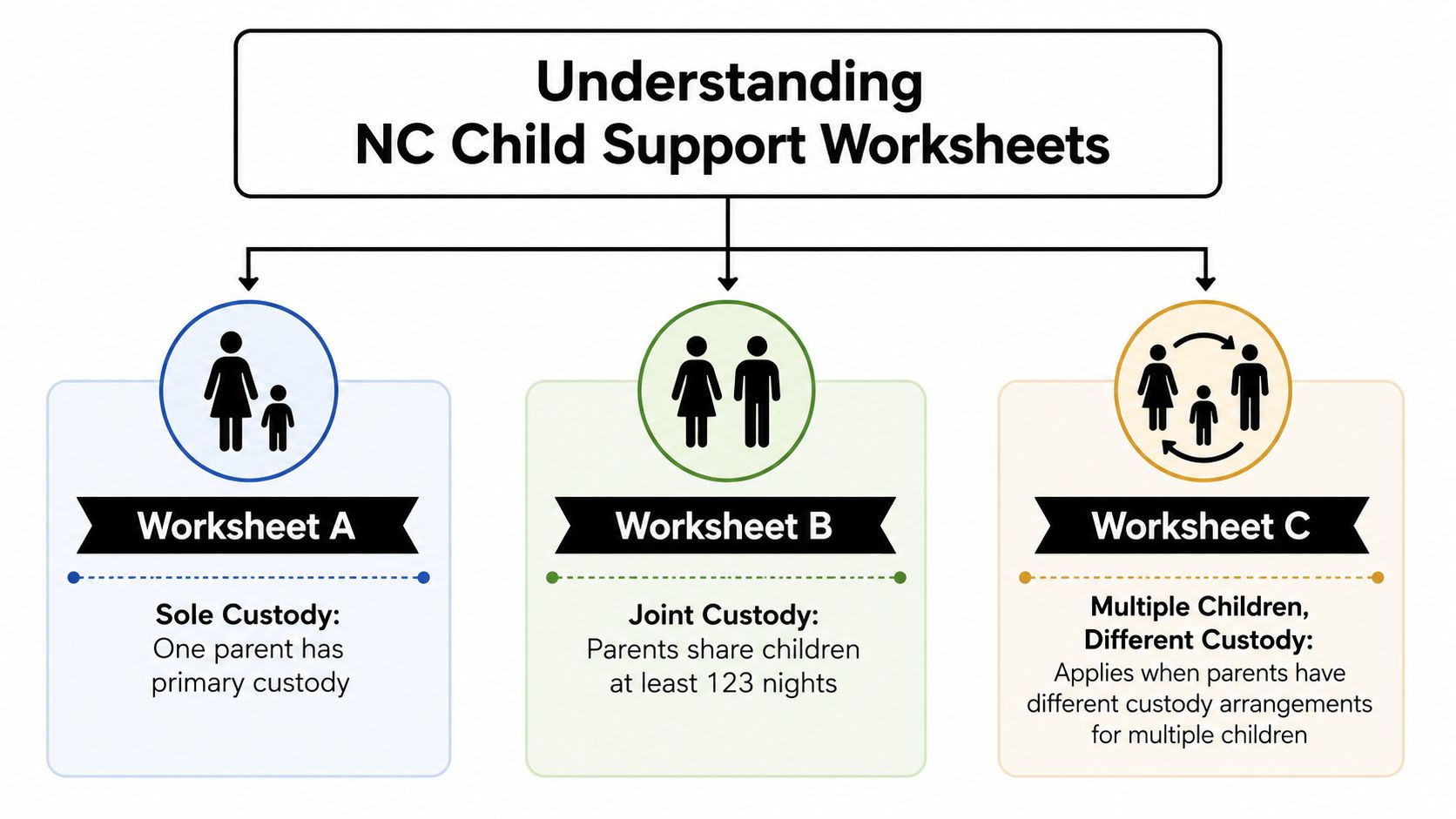
Worksheet A for primary physical custody
Worksheet A usually fits the most familiar setup. One parent has the child most of the year, and the other parent has visitation or a more limited schedule. The worksheet is built around that reality.
The court looks at the parents' combined gross income, then allocates support based on each parent's share. In practice, parents often assume legal custody controls the worksheet choice. It doesn't. The worksheet turns on actual overnight parenting time, not labels like “joint legal custody.”
Practical rule: Count overnights carefully. In North Carolina child support work, the number of nights matters more than the title on the custody order.
Worksheet B for shared custody
Worksheet B applies when each parent has the children at least 123 nights per year. This worksheet accounts for a more balanced parenting schedule and shared financial responsibility across both households.
That often produces a different result than Worksheet A. Not always lower in every case, but often materially different because the formula adjusts for shared parenting costs. This is why parents in a near-equal schedule can end up with a distorted support number if someone still plugs the case into Worksheet A.
For readers who want a short video overview before digging deeper, this walkthrough is useful:
Worksheet C for split custody
Worksheet C is narrower. It applies when there are multiple children and primary custody of different children is divided between the parents. The support calculation is done separately, then offset.
This is the worksheet that causes a lot of confusion in multi-child families, especially where one child has a primary schedule and another has a shared schedule. That's where parents can easily drift into the wrong form.
| NC Child Support Worksheets At a Glance | |||
|---|---|---|---|
| Worksheet | Custody Arrangement | Parenting Time Threshold | Common Scenario |
| Worksheet A | Primary physical custody | One parent has at least 243 nights | One child primarily lives with one parent |
| Worksheet B | Shared custody | Each parent has at least 123 nights | Parents share a substantial overnight schedule |
| Worksheet C | Split custody | Different children primarily live with different parents | One child primarily lives with each parent |
Critical Mistake 1 Choosing the Wrong NC Worksheet
The most expensive worksheet mistake usually happens before anyone reaches the income lines. Someone picks the wrong form, and every number after that looks official even though the premise is flawed.
That mistake is common in mixed custody situations. A family may have two children. One child primarily lives with one parent, while the other child follows a shared schedule. Parents often assume that because there are multiple children and different schedules, Worksheet C must apply. That isn't always right.
The B versus C confusion in real life
One of the biggest trouble spots in North Carolina child support practice is the choice between Worksheet B and Worksheet C in mixed arrangements involving more than one child. As discussed in this North Carolina worksheet discussion on mixed custody scenarios, parents often ask whether Worksheet B should be used when one child lives full-time with one parent and another child splits time. The same discussion notes that official guidance points to Worksheet B for shared custody of all children or primary for some with shared for others, but the lack of clear scenario examples leads to confusion and potential calculation errors of 20-50%.
This is why I tell clients not to guess based on the worksheet names. “Shared,” “split,” and “joint” sound similar, but they don't mean the same thing in the support guidelines.
If you're trying to sort out which worksheet fits your family's schedule, this guide on how to choose the correct child support worksheet in NC is a helpful starting point.
Why the wrong worksheet changes the whole case
An incorrect worksheet does more than produce an inaccurate payment total. It alters the balance of power within the wider family law case.
A parent who appears to owe more support under the wrong worksheet may feel pressure to concede on custody details just to reduce the financial burden. A parent who appears to receive more support may build settlement expectations around a number the court may not ultimately accept. That can derail mediation and make negotiations harder than they need to be.
A child support worksheet can shape the tone of the entire case. When the number is wrong, the bargaining positions built around it are usually wrong too.
A practical example
Take a parent who has enough overnights to qualify for shared custody treatment, but the worksheet used is Worksheet A instead of Worksheet B. The case may look like a primary custody matter on paper even though the actual schedule is far more balanced. The support amount can swing sharply because the formula no longer reflects the cost-sharing reality across two homes.
That kind of mismatch creates more than sticker shock. It can produce distrust. One side thinks the other parent is manipulating the numbers. Sometimes that's true. Sometimes it's just a misunderstanding. Either way, the case becomes more difficult to resolve.
Critical Mistake 2 Common Calculation and Data Entry Errors
Even with the correct worksheet, the numbers can still be wrong. Child support formulas are only as reliable as the information entered into them. If the inputs are incomplete or sloppy, the result will be unreliable no matter how official the form looks.
That's why many mistakes on child support worksheet nc cases come down to one basic problem. Someone typed the wrong figure, left out a required figure, or relied on a tool that didn't perform the calculation correctly.

Gross income errors start the chain reaction
Gross income is one of the first places worksheet problems appear. A parent may use a base salary but ignore overtime, commissions, bonuses, or self-employment income. In other cases, someone uses an outdated pay stub that doesn't reflect current earnings.
That matters because each later line depends on the income figures entered at the start. If the gross income is understated or overstated, the percentages assigned to each parent will also be distorted.
Common examples include:
- Using take-home pay instead of gross income: The worksheet generally starts with gross income, not what lands in the bank after taxes and deductions.
- Ignoring variable compensation: A parent with commissions or fluctuating pay can't assume the lowest recent month tells the whole story.
- Treating self-employment casually: Business income often requires closer review because personal and business expenses can blur together.
Overnight counts get misreported more often than people think
The overnight threshold for shared custody treatment is a bright line. If the case qualifies for Worksheet B, the overnight count matters enormously. Parents often estimate from memory instead of working from a calendar, custody order, or school-year breakdown.
That creates predictable conflict. One parent counts “intended” time. The other counts actual overnights. Holiday trades, summer schedules, and makeup days further complicate the issue.
A careful overnight review usually includes:
- The written court order or parenting agreement
- A full-year calendar showing actual nights
- Adjustments for holidays, school breaks, and summer periods
- Consistency checks against what each parent is telling the court
Child-related expenses are often entered incorrectly
Health insurance and work-related childcare costs also cause frequent worksheet errors. Parents may enter the full insurance premium instead of the child's portion, or include daycare that isn't specifically work-related.
These numbers matter because they shift how expenses are shared between the parties. If the wrong amount goes in, the support number moves with it.
Small line-item mistakes can produce a support figure that looks polished and still isn't trustworthy.
For a broader overview of the underlying formula, see this explanation of how child support is calculated in NC.
Even automated worksheets can be wrong
Parents sometimes assume an auto-calculating worksheet must be accurate because it came from a court-related source or looked official. That assumption is risky.
According to this analysis of an error in a court-published auto-calculating NC worksheet, a computational bug in some auto-calculating Excel worksheets failed to apply the full adjustment for shared parenting costs. In the sample case described there, the error produced a 15.7% overpayment, equivalent to $2,912 annually.
That example matters for one reason above all. You can have the right worksheet, the right category of expenses, and still end up with the wrong result if you rely blindly on automation.
What works and what doesn't
What works is boring but effective. Match each line item to supporting documents. Recalculate manually when something looks off. Compare the worksheet to the custody order and to actual calendars.
What doesn't work is treating the worksheet as a one-click form. It isn't. It's a legal calculation document that deserves the same scrutiny as an affidavit or proposed order.
The Legal Consequences of Worksheet Errors in North Carolina
A worksheet error isn't confined to a spreadsheet. Once a support number is incorporated into a court order, that number can affect enforcement, arrears, settlement negotiations, and credibility with the judge.
Innocent mistakes happen. Courts understand that. But North Carolina courts also expect accurate and current financial information in child support proceedings. If a parent signs off on wrong figures without checking them, the court may still treat the resulting order as binding until it is properly challenged.

When a mistake is accidental
A simple math or input error can still cause real harm. A parent may overpay for months while trying to keep up with an inflated obligation. Another parent may receive too little support and struggle to cover ordinary child-related expenses. In either direction, family stability takes the hit first.
The court's presumption that guideline support is correct also means the burden usually falls on the parent challenging the number. That takes time, records, and a clear explanation of what went wrong.
When the problem looks intentional
The legal exposure increases sharply if the worksheet was knowingly falsified. According to this discussion of penalties for falsifying a North Carolina child support worksheet, falsifying or erroneously completing NC Child Support Guidelines Worksheets can trigger serious consequences under G.S. 50-13.4. The same source states that knowing falsification can be treated as perjury under N.C.G.S. 14-209, a Class 1 misdemeanor, and discrepancies of more than 10% between worksheets and financial affidavits can trigger audits.
That changes the posture of the case. What began as a support dispute can become a credibility problem. Judges notice when documents don't line up.
Courtroom reality: If the worksheet says one thing and the financial records say another, the judge will focus on who supplied the bad numbers and why.
Ripple effects beyond the support amount
An inaccurate worksheet can also spill into related issues:
- Settlement breakdowns: Parties negotiate around numbers they think are reliable.
- Contempt exposure: A parent may be held to an order that was based on faulty data until the order is changed.
- Trust damage: Once one side believes the other manipulated the worksheet, cooperation usually gets harder.
- More litigation: Correcting avoidable errors often costs more than getting the worksheet right the first time.
This is one reason accuracy matters so much in family court. The worksheet is not separate from the rest of the case. It often influences how the court views the parties' honesty and preparation.
How to Correct or Contest a North Carolina Child Support Worksheet
If you think the worksheet is wrong, the next question is timing. The path is different depending on whether the court has already entered a final support order.
That distinction matters because North Carolina courts don't treat a draft worksheet the same way they treat an existing order. Before entry of the order, the goal is correction. After entry, the goal is usually modification or another formal challenge based on the facts of your case.
Before the final order is entered
This is the better time to fix a problem. If the worksheet is still being negotiated, exchanged in discovery, or presented for hearing, you can challenge the inputs directly.
Focus on records, not assumptions. Bring pay stubs, tax returns, childcare invoices, health insurance breakdowns, and a clean overnight calendar. If the other parent's worksheet doesn't match the documents, point to the exact line and the supporting record that contradicts it.
A useful approach is to work from a checklist:
- Verify the worksheet type: Make sure the form matches the actual custody arrangement.
- Audit the income lines: Compare them against recent earnings records and tax documents.
- Check child-specific expenses: Confirm that only the child's portion of insurance and qualifying childcare costs are included.
- Count overnights from a calendar: Don't rely on estimates or memory.
After the order is already in place
Once the support order has been signed, the analysis changes. North Carolina generally requires a formal request to modify the order rather than an informal correction request.
According to this discussion of correcting worksheet errors after a North Carolina child support order, a parent must file a motion for modification and show a substantial change in circumstances. That source also notes that significant errors in gross income, parenting overnights including the 123-night threshold for Worksheet B, or overlooked extraordinary costs can support recalculation when backed by new evidence such as pay stubs and tax returns.
If you're already at that stage, this overview of child support modification in NC may help you understand the process.
A practical correction path
When parents ask what works, the answer is usually this:
- Get the full file together. That includes the existing order, every worksheet exchanged, financial affidavits, and supporting records.
- Identify the specific error. “The number seems unfair” isn't enough. “The worksheet used the wrong overnight count” is a real issue.
- Measure the impact. Determine whether correcting the mistake would materially change support.
- Choose the right procedure. Pre-order objections and post-order modification motions are not interchangeable.
- Submit a corrected worksheet. Courts need a workable alternative, not just criticism of the old one.
The strongest challenge usually pairs two things. A clearly identified worksheet mistake and the documents that prove the corrected number.
Frequently Asked Questions About NC Child Support Worksheets
What if the other parent is self-employed and I think income is being hidden
Self-employment cases often require closer document review because income may not appear in a straightforward payroll record. Bank statements, tax returns, business records, and expense claims may all matter. If a worksheet seems low because business income was minimized, the answer usually isn't argument alone. It's documentation.
A court will want evidence, not suspicion. If you believe the worksheet understates income, gather the records that show why and raise the issue through the proper court process.
How are bonuses or commissions handled on a North Carolina child support worksheet
Variable pay can still count as income. The key issue is whether the worksheet reflects a fair and current picture of earnings. In practice, that often means looking beyond one pay period.
A worksheet based only on base salary may miss the parent's true earning pattern. When compensation changes month to month, accurate support work usually requires a broader financial picture rather than a single recent paycheck.
Do I have to include my new spouse's income on the worksheet
Usually, the worksheet focuses on the income of the child's parents, not a new spouse. That said, every case has context, and new household finances can sometimes affect broader arguments in related family law disputes even if they aren't direct worksheet inputs.
If you're filling out a North Carolina worksheet, don't assume your new spouse's income belongs on the form because the household has changed. Review the actual worksheet lines and your case posture carefully before adding information that may not belong there.
Can child support still be owed in a shared custody case
Yes. Shared custody doesn't automatically eliminate support. If the case qualifies for Worksheet B, the formula still weighs each parent's income and certain child-related costs.
That surprises many parents. A near-equal schedule can still result in one parent paying support, especially when incomes or child-related expenses aren't evenly matched. The schedule matters, but it isn't the only factor.
If the worksheet has a mistake, will the judge fix it automatically
Usually not. Courts rely on the information the parties present. If the worksheet contains an error and no one identifies it clearly with supporting records, the mistake may remain embedded in the case.
That's why passive disagreement rarely works. If you think the numbers are wrong, raise the issue precisely, support it with documents, and ask for a corrected calculation through the proper procedural path.
Protect Your Finances and Your Family Get Expert NC Legal Help
A child support worksheet looks simple until you see what depends on it. The worksheet choice, the overnight count, the income figures, and the expense entries all shape the support amount. Once that amount shows up in an order, the effects can reach far beyond a monthly payment.
The families dealing with mistakes on child support worksheet nc are often dealing with more than arithmetic. They're trying to protect housing budgets, preserve workable co-parenting arrangements, and avoid being locked into a number built on bad information. That's why careful review matters. It's also why waiting too long can make the problem harder and more expensive to fix.
North Carolina law gives parents ways to challenge inaccurate worksheets and seek correction, but the process works best when the issue is identified clearly and supported with records. General frustration won't move a case forward. Specific proof often will.
If you live in North Carolina and you believe a child support worksheet in your case is wrong, don't guess and don't assume the problem will fix itself. A detailed legal review can clarify whether the worksheet is incorrect, whether the error changed the support amount, and what procedural step makes sense next.
If you need guidance on a North Carolina child support dispute, the Law Office of Bryan Fagan can help you evaluate the worksheet, the court order, and your options for correction or modification. Schedule a consultation to discuss your case, get clear answers, and build a strategy focused on protecting your finances and your family.