Losing a loved one is hard enough. Finding out they didn't leave a will can turn grief into confusion almost immediately. Families often don't know who's in charge, what happens to the house, whether the surviving spouse can access accounts, or whether children from a prior relationship will inherit.
That's where intestate succession comes in. In plain English, it's the legal system North Carolina uses when someone dies without a valid will, or when a will doesn't fully dispose of the probate estate. Instead of following personal wishes, the court follows a state-created inheritance plan.
If you're searching for what is intestate succession, you probably need more than a dictionary definition. You need to know what it means for a spouse, children, parents, stepchildren, jointly owned property, and the probate process in North Carolina. That's the focus here.
When a Loved One Dies Without a Will
A common call to an estate planning or probate office starts the same way: a parent, spouse, or sibling has passed away, and no one can find a will. Sometimes there never was one. Sometimes there's an old document that may not be valid. Sometimes the family assumes the closest relative automatically gets everything, only to learn that North Carolina law may divide property in a very different way.
Intestate succession is the legal default that applies when a person dies without a valid will. Historically, intestacy developed as a standardized inheritance framework so property would pass to legally recognized heirs instead of being distributed according to informal wishes, as described in this overview of intestate succession's legal role. Today, every state has its own version of that default system.
In North Carolina, that means state law decides who inherits probate property. The court doesn't try to guess what your loved one would have wanted. It applies the statutory order of heirs.
When there's no valid will, the law supplies one.
That can produce reasonable results in some families. In others, it can create outcomes the deceased never intended. An unmarried partner may receive nothing. A stepchild may be left out. A blended family may face tension over the family home, personal property, or accounts that must pass through probate.
The first practical step is to slow down and identify three things: whether there is a valid will, what assets are in the probate estate, and which relatives survive the person who died.
Understanding North Carolina Intestate Succession Law
North Carolina treats intestate succession as a statutory system, not a flexible fairness-based process. The legal framework is found in Chapter 29 of the North Carolina General Statutes, often called the state's laws of intestate succession.
Core rule: Intestate succession is a state-written backup plan that applies when a person dies without a valid will, or when a valid will doesn't fully dispose of the probate estate.
A reliable general statement of the concept appears in Western & Southern's intestate succession overview, which explains that intestate succession is a statutory default rule set. The court identifies heirs in a fixed priority order, commonly beginning with a surviving spouse and descendants, rather than trying to determine what the decedent probably intended.
When North Carolina intestacy rules apply
These rules typically matter in several situations:
- No will exists: The person died without ever signing a valid will.
- The will is invalid: There may be problems with execution, witnesses, or other legal requirements.
- The will is partial: A document may leave some property unaddressed, and the undisposed portion can pass under intestacy rules.
Think of it as the legislature writing a default estate plan for every North Carolina resident who didn't leave one of their own.
Why the result often surprises families
It is commonly assumed that “next of kin” is enough. It usually isn't. North Carolina law distinguishes between spouses, children, parents, and more remote relatives. It also treats probate and non-probate assets differently, which means one asset may pass under intestacy while another transfers by title or beneficiary designation.
That same idea appears in other areas of family law. For example, North Carolina Child Support Guidelines Explained discusses how NC calculates child support using the Worksheet system. Probate works the same way in one important sense: statutory formulas often control outcomes more than people expect.
The legal question is narrower than families think
When families ask, “What would he have wanted?” the probate court asks a different question: “Who inherits under the statute?”
That difference matters. It's why a valid will, trust, beneficiary review, and title review are so important. Without those tools, North Carolina's default rules decide.
How Assets Are Divided Under NC Intestacy Rules
A spouse walks into my office after a funeral and says, "We were married for 20 years, so everything should come to me." Sometimes that is true. Often, under North Carolina intestacy law, it is not.
Distribution depends on two things. First, who survived the person who died. Second, which assets are part of the probate estate. North Carolina's core intestacy rules appear in N.C.G.S. § 29-14, § 29-15, and § 29-16. Those statutes control the result, even when the family expected something else.
Start with the surviving spouse
A surviving spouse has strong rights under North Carolina law, but those rights change based on the rest of the family tree. Children matter. So do parents, if there are no descendants. That is why two estates with similar dollar values can produce very different results.
Here is a simplified reference point for common North Carolina intestacy outcomes.
North Carolina Intestate Succession Distribution at a Glance
| Surviving Heirs | Surviving Spouse's Share | Children's / Other Heirs' Share |
|---|---|---|
| Spouse only, no descendants, no parents | Entire intestate estate | None |
| Spouse and one child, or spouse and descendants of one deceased child | Share set by N.C.G.S. § 29-14 | Remaining share passes to the child or descendants under the statute |
| Spouse and two or more children, or descendants of two or more deceased children | Share set by N.C.G.S. § 29-14 | Remaining share passes to the children or descendants under the statute |
| Spouse and one or both parents, no descendants | Share set by N.C.G.S. § 29-14 | Remaining share passes to the parent or parents under the statute |
| No spouse | No spouse's share | Estate passes by statutory order to descendants, then parents, then siblings, then more remote heirs under N.C.G.S. § 29-15 and § 29-16 |
I am not listing fixed dollar amounts here because the statute uses formulas that depend on the family structure and the character of the property. For a grieving family, that distinction can feel technical. Financially, it is not. It affects who receives the house equity, cash accounts, and other probate assets.
One practical rule helps: in North Carolina, marriage alone does not guarantee that the surviving spouse receives the entire probate estate.
If there is no surviving spouse
If there is no surviving spouse, North Carolina follows a statutory order of inheritance. The estate usually passes in this sequence:
- Descendants first: Children and other lineal descendants are first in line.
- Parents next: If there are no descendants, surviving parents may inherit.
- Siblings next: If there is no spouse, no descendants, and no surviving parent, siblings may inherit.
- More remote heirs after that: The statute continues through extended family lines.
Probate courts apply legal categories, not family sentiment. A person may have been the closest caregiver in real life and still have no inheritance rights under intestacy.
Children, descendants, and representation
Family trees are not always simple. A child may have died before the parent but left children of their own. In that situation, North Carolina law may allow that branch of the family to take by representation rather than losing the share entirely.
That issue comes up often in larger families, blended families, and estates where one generation has already passed away. It also affects settlement decisions. Before anyone assumes "the children will just split everything evenly," the personal representative needs to confirm who legally counts as a descendant and whether any deceased child's line steps into that share.
As noted in this probate administration explanation, substitution and survivorship rules can change the outcome in multigenerational estates. In practice, I tell families to build a careful family tree before they try to divide anything.
Probate assets only
Intestacy rules apply only to assets that pass through probate.
That point changes the financial picture in many North Carolina estates. A life insurance policy with a named beneficiary usually passes by beneficiary designation. A jointly owned account may pass by survivorship terms. A retirement account usually follows its beneficiary form. By contrast, a bank account in the decedent's sole name with no payable-on-death designation may fall into the probate estate and be distributed under intestacy.
Families often focus on who should inherit. The first legal question is narrower: which assets are even controlled by the intestacy statute?
That is where disputes start. One asset may transfer outside probate and never be divided under N.C.G.S. Chapter 29. Another asset, sitting in the same household or listed on the same balance sheet, may have to be opened in the estate and divided under the statutory formula.
Assumptions that cause trouble
Several misunderstandings create expensive problems in North Carolina probate estates:
- "We lived together for years, so I inherit." North Carolina intestacy turns on legal status, not the length of the relationship.
- "My stepchildren inherit the same as my children." Not unless adoption or another legal basis gives them that status.
- "Everything the person owned goes through intestacy." Only probate assets do.
- "The family can work it out privately." Families can agree on many practical issues, but title to estate assets still has to pass the right way.
The safest first step is to inventory every asset, identify how each asset is titled, check for beneficiary designations, and match the surviving family members to the statute. That work gives the family a North Carolina-specific roadmap instead of guesses, and it usually prevents the worst probate fights.
Real-World Examples of Intestate Succession in NC
Rules make more sense when you can see how they affect an actual family. These examples are fictional, but they reflect situations North Carolina families regularly face.

A blended family with a surviving spouse and children
A married North Carolina resident dies without a will. He leaves a wife, one child from that marriage, and one adult child from an earlier relationship. He also leaves a home titled in his name alone, a checking account with no payable-on-death designation, and a life insurance policy naming his wife as beneficiary.
Here's what often surprises the family. The life insurance policy may pass directly to the named beneficiary and may not be controlled by intestate succession at all. The house and checking account, if they are probate assets, are a different matter.
The spouse does not receive every probate asset automatically because she is the surviving wife. North Carolina's statute controls the distribution of the probate estate, and the children's rights matter. In a blended family, that often leads to tension because the surviving spouse may need the house while children from a prior relationship may have inheritance rights in the probate estate.
In practice, families in this situation usually need answers to questions like these:
- Who has the right to open the estate
- Whether the home is probate property or passes by title
- How the spouse's statutory share is calculated
- Whether the children inherit immediately or through later administration
Without a will or trust, there is no custom plan for the spouse's housing needs, no directed gift structure, and no handpicked fiduciary to manage the process.
An unmarried person with parents and siblings
Now consider a single North Carolina resident who dies without a will, no children, and no surviving spouse. She leaves behind one bank account in her sole name, a car, and personal property in her apartment. Her parents survive her, and she also has siblings she was close to.
Many families assume siblings will share because they were more involved in daily life. But if the statutory order places surviving parents ahead of siblings, the parents may inherit first. The court doesn't ask who visited most often or who helped pay bills. It applies the legal hierarchy.
Emotional closeness and legal heirship are not the same thing.
That can be painful, especially when a sibling handled caregiving and expected to manage everything after death. In an intestate estate, legal priority matters more than family expectations.
A stepchild the decedent treated as their own
A widowed North Carolina resident dies without a will and leaves a stepdaughter he raised from childhood but never legally adopted. He also has a surviving brother. The family expects the stepdaughter to inherit because she was the practical child in the relationship.
That may not happen under intestacy. As a general rule, inheritance rights can differ for adopted children and generally do not extend to stepchildren or foster children under intestacy law, as noted in the earlier Cornell discussion. If the stepdaughter was never adopted and was not named in a valid estate plan, she may not inherit under the intestacy statute.
This is one of the most difficult situations emotionally because it feels unfair to the people involved. Legally, though, intestacy recognizes legal relationships, not informal family roles.
Navigating the Intestate Probate Process in Court
Families often think the hardest part is figuring out who inherits. In practice, the court process can be just as stressful. When there is no valid will, there is also no named executor. That means the clerk of court must appoint someone to administer the estate.
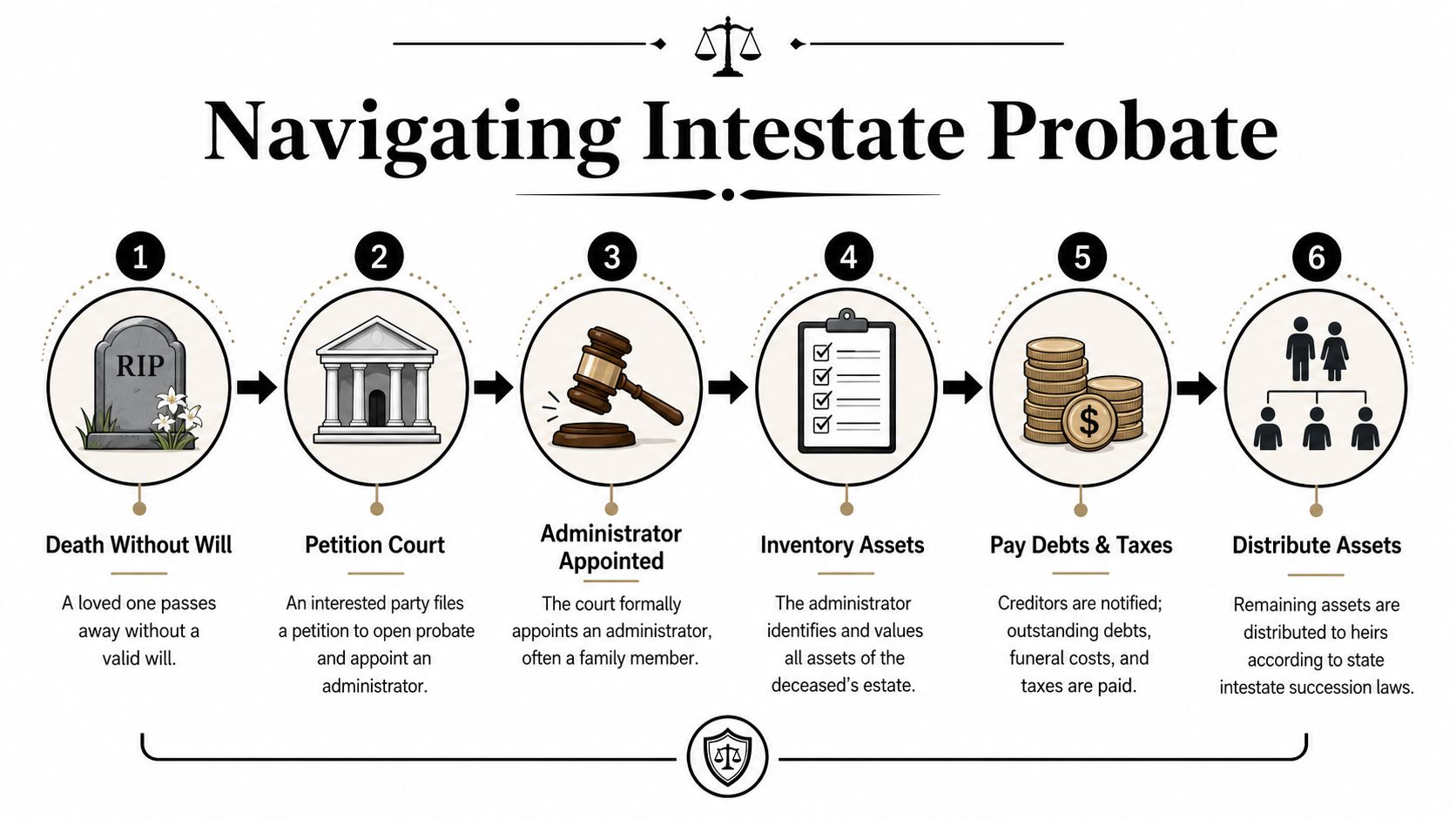
A helpful overview of the broader North Carolina procedure is this guide to the North Carolina probate process.
Administrator versus executor
An executor is the person named in a will to carry out the estate administration. An administrator is the person the court appoints when there is no executor available because there is no valid will.
That difference matters. The decedent did not choose the administrator. The court fills the role under probate rules.
According to the verified probate-administration guidance cited earlier from MetLife, dying intestate increases court dependence because the probate court appoints an administrator who must inventory assets, pay debts and taxes, and then distribute the net estate according to the statutory formula. That added layer can increase delay and dispute risk.
What the administrator has to do
The job is more than collecting mail and closing accounts. In a typical intestate estate, the administrator may need to:
- Open the estate with the court
- Identify and value probate assets
- Notify creditors and handle claims
- Pay valid debts, expenses, and taxes
- Account to the court
- Distribute what remains to heirs under the statute
The process becomes more difficult when families disagree about who should serve, what property belongs in the estate, or whether an asset passes outside probate.
This short video gives a useful general look at probate concepts:
Why intestate probate often feels slower
A well-drafted will can reduce uncertainty by naming an executor and giving clearer instructions. Intestacy removes that guidance. The administrator still has legal duties, but often with more room for family conflict.
Common pressure points include:
- Access to the home: A surviving spouse or child may be living there while title questions remain unresolved.
- Personal property disputes: Heirs may disagree over vehicles, jewelry, family photographs, or furniture.
- Mixed-family tension: Children from different relationships may not agree on sale decisions or timing.
The more complicated the family structure and the asset list, the more important it is to get legal guidance early.
Frequently Asked Questions About Intestacy in NC
A common call to my office starts like this: a family member has died, there is no will, and relatives are already making assumptions about who gets the house, the bank account, or the car. In North Carolina, those answers depend on the statute, the family tree, and whether the asset is even part of the probate estate.
Does a spouse automatically inherit everything in North Carolina?
A surviving spouse does not always receive the entire estate. Under North Carolina intestacy rules, the spouse's share changes depending on whether the decedent left children, descendants of deceased children, or parents.
That point matters in real dollars. In a first-marriage family with no surviving parents, the result may be very different from a blended family with children from an earlier relationship. Before anyone promises that “everything goes to the spouse,” review the family structure and the asset list carefully.
Does intestacy cover every asset a person owned?
Intestacy applies only to probate assets. Property that passes by beneficiary designation, survivorship, or other non-probate transfer rules may go to someone else entirely.
This is one of the biggest sources of confusion I see. Families often focus on what the intestacy statute says, but the first question is whether the asset belongs in the probate estate at all. A jointly owned account, a life insurance policy with a named beneficiary, and certain retirement accounts may pass outside intestacy even when there is no will.
Can an unmarried partner inherit under North Carolina intestacy law?
Usually no. North Carolina intestacy law follows statutory heir categories, and an unmarried partner is generally not in that line unless another legal arrangement controls a particular asset.
That can create harsh outcomes. A long-term partner may have shared bills, shared a home, and expected to inherit, yet still have no right to an intestate probate asset.
Do stepchildren inherit if there is no will?
Stepchildren generally do not inherit under intestacy unless they were legally adopted. This issue comes up often in blended families, especially where everyone assumed “the kids will be treated the same.”
North Carolina law does not make that assumption for probate assets. If a parent wants a stepchild to inherit, that usually needs to be handled through a valid estate plan or through assets structured to pass outside probate.
Is a handwritten or online form enough to avoid intestacy?
Sometimes. The key question is whether the document is valid under North Carolina law and whether it disposes of the property that would otherwise pass through intestacy.
A form can help, but only if it is signed correctly, witnessed correctly when required, and coordinated with titles and beneficiary designations. For a basic starting point, this overview of a North Carolina will template explains what a simple form may do, and what it may leave unresolved.
Take Control of Your Legacy and Avoid Intestacy
If there is one lesson in what is intestate succession, it's this: when you don't make the plan, the state supplies one. Sometimes that plan lines up with family expectations. Often it doesn't.
A proper estate plan gives you options that intestacy does not. You can choose who receives property, provide for a spouse while still protecting children from an earlier relationship, name someone you trust to handle the estate, and make clear whether certain people or organizations should receive anything at all. You can also review which assets should pass outside probate.
For many North Carolina residents, that planning starts with a will and may expand to trusts, beneficiary updates, and title review. Some families also want to explore strategies for reducing probate exposure. This guide on how to avoid probate in North Carolina covers that topic at a high level.

If you're dealing with a recent death or you want to prevent this burden for your own family, now is the right time to get clear advice under North Carolina law.
North Carolina residents who need help with intestate succession, probate, wills, or estate planning can schedule a consultation with Law Office of Bryan Fagan. The firm advises clients on North Carolina probate and estate planning issues, including how property may pass when someone dies without a valid will.