You may be in a position many grandparents never expect. You helped with school pickups, kept extra clothes at your house, showed up for birthdays, and built a real daily bond with your grandchild. Then a divorce starts, a parent remarries, or a family dispute turns personal. Calls stop. Visits become irregular. Sometimes contact ends overnight.
That kind of cutoff feels personal because it is. But in North Carolina, the legal question isn't whether you love your grandchild or whether the relationship matters. The first question is whether the court will even let you file.
That's where many grandparents get blindsided. Grandparents rights in NC are limited, situation-specific, and controlled by statute. The law gives some grandparents a path into court, but only in defined circumstances. A strong bond helps. It doesn't automatically create standing.
If you're trying to protect contact with a grandchild, or you're worried a child isn't safe with a parent, you need a realistic view of what North Carolina courts can and cannot do. That starts with understanding standing, the difference between custody and visitation, and the filing path that fits your facts.
Protecting Your Bond with Your Grandchild in North Carolina
A common story looks like this. Grandmother sees her grandson every week while the parents' marriage is struggling. She keeps him after school, helps with homework, and fills gaps when the parents are working. Then the parents reconcile briefly, tensions rise, and one parent decides the grandparent is "too involved." Access is cut off.
Another version happens after a parent dies. The surviving parent starts dating someone new and distances the child from the deceased parent's side of the family. The grandparents assume the court will protect their relationship because it's obviously important to the child. Sometimes the law gives them an opening. Sometimes it doesn't.
Practical rule: In North Carolina, emotional fairness and legal standing are not the same thing.
That's hard to hear, but it matters. I often find that grandparents delay getting legal advice because they assume the court will step in once a judge hears how close they are to the child. North Carolina law doesn't work that way. The court first looks at whether a statute allows the grandparent to bring the issue before the court at all.
What grandparents usually want
Most grandparents who contact a family lawyer aren't trying to take over parenting. They usually want one of two things:
- Regular contact: A predictable schedule for visits, calls, holidays, or school breaks.
- Protection for the child: Custody when they believe a parent can't safely care for the child.
Those are very different legal requests. The proof is different, the statutes are different, and the odds are different.
What actually helps
The grandparents who put themselves in the strongest position usually do three things early:
- They identify the family posture: Are the parents together, separated, divorced, or already in court?
- They focus on facts, not outrage: Judges care about caregiving history, the child's welfare, and legal standing.
- They act before doors close: In some situations, timing matters. Waiting until a case is over can change what remedies are available.
Regarding grandparents rights in NC, the most important step is getting clear on whether you have a legal path, not just a compelling family story.
The Intact Family Rule and Your Right to File
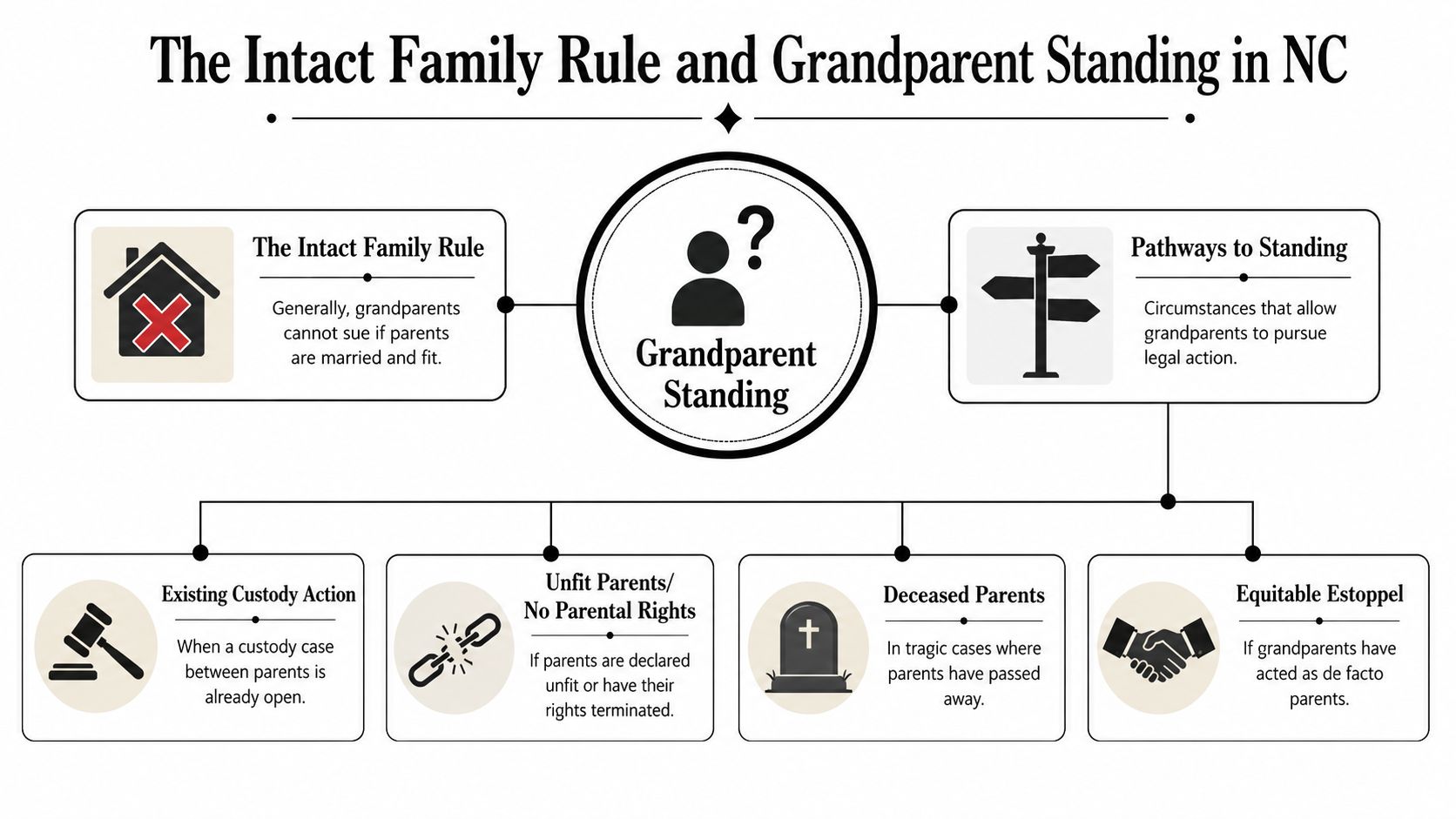
The biggest misconception in these cases is simple. Grandparents do not have automatic visitation rights in North Carolina.
That misconception causes real damage because it leads grandparents to file motions the court can't grant, or to spend months arguing with parents when the actual barrier is legal standing. The most overlooked barrier is the intact family rule.
Why loving grandparents still get turned away
If the child's parents are married, living together, and no custody case exists, a grandparent generally can't petition for visitation in North Carolina, even if the grandparent has a deep and healthy relationship with the child. A North Carolina legislative study from 1997 confirmed that under current law a grandparent has no standing if the grandchild lives in an intact family, and the Committee recommended a change to allow those petitions.
That point still surprises people. They assume the court will weigh the value of the grandparent relationship first. It won't. If there is no standing, the court doesn't get to the merits.
What counts as a legal opening
The law is more likely to create a filing opportunity when the family is no longer legally intact. In practice, that often means circumstances such as:
- Parents are separating or divorcing
- A custody case between parents is already pending
- A parent has died
- Adoption by a stepparent or relative changes the legal posture
- The facts support a custody claim because parents are unfit or have acted inconsistently with protected parental rights
These aren't shortcuts. They are threshold conditions that can create access to court.
Even a grandparent who has cared for a child for years may have no visitation claim if both parents are fit, married, and united in denying contact.
A practical example
Suppose your daughter and son-in-law are married, living together, and decide after an argument that you won't see your granddaughter anymore. You may feel blindsided and believe the judge will order visits because the child has stayed with you every weekend for years. In an intact family, that history alone usually won't let you file for visitation.
Now change one fact. The parents separate and start a custody dispute. That change may create a legal opening that didn't exist before. Same child. Same relationship. Different standing.
This is why grandparents rights in NC often turn less on sentiment and more on family status at the moment legal action is considered.
Understanding Your Goal Custody vs Visitation
Once a grandparent has a possible path into court, the next question is what you're asking for. Many people use custody and visitation interchangeably. North Carolina courts do not.
Custody means control and responsibility
A request for custody asks the court to place the child with you, either physically, legally, or both. In plain English, that means you are seeking the right to care for the child day to day and possibly make major decisions about education, medical care, and other core issues.
This is a serious request. Courts usually don't remove decision-making authority from a parent just because a grandparent can offer a calmer home or more help with school. The issue is whether the parents are unfit or have acted inconsistently with their protected parental rights.
Visitation means time, not parental authority
A request for visitation is narrower. You're asking for court-ordered contact with the child, not to replace the parent. That might mean weekends, holiday time, phone calls, or another defined schedule.
Visitation disputes often overlap with broader custody fights. If you're trying to understand how conflicts over access can arise, this discussion of when a parent may deny visitation in North Carolina gives useful context on how courts view control over parenting time.
Grandparent Custody vs. Grandparent Visitation in NC
| Legal Aspect | Grandparent Custody | Grandparent Visitation |
|---|---|---|
| Primary request | Placement of the child with the grandparent | Scheduled contact between grandparent and child |
| Decision-making rights | May include authority over major child-related decisions | Usually does not transfer parental decision-making |
| Where the child lives | Child may primarily live with the grandparent | Child remains in a parent's or legal custodian's home |
| Typical legal hurdle | High. Usually tied to parental unfitness or conduct inconsistent with parental rights | Limited standing. Often depends on procedural posture and statute |
| Common scenario | Child is in an unsafe or unstable home and grandparent seeks placement | Parents are in litigation and grandparent seeks continued contact |
| Effect on parents | Can significantly limit parental control | Preserves parental status while adding court-ordered contact |
A real-world comparison
Consider two grandparents.
One learns that her grandchild is living in chaotic conditions. School attendance is inconsistent, supervision is poor, and the parents are not functioning as caregivers. Her legal goal may be custody.
Another grandparent has always seen the child after church on Sundays and during school breaks. After a bitter divorce, one parent cuts off that contact. That grandparent may be looking for visitation, not custody.
Custody cases ask, "Who should raise this child right now?" Visitation cases ask, "Should this grandparent have court-protected contact?"
Getting that distinction right shapes everything that follows, including what evidence matters and which statute may apply.
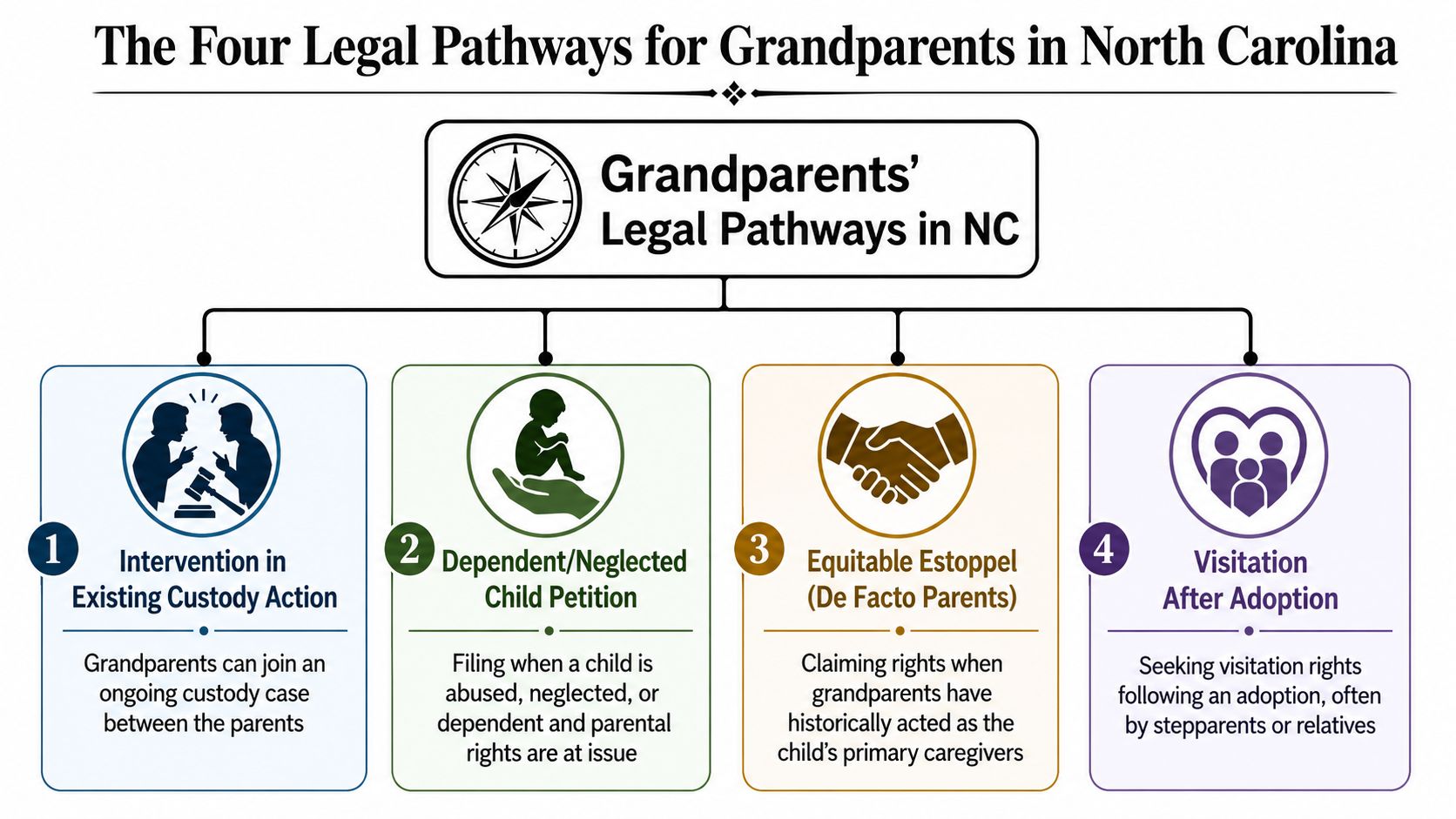
The Four Legal Pathways for Grandparents in North Carolina
North Carolina doesn't have a broad, free-standing grandparent visitation law. Instead, grandparents have a limited set of statutory routes. As explained in this summary of North Carolina grandparent visitation and custody statutes, grandparents may seek relief only through specific legal avenues, including intervention under N.C. Gen. Stat. § 50-13.2(b1), custody under § 50-13.1(a), visitation after certain adoptions under § 50-13.2A, and modification under § 50-13.5(j).
If you're also trying to understand the larger framework of Child Custody in North Carolina, it's helpful to know that courts decide custody issues under the best interests standard once the proper legal threshold has been met.
Intervention in an existing custody case under Section 50-13.2(b1)
This is one of the most important paths for visitation. A grandparent may seek visitation by intervening in an active custody case before that case is resolved.
The timing matters. If the parents are already litigating custody, a grandparent may ask to step into that case and request visitation. If the case ends and no intervention happened, that opportunity may be gone.
A common example is a divorce case where both parents are fighting over the child. The paternal grandparents have been closely involved for years and fear one parent will cut off contact. That existing custody action may provide the opening to intervene.
Original custody claim under Section 50-13.1(a)
A grandparent may seek custody under N.C. Gen. Stat. § 50-13.1(a) if the facts support a claim that the parents are unfit or have acted inconsistently with their constitutional rights as parents.
This isn't a preference contest. The court is not deciding whether the grandparent's home is nicer or calmer. The issue is whether the parents have lost the legal protection usually given to parental decisions.
A practical example is a child who has lived with grandparents for a substantial period while the parents failed to function in a parental role. Depending on the facts, that may support a custody filing.
Visitation after stepparent or relative adoption under Section 50-13.2A
North Carolina allows a more specific visitation route when a child is adopted by a stepparent or relative, and the grandparent has a meaningful relationship with the child.
That matters because adoption often changes who has legal standing. If a child's mother remarries and the stepfather adopts the child, a grandparent may still have a potential path for visitation under this statute. By contrast, if the child is adopted by an unrelated third party and parental rights are terminated, grandparents generally lack standing.
Modification of an existing order under Section 50-13.5(j)
If there is already a custody order in place, a grandparent may seek modification under N.C. Gen. Stat. § 50-13.5(j). The required showing is a substantial change in circumstances affecting the child's welfare.
That standard is demanding. It means the court is not reopening the case just because the grandparent disagrees with how things are going. There must be a meaningful change tied to the child's well-being.
For example, if a child was thriving under one arrangement and serious problems later emerge that affect the child's welfare, a modification request may be appropriate.
A Step-by-Step Overview of the Filing Process
Procedure matters in these cases. Grandparents often lose momentum, and sometimes their advantage, because they file the wrong document or file at the wrong time.
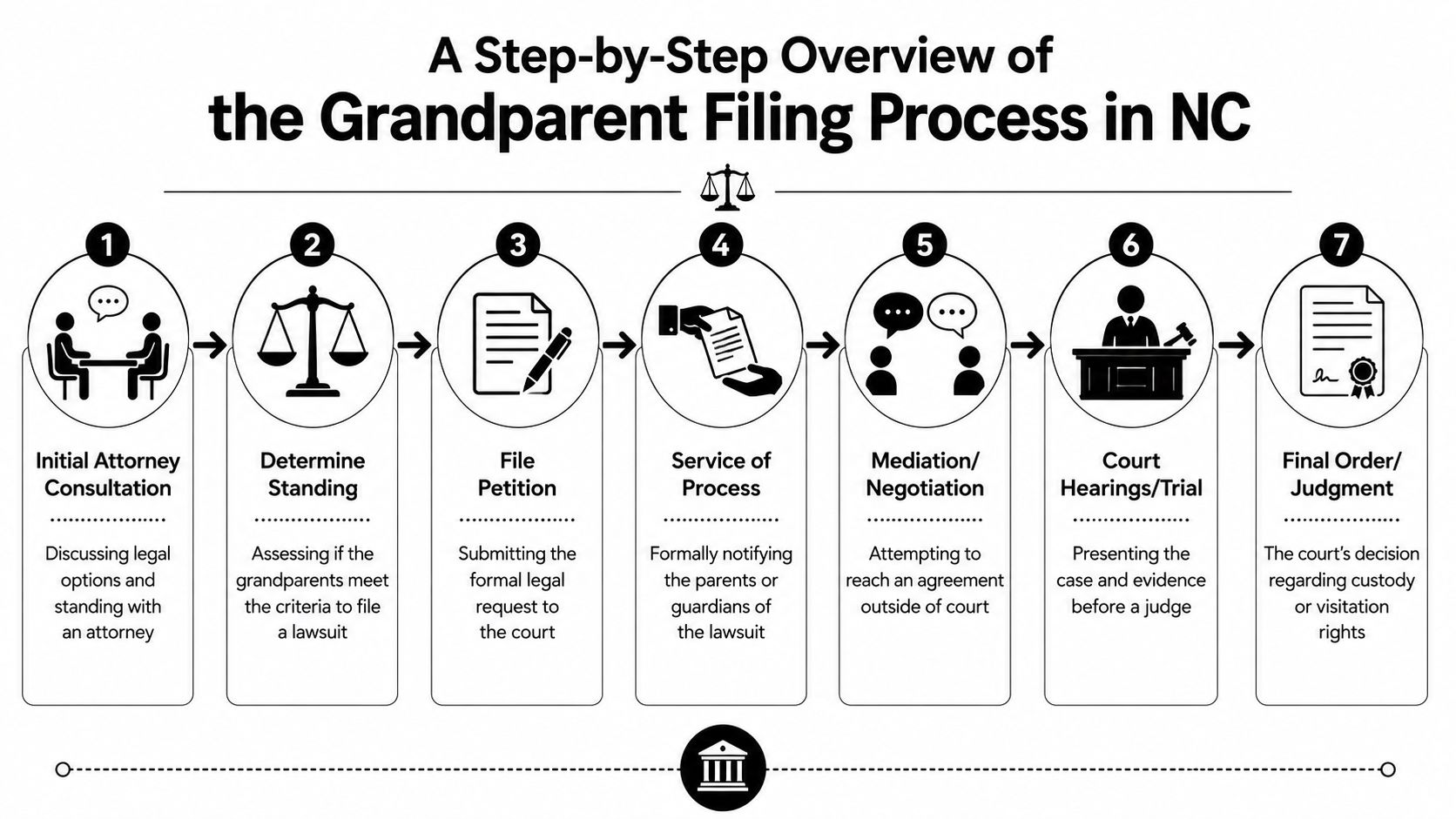
The process usually starts with a careful review of standing, family status, and existing court files. If you're dealing with an urgent caregiving issue, information on how to get temporary custody can help you understand what immediate relief may or may not be available under North Carolina practice.
Step one is checking whether you can file at all
Before drafting anything, identify the legal posture:
- Is there an active custody case already? If yes, intervention may be the correct route.
- Is there already a custody order? If yes, modification may be the issue.
- Are you alleging serious parental failure? If so, custody under Section 50-13.1(a) may be considered.
- Was there a stepparent or relative adoption? That may raise the Section 50-13.2A pathway.
The answer determines the form of filing and the legal standard you'll face.
Step two is filing in the proper county and serving the parents
According to this discussion of grandparent custody procedure in North Carolina, grandparents generally must file in the child's home county, serve notice on the parents, and be prepared for mediation or hearings. That same source explains that grandparents can't open a new custody case on their own if no dispute between parents is underway, and instead must intervene or file a motion within an existing proceeding.
That practical point trips people up. A grandparent may prepare a strong statement about the child bond, but if there is no qualifying procedural basis for a standalone filing, the court may never reach that evidence.
Here's a helpful overview of the process in visual form:
Step three is preparing for mediation, investigation, and hearing
Some counties require mediation before a judge hears the dispute. Mediation doesn't mean your concerns aren't serious. It means the court wants the parties to try to narrow issues or reach an agreement before a contested hearing.
The court may also appoint a guardian ad litem for the child. In plain English, that is a person appointed to represent the child's interests in the litigation.
You should expect to gather and organize evidence such as:
- Caregiving history: School pickups, overnights, medical involvement, and consistent routines.
- Records and communications: Texts, calendars, attendance issues, or other documentation tied to the child's welfare.
- Witness testimony: Teachers, relatives, or others with direct knowledge of your role and the child's needs.
- Current concerns: Specific facts about instability, neglect, or disruption. Not general frustration with a parent.
The strongest grandparent cases are fact-heavy, organized, and tied directly to the child's welfare rather than adult grievances.
What doesn't work well
Several patterns tend to hurt these cases:
- Filing based on emotion alone: Judges need facts and legal standing.
- Attacking the parent personally: Courts focus on parenting conduct and the child's needs.
- Relying on verbal promises: "She always said I'd see him every Christmas" isn't the same as an enforceable order.
- Waiting too long during active litigation: Some rights depend on acting before a case is resolved.
Grandparents rights in NC are narrow enough that procedural mistakes can be expensive in both time and opportunity.
Parental Defenses and the Best Interest of the Child Standard
Parents typically do not remain quiet when these cases arise. Even when a grandparent has standing, the parent will often argue that court-ordered involvement would create more conflict, undermine household rules, or interfere with the child's stability.

Common defenses parents raise
A parent may claim:
- The grandparent undermines authority: For example, ignoring discipline rules or speaking badly about a parent.
- The case is adult-driven: The parent may argue the filing is really about family control, not the child.
- The proposed schedule is disruptive: School, therapy, sports, and routines often become part of the argument.
- The home conflict is harmful: If exchanges are tense, the parent may argue contact increases stress for the child.
Those defenses aren't always persuasive, but they are common. A grandparent should be ready to answer them with calm, specific evidence.
How judges think about best interests
Once the court reaches the merits, the judge focuses on the best interest of the child. This overview of the best interest of the child in North Carolina is a useful starting point for understanding that framework.
In practical terms, judges often look closely at:
- The child's welfare and needs
- The existing bond between the child and grandparent
- Stability and consistency in the child's life
- Each adult's ability to support the child's well-being
- Whether the requested arrangement helps or harms the child
A judge is less interested in who feels wronged and more interested in what arrangement serves the child going forward.
This is why respectful conduct matters. A grandparent who documents care, stays child-focused, and avoids escalating family warfare usually presents a stronger case than one who treats litigation as a referendum on a parent's character.
NC Grandparents Rights FAQs and Your Next Steps
Can great-grandparents, aunts, or uncles file for visitation in North Carolina?
Usually, the statutes are much narrower for people other than grandparents. In many situations, the law primarily recognizes biological or step-grandparents, and other relatives may have limited options unless unusual facts apply.
Is a verbal agreement for visits enforceable?
Usually not in the way people hope. If a parent informally promises visits and later changes course, that promise is difficult to enforce unless it became part of a court order or another enforceable legal arrangement.
How long does a grandparents' rights case take?
There isn't one reliable answer. Timing depends on whether there's already a pending case, whether mediation is required, how quickly service is completed, and whether the matter settles or goes to hearing.
If I've practically raised my grandchild, does that matter?
Yes, it can matter a great deal. A long caregiving history, especially where a grandparent has functioned like a parent, may be legally significant. But it still has to fit a recognized path under North Carolina law.
If you're dealing with grandparents rights in NC, don't assume the strength of your bond alone will open the courthouse door. The law is technical, and timing can change your options. The right next step is a focused legal review of your family situation, your standing, and the remedy that matches the facts.
If you're a North Carolina grandparent facing the loss of contact with a grandchild, or you're concerned a child needs the protection of a custody case, schedule a consultation with the Law Office of Bryan Fagan. The firm handles North Carolina family law matters, including custody disputes, and can help you evaluate whether you have standing, what statute may apply, and what steps make sense for your situation.