You may be sitting at the kitchen table, trying to figure out what happens next. One spouse has already moved out, or the conversation is coming soon. Bills still need to be paid. The children still need a schedule. The house, retirement accounts, and debt haven't disappeared just because the marriage is under strain.
A lot of North Carolina spouses start in the same place, with the same fear. They think they need to file something immediately or sign a formal document before they can even say they're separated. That belief causes confusion, rushed decisions, and sometimes bad agreements.
Starting Your Separation Journey in North Carolina
One of the most common misconceptions I see is the idea that a signed separation agreement is required before a couple is legally separated. It isn't. In fact, legal assistance data in North Carolina shows that 68% of people seeking separation guidance mistakenly believe a signed agreement is mandatory.

That misunderstanding matters because it often keeps people stuck. They delay a necessary move, tolerate financial uncertainty, or sign terms they don't fully understand because they think the document itself creates the separation.
Separation in North Carolina starts with living apart
In North Carolina, separation is based on facts, not a court filing. A couple becomes separated when they live in separate residences and at least one spouse intends for the separation to be permanent or indefinite. If you want a more detailed explanation of the legal standard, this overview of what legal separation means in NC is a helpful starting point.
Practical rule: You don't need a judge's permission, a filed lawsuit, or your spouse's agreement to begin living separately.
That doesn't mean a separation agreement lacks value. It means the document is optional, not irrelevant. Used well, it can organize the most important parts of your life while you live apart. Used poorly, it can create years of avoidable conflict.
Why this distinction matters right away
If you believe the agreement is mandatory, you may treat it like a box to check. That's a mistake. A North Carolina separation agreement is a strategic contract. It should be negotiated carefully, with attention to support, custody, property, debts, and how the terms will work in real life.
For example, if one spouse stays in the home and the other pays the mortgage for a period of time, the agreement should spell out whether that payment is temporary support, an advance on property division, or a shared debt arrangement. If it doesn't, arguments usually follow.
People going through separation need clarity, not pressure. The first step is knowing that the law gives you room to separate first and decide later whether a formal agreement makes sense for your situation.
What Is a Separation Agreement in NC
A North Carolina separation agreement is a private contract between spouses who are already living separately. It is not a court order, and it is not the event that makes you separated. It is the written document that sets rules for the separation period and, in many cases, beyond.
Under North Carolina law, a couple is legally separated when they live in separate residences and one spouse intends to remain apart. No court filing is required for that status. But to obtain an absolute divorce, the spouses must live separate and apart for one year and one day under N.C. Gen. Stat. § 52-10.1, as summarized in this explanation of legally binding separation agreements in North Carolina.
What the agreement does and does not do
The easiest way to think about it is this. If marriage is partly a legal and financial partnership, the separation agreement is the contract that governs how that partnership functions while the spouses live apart.
It can address:
- Property division so each spouse knows who keeps what
- Spousal support so monthly obligations are clear
- Custody terms so parenting time is predictable
- Child support so financial responsibilities are spelled out
- Debt allocation so joint obligations don't become a surprise later
It does not do certain things people often assume it does.
- It does not prove the separation by itself
- It does not shorten the waiting period for divorce
- It is not required before a divorce can eventually be filed
That's why a rushed, generic document often causes trouble. A proper agreement should match the couple's actual finances, parenting needs, and long-term goals.
Why many spouses still choose one
Even though it's voluntary, a separation agreement can reduce uncertainty during the year apart. If one parent wants a holiday schedule in writing, or one spouse wants certainty about who pays the credit card debt, the agreement gives both sides structure.
Some people also use a Memorandum of Separation, which is a shorter recorded document tied to a broader agreement. Whether that makes sense depends on the assets involved and what protection is needed.
For spouses who want a practical overview, Separation Agreements in North Carolina explains how a separation agreement can resolve property, support, and custody. That's the core purpose of the document. It creates a clear plan while the legal clock toward divorce runs.
A strong separation agreement doesn't create the separation. It manages the consequences of it.
Key Clauses in a North Carolina Separation Agreement
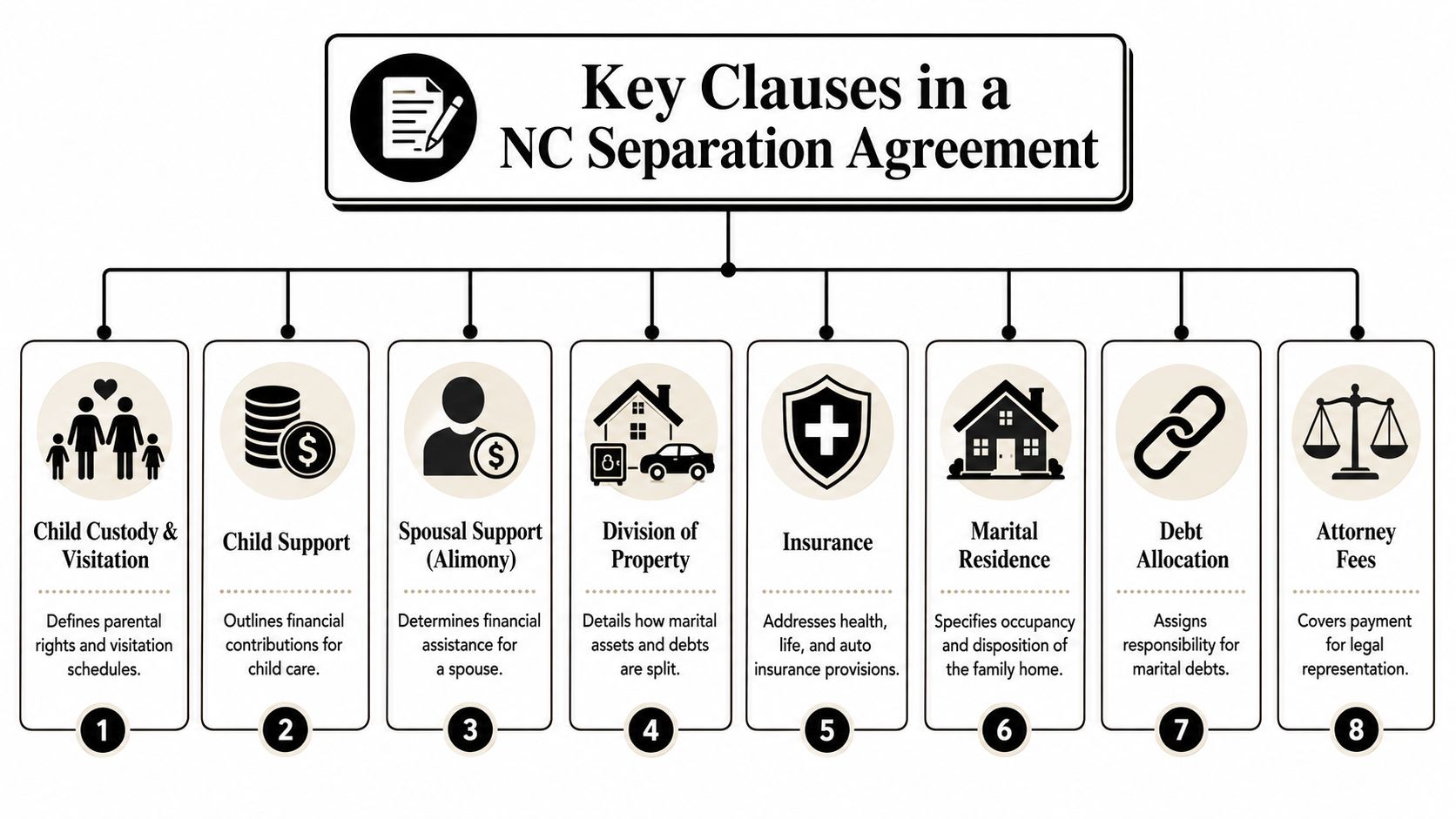
A useful separation agreement NC document is specific. Vague language creates expensive problems later. If a term matters to your daily life or financial future, it belongs in writing.
Property division
In court, North Carolina starts with the presumption that marital property is divided 50-50. But spouses can agree to a different split in a notarized separation agreement, including a 60-40 division if both believe it is fair, as described in this guide to North Carolina separation agreement terms from Seymour Johnson Air Force Base's separation agreement survival guide.
That flexibility matters. Court presumptions are a starting point, not a command when both spouses voluntarily contract around them.
A common example involves the house. One spouse may want to keep the home for the children's stability. The other may prefer a larger share of retirement assets instead of forcing a sale. That can work if the agreement clearly states who keeps the home, who refinances, who pays taxes and insurance, and when the other spouse's name will be removed from liability.
If you're sorting out assets acquired during the marriage, this explanation of equitable distribution in North Carolina can help frame the issue.
Spousal support
Support clauses often cause the most emotion because they blend law, cash flow, and resentment. In plain terms, postseparation support is temporary financial support after separation, while alimony usually refers to longer-term support.
A workable agreement answers practical questions, such as:
- Amount and timing so each spouse knows when payments are due
- Duration so nobody is left guessing whether support lasts months or years
- Method of payment so there is a clear record
- Events that end support such as remarriage or another specified event if the law and agreement permit
One spouse might agree to pay monthly support while the other completes training or reenters the workforce. If that arrangement is intended to be fixed, the wording matters. If it's sloppy, the parties may later fight over whether the payment was support, help with rent, or an advance on property division.
Child custody and parenting schedules
Parents often say they want to “share custody,” but that phrase alone doesn't solve anything. A real agreement should address who makes major decisions, where the children spend school nights, how holidays work, how exchanges happen, and what notice is required for travel.
A detailed parenting plan can cover issues such as:
| Topic | Why it matters |
|---|---|
| School-week schedule | Reduces last-minute conflict |
| Holidays and birthdays | Prevents recurring annual disputes |
| Transportation | Clarifies pickup and drop-off duties |
| Communication rules | Sets expectations for parents and children |
A practical example is a family with two school-age children. One parent may handle weekday routines because of proximity to school, while the other has alternate weekends and one overnight during the week. If the agreement doesn't address school breaks, extracurricular costs, and medical decisions, the disputes tend to show up later.
Child support
Parents can agree on many parenting terms, but child support must still be enforceable under North Carolina standards. If the amount in the agreement ignores the state guidelines, that creates risk.
Child support language needs to work on paper and hold up if a judge ever reviews it.
The agreement should also say who pays for health insurance, uncovered medical costs, school fees, and similar expenses. Those details matter just as much as the monthly number.
Debt allocation
Debt is often the forgotten clause. It shouldn't be. A separation agreement should identify each debt and assign responsibility with precision.
- Mortgage debt should state who pays, whether the home will be refinanced, and what happens if payments stop.
- Credit cards should identify balances and whether charges after separation are individual or joint responsibility.
- Vehicle loans should connect the debt to the person keeping the car.
One caution is worth repeating. Assigning a debt between spouses doesn't automatically remove a lender's contractual rights. If both spouses signed for the debt, the creditor may still pursue either one unless the debt is refinanced or otherwise resolved.
Other clauses people overlook
Several clauses don't get enough attention until a dispute starts.
- Insurance provisions can require life insurance to secure support obligations.
- Attorney fee clauses can address whether one spouse pays fees if enforcement becomes necessary.
- Dispute resolution terms can require mediation or arbitration before a lawsuit over contract issues.
These provisions often determine whether the agreement remains manageable or becomes a second round of litigation.
Enforceability and the Legal Power of Your Agreement
A separation agreement is only valuable if it is enforceable. In North Carolina, that starts with execution formalities and then moves to a choice that many people miss entirely: whether the agreement will be incorporated into the divorce judgment.

Notarization is not optional
North Carolina treats a separation agreement as a contract. To be admissible and enforceable as that contract, it must be properly signed and notarized. If the document isn't notarized, the parties may have a piece of paper that reflects intentions but fails when enforcement becomes necessary.
This is one reason homemade agreements often backfire. The parties may agree on the substance, but they skip the formalities or use language that creates confusion about whether a promise is binding.
Bottom line: A poorly executed agreement can be harder to fix than a disagreement that was never put in writing.
Incorporation and non-incorporation
One of the most important drafting decisions is whether the agreement, or certain provisions of it, will be incorporated into the divorce decree later.
A North Carolina separation agreement can be drafted as a non-modifiable contract by including a clause that prevents incorporation into the divorce decree. That structure can make spousal support terms binding and unchangeable by the court later, as explained by the North Carolina Bar's article on separation agreements and non-incorporation.
That choice carries real consequences:
- Incorporated terms may become enforceable through the court as part of the divorce judgment.
- Unincorporated terms remain private contractual promises.
- Non-incorporation clauses can limit later court modification of certain promises, especially support terms that the parties want locked in.
For some spouses, non-incorporation offers certainty. For others, incorporation offers easier court enforcement. Neither path is automatically better. The right answer depends on the issue involved and the level of future flexibility each side needs.
A brief overview can help clarify what lawyers look for in a valid agreement:
Why structure matters long term
Take a common example. A spouse agrees to pay support for a fixed period in exchange for receiving more property. If the agreement is drafted one way, a later court may have room to modify parts of that arrangement. If it is drafted another way, the bargain may stay fixed as a contract.
That is why technical language matters. A separation agreement NC document isn't just about memorializing good intentions. It is about deciding, in advance, how much control the parties and the court will have later.
The Process for Creating a Valid NC Separation Agreement
Individuals often feel overwhelmed because they think the process is mysterious. It isn't. It's demanding, but it's manageable when handled in the right order.
Start with full financial disclosure
Before anyone negotiates intelligently, both spouses need a clear picture of the finances. That means income, bank accounts, retirement assets, debts, monthly expenses, real estate, and insurance.
If one spouse hides information, the agreement may become harder to defend and easier to attack. Even when there's no outright concealment, partial disclosure causes bad decisions. A spouse may give up equity in the house without realizing the retirement accounts are worth more, or agree to support terms without understanding the actual budget.
Choose a negotiation path that fits the conflict level
Not every couple needs the same process. Some can negotiate directly through counsel. Others need mediation. Some need a more structured collaborative approach because communication breaks down too quickly.
Common paths include:
- Lawyer-assisted negotiation when both spouses want a defined legal framework.
- Mediation when the parties need a neutral setting to reach terms.
- Hybrid negotiation when a mediator helps with some issues and attorneys handle drafting and review.
If you're still early in the process and trying to understand the logistics of separation itself, this resource on how separation works in North Carolina can help clarify where the agreement fits.
Reduce every deal point to precise language
Many private agreements fail because the parties may agree in principle, but the draft doesn't answer operational questions.
A good draft should identify:
- Who pays what and by what date
- Which property transfers and when
- How parenting exchanges happen
- What happens if someone defaults
- Whether disputes go to mediation first
One example is the family vehicle. It's not enough to write that one spouse “gets the car.” The agreement should also state who holds title, who pays the loan, when refinancing must happen if possible, and who carries insurance.
Review carefully, then sign and notarize correctly
The final stage should never be rushed. Each spouse should review the final draft with counsel, ask questions, and make sure the practical terms match the legal language.
Then comes execution. The agreement must be signed and notarized after the spouses are living separately if it is intended to function as a North Carolina separation agreement. That formality is what gives the document legal force as a contract.
A valid agreement usually looks calm on paper. That calm result often comes from careful drafting behind the scenes.
Common Pitfalls That Can Invalidate Your Agreement
The biggest mistakes in separation agreements usually come from assumptions. People assume reconciliation won't matter. They assume a template from another state is close enough. They assume “we both know what we meant” is the same as clear drafting. It isn't.
Reconciliation can undo more than people expect
North Carolina case law, including In re Estate of Adamee (1976), recognizes that reconciliation can terminate unexecuted promises in a separation agreement. If spouses reconcile, even briefly, they may lose agreed terms involving future support or property transfers, as discussed in this University of North Carolina School of Government material on separation agreement problems and reconciliation.
That catches many people off guard.
Take a simple scenario. A couple signs an agreement saying the husband will transfer a vehicle title in sixty days and pay support for a defined period. They then try living together again for a short time. The reconciliation fails. If the agreement was not structured to preserve certain provisions, one or both spouses may discover that parts of their prior deal no longer operate the way they expected.
A brief reunion can create legal consequences far out of proportion to the emotional decision that caused it.
Generic templates create North Carolina-specific problems
Online forms often use the right vocabulary but the wrong law. They may omit notarization language, use provisions borrowed from another state, or fail to reflect how North Carolina treats support, custody, and property rights.
A template also won't ask the hard follow-up questions. Who claims the children for tax purposes? What if the house doesn't refinance? Does the support obligation survive remarriage, or end automatically? If the language isn't there, the conflict remains.
Duress and incomplete disclosure can poison the document
A separation agreement should be voluntary. If one spouse signs because of threats, intimidation, or pressure that undermines genuine consent, enforceability becomes an issue.
The same is true when one spouse withholds critical financial information. A spouse who signs without knowing about major debt, hidden accounts, or the true value of assets may later challenge the fairness or validity of the deal.
Verbal side promises usually fail when tested
Clients sometimes tell me, “We left that out because we agreed privately.” That's risky. If a term matters, it belongs in the written agreement.
Examples include:
- Private repayment plans for joint credit card balances
- Undocumented custody swaps that differ from the written schedule
- Informal promises to sell the house later or divide proceeds differently
When conflict returns, the written document usually controls the dispute. Side promises are hard to prove and even harder to enforce.
Frequently Asked Questions About Separation Agreements
Does my spouse have to sign a separation agreement?
No. A separation agreement is voluntary. One spouse cannot force the other to sign it. If your spouse refuses, you may still live separately and address some issues later through court procedures if necessary.
Can we use an online template for a separation agreement NC matter?
You can, but that doesn't mean you should. The main risk isn't just bad wording. It's leaving out terms that matter under North Carolina law, failing to address practical issues like debt and insurance, or signing a document that doesn't fit your situation. Templates rarely ask enough questions.
Can a separation agreement be changed later?
Sometimes, yes. It depends on how it was drafted and whether both parties agree to modify it in writing. Some agreements are structured to remain private contracts with strong limits on later court modification. Others may become part of a divorce judgment. The details matter.
What if we reconcile after signing?
That is one of the most dangerous points in this area of law. As discussed earlier, reconciliation can affect whether unexecuted promises survive. If you and your spouse resume the marital relationship after signing, get legal advice before assuming the old agreement still protects you.
How much does it cost to have an attorney draft one?
The cost varies based on complexity. A short agreement for a couple with limited assets is different from a high-conflict matter involving a house, retirement accounts, support, and a detailed parenting plan. The better question is usually not “What is the cheapest document?” but “What mistakes will cost more later if this is drafted badly?”
Paying for clarity on the front end is often cheaper than litigating ambiguity later.
Protect Your Future with a Strategic Separation Agreement
A separation agreement can be optional and still be one of the most important documents you sign. That's the key point many North Carolina spouses miss. You don't need one to become separated, but if you choose to use one, it needs to be accurate, complete, and built for your actual life.
The strongest agreements do more than divide property. They reduce uncertainty. They set expectations. They protect parenting routines, financial planning, and enforceable rights. They also account for risks people often overlook, including debt exposure, support terms that need precision, and the possibility that reconciliation may affect the deal.
No article can replace legal advice suited to your particular facts. A family with young children, a marital home, and uneven income needs a different strategy than a couple with no children and separate finances. The same is true for spouses trying to preserve privacy, avoid court modification of support, or negotiate an unequal division of property by agreement.
If you're considering a separation agreement in North Carolina, treat it like a legal contract with long-term consequences. Because that's exactly what it is.
If you're facing separation and need guidance specific to North Carolina law, consider scheduling a consultation with Law Office of Bryan Fagan. The firm works with clients on family law matters including separation agreements, divorce, custody, support, and property issues, and a consultation can help you understand your options before you sign anything.