You owned a Raleigh home before marriage. At the wedding, it was worth $250,000. By separation, its value had reached $475,000, while marital earnings had paid down $40,000 of mortgage principal. The difficult question isn't just who owns the house. It's how North Carolina treats the $225,000 increase in value, the mortgage reduction, and any improvements or management that helped create the equity.
That question appears in disputes involving homes, brokerage accounts, professional practices, family businesses, and real estate holdings. Under North Carolina's equitable distribution law, passive appreciation generally remains separate, while active appreciation connected to marital labor, management, or money may be treated as marital property. The answer can change the amount one spouse keeps or shares, sometimes by a substantial margin.
Why Appreciation Matters in a North Carolina Divorce
North Carolina doesn't divide property merely by looking at whose name appears on a deed or account statement. The court examines when the asset was acquired, how its value changed, and whether either spouse or the marital partnership contributed to that change. That makes appreciation one of the most important issues in a high-asset equitable distribution case.
Return to the Raleigh house. If the increase from $250,000 to $475,000 came entirely from inflation and the housing market, the owner may argue that the growth was passive and should remain separate. If marital income paid down principal, or a spouse renovated, managed, or materially improved the property, the other spouse may claim that some portion of the increased equity resulted from marital contributions.
The court may not treat every dollar of increase the same way. A valuation professional might separate market-driven growth from value connected to improvements, labor, management, or marital funds. The underlying property can remain separate while a marital estate receives credit for contributions or active growth, depending on the evidence and the applicable appellate decisions.
Practical rule: The real dispute usually isn't “Did the property go up in value?” It's “What caused the increase, and can that cause be proved?”
The North Carolina rules about who gets the house in a divorce become more complicated when the home was owned before marriage. A spouse may have a separate-property claim, but that claim doesn't automatically erase the other spouse's potential interest in mortgage payments, renovations, maintenance, or other contributions.
The same analysis applies to a business. Market conditions may raise the value of a company without either spouse doing anything unusual. But if one spouse worked in the business, made strategic decisions, expanded operations, or invested marital funds, the increase may have an active component. That distinction affects both classification and the final distribution.
How North Carolina Classifies Property in Equitable Distribution
G.S. 50-20 requires a North Carolina court to move through classification, valuation, and distribution. The statute requires the court to identify property as marital, divisible, or separate, determine the relevant value, and then distribute the estate equitably. The statute also addresses changes in value after separation and before distribution, subject to exceptions for changes caused by a spouse's post-separation actions or activities. G.S. 50-20 provides the governing framework.
The three categories
| Category | Definition | Example | Treatment in Distribution |
|---|---|---|---|
| Separate property | Property owned before marriage, or acquired individually through a qualifying gift or inheritance | A home purchased before the wedding | Generally excluded, although marital contributions and active appreciation can create a distribution issue |
| Marital property | Property acquired by either spouse during the marriage and owned at separation, subject to statutory exceptions | A retirement account funded with marital earnings | Included in the equitable distribution estate |
| Divisible property | Certain post-separation income, interests, appreciation, or diminution connected to marital property | Interest or dividends earned after separation on a marital account | Classified and distributed under the statute |
The first question is classification. A court asks what the asset was and when it was acquired. A premarital home usually begins as separate property. An account funded during the marriage usually begins as marital property. An inheritance may remain separate if the recipient keeps it identifiable and doesn't convert it through marital use or other conduct.
The second question is valuation. North Carolina generally values marital property as of the date of separation, while divisible-property rules address qualifying changes between separation and distribution. This is why a party needs reliable records and, when appropriate, professional valuation evidence.
The third question is distribution. North Carolina has a strong statutory presumption in favor of equal division, but the statute permits an unequal result when equal division would be inequitable after consideration of the relevant factors. Equitable Distribution of Property in North Carolina describes this process as equitable distribution rather than community property division.
Appreciation isn't a fourth category. It follows the classification of the underlying asset and the source of the growth. For a broader discussion of classification, see Marital Property in North Carolina. The classification stage is often where the most important appreciation dispute is won or lost.
Active vs Passive Appreciation Explained
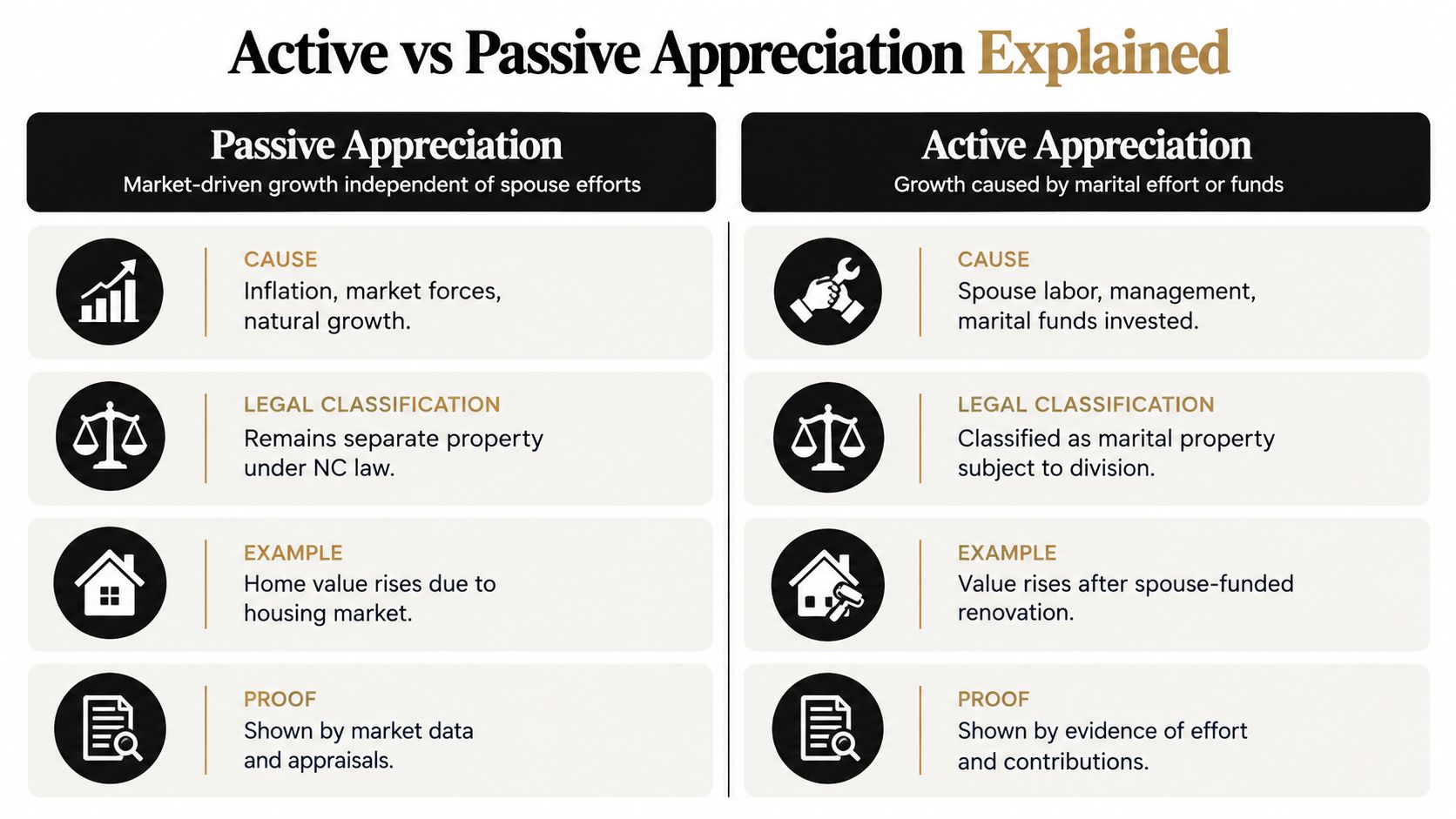
Passive appreciation is growth caused by forces outside either spouse's control, such as inflation, changing economic conditions, or market movement. North Carolina appellate decisions generally treat passive growth on separate property as remaining separate. If a premarital brokerage account rises because securities increase in market value and neither spouse contributes money or management, the owner has a strong argument that the increase is passive.
Active appreciation results from effort or resources connected to the marriage. It can involve a spouse's labor, managerial decisions, professional services, marital funds, debt reduction, or improvements. If marital money funds a renovation that increases a separate home's value, or a spouse actively manages a separate business and produces growth, the increase may be classified differently.
One asset can contain both forms
A home may rise in value because the local market improved, while also gaining value from a spouse's renovation work. A business may benefit from industry growth while the owner spouse's management expands revenue or improves operations. A court doesn't have to choose between “all passive” and “all active” if the evidence supports both.
The practical test is causation. What caused the increase? Was the cause external and market-driven, or did marital labor, funds, or management materially contribute? The party making the claim needs evidence that connects the contribution to the value change.
A useful rule of thumb is simple, but not conclusive: market movement points toward passive appreciation, while identifiable marital effort or money points toward active appreciation. The rule doesn't decide the case by itself. It only identifies the evidence that matters.
Appreciation disputes should also be kept separate from issues such as alimony. For example, How Marital Misconduct Affects Alimony in NC concerns how adultery and other misconduct can affect an alimony outcome. That is a different analysis from classifying appreciation in equitable distribution.
Key NC Case Law That Shapes the Doctrine
North Carolina's appellate decisions provide the working vocabulary for active and passive appreciation. In Wade v. Wade (1985), the Court of Appeals explained that the statute referred to passive appreciation, including growth caused by inflation, rather than appreciation produced by the contributions of one or both spouses. The decision established the important distinction between external growth and value created through marital effort.
Chandler v. Chandler (1992) addressed appreciation after separation of a marital asset. The court held that post-separation appreciation, whether passive or caused by one spouse's efforts, wasn't itself marital property available for distribution as marital property. Later decisions recognized that post-separation appreciation can still matter through valuation and equitable distribution credits.
Sharp v. Sharp (1994) is important because it recognized that a trial court may distribute marital property in any ratio it finds equitable and may use adjustive credits reflecting post-separation appreciation as a distributional factor. That means classification and distribution aren't always identical questions. A change may not become marital property, yet still influence the equitable result.
Smith v. Smith clarified the trial court's obligation to make written findings concerning whether total post-separation appreciation was active or passive. The court didn't require judges to quantify active and passive appreciation separately for every asset, but it did require ultimate findings addressing the character of the appreciation.
Foster v. Foster (2023) continued the doctrine by defining active appreciation as growth connected to financial or managerial contributions and passive appreciation as growth caused solely by inflation or forces beyond either spouse's control. In a hybrid asset, the judge must weigh the competing evidence rather than rely on title alone.
| Case | Asset Type | Court's Holding | Practical Takeaway |
|---|---|---|---|
| Wade v. Wade | Separate property and appreciation | Labor, services, or management can make appreciation active | Prove the contribution and its connection to growth |
| Chandler v. Chandler | Marital asset after separation | Post-separation appreciation isn't itself marital property | Separate classification from distributional credits |
| Sharp v. Sharp | Marital property and post-separation change | Courts may use adjustive credits in an equitable distribution | A value change can affect the result without changing classification |
| Smith v. Smith | Appreciation after separation | Written findings must address whether appreciation was active or passive | Trial findings matter on appeal |
| Foster v. Foster | Separate and hybrid assets | Active growth follows financial or managerial contribution, passive growth follows outside forces | Mixed causation requires careful proof |
A North Carolina Divorce Lawyer handling a complex property case will typically focus on the asset's history, contribution records, valuation evidence, and the precise findings the court must make.
How Courts Apportion Appreciation in Practice
The arithmetic can look straightforward, but courts don't divide an increase just because the numbers are large. They first identify the starting value, the value at separation, the funds or labor contributed during marriage, and the evidence connecting those contributions to the final value.
Consider three simplified illustrations. These aren't predictions of a particular result, because actual apportionment depends on records, expert opinions, credibility, debt, and the court's findings.
| Asset | Starting Value | Value at Separation | Marital Contribution | Marital Share |
|---|---|---|---|---|
| Residence | $200,000 | $350,000 | $40,000 principal reduction | Requires analysis of market growth, debt reduction, and improvements |
| Brokerage account | $50,000 | $120,000 | $30,000 marital contributions | Contributions are potentially marital, while market growth requires tracing |
| Family LLC interest | $100,000 | $400,000 | Active consultation and management | Depends on proof connecting work to business growth |
Residence
A residence purchased before marriage for $200,000 is worth $350,000 at separation. The gross increase is $150,000. If marital earnings reduced principal by $40,000, that payment is an identifiable marital contribution, but it isn't automatically equal to $40,000 of appreciation.
The court may need to determine the home's debt at relevant dates, the value created by market movement, and whether renovations or management produced additional value. A qualified appraiser can address comparable sales and improvement value. Financial records can show the source of mortgage payments.
Brokerage account
An account begins with a separate balance of $50,000 and reaches $120,000 at separation. The spouses contributed an additional $30,000 from marital income. The records must distinguish the original balance, later contributions, withdrawals, dividends, and market gains.
The $30,000 contribution may be treated as marital, while the original balance may remain separate. The remaining growth can't be labeled automatically. A forensic review may be needed to determine how much resulted from market movement on separate funds and how much followed marital contributions or active trading.
Family LLC interest
A spouse owns a 25 percent interest in a family LLC worth $100,000 before marriage and $400,000 at separation. The spouse also consulted on operations. The increase may include industry or market forces, retained earnings, capital changes, and active management.
An expert can compare business performance, compensation, distributions, operational decisions, and comparable-company evidence. Unsupported statements that “I helped the business” usually carry less weight than calendars, emails, financial records, job descriptions, and expert analysis connecting the work to value.
Tracing, Burden of Proof, and Common Evidentiary Issues
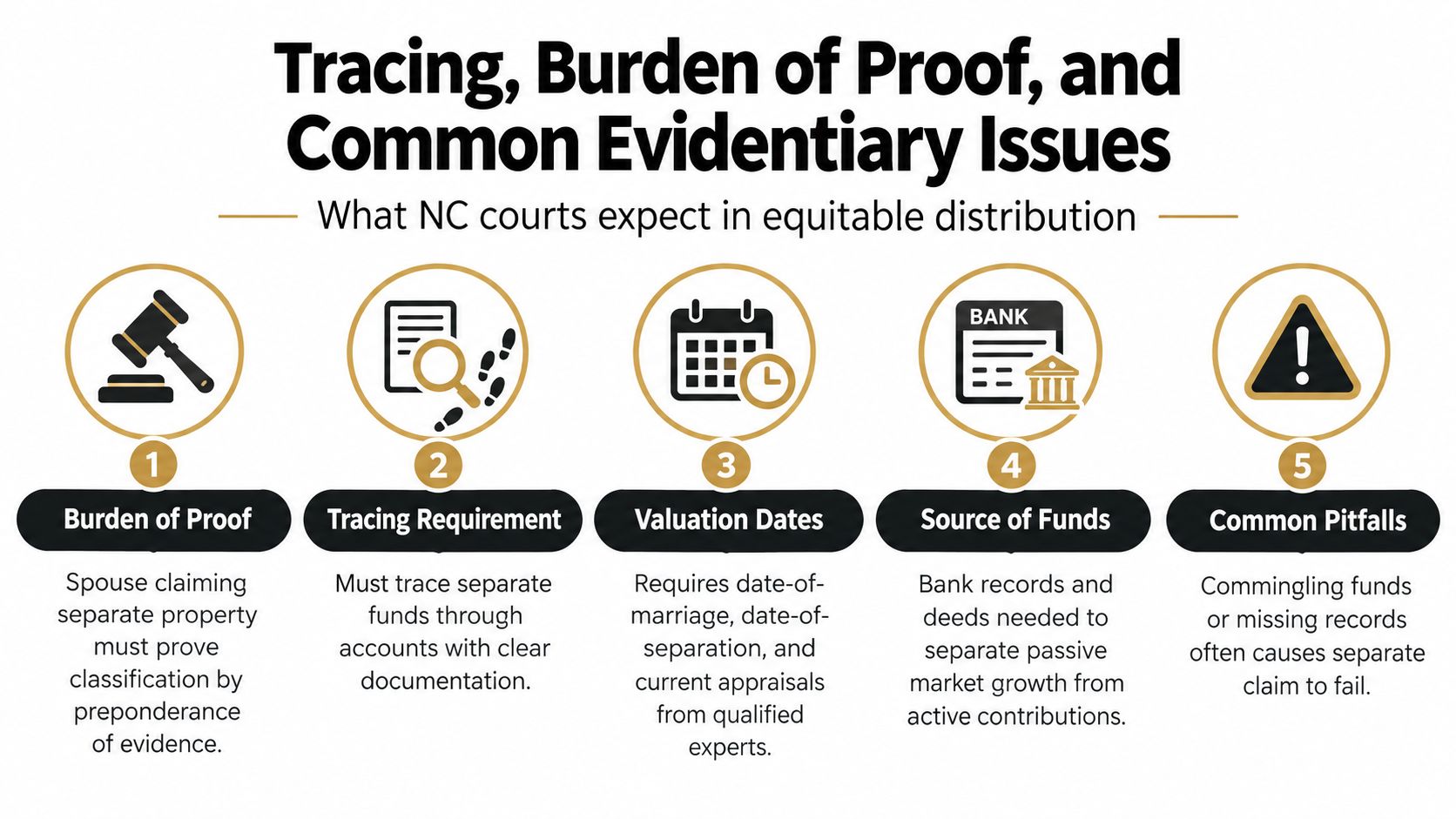
A spouse claiming that appreciation or an asset is separate must prove the separate character through evidence. North Carolina materials describe a difficult burden when separate property increases during marriage and the increase may be tied to marital effort. The owner generally needs to show the source of the property and explain what happened to it over time.
Tracing begins with documents, not recollection. Useful records can include:
- Bank statements: Show deposits, transfers, withdrawals, and the source of funds.
- Brokerage records: Identify the premarital balance, later contributions, reinvested income, and trading activity.
- Deeds and closing documents: Establish ownership, acquisition dates, debt, and transaction values.
- Business records: Include tax returns, general ledgers, payroll information, distributions, and ownership documents.
- Expert reconstructions: A forensic accountant or valuation professional can organize incomplete records and test competing explanations.
Where claims often weaken
Commingling creates problems when separate and marital funds flow through the same account without reliable documentation. A spouse may remember which money was premarital, but testimony alone may not explain every transfer, withdrawal, reinvestment, and balance.
Informal spreadsheets can help organize a case, but they don't replace original records. Experts also need a dependable factual foundation. A valuation opinion that assumes a spouse's work created all growth, without testing market conditions or business records, can face serious challenges.
Business valuation adds another layer. The value may reflect goodwill, retained earnings, owner compensation, market conditions, or active management. A business valuation for divorce should address the valuation date and explain the methodology rather than merely offer a conclusion.
Practical Steps to Protect or Claim Appreciation
The strongest appreciation claims are built before trial. A spouse who owns separate property should preserve its identity. A spouse seeking a marital share should document the contributions that allegedly created value.

During marriage, practical safeguards include:
- Keep separate funds identifiable. Use separate accounts where possible and avoid depositing marital earnings into a premarital account without a clear reason and complete records.
- Document improvements. Preserve invoices, permits, contracts, photographs, and proof of who paid for renovations or repairs.
- Record premarital values. Keep deeds, closing statements, account statements, tax records, and prior appraisals.
- Track business involvement. Save compensation records, emails, calendars, operating documents, and evidence of management decisions.
- Obtain advice before major transfers. Moving funds, refinancing property, changing ownership, or using marital money on separate assets can affect later arguments.
Around separation, preserve account statements and request relevant financial information. A lawyer may consider preservation letters, temporary restraints when assets face dissipation, financial declarations, and formal discovery. The appropriate procedure depends on the facts and the immediate risk.
Experts should match the asset. A real estate appraiser may be appropriate for a residence, a business valuator for a closely held company, and a forensic accountant for mixed accounts. In mediation, a tracing analysis can turn an uncertain claim into a settlement position. Parties may also trade assets, such as keeping a residence in exchange for another spouse receiving a greater share of an account, but any trade should account for valuation uncertainty and tax consequences.
Frequently Asked Questions and Next Steps
Does the titled spouse always receive the appreciation?
No. Title is relevant, but it doesn't answer whether growth was passive or active. Marital money, labor, management, or improvements may support a claim to a marital share or an equitable distribution credit.
How long must a marriage last before appreciation becomes marital?
There isn't a simple duration rule that decides the issue. The analysis focuses on classification, the cause of the increase, the contributions made, and the evidence available.
What if the non-owning spouse paid the mortgage or made improvements?
Those payments or improvements may support a claim, but the spouse must connect the contribution to the asset and distinguish principal reduction, maintenance, and value-enhancing work. Records are especially important.
Are premarital stock options automatically separate?
Not necessarily. The classification may depend on when the options were earned, what services or employment period generated them, and whether marital effort contributed to the entitlement. The documents and vesting history matter.
What happens to appreciation after separation?
Under North Carolina law, post-separation changes may fall within divisible-property rules or affect distribution through credits and valuation analysis. The result depends on the asset, the cause of the change, and whether a spouse's post-separation actions produced it.
Every active versus passive appreciation dispute turns on facts, tracing, valuation, and proof. Gather deeds, statements, tax records, business documents, improvement invoices, and valuation materials before accounts are closed or assets are transferred. A consultation can help identify the classification issues and preserve the evidence needed for an informed strategy.
The Law Office of Bryan Fagan provides North Carolina-focused representation in equitable distribution and other family law disputes, including complex property division involving homes, businesses, and financial accounts. Visit Law Office of Bryan Fagan to schedule a consultation and discuss how active or passive appreciation may affect your case.