You've moved out of the family home in Raleigh, Charlotte, or another North Carolina community, and now you're looking at a mortgage statement, retirement account, vehicles, and bank records wondering which assets belong to the marriage and which belong to you. Your spouse may be making a similar list. The answer usually won't come from whose name appears on a document or who earned more money. It starts with classification, the legal process of deciding whether an asset is marital, separate, or divisible property.
North Carolina uses equitable distribution, not a community-property system. The court identifies the marital estate, values the property, and then decides how to distribute it fairly under North Carolina law. The date of separation is especially important because it generally marks the boundary for identifying marital property and the valuation point for that property under G.S. 50-20.
Introduction to Marital Property in North Carolina
A spouse leaves the marital home after years of marriage. The couple has a house, retirement savings, a vehicle bought during the marriage, and an inheritance received by one spouse. One spouse may argue that the house belongs to the person who paid the mortgage. The other may believe that family use makes every asset divisible. Neither conclusion follows automatically.
North Carolina courts examine the facts in a set order: when property was acquired, where it came from, whether it remained separate, and what happened before and after separation. Those questions often overlap. A retirement account may include marital contributions and separate funds. A home owned before marriage may gain marital value through payments or improvements. A bank account may require tracing, like following colored threads through a tangled record, before the marital portion can be identified.
Why the date of separation matters
Property acquired after marriage and before separation is generally presumed marital unless it falls within a separate-property exception. The date of separation also generally provides the valuation point for marital property. A house, business interest, or retirement account may be worth more or less when the case is resolved, but later evidence may help establish its value at separation rather than automatically changing the legally relevant date. The governing framework appears in North Carolina's equitable distribution statute.
A vague statement such as “we separated sometime in the spring” can create a serious dispute. The spouses may disagree about when the marital relationship ended, whether they intended to separate, or whether their conduct supports one date over another. Communications, living arrangements, financial records, and account activity may help establish what occurred.
The date is only one part of the analysis. Classification determines whether an asset belongs in the marital estate, valuation determines its relevant worth, and equitable distribution determines how the estate should be divided. Commingling can complicate all three steps, while retirement accounts may require records showing contributions and growth over time.
Practical perspective: Before selling, transferring, withdrawing, or dividing significant property, identify the likely separation date and preserve records showing each asset's value, ownership history, and funding.
This guide addresses marital property NC residents may encounter in divorce or an equitable distribution claim. It explains the marital presumption, separate and divisible property, date-of-separation valuation, commingling, retirement accounts, and practical ways to preserve accurate financial information. Individual results depend on the facts and available evidence, so general information cannot replace legal advice about your circumstances.
How North Carolina Law Defines Marital and Separate Property
A retirement account may contain money earned before marriage, contributions made during the marriage, and investment changes after separation. North Carolina law does not classify the entire account by its title alone. The court first determines which portions are marital, separate, or potentially divisible, then values the relevant portions and addresses equitable distribution.
North Carolina begins with a statutory marital presumption. Under G.S. 50-20, property acquired by either spouse or both spouses during the marriage and before separation is presumed to be marital unless it falls within the statutory definition of separate property. The rule covers real and personal property and expressly includes vested and nonvested pension rights, retirement benefits, deferred compensation rights, and qualifying military pensions.
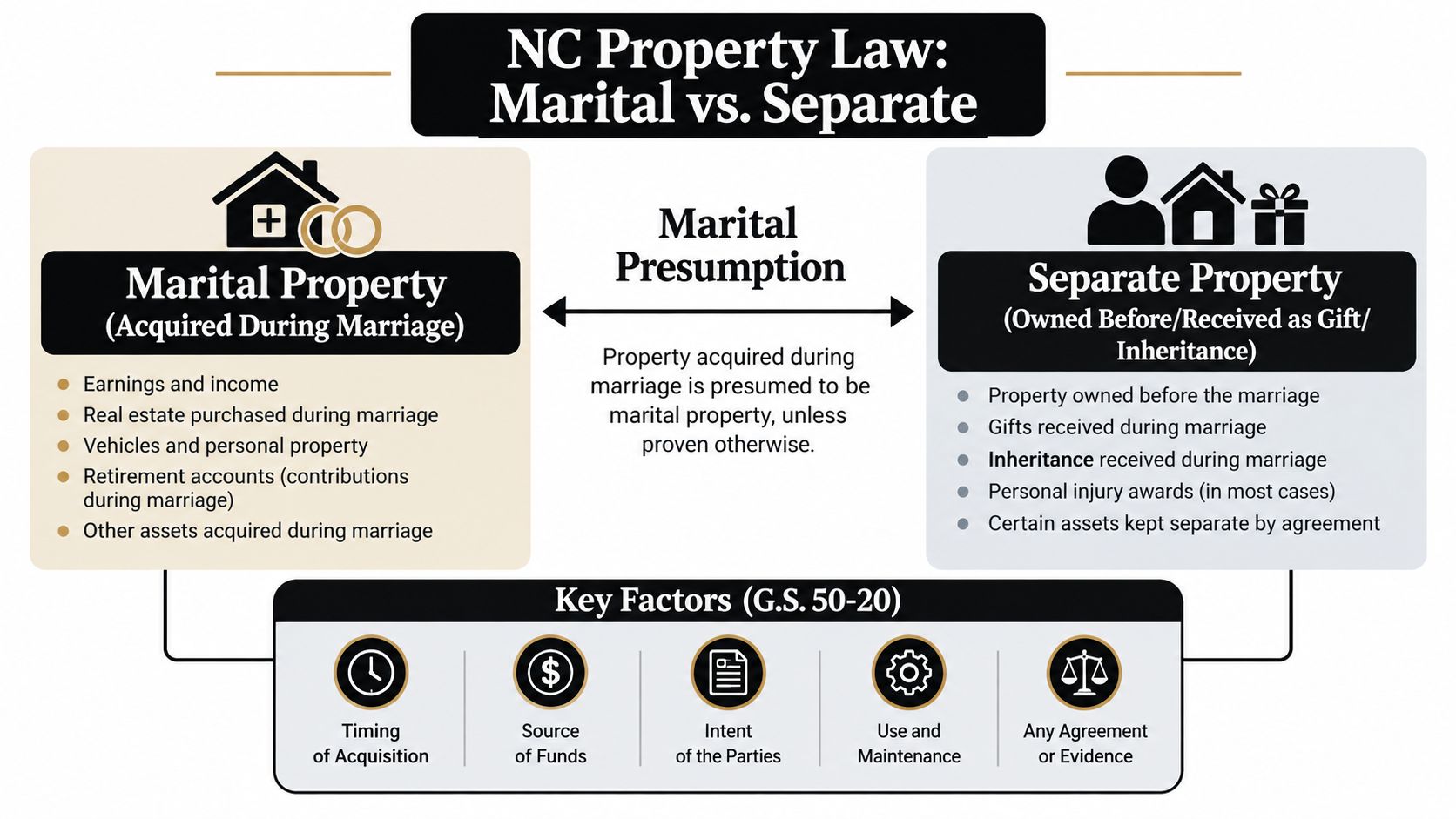
The presumption sets the starting point, not the final result. A spouse who claims that an asset is separate generally must produce evidence showing why a statutory exception applies. Account statements, purchase records, inheritance documents, loan histories, and other financial records can help establish that history.
The two bookends
The date of marriage and the date of separation provide practical bookends for classification:
- Before marriage: Property owned before marriage generally begins as separate property.
- During marriage: Property acquired after marriage and before separation generally begins with the marital presumption.
- After separation: Property acquired later is generally outside the marital estate, although post-separation changes connected to marital property may require a separate analysis.
Separate property can include property acquired before marriage, after separation, or by gift or inheritance from someone other than the spouse, provided the asset remains separate under the facts. The source and handling of the funds matter. An inheritance kept in an account used only by the recipient presents a different tracing issue from an inheritance deposited into a joint account and spent on shared expenses.
Title isn't the entire answer
A deed, account statement, or vehicle title may show ownership, but title alone does not always determine classification. Courts examine timing, the source of funds, the parties' intent, and whether separate property was exchanged, transferred, or mixed with marital funds.
For example, a vehicle purchased during the marriage and before separation generally begins in the marital estate when no separate-property exception applies. A savings account owned before marriage may begin as separate property, but later deposits and withdrawals can create tracing questions. Commingling does not answer the issue by itself. The records must show what happened to the funds.
Classification also affects the later valuation. North Carolina generally uses the date of separation to identify the relevant value of marital property, while certain post-separation changes may be addressed as divisible property under North Carolina equitable distribution. Separate property is not divided as marital property, while marital property is subject to equitable distribution.
A spouse seeking representation for an absolute divorce or related claims may review information about a North Carolina Divorce Lawyer. Before selling, transferring, withdrawing, or dividing a significant asset, preserve records showing its value, ownership history, and funding.
Understanding Marital Separate and Divisible Property Differences
The three classifications answer different questions. Marital property asks what belongs to the marital estate. Separate property asks what belongs to one spouse individually. Divisible property addresses certain property or changes connected to the marital estate during the period after separation and before distribution.
| Classification | Timing Rule | Typical Examples |
|---|---|---|
| Marital property | Acquired after marriage and before separation, unless an exception applies | A vehicle purchased during the marriage, marital retirement contributions, or a home acquired during the marriage |
| Separate property | Owned before marriage, acquired after separation, or received through a qualifying gift or inheritance | Premarital savings or an inheritance kept separate |
| Divisible property | Certain post-separation property or changes connected to marital property, with valuation generally considered at distribution | A qualifying post-separation change in value or payment associated with a marital asset |
The same asset type can fall into different categories
A retirement account illustrates why labels aren't enough. Contributions made during the marriage and before separation may be marital, while an account balance accumulated before marriage may be separate. The account may need to be divided into components rather than assigned entirely to one spouse.
The same is true of a home. A residence purchased during marriage generally begins with the marital presumption. A home owned before marriage may begin as separate, but later marital payments, improvements, or other transactions can create questions about the marital estate's interest and the evidence needed to trace it.
An inheritance often begins as separate property when received from someone other than the spouse. That classification can become harder to establish if the recipient deposits the inheritance into a joint account, uses it to buy jointly titled property, or uses it for family expenses without keeping records.
Divisible property is not simply “anything earned later”
Post-separation timing causes frequent confusion. Not every increase in an asset after separation becomes divisible property, and not every post-separation receipt belongs in the marital estate. North Carolina law uses a more specific framework for divisible property, and the classification can depend on the source and character of the payment or change.
For example, a qualifying post-separation payment connected to a marital account may need to be analyzed separately from the account's marital value at separation. Likewise, a change in value may require careful attention to whether it resulted from passive market conditions, a spouse's active efforts, deposits, withdrawals, or another event.
The important distinction: Classification depends on timing and source, not merely on the asset's name or the date it was sold.
A careful inventory should therefore identify the asset, the date acquired, the funding source, the value at separation, and any meaningful activity afterward. That record helps prevent a marital, separate, and divisible claim from being treated as though it were one undifferentiated account.
How NC Courts Value and Divide Property Under Equitable Distribution
After classification comes valuation. North Carolina values marital property as of the date of separation, while divisible property is valued at distribution under the statutory framework. The law permits evidence from before and after separation as corroborative proof of the separation-date value. In practical terms, a later appraisal or account statement may help explain what a home, business, or retirement account was worth when the marriage ended, but it doesn't automatically move the valuation date forward. The relevant provisions appear in G.S. 50-21.
Classification, valuation, distribution
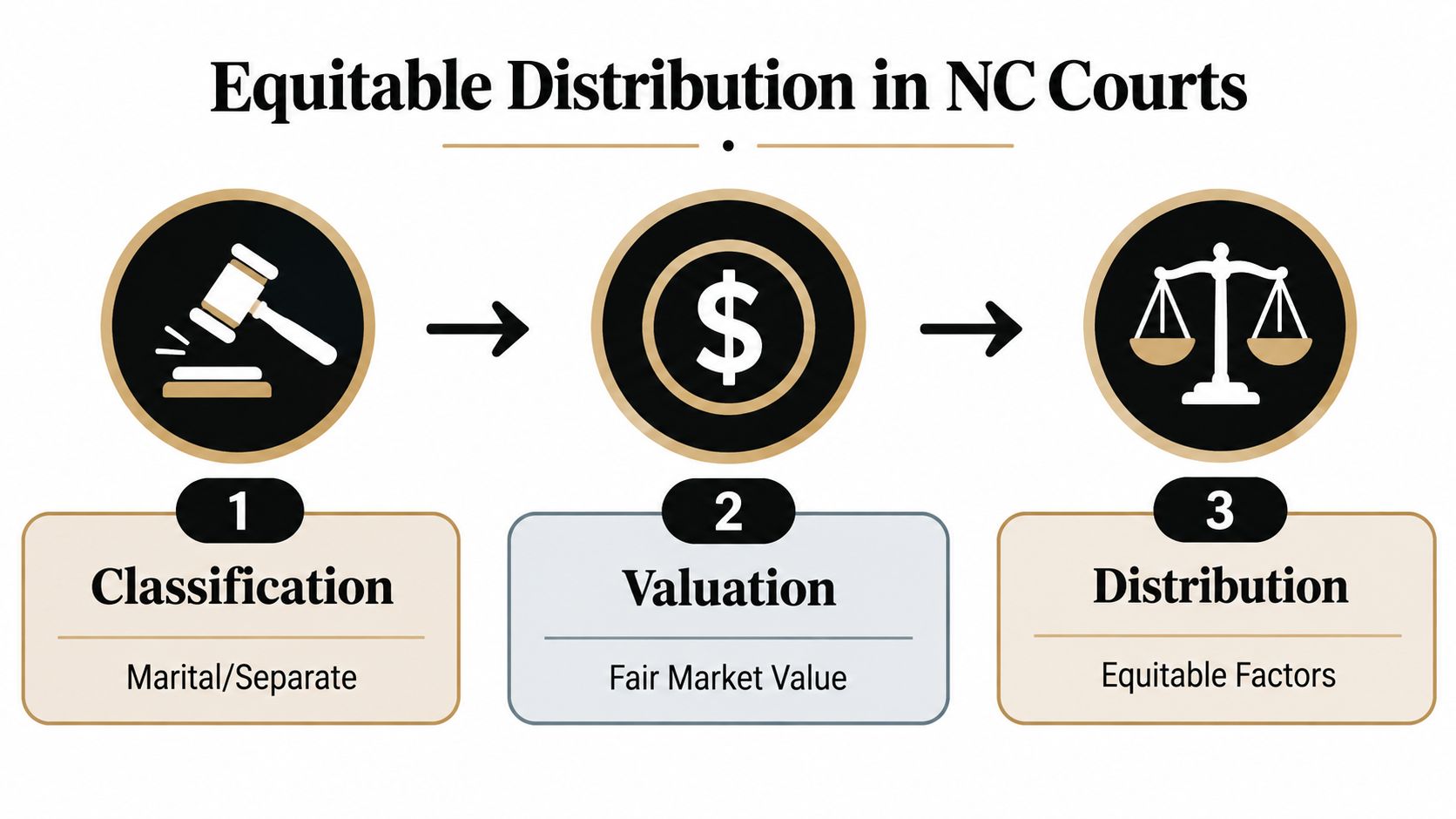
The process is easier to understand as three separate tasks:
- Classification: Determine whether each asset or debt is marital, separate, or divisible.
- Valuation: Determine the relevant value under North Carolina's timing rules.
- Distribution: Decide how the marital and divisible property should be allocated under the equitable distribution factors.
A home may require a market appraisal and a review of mortgage information. A business may require financial records and a valuation method appropriate to the company. A retirement account may require statements showing balances and contributions around the date of separation. The court may need to distinguish marital contributions from premarital or post-separation portions.
“Equitable” means fair under the statutory circumstances, not necessarily an automatic equal split. North Carolina's equitable distribution statute lists factors that may affect an unequal division, including property brought into the marriage, income and earning capacity, contributions to a spouse's education or earning power, tax consequences, custody-related effects on earning power, and other financial circumstances. The statute's factors can be reviewed through North Carolina's alimony statute, although alimony and equitable distribution are separate claims with different legal standards.
Misconduct and property division
A spouse may believe an affair or other marital misconduct should automatically produce a larger property award. Recent appellate coverage highlights a narrower rule: non-economic marital misconduct cannot justify an unequal equitable distribution award. Conduct that has a direct economic effect may require a different analysis, but fault alone doesn't answer the property question.
A difficult marriage and a property claim are related life events, but they aren't interchangeable legal arguments.
For a broader explanation of the process, review what equitable distribution means in North Carolina. The strongest property analysis usually connects each requested distribution decision to evidence about classification, value, contribution, preservation, or an applicable statutory factor.
Common Exceptions That Change Property Classification in NC
Real financial lives rarely fit neatly into separate accounts. Spouses buy homes with inherited funds, deposit paychecks into accounts that once held premarital savings, and transfer property between themselves without documenting intent. These events can change the evidence needed to establish classification.
Commingling
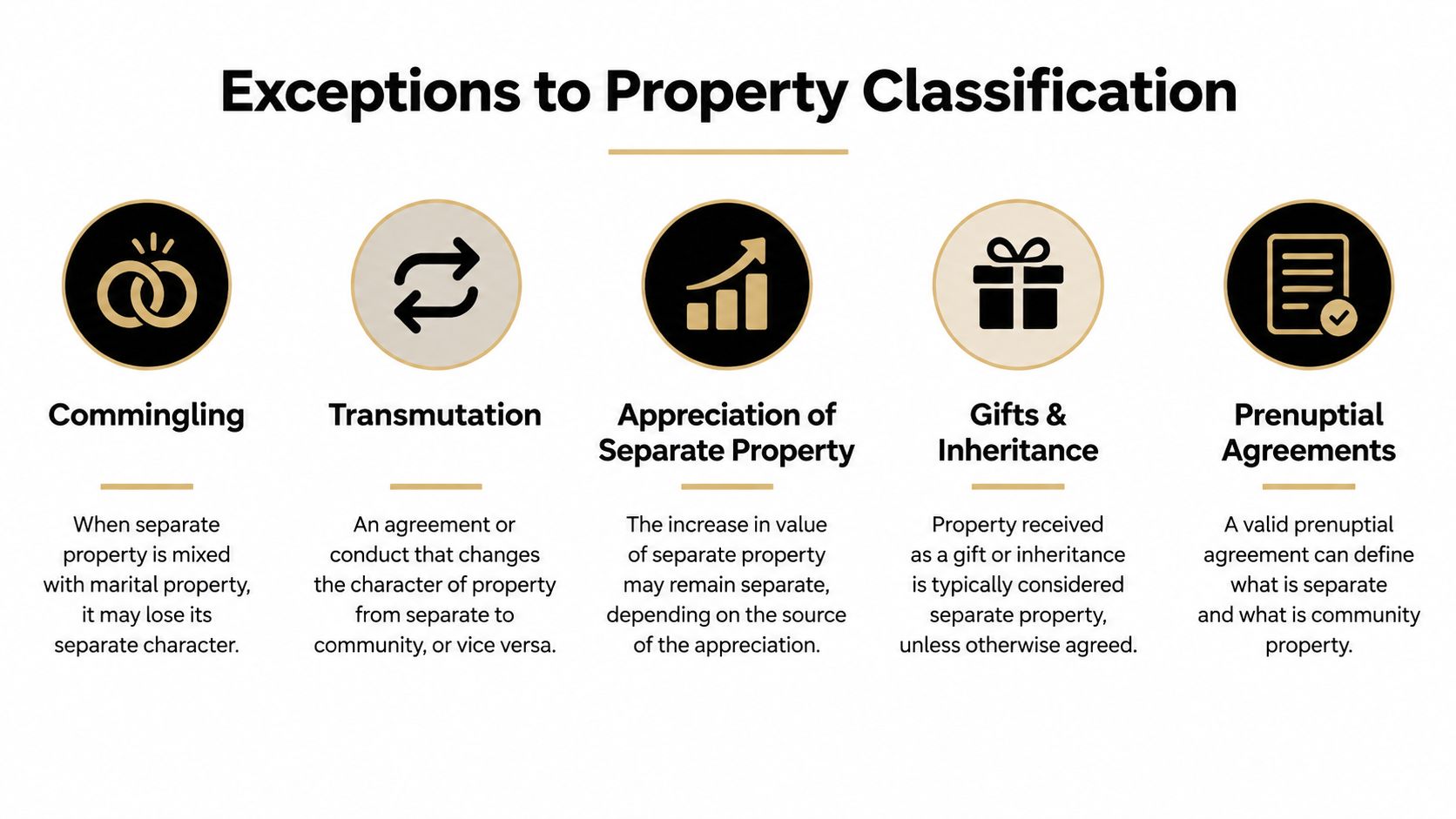
Commingling happens when separate and marital funds are mixed. Suppose a spouse receives an inheritance and deposits it into a joint checking account. The account may then contain both inherited funds and marital income, with withdrawals making the original inheritance harder to trace. Statements, deposit records, and a consistent paper trail may become central.
Commingling doesn't always answer the case by itself. The court may need to determine whether the separate funds remained identifiable, whether they were used for marital purposes, and what the parties intended.
Transmutation and marital contributions
Transmutation describes a change in an asset's character. A spouse may own a home before marriage, then use marital income to pay the mortgage or make substantial improvements. The original ownership history remains important, but the marital estate may assert an interest connected to later payments, contributions, or changes.
A similar issue can arise when one spouse places an individually owned asset into joint ownership. The legal effect depends on the document, the source of the property, and the circumstances surrounding the transfer. Don't assume that adding a name or removing a name resolves every equitable distribution issue.
Gifts and inheritance
A gift or inheritance from a third party may remain separate property when the recipient keeps it separate. The result can become less clear when the recipient uses it to acquire a jointly held asset, pays shared debts, or combines it with marital funds.
Documentation should show the transfer, the recipient, the account history, and the use of the funds. Memories can differ after separation, but contemporaneous records often provide a clearer foundation.
Agreements between spouses
A premarital agreement or another valid written agreement can affect property rights. The agreement's language, execution, and connection to the disputed asset matter. A spouse shouldn't rely on a general belief that “we agreed everything was mine” without having counsel review the actual document.
Evidence of intent is most useful before the dispute begins, not after the account has been emptied or the property has been sold.
Practical Steps to Protect Your Property During Separation
Separation creates pressure to act quickly, but rushed financial decisions can make classification and valuation harder. Start by preserving information rather than moving, hiding, selling, or retitling property without legal advice.

Create a reliable record
Use a secure location to collect bank statements, retirement statements, deeds, loan records, business documents, tax records, vehicle titles, insurance information, and records of gifts or inheritances. Make a written list of assets and debts, including when each item was acquired and how it was funded.
North Carolina procedure requires the filing spouse, within 90 days after service of an equitable distribution claim, to serve an inventory affidavit listing claimed marital and separate property and estimated fair market values as of the date of separation. That requirement appears in G.S. 50-21. Missing information can make the inventory less reliable, so begin gathering records early.
A short educational video may help organize the practical questions that arise during separation:
Avoid avoidable complications
- Document the separation date: Record when you and your spouse began living separate lives and preserve communications that may clarify the date.
- Separate carefully: Don't commingle inherited or premarital funds with marital money without understanding the tracing consequences.
- Value assets at the right time: Obtain appropriate date-of-separation information for homes, businesses, and retirement accounts.
- Preserve account history: Keep complete statements instead of relying only on current balances.
- Get advice before signing: A separation agreement can address property and support issues, but its language should be reviewed before execution. Information about separation agreements in North Carolina can help you identify questions for counsel.
The Law Office of Bryan Fagan handles North Carolina family law matters, including equitable distribution and related divorce claims. A consultation can help organize the facts, identify missing records, and determine whether negotiation, an agreement, or court proceedings fit the circumstances.
Marital Property NC FAQs and Next Steps With an Attorney
Is property in my name automatically separate?
No. Property acquired during the marriage and before separation generally begins with the marital presumption, even if only one spouse's name appears on the title. Timing, source of funds, and statutory exceptions still matter.
Can my spouse receive part of my inheritance?
An inheritance from a third party may remain separate property if it's kept separate. Depositing it into a joint account, using it to purchase jointly held property, or spending it on marital obligations can create classification and tracing issues.
How are retirement accounts handled?
Retirement benefits are expressly included in the marital-property framework. The court may need to distinguish benefits or contributions earned before marriage, during marriage and before separation, and after separation. Statements and plan records are often essential to that analysis.
Are debts divided too?
Debts require classification just like assets. The court may examine when the debt arose, what it paid for, who benefited, and whether it is connected to marital or separate property. Don't assume that the spouse whose name appears on an account is the only person affected by the debt's treatment.
North Carolina property division depends on facts that often aren't visible from a single deed or account balance. A consultation can clarify the separation date, inventory obligations, tracing questions, retirement issues, and the evidence needed to present your position responsibly.
The Law Office of Bryan Fagan offers North Carolina-focused representation in divorce and equitable distribution matters, including disputes involving homes, retirement accounts, businesses, inheritances, and commingled funds. Schedule a consultation to review your property records and develop practical next steps under North Carolina law.