When Can You Modify Child Support in North Carolina?
Life rarely stays the same, and a child support order established months or years ago may no longer fit your family’s current reality. Fortunately, North Carolina law provides a way to request a change. However, you cannot modify an order simply because you feel the amount is unfair. The court requires a specific, legally recognized reason to intervene.
To successfully modify child support, you must prove there has been a “substantial change of circumstances” since the last order was entered. This legal standard is established in North Carolina General Statute § 50-13.7.
This isn't about small, temporary fluctuations in your monthly budget. A "substantial change" refers to a significant, ongoing event that makes the original order genuinely unfair or unworkable. This rule ensures the court system focuses on cases where major life events have altered a family's financial landscape, with the ultimate goal of aligning the support amount with the parents' current ability to pay and the child's actual needs.
Common Grounds for Modification
So, what does a North Carolina court consider a “substantial change”? While a judge has the final say, certain situations are widely recognized as valid grounds to file a Motion to Modify. If you are experiencing one of these, you may have a strong case.
Here is a practical guide to the events that most commonly justify a child support modification in North Carolina.
Common Grounds for Child Support Modification in NC
| Qualifying Event | What This Means in Practice | Real-World Scenario |
|---|---|---|
| Significant Income Change | A parent faces an involuntary job loss, a major promotion, a demotion, or a disability that impacts earning capacity. The key is that the change is typically not self-inflicted. | A parent who was earning $75,000 per year is laid off and now receives only unemployment benefits, drastically reducing their ability to pay the current support amount. |
| Shift in Custody Schedule | The number of overnights the child spends with each parent changes enough to shift the calculation from, for example, a primary to a shared custody plan under the guidelines. | A non-custodial parent who previously had the child for 50 nights a year now has them for 130 nights, taking on a much greater share of the daily costs like food and utilities. |
| Change in Child's Needs | The child develops a new condition or need that significantly increases their expenses, such as ongoing medical care, specialized tutoring, or therapy. | A child is diagnosed with a condition requiring weekly therapy sessions and special equipment not covered by insurance, adding hundreds of dollars in new monthly expenses. |
| Change in Childcare Costs | The amount spent on work-related daycare or after-school care has substantially increased, decreased, or been eliminated entirely. | A child who was in full-time daycare at a cost of $900 per month starts public kindergarten, eliminating that expense from the family budget. |
Understanding these scenarios is the first step in determining whether a modification is possible. If your situation fits one of these patterns, it is often worth exploring your legal options to ensure your child support order is fair and up-to-date.
Proving a Substantial Change in Circumstances
To change your child support order in North Carolina, your entire case will depend on proving a "substantial change in circumstances." This isn't just legal jargon; it’s a specific requirement that means a significant, ongoing event has occurred since your last order was signed, making the payment amount outdated or unworkable.
A judge needs to see concrete evidence of a real shift in the financial picture for you, the other parent, or your child. This is the legal hurdle you must clear before a court will consider issuing a new order.
The 3-Year, 15% Presumption: A Key Shortcut
Fortunately, North Carolina law offers a more direct path for parents whose orders are more than a few years old. If your child support order was established at least three years ago, the law automatically presumes a substantial change has occurred if one key condition is met.
As defined in North Carolina General Statute § 50-13.7, this presumption applies if a new calculation using the current Child Support Guidelines shows a 15% or greater difference between the existing payment and the new calculated amount.
This rule is a game-changer. It means you don’t have to spend time and energy arguing about whether a change was "substantial" enough. If the math shows that 15% variance after three years, the court begins with the assumption that a modification is justified, unless the other parent can provide strong evidence to prove otherwise.
What if It Hasn't Been 3 Years? Other Qualifying Changes
If your order is less than three years old, you can still request a modification. The difference is that the burden falls entirely on you to prove the change in circumstances is truly substantial. Judges evaluate these situations on a case-by-case basis.
Some of the most common reasons a court might agree to modify an order include:
- Involuntary Income Loss: Being laid off, having your hours significantly cut back, or losing your job through no fault of your own. A judge is unlikely to approve a modification if you voluntarily quit your job to try to lower your payment.
- A Major Promotion or New Job: Just as an income loss can trigger a change, a significant and lasting pay increase for either parent can also be grounds for an upward modification.
- Changes in the Child’s Needs: This is a critical factor. For instance, if your child is diagnosed with a medical condition that requires expensive therapy, equipment, or medication, that can justify a change.
- Shifts in Health Insurance Costs: If the monthly premium for the child's health insurance policy goes up or down dramatically, it directly impacts the support calculation.
- Changes in Childcare Expenses: When a child starts kindergarten and no longer needs full-time daycare, the parent paying for that work-related expense may be able to have the support order adjusted.
Key Takeaway: The change must be significant and lasting. A temporary dip in commissions for one month is unlikely to be sufficient, but a permanent salary reduction of 25% due to a company-wide restructuring almost certainly is.
This flowchart provides a visual of the basic logic a North Carolina judge uses when deciding whether to grant a child support modification.
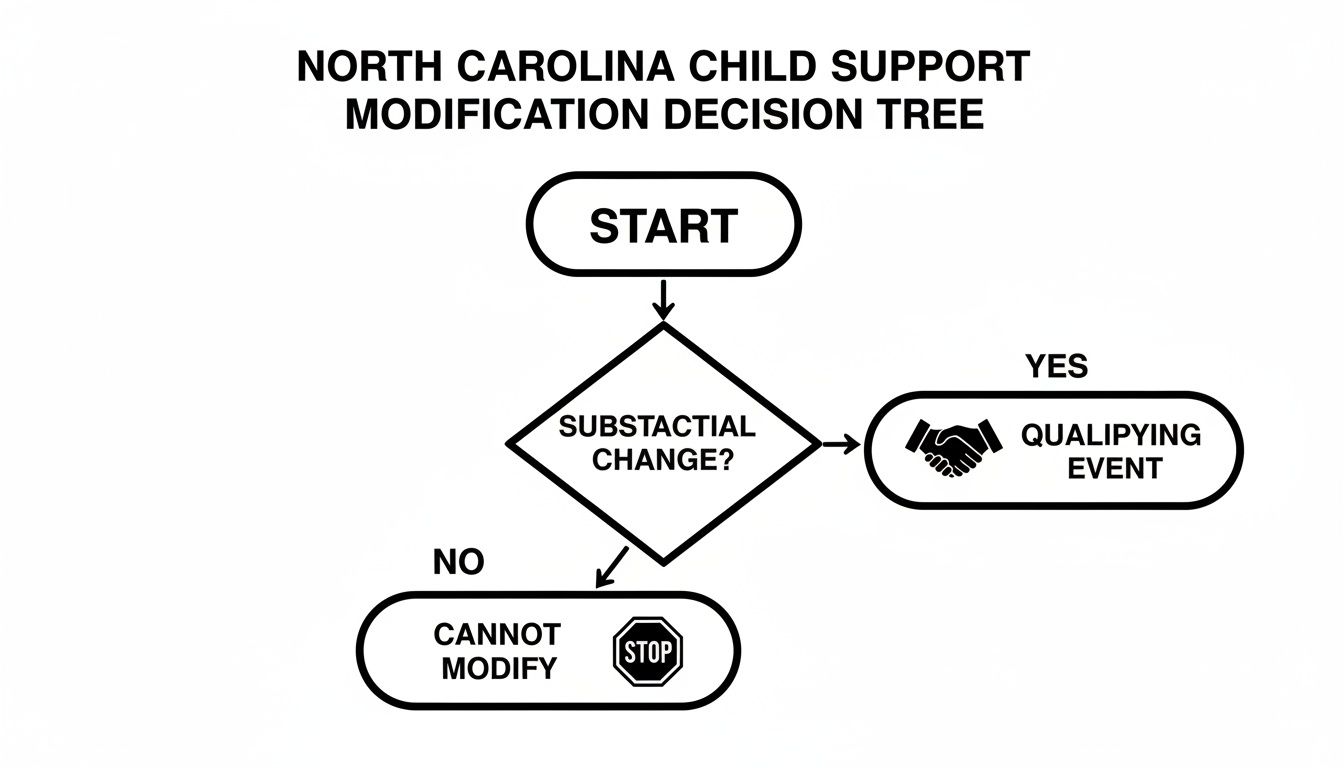
As you can see, every path to a successful modification starts with proving that legally recognized substantial change.
The Role of Custody Changes
A major shift in the parenting schedule is one of the most powerful reasons to modify child support. The North Carolina Child Support Guidelines use different worksheets depending on how many overnight visits each parent has with the child.
When a parent's number of overnights crosses the 123-night threshold in a year, the calculation often moves from Worksheet A (for primary custody) to Worksheet B (for shared custody). This almost always results in a different child support obligation.
Because custody and support are so deeply intertwined, it’s critical to look at your family law orders as a whole. It can be helpful to understand more about how child custody works in North Carolina to see how these issues connect. Proving your case requires documentation, organization, and a clear understanding of what a judge needs to see.
Filing Your Motion to Modify Child Support
Once you've determined that a substantial change in circumstances has occurred, it's time to take formal legal action. A common but costly mistake is to simply start paying a different amount or rely on a verbal agreement with the other parent. In the eyes of a North Carolina court, those informal changes do not count—the original order remains fully enforceable until a judge says otherwise.
To officially request a child support modification nc, you must file specific legal documents with the court. This process is precise, and any mistakes in your paperwork can cause frustrating delays or even get your case dismissed. Let’s walk through the practical steps of filing your motion and putting together the financial evidence you’ll need.
Kicking Off the Legal Process
The first step is to file a Motion to Modify Child Support. In North Carolina, this document formally tells the court who you are, identifies the other parent, and explains exactly why you're asking for the child support amount to be changed. You'll file this motion in the same county where the original child support order was issued.
Filing the motion is just the beginning. The next critical step is ensuring the other parent is properly notified through a formal procedure known as “service of process.” This is a strict legal requirement to officially inform the other party that a legal action has started.
Without proof of proper service, the court cannot move forward with your case. Common methods for service in North Carolina include:
- Sheriff's Service: The local sheriff’s department will personally deliver the legal documents to the other parent.
- Certified Mail: You can send the paperwork via certified mail with a return receipt requested, which provides proof of delivery.
- Acceptance of Service: The other parent can agree to sign a form acknowledging they’ve received the documents, avoiding the need for formal service.
This step ensures the process is fair and gives both parents an opportunity to prepare and respond.
The Financial Affidavit: The Backbone of Your Case
Along with your motion, you must complete and file a Financial Affidavit. This is one of the most important documents you will prepare. It’s a sworn statement that gives the court a detailed, under-oath snapshot of your entire financial life.
There is no room for error or guesswork here. The affidavit requires you to list all your income sources, monthly expenses, assets, and debts. A judge will scrutinize this document to understand your financial reality, so complete honesty and accuracy are essential.
Gathering all the necessary information takes time. You will need to collect key documents, such as:
- Recent pay stubs (at least two months' worth)
- Your last two years of federal and state tax returns
- Current bank statements
- Proof of health insurance premiums paid for the child
- Receipts for any work-related childcare expenses
- Documentation of extraordinary expenses, like private tutoring or ongoing medical care
Think of this as building the financial foundation of your argument. The numbers you list on your affidavit must be backed up by the documents you provide. Any inconsistency can seriously damage your credibility with the judge.
Expert Tip: Do not estimate figures on your Financial Affidavit. Take the time to dig up your bank statements, bills, and pay stubs to find the exact amounts. A well-documented and truthful affidavit demonstrates to the court that you are taking this process seriously.
Using the NC Child Support Worksheets
To calculate the proposed new child support amount, North Carolina courts use specific formulas laid out in the NC Child Support Worksheets. It’s your responsibility to fill out the correct worksheet for your custody situation and attach it with your filing.
There are three primary worksheets, each for a different custody arrangement:
- Worksheet A (Primary Custody): Used when one parent has the child for 243 or more nights per year.
- Worksheet B (Shared Custody): Applies when each parent has the child for at least 123 nights per year.
- Worksheet C (Split Custody): Used in less common situations where there are multiple children and each parent has primary custody of at least one child.
These worksheets act like calculators. You will plug in both parents' gross monthly incomes, the number of overnights each parent has, and any payments for the child's health insurance or work-related childcare. The worksheet then produces a "presumptive" child support amount.
While a judge has the discretion to deviate from this figure, it serves as the starting point for nearly every decision. Completing this worksheet gives both you and the court a clear picture of the potential outcome of your child support modification nc request.
Filing a motion is about more than just forms; it’s about constructing a clear, evidence-based case for why the old support order is no longer appropriate. The procedure shares similarities with other family law actions, and you might find it helpful to review the general steps for divorce in North Carolina to better understand court processes.
Navigating the NC Court Process and Hearings

Once your Motion to Modify Child Support has been filed and properly served on the other parent, the case moves into the court system. For many parents, this is the most intimidating part of the process, but understanding what comes next can make it feel far more manageable.
In many North Carolina counties, the first step is a mandatory mediation session. This is a structured negotiation where a neutral professional helps you and the other parent try to find common ground.
If you can reach an agreement, it can be formalized in a Consent Order for a judge to sign. This is the fastest and most cost-effective way to resolve your case and avoid a formal hearing. If mediation doesn't lead to a resolution, your case will then be scheduled for a hearing in family court.
The Court Hearing: What to Expect
The hearing is your chance to formally present your case to a District Court Judge. While you might picture a dramatic courtroom scene, these hearings are typically straightforward and focused on facts and finances. The judge has one main objective: to determine if a substantial change in circumstances has actually occurred.
If it has, the judge will then apply the North Carolina Child Support Guidelines to calculate the new support amount.
During the hearing, both you and the other parent will be able to:
- Give Testimony: You will be sworn in and asked to explain your financial situation, the child's needs, and the specific changes that prompted you to file the motion.
- Present Your Evidence: This is where your preparation pays off. The pay stubs, tax returns, and receipts you have gathered will be presented as official exhibits to back up your claims.
- Make Your Legal Arguments: Your attorney will explain to the judge how your evidence proves a substantial change and why your proposed child support calculation is correct under North Carolina law.
The judge’s role is to listen to both sides, review the evidence, and apply the law to the facts of your case. It all comes down to presenting a clear, honest, and well-organized argument.
Key Insight: Family court judges handle hundreds of these cases. They appreciate parents who come to court prepared, are straightforward about their finances, and stick to the facts instead of getting sidetracked by emotion. A well-documented case is always more persuasive.
Understanding Realistic Timelines
One of the biggest frustrations for parents is how slowly the legal system can move. It’s important to set realistic expectations. Depending on your county’s court calendar, it can take several months from the day you file your motion to get a final hearing date.
This timeline is exactly why it’s so critical to file your motion as soon as your circumstances change. Any new child support amount the judge orders will almost always be retroactive only to the date you officially filed—not the date your income dropped or expenses went up. Waiting to file can cost you months of a more appropriate child support payment.
Potential Outcomes and the Rule of Retroactivity
After hearing all the evidence, the judge will issue a ruling. There are two main possibilities:
- Motion Granted: The judge agrees that a substantial change has occurred and issues a new order with an adjusted child support amount, either higher or lower.
- Motion Denied: The judge finds that you did not prove a substantial change, and the original child support order remains in place.
If your motion is granted, the concept of retroactivity is key. The new support amount is effective from the date you filed your motion. For example, if your income was reduced in January but you didn't file until March, and your hearing is in July, the judge can make the new, lower payment effective back to March. Any overpayment you made from March to July could then be credited toward your future payments.
How Judges Calculate Child Support in North Carolina
When you're facing a child support modification, it’s easy to feel like the final number is a complete mystery. But in North Carolina, judges don’t just pick a number out of thin air. They start with a very specific formula known as the North Carolina Child Support Guidelines.
Think of the Guidelines as a statewide rulebook for calculating support. This formula takes key financial details from both parents and produces a "presumptive" support amount. A judge will almost always order this amount unless there's a compelling reason to deviate. Understanding how this works is the first step in preparing for your child support modification NC hearing.
The Four Core Numbers in Every Calculation
The entire calculation boils down to a few critical pieces of information. Getting these numbers right is essential, as they directly impact the final child support obligation.
Here’s what the court needs from both you and the other parent:
- Each Parent's Gross Monthly Income: This is your pre-tax income from every source—wages, salaries, bonuses, commissions, and any self-employment earnings. It is not your take-home pay.
- The Number of Overnights: The custody schedule plays a huge role. The specific worksheet used (Worksheet A, B, or C) is determined by how many nights the child spends with each parent throughout the year.
- Health Insurance Costs: The court looks at the portion of the monthly health insurance premium paid specifically for the child’s coverage.
- Work-Related Childcare Costs: If you pay for childcare so you can work, those reasonable and necessary expenses are included in the formula.
Once these figures are plugged into the correct worksheet, the court has its presumptive child support amount.
Why the “Presumptive” Guideline Amount Is So Important
You’ll hear the word "presumptive" a lot in these cases. It means the court presumes the number from the Guideline worksheet is the fair and correct amount. While that presumption is strong, it is not unbreakable.
A judge can order a different amount—a process called “deviating from the guidelines”—but they can’t do it on a whim. To deviate, the judge must make specific written findings that the guideline amount would be unjust, inappropriate, or wouldn't meet the child’s reasonable needs. For example, a child with extraordinary medical expenses might justify a support amount higher than what the formula produces.
From Our Experience: Judges strongly prefer to stick to the Guidelines. It creates predictable, consistent, and legally sound orders. If you want to argue for a deviation, you need to come prepared with compelling evidence that proves why the standard calculation is unfair in your unique situation.
Special Rules for Low and High-Income Cases
The Guidelines are designed to be flexible, with special rules for families at both ends of the financial spectrum. For lower-income parents, North Carolina law sets a minimum child support order of $50 per month. This ensures every parent contributes, even if their income is limited.
The standard Guidelines, however, do have a ceiling. As of 2026, the worksheets apply to parents with a combined adjusted gross income of up to $480,000 per year.
For families who earn more than this, the court moves to an "off-guideline" analysis. In these high-income cases, child support is no longer about a simple formula. Instead, the judge determines an amount based on the child's actual, reasonable needs for their health, education, and maintenance, while also considering the family’s established standard of living. This requires a much more detailed look at the child’s accustomed lifestyle and expenses.
The rules are complex, but they provide a clear framework. You can read more about them by reviewing the official guidelines on the NC Courts website.
FAQ: Common Questions About Modifying NC Child Support
When a major life change happens, parents often wonder how it will impact their child support order. The modification process in North Carolina can feel confusing. Here are direct, practical answers to some of the most common questions we hear.
What if my ex and I agree to change the child support amount?
A verbal or informal written agreement between parents to change child support is not legally enforceable in North Carolina. For the new amount to become official, you must formalize your agreement in a document called a "Consent Order" and have a judge sign it. Without that signed court order, the original child support order remains in full effect, and you could be held liable for any unpaid difference later.
Can I lower my support if I quit my job to go back to school?
Generally, no. A North Carolina judge will almost certainly view this as being "voluntarily underemployed." The court’s priority is the child's right to consistent financial support. If a judge believes you reduced your income in bad faith or without a compelling reason, they will likely calculate support based on your "potential income"—what you could and should be earning based on your work history, not your new, lower income.
How far back can a child support modification go in NC?
A modification is typically only retroactive to the date you filed your Motion to Modify with the court clerk. For example, if your income was cut in January but you don't file the proper legal paperwork until June, the judge can only adjust your payments starting from June. The court cannot go back and credit you for the months between January and your filing date. This is why acting immediately when a substantial change occurs is so important.
Do I need a lawyer for a child support modification in NC?
While you can represent yourself, the legal system has many potential pitfalls. An experienced North Carolina family law attorney can ensure your motion is filed correctly, your financial evidence is presented persuasively, and your rights are protected. This is especially true if the other parent is contesting the change, your financial situation is complex, or you are arguing for a deviation from the guidelines.
Take the Next Step with a North Carolina Family Law Attorney
As this guide makes clear, modifying child support in North Carolina is a formal legal process, not just a casual conversation with your co-parent. It requires hard evidence of a substantial change in circumstances and strict adherence to court rules. Trying to manage this on your own while dealing with a major life change can feel overwhelming.
If you are a North Carolina resident facing this complex challenge, you don’t have to navigate it alone. The most important thing you can do right now is take decisive action to protect your family's financial stability.
Secure Your Family's Financial Future in North Carolina
Our team understands that every family’s situation in North Carolina is unique. We have the experience to review your circumstances, gather the right evidence, and build a persuasive case for modification. Whether you need to increase or decrease support, our goal is to provide the strategic advocacy required to secure a fair outcome under North Carolina law.
Don’t let uncertainty or delays put your rights at risk. A North Carolina court can only modify support retroactively to the date you file your motion, so acting quickly is essential.
Protecting your interests starts with a clear understanding of state law and local court procedures. To get a better sense of our firm's approach, you can learn more about our North Carolina family law services. We are dedicated to helping North Carolina residents find resolutions that reflect their current reality.
Navigating a child support modification in NC requires skilled legal guidance. Contact the Law Office of Bryan Fagan for a consultation to discuss your specific North Carolina case and learn how we can help protect your family’s future.