One of the most common questions we hear from parents in North Carolina is straightforward: "When do my child support payments finally stop?" It's a question that can cause a lot of anxiety, and the answer isn't always as simple as a child turning 18.
While that birthday is a major milestone, North Carolina law has specific rules that can extend payments if your child is still in high school or, in some cases, end them earlier. Understanding these rules is critical to avoid serious legal and financial headaches.
The Official Rules For Ending Child Support In North Carolina

Many parents assume child support obligations automatically disappear the day their child turns 18. This is a common and costly misconception. The truth is that North Carolina law sets clear, and sometimes nuanced, benchmarks for when a parent's financial duty is officially complete.
The core rule is found in North Carolina General Statute § 50-13.4. This law establishes that a parent’s duty to provide support generally ends when their child reaches the age of 18.
However, there’s a critical exception built into the law that every parent needs to understand. If your child turns 18 but is still enrolled full-time and making progress toward a high school diploma, your support obligation continues.
Key Termination Benchmarks
This continuation rule isn't indefinite. Your support obligation will end as soon as one of the following events happens:
- The child graduates from high school.
- The child stops attending school on a regular, full-time basis.
- The child reaches the age of 20.
That last point is a hard stop. Even if your child is still finishing high school, your legal duty to pay support automatically terminates on their 20th birthday. This "age 20 cutoff" creates a final, definite end date for parents. You can find more detailed discussions on these legal standards in our articles about NC child support.
To help clarify these rules, we've put together a quick-reference table summarizing the events that trigger the end of child support in our state.
North Carolina Child Support Termination Triggers At A Glance
This table breaks down the primary legal events that cause a child support obligation to end, giving you a practical overview of what to expect.
| Termination Event | What This Means In Practice | Governing NC Statute | Key Considerations |
|---|---|---|---|
| Child Turns 18 & Graduates | This is the most common scenario. If your child graduates in June but turns 18 in August, support ends in August. | § 50-13.4(c) | The obligation ends on whichever of these two events occurs last. |
| Child Turns 20 | Support legally terminates on the child’s 20th birthday, even if they are still in high school. | § 50-13.4(c) | This acts as the absolute cutoff date for high school-related support. |
| Child Emancipates | If a child under 18 marries, joins the military, or is legally declared emancipated by a court, support ends. | § 50-13.4(c) | Emancipation is a formal legal process. It doesn't happen just because a child moves out or gets a job. |
| Death or Adoption | Support ends if the child passes away or is legally adopted by someone else, like a stepparent. | General legal principles | Upon adoption, the paying parent's obligation is legally and permanently transferred to the adoptive parent. |
Understanding these specific triggers is the first step in managing the end of your child support case correctly and avoiding any potential overpayments or legal penalties.
How The Age 18 and High School Rule Works in Practice
One of the biggest misconceptions we see in our North Carolina practice is the idea that child support automatically stops the day a child turns 18. While that birthday is a major milestone, it’s only half the story. The law actually links a child’s age to their high school status, and knowing how those two things work together is critical for figuring out when your legal obligation truly ends.
Under North Carolina General Statute § 50-13.4(c), your duty to pay child support continues past the 18th birthday as long as your child is still enrolled full-time in a primary or secondary school. This “high school rule” was designed to give children consistent financial support until they can get their diploma. It avoids the harsh scenario where support suddenly cuts off mid-semester, right before graduation.
This means your support obligation continues until the last of two events happens: your child turns 18, or your child graduates from high school. But it isn't a forever obligation—the law also sets a hard cutoff at age 20, no matter what.
Unpacking The "Continuously Enrolled" Requirement
For the high school rule to apply, the child has to be "continuously enrolled" and making real progress toward their diploma. That language is important. It means they can’t just be signed up for a class or two; they need to be attending school regularly on a full-time basis, as defined by their school.
So, what does that look like in the real world?
- Full-Time Attendance: The child has to maintain a full course load. If they drop to part-time status or their attendance becomes sporadic, the continuation of support could be in jeopardy.
- Making Progress: The child needs to be on a clear path to graduation. If a child is failing classes over and over with no reasonable chance of graduating, a paying parent may have grounds to ask the court to terminate support.
- Dropping Out: If a child who is over 18 drops out of high school, the high school rule no longer applies. In that situation, the support obligation would end.
This rule ensures that the extension of support is tied to a legitimate educational effort, not just being enrolled on paper.
Practical Scenarios: The Order Of Events Matters
To really get a handle on this, let's walk through a few common examples. The timing of your child's birthday versus their graduation day is what ultimately determines when your legal duty to pay child support ends.
Scenario 1: Graduation Before Birthday
- Child's Graduation: June 5th
- Child's 18th Birthday: August 15th
- When Support Ends: August 15th
In this common situation, the child has already graduated, so the final legal requirement is turning 18. The support obligation continues through the summer and legally terminates on their 18th birthday.
Scenario 2: Birthday Before Graduation
- Child's 18th Birthday: March 10th
- Child's Graduation: June 3rd
- When Support Ends: June 3rd
Here, the child turns 18 while still in their senior year. Since they are continuously enrolled and working toward graduation, the support obligation extends past their birthday. Payments must continue right up until the day they officially graduate.
Key Takeaway: Payments do not stop on their own. The court order stays in place until a judge formally ends it. Even if your child has clearly met the termination requirements, you must file a Motion to Terminate Child Support to legally end your obligation and stop wage withholding.
The Absolute Age 20 Cutoff
But what if a child is held back and won’t graduate by 19? The law provides a final, non-negotiable end date. Child support automatically terminates on the child’s 20th birthday, regardless of whether they have finished high school.
This "age 20 cutoff" gives the paying parent certainty, ensuring the high school rule doesn't stretch on forever. For example, if a child turns 19 during senior year but won't graduate until after their 20th birthday, support ends on their 20th birthday—not on graduation day. This hard stop protects parents from an open-ended obligation while still giving children who need more time a fair window to finish their education.
Important Exceptions to the Standard Termination Rules

While the “age 18 and high school” rule covers most child support cases in North Carolina, life rarely follows a simple script. State law accounts for this, creating important exceptions that can either end a support obligation early or, in specific circumstances, extend it.
For both paying and receiving parents, knowing these exceptions is critical. They address major life events that legally change a child's dependency status. Failing to act when one occurs could mean you overpay for months—or, for the receiving parent, risk losing essential financial support unexpectedly.
Early Termination Through Emancipation
Not every child support obligation lasts until a child’s 18th birthday. Under North Carolina law, support can end much sooner if a child becomes legally emancipated. Emancipation is a formal legal process that grants a minor the rights and responsibilities of an adult, effectively ending their financial dependence on their parents.
This isn't something that happens informally. A child getting a part-time job or moving out for a few months does not count. Instead, emancipation occurs under very specific circumstances:
- Marriage: If a minor legally marries, they are considered emancipated, and the parent’s support obligation terminates.
- Joining the Armed Forces: When a minor enlists in the military, they are legally emancipated, ending the duty to pay child support.
- Court Order: In some cases, a minor can petition the court to be declared legally emancipated if they can prove they are fully capable of managing their own financial and personal affairs.
If your child becomes emancipated, the support payments do not stop automatically. You must file a Motion to Terminate Child Support with the court to make it official and end your legal obligation.
The Critical Exception For Adult Children With Disabilities
Perhaps the most significant exception to the standard rule is for children who cannot support themselves due to a physical or mental disability. North Carolina law gives courts the authority to order that child support continue indefinitely for an adult child who is "physically or mentally incapable of self-support."
This is a profound and compassionate exception. It acknowledges that for some families, the need for financial support doesn't just stop when a child turns 18 or 20.
A parent’s obligation to support a disabled adult child is a serious legal matter. Unlike standard child support, there is no automatic end date. A court can order support to remain in place for the child's entire life, as long as they remain incapable of being self-sufficient.
To secure this kind of lifelong support, a parent must go back to court and provide clear, convincing evidence of the child's condition and needs. This process often involves presenting:
- Medical and Psychological Records: Detailed documentation from doctors, specialists, or therapists that explains the disability’s nature and severity.
- Expert Testimony: Statements from vocational experts who can assess the adult child’s ability to find and maintain meaningful employment.
- Financial Information: Evidence detailing the child's ongoing needs and each parent's ability to provide financial support.
Because this is such a complex legal area, the court will carefully examine whether the child’s condition truly prevents them from becoming self-supporting. This framework isn't unique to our state; it's a common feature in global family law. While most OECD and EU countries end child support at 18, only four—Finland, Korea, New Zealand, and Thailand—have a strict cutoff without any exceptions for disabilities or education. You can explore how these international policies compare by reviewing the comprehensive data from the OECD Family Database.pdf). For North Carolina families, knowing your rights in these exceptional cases is paramount.
Can a North Carolina Judge Order a Parent to Pay for College?
Of all the issues that come up for separated parents, the topic of college is one of the most emotionally charged. As your child’s high school graduation gets closer, a whole new set of questions—and potential arguments—can surface. Does child support automatically cover tuition? Can a judge force you to pay for university? This is a major point of confusion for parents trying to understand when child support ends in North Carolina.
Let’s be direct: a North Carolina judge cannot order a parent to pay for their child’s college education. The court’s power to mandate child support stops when the child meets the standard termination rules—usually turning 18 and graduating from high school, or at the latest, turning 20. From the court's perspective, post-secondary education falls outside the scope of a standard child support obligation.
Creating Enforceable Agreements For College
Just because a judge can't force you to pay doesn't mean you're out of options. Many parents want to help with their child's higher education and prefer to have a clear, predictable plan in place. The best way to manage college expenses is through a voluntary, written contract.
Parents can create a legally binding agreement to cover these costs in two main ways:
- Separation Agreement: This is a comprehensive contract that settles all aspects of a separation, including property division, spousal support, and all child-related matters.
- Consent Order: This is an agreement between the parents that gets signed by a judge, turning it into an official court order.
By making college support part of one of these documents, you turn a voluntary promise into an enforceable legal duty. This proactive step can prevent a world of arguments down the road and gives everyone—parents and child—clarity and certainty.
What A Strong College Support Agreement Includes
A vague promise to "help with college" is a recipe for future conflict. To avoid disputes later, a solid college support agreement needs to be specific and detailed. Think of it as a roadmap that clearly defines each parent’s financial role and what is expected of the child.
A well-drafted agreement should clearly spell out:
- Covered Expenses: Be specific about what costs are included. Does it only cover tuition and fees, or does it extend to room and board, textbooks, a meal plan, and health insurance?
- Payment Caps: Define the financial limits clearly. Are you agreeing to cover costs up to the amount for an in-state public university, or will you contribute to a private or out-of-state school? Use specific dollar amounts or percentages.
- Duration of Support: State exactly when the obligation ends. For example, support might continue for "eight consecutive semesters" or until the child turns a certain age, like 22.
- Child's Responsibilities: Include conditions the child must meet to stay eligible for the financial support. Common requirements include maintaining a minimum GPA (like a 2.5), staying enrolled as a full-time student, and giving parents access to their grades.
Real-World Example: Sarah and Tom agree to split their daughter Emily's college costs. Their separation agreement states they will each pay 50% of her tuition, housing, and fees at any UNC system school for up to eight semesters. The agreement is conditioned on Emily maintaining a 2.75 GPA and being enrolled full-time. This creates a clear, enforceable plan that protects both parents and ensures Emily has the support she needs to succeed.
Agreements like these show why it's so important to formalize financial commitments. The massive gaps in support payments globally highlight how critical enforceable orders are for a family's stability. In fact, one study on child support policies found that even in wealthy countries, only about 40% of single-parent families get the support they are owed, often due to weak enforcement or unclear end dates. You can see the full findings on global child support trends from Cambridge University Press. For parents in North Carolina, a detailed college agreement provides the legal clarity you need to avoid becoming another statistic.
The Correct Way To Officially Terminate Your Support Order
One of the most costly mistakes a paying parent can make is assuming child support stops automatically. It doesn't. Even if your child has turned 18 and graduated, the court order is still active, and you are legally on the hook for payments until you take formal action.
This is a critical point that trips up many parents. They end up overpaying for months or, worse, find themselves in legal trouble with mounting arrears for payments they thought were no longer due.
To protect yourself, you must have the child support order formally terminated by the court. This isn't just a suggestion; it's the only way to officially end your financial obligation and close the book on the order.
Filing A Motion To Terminate Child Support
The legal document you'll use to start this process is called a Motion to Terminate Child Support. This motion formally notifies the court that a terminating event—like your child aging out—has happened and asks a judge to issue a new order ending your payments.
Think of your original support order as an ongoing instruction from the court to your employer and the state. Until the court issues a new instruction to stop, the old one remains in full force. Filing this motion is how you get that new instruction.
The infographic below illustrates how parents can proactively handle related financial issues, like college expenses, which often come up as the standard support obligation ends. It highlights the importance of formalizing any new agreements you make.
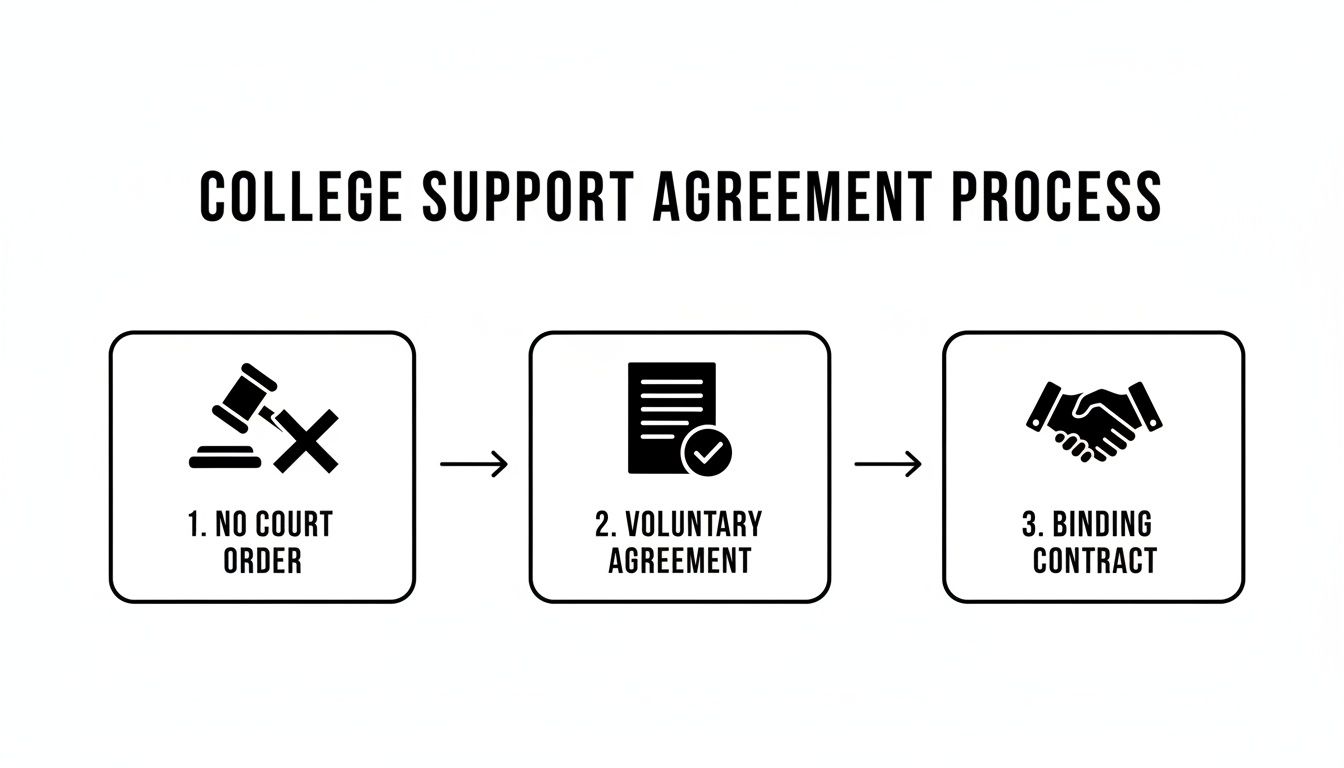
As you can see, while a judge won't order college support, parents can create a binding contract on their own. Formalizing these agreements is key to preventing future conflict and confusion.
Essential Documentation You Will Need
When you file your motion, you must give the court proof that your obligation has legally ended. Don't just show up and expect the judge to take your word for it. Be prepared to present clear, supporting evidence, such as:
- Proof of the Child’s Age: A copy of your child's birth certificate is the standard way to prove they have reached the age of majority.
- Proof of High School Graduation: A copy of their high school diploma or a final transcript showing the official graduation date.
- Proof of Other Terminating Events: If support is ending for another reason, like emancipation through marriage or military service, you'll need the corresponding documents (e.g., marriage certificate, enlistment papers).
Having this paperwork organized ahead of time will make the process much smoother and help the judge quickly verify that the legal requirements for termination have been met.
Stopping An Income Withholding Order
If your support payments are automatically taken from your paycheck, filing the motion is only the first step. Once the judge signs the order terminating support, that order must be sent to your employer to stop the income withholding order (IWO).
Critical Warning: Your employer is legally bound to follow the court's instruction. They will continue deducting payments until they receive a new court order telling them to stop. A phone call or email to HR won't work.
This step is vital for preventing overpayments. We see it all the time—delays here are a common reason parents end up paying for weeks or even months after their obligation has legally ended.
Finally, remember that terminating your future support obligation does not erase any past-due payments. If you have arrears (unpaid back child support), that debt is still owed and must be paid in full. The termination order only applies to ongoing monthly payments moving forward. You can learn more about changing existing orders in our guide on child support modification in North Carolina.
FAQ: Common Questions About Ending Child Support in North Carolina
We hear a lot of the same questions from parents navigating the end of child support. These situations can be confusing, and a simple misunderstanding can lead to serious legal and financial problems. Here are straightforward answers to some of the most common questions we get.
My order is for multiple children. Does it automatically go down when one turns 18?
No, the support amount will not decrease on its own. Your court order for the total amount stays in full force until you get it officially changed by a judge. To do this, you must file a Motion to Modify Child Support. The oldest child aging out is considered a "substantial change in circumstances," which gives you the right to ask the court to recalculate the support obligation for the remaining children. If you don't take this step, you are legally required to pay the original, higher amount.
What if I overpaid child support after my obligation legally ended?
Unfortunately, getting that money back is extremely difficult in North Carolina. Courts often consider any payments made after a child support obligation legally ends to be a voluntary gift. That means they are generally non-reimbursable. This is precisely why you must be proactive. Filing a Motion to Terminate Support as soon as the terminating event occurs is critical to prevent overpayment.
Can my ex and I just agree to stop child support without involving the court?
While you and the other parent can have an informal agreement, it is not legally binding and does nothing to end the official court order. If your support is paid through wage withholding, your employer must continue to deduct the amount specified in the court order on file. The other parent could change their mind at any time and enforce the original order, leaving you responsible for all "missed" payments as arrears. The only way to legally protect yourself is to get a new court order signed by a judge.
Get Trusted Legal Guidance on Your Child Support Case
Knowing when child support is supposed to end in North Carolina is one thing. Taking the right legal steps to make it happen is another matter entirely. Every family’s situation is different, and trying to navigate the court system on your own can lead to expensive and frustrating mistakes.
These aren't just minor errors—they can mean overpaying for months or having arrears build up for a support obligation that should have already ended. An experienced family law attorney ensures the process is handled correctly from the start, protecting your financial future and providing peace of mind.
How We Can Help You
Don't leave the final chapter of your child support obligation to chance or informal agreements. A skilled legal advocate provides the critical support you need to close the books properly.
Here’s how our firm can help North Carolina parents:
- Confirm the Termination Date: We will analyze your specific court order and the facts of your case to pinpoint the exact date your legal obligation ends.
- File Necessary Motions: Our team handles all the critical paperwork, filing the Motion to Terminate Child Support with the court to make the end date official and legally binding.
- Stop Wage Withholding: We take swift action to make sure your employer receives the updated court order needed to stop automatic deductions from your paycheck.
- Address Disputes and Modifications: If the other parent disagrees on the end date, files for extended support, or you need to modify an order for multiple children, we will advocate firmly for your rights.
Taking proactive legal steps is the only way to guarantee your child support order is officially closed. An attorney ensures that every detail is handled properly, preventing future legal and financial complications that can arise from informal agreements or misunderstandings.
Navigating the nuances of North Carolina family law requires a deep understanding of state statutes and local court procedures. Whether you are a paying parent ready to terminate an order or a receiving parent with questions about continuing support for a disabled child, professional guidance is essential. To learn more about how we can assist in these and other disputes, explore our comprehensive family law services.
The legal landscape surrounding child support can feel overwhelming, but you don't have to face it alone. At the Law Office of Bryan Fagan, we provide North Carolina families with the strategic guidance and empathetic support needed to move forward with confidence. If you are dealing with a child support issue in North Carolina, schedule a consultation with our experienced team today. Visit https://bryanfaganlaw-nc.com to discuss your case and protect your future.