When your marriage is ending, property division can feel like the most confusing part of the case. You may be looking at the house, retirement accounts, credit card balances, a small business, or land that has been in one side of the family for years, and wondering what North Carolina law does with all of it.
That confusion is normal. Many people assume the court cuts everything down the middle. In North Carolina, that isn't how it works.
A property division attorney North Carolina residents turn to is often helping with more than a list of assets. The work usually involves tracing where property came from, figuring out what changed after separation, identifying what belongs to one spouse alone, and deciding what evidence will matter if the other side disputes value or ownership.
Property division issues also remain common across the state. North Carolina's divorce rate declined from 5.1 divorces per 1,000 residents in 2000 to 2.7 per 1,000 in 2023, yet the state still averages about 32,862 divorces annually, according to North Carolina divorce statistics discussed here. Even with that decline, many families still find themselves sorting through the same hard questions.
Facing Property Division in North Carolina
A common North Carolina divorce scenario looks like this. One spouse stayed in the marital home with the children. The other moved into an apartment. Both are still tied to the mortgage. One has a retirement plan through work. The other helped build a family business but isn't listed as the owner. They both think they know what's fair, and their views are far apart.
That gap matters because property division isn't just about ownership on paper. It often turns on timing, records, and the history behind each asset.
Why this part of divorce feels harder than people expect
People usually know what they own. They often don't know how the law classifies it.
A home may have been purchased during the marriage, but one spouse may have used premarital funds for the down payment. A brokerage account may contain both marital and separate money. A retirement account may have existed before marriage and continued to grow during marriage and after separation. Those details can change the analysis.
Practical rule: The question usually isn't just "Whose name is on it?" The better question is "When was it acquired, how was it funded, and what happened to it after separation?"
Early mistakes can affect the whole case
The first weeks after separation are especially important. People often make avoidable mistakes such as:
- Mixing accounts: Moving money around without good records can blur the line between separate and marital property.
- Ignoring statements: Retirement, mortgage, and investment statements from the separation period often become key evidence.
- Assuming debt follows the cardholder: In equitable distribution, debt analysis can be more nuanced than whose name appears first.
- Valuing assets by instinct: A business, professional practice, or unusual investment may need a formal valuation.
If you're in that position now, you're not expected to know all of this yourself. But you do need to understand that North Carolina law has a specific framework, and it starts with equitable distribution.
Understanding Equitable Distribution Under North Carolina Law
North Carolina follows equitable distribution under G.S. § 50-20. That means the court divides marital property fairly, not automatically equally. Courts look at the facts of the marriage, the property, and the financial circumstances of each spouse.
North Carolina does not use a community property system. In community property states, people often expect an exact half-and-half model. In North Carolina, equal division may be the starting presumption, but fairness under the statute controls the final result. A plain-English overview of that framework appears in this discussion of what equitable distribution means in North Carolina.
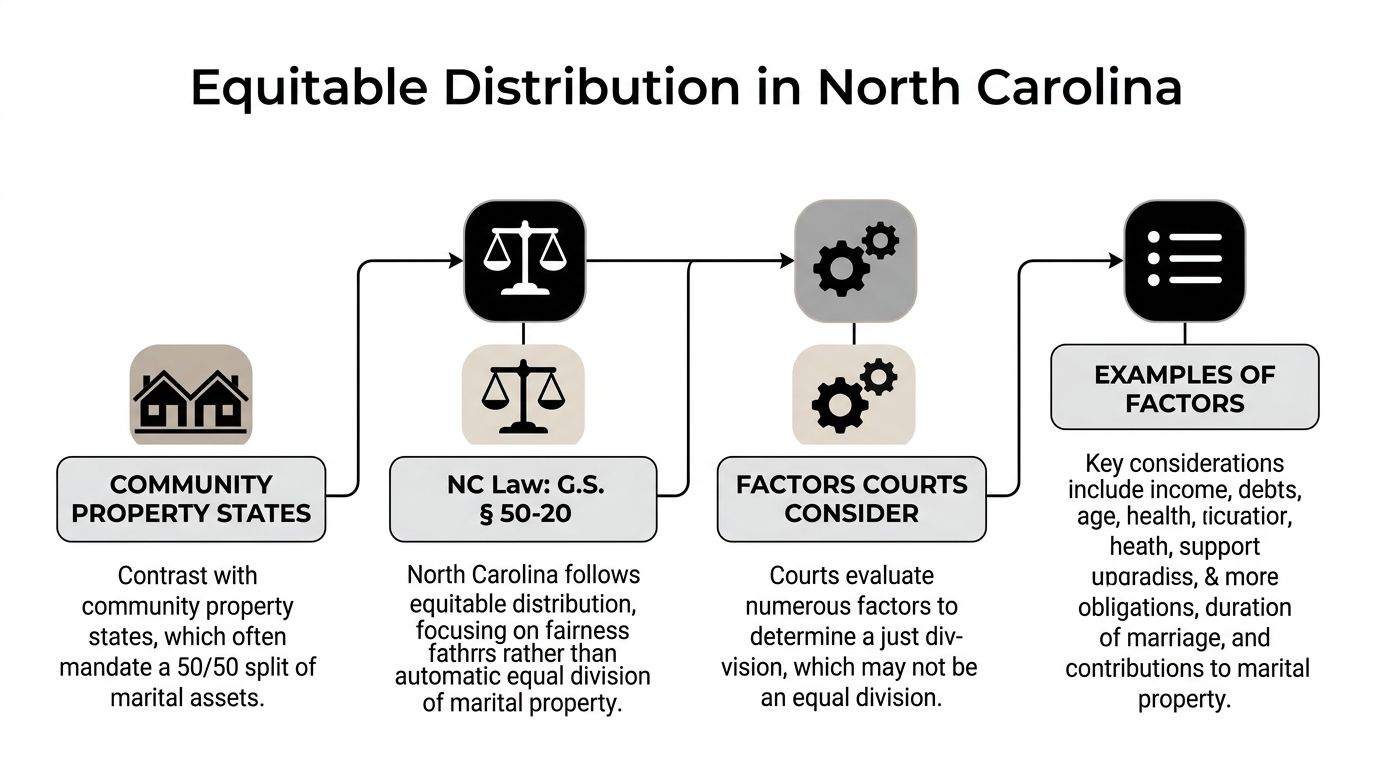
North Carolina follows equitable distribution rather than a strict 50/50 split, and courts weigh factors under G.S. § 50-20 including marriage duration, contributions, and economic circumstances to divide assets fairly, as explained by this North Carolina property division resource.
The three property categories that drive most cases
North Carolina law recognizes three broad categories.
Separate property
Separate property usually means property one spouse owned before the marriage, or certain gifts and inheritances that belong to one spouse individually. In many cases, separate property isn't divided.
But "separate" doesn't always stay clean. If separate funds were deposited into a joint account and used interchangeably with marital funds, tracing becomes harder.
Marital property
Marital property generally includes property acquired during the marriage and owned on the date of separation. It doesn't matter that one paycheck funded the purchase or that title is only in one spouse's name. If it was acquired during the marriage, it may still be marital.
Many people find this surprising. A car titled to one spouse can still be marital. So can an account held in only one name.
Divisible property
Divisible property is where many generic guides stop too soon. In North Carolina, some post-separation changes related to marital property can still be part of the equitable distribution analysis.
Examples often include passive increases or decreases in value after separation, certain income connected to marital property, or changes tied to the asset itself rather than a new post-separation effort by one spouse.
Post-separation appreciation is one of the hidden complexities in NC property cases. The date of separation matters, but it doesn't always end the valuation story.
What the court looks at when equal isn't fair
North Carolina's system is flexible on purpose. Courts can consider a range of facts when deciding whether equal division should stand or whether a different split is more just.
Some of the considerations people commonly struggle to understand include:
- Length of the marriage: A short marriage and a long marriage may produce very different arguments.
- Monetary contributions: Wages, investments, and debt payments matter.
- Non-monetary contributions: Caring for children, managing the household, or stepping back from a career can matter too.
- Economic circumstances: Current access to income, assets, and obligations can affect the result.
- Property history: What each spouse brought into the marriage can shape arguments about fairness.
Why statutory detail matters in negotiation
Most equitable distribution cases don't turn on a single dramatic fact. They turn on documentation and how the facts fit the statute.
If one spouse says, "I built this business," and the other says, "I gave up my career so you could build it," both statements may matter. A lawyer's job is to connect those facts to the legal factors the court is allowed to consider under G.S. § 50-20.
Classifying Marital and Separate Property
Classification is where many property disputes are won or lost. Before anyone can argue over fairness, someone has to decide what bucket each asset belongs in.
In North Carolina, that often means sorting property into separate, marital, and divisible categories, then proving why a particular asset fits where you say it fits.
Why classification gets messy fast
On paper, the categories sound simple. In real life, people combine accounts, refinance homes, inherit property mid-marriage, add a spouse to title, roll retirement funds from one account to another, and use one pool of money to support another.
A few familiar examples show how this works.
Example one: the inherited hobby farm
A wife inherits rural property from her parents during the marriage. If the inheritance was intended for her alone, that often supports a separate-property argument.
But facts can complicate it. If marital funds were later used for major improvements, the land generated income that both spouses managed, or title was changed jointly, the analysis may no longer be simple.
Example two: stock received as a personal gift
A husband receives stock from an aunt who clearly intended it for him alone. That points toward separate property.
If he later transfers some shares into a joint investment account and both spouses treat the position as shared family money, he may face tracing problems. The original character of the asset may not disappear automatically, but proving it becomes harder.
The role of divisible property after separation
Divisible property often confuses people because it deals with change after the marriage has functionally ended.
Suppose a marital brokerage account increased in value after separation because the market moved. That may be analyzed differently from a post-separation increase caused by one spouse's new labor, new income, or new decision-making.
The same kind of issue comes up with rental income, dividends, and property values. A house may appreciate after separation. The legal question becomes whether that increase should be treated as divisible property connected to the marital estate, or whether some portion is tied to post-separation effort and should be argued differently.
Good records from the date of separation forward often decide whether an appreciation argument is strong or weak.
The default is equal division, but not always the outcome
North Carolina starts with a presumption of equal division, but that presumption can be challenged. Although the default presumption is equal division, North Carolina courts consider 14 factors, including economic misconduct, custodial responsibilities, and separate property contributions, before ordering a deviation, as described in this overview of equitable distribution factors.
That matters in cases where one spouse says, "Half is not fair here."
Situations that may support an unequal division argument
An unequal distribution claim usually needs evidence, not frustration. Examples can include:
- Career sacrifice: One spouse stepped out of the workforce to raise children or support the other's education or career path.
- Separate property contribution: One spouse used separate assets in a way that materially helped acquire or preserve marital property.
- Custodial reality: One spouse will shoulder most day-to-day child-related housing or care needs after separation.
- Economic misconduct: One spouse wasted, hid, transferred, or misused assets in a way that affected the marital estate.
Retirement accounts deserve special attention
Retirement assets are often among the largest items in a North Carolina divorce, and they are rarely as simple as "split it in half."
Questions often include:
- What portion existed before the marriage?
- What part was earned during the marriage?
- Did the account rise or fall in value after separation?
- Are there loans against the account?
- Will a separate court order be needed to divide it?
If you don't identify the right valuation period and supporting statements, it's easy to oversimplify a retirement asset and negotiate from the wrong number.
A practical way to think about classification
Ask these questions in order:
| Question | Why it matters |
|---|---|
| When was the asset acquired? | Timing is the first clue to classification |
| How was it funded? | Premarital, inherited, gifted, earned, or mixed funds can change the answer |
| Who used and controlled it? | Conduct can affect tracing and ownership arguments |
| What changed after separation? | Appreciation, depreciation, or income may create divisible-property issues |
Classification disputes can feel technical, but they directly affect what is even on the table for division. That's why this stage of the case deserves careful attention.
Role and Benefits of Hiring a Property Division Attorney
A contested equitable distribution case is part legal analysis, part financial investigation, and part strategy. A lawyer isn't just filling out forms. In the right case, counsel is organizing proof, narrowing disputes, and deciding when outside experts are necessary.

Complex property division often involves forensic accountants and business valuators under NC Rule 702 and Daubert standards to establish accurate asset values, as noted in this discussion of complex property division in North Carolina.
What an attorney actually does in a property case
A property division attorney North Carolina families hire is often handling issues such as:
- Asset tracing: Following money from premarital accounts, inheritances, gifts, or business distributions.
- Document review: Reading account statements, deeds, tax returns, loan records, and plan summaries for classification clues.
- Valuation planning: Deciding when to involve a CPA, appraiser, or business valuator.
- Settlement structure: Turning broad agreements into specific terms that can be enforced.
- Trial preparation: Organizing testimony, exhibits, and expert support when agreement isn't possible.
For readers comparing options, this page on North Carolina asset division representation outlines the type of legal support that may be relevant in an equitable distribution matter.
Why expert coordination matters
In high-asset or closely held business cases, the law and the numbers have to work together.
A business owner may say the company isn't worth much because profits fluctuate. The other spouse may say the business supports the entire household and has substantial underlying value. That's where a formal valuation can move the discussion from accusation to evidence.
The same is true with:
- professional practices
- investment accounts with mixed funds
- executive compensation structures
- unusual real estate holdings
- trusts and inherited assets with disputed treatment
What to bring to the first meeting
You don't need a perfect spreadsheet before speaking with counsel. But certain records help immediately.
Bring what you can find, especially:
- Tax returns: Personal and business returns often reveal assets, income streams, and deductions.
- Account statements: Bank, retirement, brokerage, and loan statements close to the separation date are often critical.
- Property records: Deeds, closing statements, mortgage records, appraisals, and refinance documents.
- Business materials: Profit and loss statements, balance sheets, shareholder documents, operating agreements.
- Debt records: Credit card statements, personal loans, home equity lines, and vehicle financing.
The strongest first consultation usually isn't the one with the most emotion. It's the one with the clearest paper trail.
Legal help often prevents expensive mistakes
People sometimes delay hiring counsel because they want to "keep things simple." That can work in some cases. In others, it leads to informal side deals that ignore tax consequences, omit retirement division language, or misclassify separate property.
The right lawyer may also help identify when a case is suitable for negotiation and when it needs firmer litigation preparation. The point isn't to create conflict. It's to prevent avoidable loss.
The Law Office of Bryan Fagan is one North Carolina-focused option for people dealing with equitable distribution, divorce, and related family law disputes.
Real-World Property Division Scenarios
Theory helps. Real scenarios usually make the rules clearer.
The examples below aren't promises about outcomes. They show how North Carolina property issues often unfold when facts get specific.
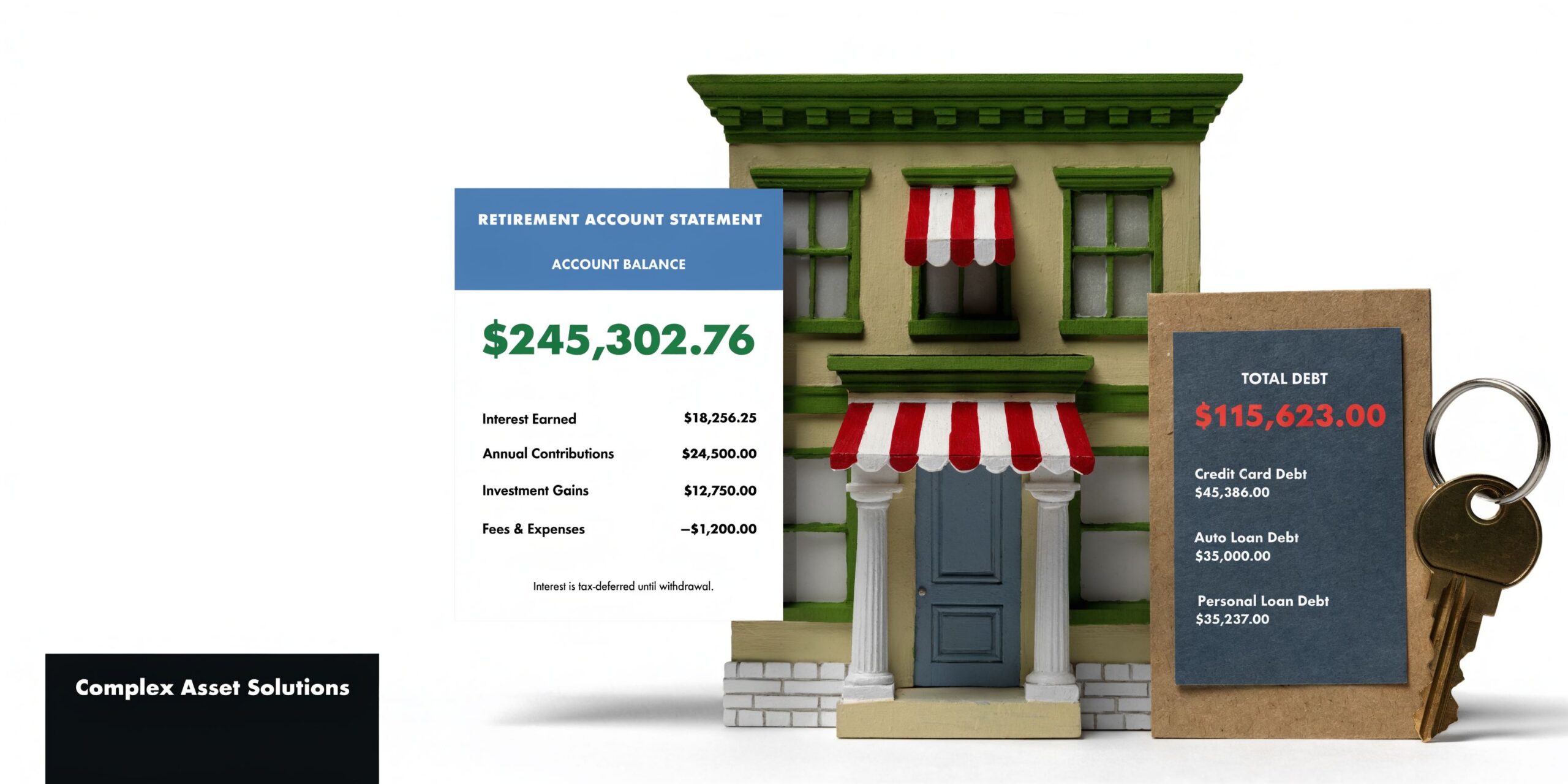
Expert witness engagement in North Carolina divorce litigation follows rigorous Rule 702 gatekeeping, making properly documented appraisals essential in high-asset cases to avoid testimony exclusion, according to this discussion of expert witnesses in North Carolina divorce cases.
A small business built during the marriage
Spouse A owns a landscaping company formed during the marriage. The LLC is in A's name only. Spouse B handled invoicing, scheduling, and home responsibilities while also caring for the children.
A thinks the company is personal because the LLC paperwork lists only one owner. B thinks it is marital because it was created and grew during the marriage.
In many North Carolina cases, the business interest may be treated as marital property if it was acquired during the marriage and existed on the date of separation. But that's only the starting point.
The harder questions are often:
- What is the business worth?
- Is any portion tied to one spouse's separate property contribution?
- Does goodwill exist, and if so, how is it analyzed?
- Did one spouse's unpaid labor increase the value?
If valuation becomes contested, a business valuator may be necessary. If the expert's method is weak or poorly documented, the testimony may be challenged.
A retirement account with premarital and marital components
Spouse A started a retirement account before marriage and kept contributing during the marriage. At separation, the account is much larger than it was at the wedding.
A common mistake is assuming the whole account belongs to the employee spouse. Another mistake is assuming the entire account is marital.
Neither assumption is safe. The account may contain:
- a separate component from before the marriage
- a marital component earned during the marriage
- possible post-separation changes that require closer review
This is why statements near the date of marriage and the date of separation matter so much. Without them, people end up negotiating based on rough estimates instead of evidence.
Retirement division usually turns on dates, statements, and tracing. If any one of those is missing, the case gets harder quickly.
Debt that doesn't feel fair
Spouse A ran up substantial credit card charges before separation. Some charges paid for household expenses. Others appear tied to personal spending after the relationship had broken down.
Spouse B's first reaction is often, "That debt is in A's name, so it isn't mine." Sometimes that argument works. Sometimes it doesn't.
In equitable distribution, debt analysis usually depends on what the debt was for, when it was incurred, and whether it benefited the marital estate. The label on the account matters less than many people think.
That means lawyers often review statements line by line, especially when one spouse alleges wasteful spending or concealment.
Post-separation appreciation in the marital home
Spouse A stayed in the marital residence after separation and continued paying the mortgage. By the time the property is addressed in the case, its value has changed.
This raises several layered questions:
- Was the home marital property as of the separation date?
- Did the value rise because of market conditions, because of one spouse's post-separation efforts, or both?
- Did principal reduction after separation come from one spouse's separate earnings?
- Should any appreciation be treated as divisible property?
These cases often frustrate people because both spouses can make emotionally understandable arguments. The spouse who moved out may say, "We owned it together when we separated." The spouse who stayed may say, "I carried this house alone."
North Carolina law gives a framework, but the facts and records usually decide how persuasive each side's position will be.
Hidden assets and incomplete disclosure
Another recurring scenario involves a spouse who suspects an account, business stream, or side income hasn't been fully disclosed.
The answer isn't to make broad accusations without proof. The better approach is targeted discovery, careful document review, and when necessary, expert help to trace funds and identify inconsistencies.
Red flags often include:
- Missing statements: Documents stop right before separation or skip unusual months.
- Transfers to relatives or entities: Money moves somewhere that doesn't fit normal household patterns.
- Business cash flow confusion: Personal expenses appear to be paid through a company.
- Account descriptions that don't match testimony: A spouse describes an asset one way, but records suggest something else.
These scenarios show why property division isn't just a paperwork exercise. The law is detailed, but the facts usually make the difference.
Cost and Timeline Expectations for Property Division
People often ask two practical questions early. How long will this take, and how expensive will it be?
The honest answer is that both depend heavily on the level of dispute. A case with clear records and cooperative negotiation will look different from one involving a business valuation, hidden asset concerns, or repeated fights about classification.
What usually drives cost
The biggest cost drivers are usually not dramatic courtroom moments. They are the steady demands of the case.
Common factors include:
- Volume of documents: More accounts, more years, and more transactions usually mean more attorney time.
- Valuation disputes: Business interests, real estate, and mixed financial accounts often require extra analysis.
- Expert involvement: Appraisers, forensic accountants, and valuators can add substantial work and scheduling complexity.
- Litigation posture: Cases that settle early usually cost less than cases that need formal discovery and trial preparation.
What usually drives timing
Timeline often depends on how quickly the parties can exchange reliable information and narrow the core issues.
Delay tends to come from:
- incomplete financial disclosure
- arguments over classification
- scheduling appraisals or expert review
- court calendars
- repeated settlement starts and stops
A general discussion of these broader budgeting concerns appears on this page about North Carolina divorce costs.
Typical property division costs and timelines in North Carolina
The table below uses qualitative ranges rather than exact figures because costs and timelines vary significantly by facts, county, and level of dispute.
| Case Type | Average Attorney Fees | Expert Fees | Resolution Time |
|---|---|---|---|
| Uncontested property agreement | Lower relative cost | Usually minimal or unnecessary | Often shorter |
| Moderately contested asset division | Moderate and fact-dependent | May be needed for selected assets | Often medium length |
| High-asset case with business or complex retirement issues | Higher due to tracing, negotiation, and possible hearings | Often significant because formal valuation may be required | Often longer |
| Trial-bound equitable distribution case | Highest relative cost because preparation is extensive | Frequently important if value or classification is disputed | Often longest |
How to keep a case more manageable
You can't control every part of the process, but you can improve efficiency.
- Organize records early: A clean set of statements saves legal time.
- Use a consistent timeline: Dates of marriage, separation, refinance, inheritance, and transfers should be documented clearly.
- Distinguish priorities from emotions: Not every unfair feeling creates a useful legal issue.
- Ask about phased strategy: Sometimes the best approach is to resolve simpler assets first and isolate the true disputes.
Budgeting for a property case is easier when you understand that complexity, not just conflict, tends to drive expense.
Choosing the Right Property Division Attorney
Not every divorce lawyer handles property issues the same way. Some focus mainly on custody disputes. Others spend much more time on tracing, valuation, and equitable distribution litigation.
If property division is a major part of your case, interview lawyers with that in mind.
What to ask before you hire someone
A useful consultation often includes questions like these:
- How often do you handle equitable distribution cases in North Carolina?
- How do you approach mixed property and tracing disputes?
- When do you bring in appraisers, CPAs, or business valuators?
- Who will work on my case day to day?**
- How do you handle settlement versus trial preparation?
What good fit looks like
The right fit usually includes a few things at once. You want clear communication, realistic advice, familiarity with North Carolina family law procedure, and a practical approach to evidence.
Some clients prefer a smaller practice feel. Others want the broader support structure that can come with a larger firm. Neither is automatically better. The right choice depends on the complexity of your property issues and how much direct guidance you want during the case.
A good attorney shouldn't promise a specific result. They should explain the likely pressure points, identify missing records, and give you a grounded assessment of where your case may become difficult.
North Carolina Property Division FAQs
Is everything acquired during marriage automatically split equally?
Not necessarily. North Carolina uses equitable distribution under G.S. § 50-20, which starts with an equal division presumption but allows a different result when the facts support it.
Are retirement accounts always marital property?
No. A retirement account can include separate, marital, and sometimes post-separation components. The timing of contributions and changes in value matters.
What if my spouse is hiding assets?
Your lawyer may use formal discovery, subpoenas, financial record review, and in the right case, expert analysis. A suspicion alone isn't enough, but a well-documented concern can be investigated.
How is post-separation debt treated?
It depends on the purpose of the debt, when it was incurred, and whether it benefited the marital estate. The account name alone usually doesn't answer the legal question.
Does a prenuptial or postnuptial agreement control property division?
It can. A valid agreement may change what would otherwise happen under equitable distribution. The agreement's language, enforceability, and application to the disputed asset all matter.
If you're dealing with divorce, separation, or a dispute over who keeps what, a focused legal review can help you avoid expensive assumptions. The Law Office of Bryan Fagan works with North Carolina clients on equitable distribution and other family law issues. Schedule a consultation to discuss your assets, your records, and the practical next steps under North Carolina law.