If you're searching for an equitable distribution lawyer nc, you're probably dealing with one of the hardest parts of divorce. Not the paperwork. Not the court dates. The fear of what happens to the life you've built.
For many people, that fear centers on a few specific things. The house. The retirement account. The savings account that took years to grow. The car you still owe money on. The credit cards. Sometimes it's also the suspicion that your spouse has already started moving money, hiding records, or spending in ways that don't look accidental.
North Carolina law gives this process a structure. That matters. Property division isn't supposed to be a free-for-all, and it isn't supposed to depend on who has possession of an asset or whose name is on the title. The law creates a framework for sorting property, valuing it, and dividing it fairly.
That doesn't mean it feels simple when you're living through it.
A new client often comes in thinking the court will either split everything straight down the middle or let the spouse with better records control the outcome. Neither assumption is safe. In practice, the outcome usually depends on how well the property is identified, how clearly separate claims are traced, and whether anyone can prove facts that justify something other than an equal split.
A strong legal strategy starts by turning panic into a checklist. What exists. What was acquired during the marriage. What was owned before the marriage. What debt is attached to each asset. What documents are missing. What conduct might matter to a judge.

Practical rule: The sooner you organize financial records after separation, the more options you usually preserve.
When clients understand the rules, they make better decisions. They stop guessing. They stop relying on what friends say happened in another state. And they start preparing for the North Carolina process that is before them.
Introduction Facing Property Division in a North Carolina Divorce
You separate, and within a week the practical questions start stacking up. Who stays in the house. What happens to the joint account. Whether the retirement plan is on the table. Why a credit card balance suddenly looks higher than it did a month ago. For many clients, the fear is not just losing property. It is losing track of what exists, what it is worth, and what the other spouse has been doing with it.
Property division is personal for that reason. A house can be shelter for your children and the largest asset in the marriage. A pension may represent decades of work. A business interest, stock account, vehicle, or line of credit may carry both value and risk. In my experience, clients get better outcomes when they stop treating equitable distribution as a single fight over "who gets what" and start treating it as a proof-driven process.
North Carolina law gives that process structure. The court classifies property and debt, assigns values, and decides how to divide the marital estate fairly. The starting point is often an equal division, but the critical work is in the details. Separate property claims must be traced. Debt has to be tied to a purpose and a date. Missing records have to be found or reconstructed. If one spouse moved money, hid assets, or spent marital funds for a nonmarital purpose, that can change both strategy and outcome.
Those cases are not rare. One spouse may control the online logins, the bookkeeping, or the safe deposit box. Another may discover after separation that tax returns do not match account statements, or that cash advances, transfers, or new debt appeared at the worst possible time. A good equitable distribution plan addresses those problems early, before the paper trail gets colder.
The first concern is usually access
Clients often tell me the same thing at the first meeting: "My spouse handled everything." That creates a disadvantage, but it is not the end of the case. Bank records, loan files, deeds, retirement statements, business records, and electronic account histories can often be obtained through formal discovery, subpoenas, and targeted requests. The goal is not to create noise. The goal is to build a clean record the court can use.
Fairness is the next concern. Homemaking and supporting a spouse's career can matter. Title is relevant, but it does not decide every issue. A spouse who emptied an account, ran up debt, or transferred property before separation may have created a dissipation problem, and that issue needs to be documented with dates, amounts, and purpose, not just suspicion.
A practical way to approach the case
Property division usually becomes clearer once the questions are narrowed:
- What exists: Real estate, vehicles, accounts, retirement benefits, business interests, personal property, and debts.
- When it was acquired: Before marriage, during marriage, or close to separation.
- How it was funded: Wages, bonuses, refinancing, inherited money, gifts, or transfers from other accounts.
- What it is worth today: Fair market value, loan balance, tax effect, and any cost of sale.
- What conduct may affect the result: Hidden assets, unusual spending, depleted accounts, or records that do not line up.
That shift is critical; North Carolina judges divide evidence, not confusion.
The sooner a client gathers statements, tax returns, deeds, loan documents, retirement records, and business information, the more options usually remain available. That is especially true where financial misconduct may be part of the story. Hidden assets and suspicious transfers are rarely proven by one dramatic document. They are usually proven by patterns, and patterns are easier to show when the records are preserved early.
What Is Equitable Distribution in North Carolina Law
A common early mistake is treating property division like a title check. One spouse points to the deed, the car title, or the account name and assumes the analysis ends there. In North Carolina, it usually starts there, not ends there.
Equitable distribution is the court process for dividing property and debt after separation under NCGS § 50-20. The statute begins with a presumption that an equal division of marital property is fair. A judge can order an unequal division if the evidence shows that equal is not equitable under the statutory factors.
That distinction affects strategy from the start. A spouse who earned more is not automatically entitled to more. A spouse whose name appears on an account does not automatically keep it. A spouse who stayed home with children did not make a lesser contribution because the contribution was not reflected on a W-2.
The legal framework clients need to understand
North Carolina courts do not divide everything the parties own. They divide property and debts based on legal categories, then decide whether equal or unequal distribution is appropriate under the facts of that marriage.
The first question is usually classification. Was the asset acquired before marriage, during marriage and before separation, or after separation? Was it inherited by one spouse? Was it given only to one spouse? Did separate and marital funds get mixed together? Those facts often decide the case more than the label a family used during the marriage.
Here is the practical framework.
| Property Type | Definition | Example |
|---|---|---|
| Marital property | Property acquired during the marriage and before separation that is subject to division | Wages earned during marriage used to buy a vehicle |
| Separate property | Property owned before marriage, or acquired by inheritance or gift to one spouse | Savings one spouse had before marriage, or an inheritance kept separate |
| Mixed property | Property that has both marital and separate components | A home bought with separate funds and marital funds over time |
| Divisible issues | Certain post-separation changes related to marital property | Passive gain or loss on a marital investment account after separation |
Those categories sound clean on paper. Real cases are not.
A retirement account may contain a premarital balance, marital contributions, employer matches, loans, and post-separation gains or losses. A house may have been bought with one spouse's separate funds, refinanced during the marriage, and titled jointly. A business may have started before marriage but increased in value during the marriage for reasons that are disputed. Each of those facts can change classification, value, or both.
Where clients usually lose ground
Commingling is one problem. Tracing is another.
A premarital account can remain separate property if the owner can trace it clearly. Once marital earnings are deposited into that same account for years, the separate claim often becomes harder to prove. An inheritance can remain separate as well, but broad use of inherited funds for joint purposes often creates a dispute that is expensive to sort out later.
Real estate creates some of the most technical fights. Separate funds used toward jointly titled property may not be treated the way a client expects. I often have to explain that a well-meant decision made years earlier, such as adding a spouse to title during a refinance, can change the legal analysis in ways that surprise both parties.
A sound equitable distribution claim begins with classification and proof, not assumptions about fairness.
Unequal does not mean unusual
Many clients hear "equitable" and assume the court will split everything down the middle. The statute does start there. It does not stop there.
North Carolina law permits an unequal distribution when the evidence supports it. Income disparity may matter. So may the length of the marriage, the needs of a custodial parent to remain in the marital home, liquidity problems tied to a business interest, or proven financial misconduct that affected the marital estate. Hidden assets and dissipation fit here in a practical sense. If one spouse moved money, drained accounts, or created debt for a nonmarital purpose close to separation, that conduct can change the result if it is documented well enough to present in court.
Appellate decisions in North Carolina make the point clearly. Courts have upheld sharply unequal outcomes where the statutory factors justified them. That is not the typical result, but it does occur. Clients should understand that property division is a fact-driven process, and strong records often matter more than strong feelings.
What equitable distribution is really about
The court is not trying to reward one spouse for being more careful, more persuasive, or more upset. The court is trying to identify the marital estate, place a reliable value on it, and divide it fairly under the statute.
That is why property division cases often turn on details that seemed minor at the time. Which account paid the down payment. Whether inherited money stayed separate. Whether a transfer near separation had a legitimate purpose. Whether an increase in value happened passively or because of marital effort.
Those details are where cases are won or lost.
The Three Step Equitable Distribution Process in NC Courts
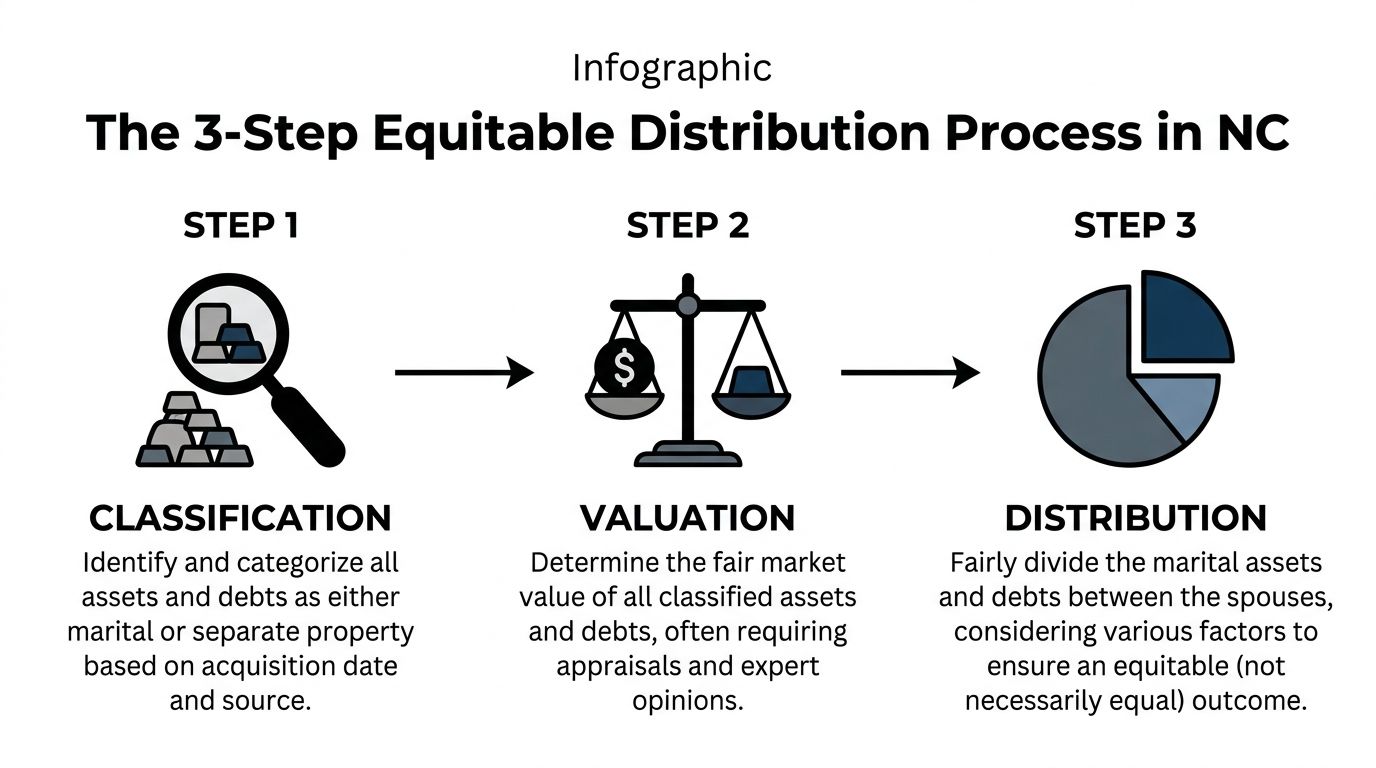
When a North Carolina court handles equitable distribution, it follows a required sequence. Lawyers usually shorten it to CVD. That means Classify, Value, and Distribute.
The order matters. If you classify an asset incorrectly, the valuation work may be wasted. If you value it incorrectly, the final division can be distorted. This is one reason a rushed settlement can create expensive problems later.
Step one is classification
Classification asks a basic question. Is the asset marital or separate?
That sounds easy until you apply it to real life. One spouse may have started a retirement account before marriage and kept contributing during marriage. A home may have been purchased with funds one spouse brought into the marriage, then refinanced and titled jointly. An account may contain inherited money mixed with paychecks.
The court has to sort that out with evidence, not assumptions.
What usually helps:
- Account statements: They show balances before marriage, during marriage, and near separation.
- Deeds and closing documents: They show title history and source of funds.
- Gift and inheritance records: They help trace whether a claimed separate asset stayed separate.
- Loan records: These matter because debt affects net value and sometimes classification arguments.
What doesn't help is a vague story without documents. Judges hear that all the time. If separate property can't be traced, the argument weakens.
Step two is valuation
After property is classified, the next question is value. North Carolina's process requires valuation at the date of separation, not the date of divorce, and the court works from net value after all liens, as explained in this UNC School of Government equitable distribution module.
That rule surprises people constantly.
If the home had a mortgage, the relevant question isn't just market price. It's the home's value minus the debt secured against it. The same logic applies to financed vehicles and other encumbered assets.
Why the separation date matters so much
Clients sometimes wait many months before focusing on property issues. During that time, accounts move, market values change, and one spouse may keep paying certain debts. The legal valuation date doesn't erase those complications, but it gives the court a reference point.
That can cut both ways.
If a retirement account rose after separation, one spouse may assume the increase is automatically shared. Not necessarily. If the home dropped in value after separation, one spouse may want to use the lower number. The legal framework often points back to the separation date, with further analysis depending on the asset and evidence.
Client warning: Waiting to gather records doesn't freeze your case. It just makes reconstruction harder.
Step three is distribution
Only after classification and valuation does the court divide the marital estate.
The presumption remains an equal split. But distribution is where the statutory fairness factors come into play. The court may look at issues such as income differences, health, substantial separate assets, custodial housing needs, expectations tied to pensions or retirement income, wasting of marital property, and tax consequences of transfer.
A practical example makes this easier to see.
If one spouse has much greater separate assets and the other will be the custodial parent needing to remain in the marital home, those facts may shape how assets are distributed. If one spouse dissipated marital funds, that can also influence the result. The court is not just cutting a pie. It is deciding what arrangement is fair under the statute.
Where mistakes happen
The UNC School of Government material is especially useful on one point. Errors in any CVD component can create grounds for later proceedings, including appeals or post-judgment actions.
The most common trouble spots include:
- Misclassification of jointly held real estate when separate funds were used.
- Using gross value instead of net value for mortgaged or financed assets.
- Missing the valuation date and relying on later account snapshots.
- Settling too early before records are complete.
- Ignoring tax consequences when comparing one asset to another.
A brokerage account and a checking account may show the same face value on paper, but they don't always transfer with the same practical consequences. A pension and a vehicle are not interchangeable because someone assigns them similar numbers.
The process is technical. That's not a flaw. It's what keeps property division from becoming guesswork.
Common Disputes and How a Lawyer Can Protect You
You separate. Two weeks later, the savings account balance is lower, the business suddenly looks unprofitable, and your spouse says the missing records are probably somewhere in the house. That is how many equitable distribution fights begin in real life.
These cases usually turn on proof, timing, and control of information. One spouse has easier access to the books, the passwords, the tax records, or the story behind a transfer. The other spouse is left trying to piece together what happened after the money has already moved.
Those disputes are rarely resolved by broad accusations. They are resolved by documents, tracing, valuation work, and a case strategy built early.

Hidden assets and missing records
Clients usually notice the problem before they can prove it. Statements stop coming. Online access changes. A retirement account balance looks different from what it was before separation. A credit card suddenly shows charges that make no sense.
Some of those issues have innocent explanations. Some do not. The point is to verify, not guess.
A lawyer protects you here by getting the paper trail before it disappears or gets harder to read. That can mean formal discovery, subpoenas, requests for production, and targeted review of tax returns, bank statements, credit card records, payroll documents, loan files, and investment histories.
A single suspicious transaction is less compelling than a consistent pattern. Repeated cash withdrawals, transfers to unfamiliar accounts, new debt, or spending that breaks sharply from the couple's normal habits can support a dissipation or concealment argument.
In more complex matters, particularly high net worth divorce cases in North Carolina, tracing funds may require forensic accounting and careful review of business, trust, and investment records. That is often where clients see the trade-off. Expert work costs money, but failing to trace a large asset can cost far more.
Business interests and hard to price assets
Business ownership changes the case.
A closely held company, medical practice, contracting business, or consulting firm may produce income in ways that are not obvious from a pay stub. The spouse who runs the business usually knows which expenses are personal, which receivables are delayed, and whether income was pushed into a different period. If those details are left untested, the business owner starts the case with a built-in advantage.
The same problem appears with deferred compensation, restricted stock, partnership interests, and unusual investment holdings. The dispute is not just what the asset is worth. The dispute is often whether the proposed value reflects economic reality.
Useful protections include independent review of financial records, comparison of positions taken in other settings such as loan applications, and expert valuation where the numbers cannot be trusted at face value. A spouse should not be claiming poverty in court while presenting a thriving operation to a bank.
I also tell clients something they do not always expect to hear. Not every valuation fight is worth litigating to the end. Sometimes the right strategy is to press hard on records and then negotiate from strength, especially when the cost of a full expert battle would consume too much of the estate.
Commingling and separate property fights
Separate property claims often look strong at the beginning and weak by the time the records are reviewed.
Inheritance funds are the classic example. A spouse receives money that began as separate property, deposits it into a joint account, uses part of it for renovations or mortgage payments, and then assumes the original character stayed intact. Sometimes that claim can still be proved. Often it becomes much harder because the funds were mixed with marital money and used for shared purposes.
These cases depend on tracing. Clean records can preserve a separate claim. Mixed deposits, missing statements, and years of ordinary family spending can undercut it.
Real estate creates another common fight. If separate funds were used to acquire jointly titled property, classification can become more technical than clients expect. A missed argument at the beginning can distort the settlement discussion for months. That is one reason I push clients to gather closing files, refinance documents, account statements, and payoff records early rather than rely on memory.
A short explanation of the financial misconduct issue can also help frame what the court may consider in disputed cases.
Financial misconduct can change the division
North Carolina is no-fault in many respects, but property division can still be affected by financial misconduct. Under NCGS 50-20(c)(12), the court may consider acts that waste, conceal, transfer, or misuse marital assets.
That issue matters most when there is proof of a pattern. Gambling losses, spending on a third party, unexplained transfers, hidden accounts, or liquidation of property near separation can all support an argument for an unequal distribution. The court needs more than suspicion. The court needs records, dates, amounts, and a credible explanation of why the spending harmed the marital estate.
This is one place where generic guides fall short. In actual cases, the hard part is not reciting the statute. The hard part is connecting the bank records, tax returns, and testimony in a way that shows misconduct rather than bad financial habits or ordinary marital spending.
If you think your spouse is draining assets, preserve full statements, download account histories, save closing documents, and get legal advice quickly. Screenshots alone rarely tell the whole story.
Debt can be just as contested as assets
Clients often focus on what they own and miss how much of the case will turn on debt.
Credit cards, tax liabilities, personal loans, vehicle notes, and home equity lines can all be disputed. A debt may be in both names but have little to do with the marriage. Another may be in one name only and still have been used for a marital purpose.
The lawyer's job is to force precision. What was the debt used for? When was it incurred? Who benefited from it? Is there a paper trail, or only a story? Those questions matter because debt allocation can change the practical outcome of a case just as much as the division of assets.
What Your Equitable Distribution Lawyer Does For You
Clients sometimes ask a fair question. What does a lawyer do in an equitable distribution case besides show up in court?
A lot. The work is part investigation, part financial organization, part negotiation, and part advocacy. In difficult cases, it's also damage control.
The lawyer builds the factual record
Property cases are document-driven. Your lawyer helps identify what must be gathered, what must be requested from the other side, and what may need to be subpoenaed from banks, employers, plan administrators, or other third parties.
That often includes the inventory affidavit and supporting records needed to identify assets, debts, balances, and competing claims. If the records are scattered, the lawyer's role is to turn them into a usable case theory.
The lawyer spots issues clients usually miss
Clients know their lives. They don't always know the legal weak points.
A lawyer looks for things such as:
- Tracing problems: Can you prove a separate property claim with documents?
- Valuation gaps: Do you need an appraiser, plan statement, or business analysis?
- Debt allocation issues: Is a claimed marital debt tied to marital purposes?
- Transfer risk: Did anyone move funds, retitle property, or liquidate assets before or after separation?
This is especially important when the marital estate includes a company, practice, or other specialized asset. In those cases, legal strategy and valuation work have to line up. If your divorce involves ownership interests, this North Carolina business valuation for divorce resource is a useful starting point for understanding why these cases need extra care.
The lawyer negotiates from evidence, not emotion
Settlement is often possible. But good settlement doesn't come from "splitting the difference" on every dispute.
It comes from identifying which issues are worth fighting, which require expert support, and which can be traded in a way that meets the client's practical goals. One client may care most about keeping the house. Another may want liquidity and a clean break. Another may prioritize retirement security over personal property.
A lawyer's value is partly judgment. Pushing every point can waste money. Conceding too early can cost far more.
A strong settlement usually looks organized, documented, and boring. That's often a sign the legal work was done well.
The lawyer prepares for court even while aiming to avoid it
Cases settle more effectively when the other side knows you're prepared to prove your claims. That means witness preparation, exhibit organization, legal briefing where needed, and a clear presentation of classification, valuation, and distribution arguments.
Even in a negotiated matter, trial readiness changes negotiating strength. It also protects you if settlement talks fail late in the process.
Choosing the Right NC Lawyer and Understanding Costs
Hiring counsel for property division is a financial decision inside an already stressful financial event. Clients want straight answers about cost, communication, and case strategy. They should.
Most family law matters are handled through a retainer and hourly billing structure. The amount of work required usually depends on complexity, conflict level, the number of disputed assets, document volume, expert involvement, and whether the case resolves in negotiation, mediation, or court. No honest lawyer should promise a cheap case or a fast case without first understanding the facts.
What to ask in a consultation
The right consultation questions reveal more than a polished sales pitch.
Ask things like:
- How do you handle tracing separate property claims?
- What documents should I gather first?
- Have you handled cases involving business interests, retirement plans, or hidden asset concerns?
- When do you bring in appraisers or forensic accountants?
- How do you approach settlement versus trial preparation?
- Who will communicate with me regularly about the status of my case?
Listen for specifics. A good answer usually includes process, not slogans.
What clients should understand about cost
A lower initial retainer doesn't always mean a lower total bill. If the case is poorly organized, the client may pay later through duplicated effort, rushed motion practice, or avoidable hearings.
By contrast, spending early time on records, chronology, and asset identification can reduce conflict later. Clients who want a more detailed overview of typical expense issues in family law often start with information about NC divorce cost considerations.
Signs of a good fit
You don't need a lawyer who promises victory. You need one who can explain trade-offs clearly.
Look for an attorney who can do these things:
- Explain North Carolina rules in plain English
- Identify the strongest and weakest parts of your property claims
- Set realistic expectations
- Respond with clarity, not theatrics
- Treat documentation as central, not optional
The best fit is usually the lawyer who makes the process feel more concrete, not more confusing.
North Carolina Equitable Distribution FAQs
Can I be forced to sell the marital home in my NC divorce
Sometimes yes, but not always.
The home can be distributed in several ways. One spouse may keep it and offset the other spouse's share with other assets. The home may be sold and the net proceeds divided. In some cases, temporary arrangements make sense before a final resolution.
The answer usually depends on affordability, equity, mortgage issues, and whether one spouse can realistically refinance or maintain the property alone.
What happens to credit card debt and mortgages
Debt doesn't disappear because a couple separates.
The court looks at the nature of the debt and how it relates to the marriage. A mortgage tied to the marital home is usually a major part of the property analysis. Credit card balances can be more disputed, especially if one spouse used them for non-marital purposes or after separation in a way that didn't benefit the family.
Documentation matters here as much as it does for assets.
Does it matter whose name is on the title or account
It can matter, but it usually doesn't end the analysis.
North Carolina equitable distribution focuses on classification and value, not just name-on-title shortcuts. A vehicle, account, or house may still be part of the marital estate even if one spouse's name appears alone. On the other hand, some assets remain separate if they can be properly traced and documented.
How long does equitable distribution take in North Carolina
It depends on complexity and cooperation.
A case with complete records and limited disputes may resolve through negotiation or mediation more efficiently. A case involving hidden assets, business valuation disputes, or tracing problems usually takes longer because the evidence takes longer to develop.
The best way to shorten the process is usually not to rush. It's to organize records early, identify disputes clearly, and avoid making positions that can't be supported later.
Schedule a Consultation to Protect Your Assets in NC
Equitable distribution isn't just about dividing things. It's about protecting your financial footing after divorce. The right outcome depends on details that many people don't spot on their own, including classification issues, valuation timing, debt allocation, tracing problems, and evidence of financial misconduct.
If you're facing separation or already in the middle of a property dispute, getting legal advice early can help you avoid mistakes that are difficult to undo. That is especially true when the case involves a home, retirement accounts, business interests, inherited property, or concerns about hidden money.
North Carolina law gives you a framework. A careful legal strategy helps you use it well.
A consultation can help you understand what property issues matter most in your case, what documents you should gather now, and what realistic options you have for settlement or court. If you're worried about the house, your savings, or whether your spouse has handled money improperly, don't wait for the confusion to deepen.
If you need guidance from a North Carolina firm that handles divorce and property division with a strategic, client-focused approach, schedule a consultation with the Law Office of Bryan Fagan.