Facing a divorce is overwhelming, but understanding your options can bring much-needed clarity. For many couples in North Carolina, an uncontested divorce offers a more peaceful and cost-effective path forward, allowing you to end your marriage by mutual agreement instead of through a drawn-out court battle. This guide breaks down the process, requirements, and common pitfalls specifically for North Carolina residents.
What is an Uncontested Divorce in North Carolina?
An uncontested divorce, sometimes called a "simple divorce," is a legal process where both spouses agree on all the major issues related to their separation. Unlike a contested divorce, where a judge makes the final decisions about your property, debts, and children, this approach empowers you and your spouse to stay in control. The entire process is built on cooperation, not conflict.

What Makes a Divorce "Uncontested"?
For a divorce to be truly uncontested under North Carolina law, you and your spouse must agree on everything. This goes far beyond simply agreeing that the marriage is over.
You need a complete consensus on these key issues:
- Property Division: How you will divide all marital assets, from the house and cars to retirement accounts and bank balances. This is known as Equitable Distribution.
- Debt Allocation: Who takes responsibility for paying off shared debts like mortgages, car loans, and credit card balances acquired during the marriage.
- Child Custody & Support: If you share minor children, you must have a settled, detailed plan for the custody schedule and how child support will be handled according to state guidelines.
- Alimony (Spousal Support): You must agree on whether one spouse will pay alimony, as well as the amount and duration of the payments.
A simple verbal agreement won't hold up in court. These terms must be formally written into a legal document known as a Separation and Property Settlement Agreement, which functions as a private, binding contract between you.
The Benefits of Choosing an Uncontested Path
Opting for an uncontested divorce provides significant advantages compared to a traditional, contested court fight. It keeps you in the driver’s seat, enabling you to finalize your separation privately, efficiently, and on your own terms.
The greatest benefit is avoiding an expensive, emotionally draining, and lengthy court battle. You and your spouse control the outcome—not a judge who is unfamiliar with your family’s unique situation.
While every divorce is a difficult process, choosing an amicable path reflects a more modern approach. The process for a North Carolina divorce can be complex, but an uncontested approach simplifies many of the required steps. By working together, you and your spouse can move forward with your lives with dignity and control.
Key Requirements for an NC Uncontested Divorce
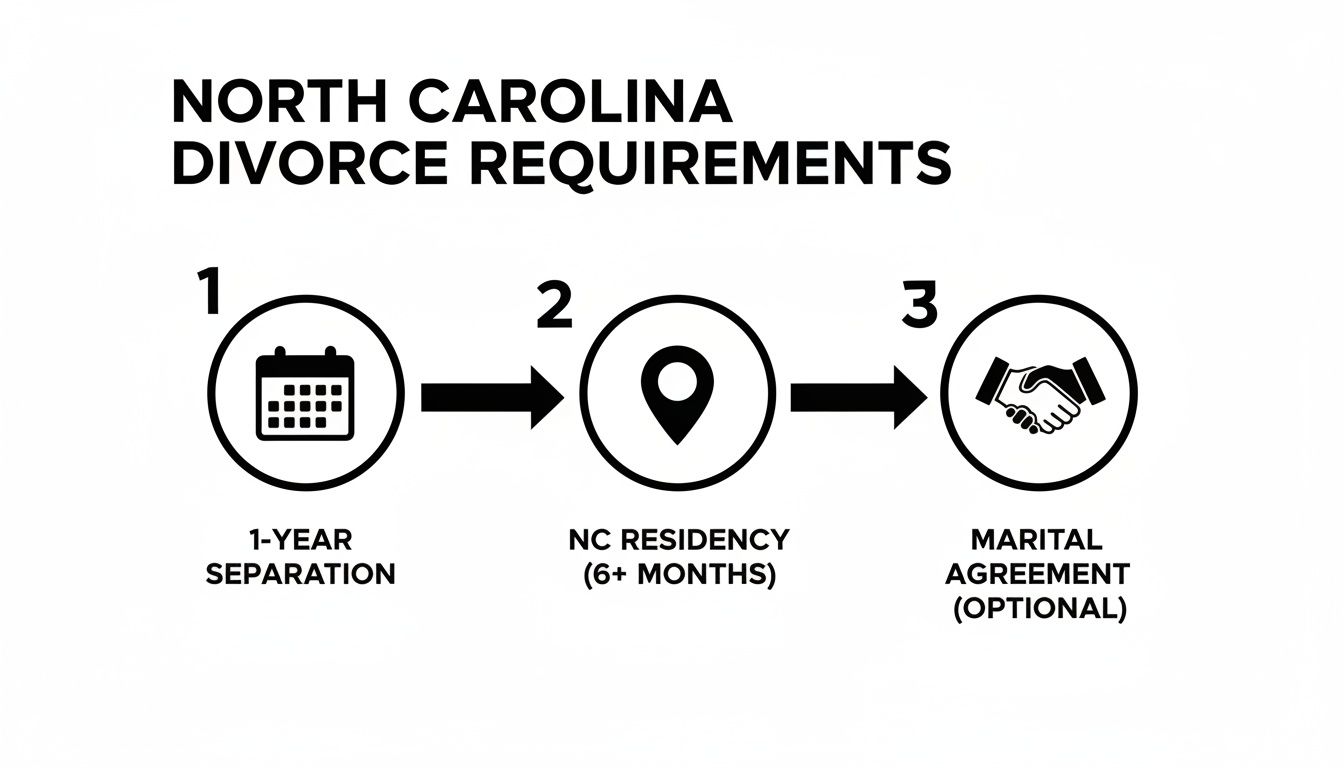
Before you can begin the filing process for an uncontested divorce in North Carolina, you must satisfy strict legal prerequisites. These are non-negotiable rules under state law. Failing to meet even one of them will stop your case before it starts.
Getting these requirements right from the beginning puts you on solid legal ground and helps you avoid the common filing errors that cause frustrating delays and added expense.
The Mandatory One-Year Separation
The first and most critical hurdle is North Carolina’s mandatory separation period. Under N.C. Gen. Stat. § 50-6, you and your spouse must live separate and apart for at least one full year before you can file a Complaint for Absolute Divorce.
This means living in two entirely different residences. Critically, you must also have the intent for the separation to be permanent. Living in separate bedrooms under the same roof will not satisfy the court—the one-year clock only starts ticking the day you begin living in separate homes.
Real-World Scenario: Imagine Sarah and Tom, who have lived in separate apartments for ten months. Tom still covers the family cell phone plan, and they recently attended their child's school play together. A judge would almost certainly see this as acceptable, as their actions don't signal an intent to reconcile. However, if they spent a weekend together at their old marital house for a "trial reconciliation," it could reset the entire one-year clock.
North Carolina Residency Requirement
On top of the separation rule, North Carolina has a straightforward residency requirement. To file for divorce here, at least one of you must have been a legal resident of North Carolina for a minimum of six months immediately before the divorce complaint is filed.
This rule is what gives the North Carolina courts jurisdiction to hear your case. It doesn’t matter where you got married or where you lived for most of your marriage. The only thing that matters is that at the time of filing, one spouse has called North Carolina home for the last six months.
For instance, if you moved to Charlotte from South Carolina seven months ago, you meet the residency requirement—even if your spouse still lives out of state.
The Foundation: A Comprehensive Separation Agreement
Finally, the core of an uncontested divorce is complete agreement. This is what separates a smooth, administrative process from a drawn-out court battle. A verbal "we agree" is not enough to protect you.
An uncontested divorce is built on a comprehensive Separation and Property Settlement Agreement. This is a legally binding contract that you should have drafted, negotiated, and signed before filing for the absolute divorce. It must clearly spell out your mutual decisions on:
- Property and Debt Division: How you’ll divide all marital assets (the house, cars, 401ks) and liabilities (mortgage, credit card debt).
- Child Custody and Support: A detailed parenting plan and child support calculations that adhere to state guidelines.
- Alimony (Spousal Support): A clear agreement on whether one spouse will pay support, how much, and for how long.
Without this signed document, your divorce isn't truly uncontested. It’s the official proof of your mutual consent that allows the court to grant your divorce smoothly and turn your private agreement into a legally enforceable reality.
How to File For An Uncontested Divorce in NC
Once you’ve met the one-year separation and six-month residency requirements, you can begin the formal divorce process. This stage involves specific court documents and procedures, but with a clear roadmap, the path to an uncontested divorce in North Carolina is predictable and straightforward.
Step 1: Finalize the Separation Agreement
Before a single court paper is filed, your most important task is finalizing the Separation and Property Settlement Agreement. This private contract is the heart of an uncontested divorce. It spells out every detail you’ve agreed upon regarding property, debt, and, if applicable, alimony and child arrangements.
It is absolutely critical to have this agreement signed and notarized before filing the divorce complaint. This document locks in your mutual decisions and prevents one spouse from changing their mind later. If you file for the absolute divorce without it, you could permanently waive your right to have the court divide property or award alimony.
Think of the Separation Agreement as your blueprint. You build the framework of your post-marriage life first, and only then do you ask the court to legally dissolve the marriage structure.
Step 2: Prepare and File the Court Paperwork
With a signed Separation Agreement in hand, you’re ready for the official court filings. The person who starts the divorce case is known as the Plaintiff, and the other spouse is the Defendant.
Here are the key documents that need to be prepared:
- Complaint for Absolute Divorce: This document formally opens your divorce case. It states the basic facts, confirms you meet the legal requirements, and asks the court to grant the divorce.
- Summons: A legal notice for your spouse (the Defendant), informing them that a lawsuit has been filed and giving them 30 days to respond.
- Domestic Civil Action Cover Sheet: An administrative form the Clerk of Court uses to categorize and track the case.
- Servicemembers Civil Relief Act (SCRA) Affidavit: This form is used to confirm your spouse’s military status, as active-duty service members have special legal protections.
Once these documents are ready, you will file them with the Clerk of Court in the county where you or your spouse lives and pay the court filing fee.
Step 3: Serve the Papers and Wait for a Response
After filing, the Plaintiff must legally notify the Defendant of the lawsuit by "serving" them with a copy of the Summons and Complaint. This step, called service of process, is a mandatory legal requirement.
Common options for serving the papers in North Carolina include:
- Certified Mail, Return Receipt Requested: A common and affordable method.
- Sheriff's Service: Paying the Sheriff's Department a fee (typically around $30) to personally deliver the papers.
- Acceptance of Service: The Defendant can sign a document to waive formal service, which speeds up the process.
Because this is an uncontested case, the Defendant will not file an "Answer" to fight the divorce. Once the 30-day response window closes, you can move to the final step.
Step 4: Finalizing Your Divorce
After the Defendant is served and the 30-day response window closes, the Plaintiff can move to finalize the divorce. One of the biggest benefits of an uncontested divorce in North Carolina is that you typically do not have to appear in court.
Your attorney will submit the final paperwork, including a proposed Judgment for Absolute Divorce, directly to a judge. The judge reviews the entire case file to confirm that all legal requirements—separation, residency, and proper service—were met. If all is in order, the judge signs the Judgment.
The moment that Judgment is signed, you are officially divorced. The entire court process, from filing the Complaint to getting the final judgment, usually takes 45 to 90 days.
For a more detailed look at the legal procedures, you may find our guide covering the steps for divorce in North Carolina helpful.
Dividing Property and Co-Parenting Amicably
For an uncontested divorce to succeed, you and your spouse have to find common ground on two of the toughest issues: your assets and your children. This means putting emotion aside and committing to clear, fair agreements.
The details you finalize in your Separation Agreement will do more than just end your marriage; they will protect your financial future and give your children the stability they need.

Navigating Property Division with Equitable Distribution
In North Carolina, marital property is divided according to a principle called equitable distribution. Many people mistakenly think "equitable" means a 50/50 split, but that’s not always the case. It means fair, which might be an equal division—or it might not.
The first step is to take stock of all marital property. This includes nearly all assets and debts acquired by either of you from your wedding day until the day you separated.
Common examples include:
- The marital home and other real estate purchased during the marriage.
- Retirement accounts, like 401(k)s and pensions, built during the marriage.
- Vehicles, bank accounts, and investment portfolios.
- Shared credit card debt, auto loans, and mortgages.
The biggest advantage of an uncontested divorce is that you and your spouse—not a judge—decide what’s fair. This empowers you to create practical solutions that fit your specific family, like one spouse keeping the house in exchange for the other taking a larger share of a retirement fund.
This kind of cooperative problem-solving allows you to reach a fair outcome without a judge making decisions for you. You can learn more about the rules of this process in our guide on what is equitable distribution in North Carolina.
Creating a Stable Future for Your Children
For any parent, nothing is more important than protecting their children’s well-being during a divorce. A solid uncontested divorce hinges on a detailed Parenting Plan that gets written directly into your Separation Agreement. This document becomes the roadmap for your co-parenting relationship.
A strong Parenting Plan must clearly define:
- Physical Custody: A specific schedule detailing when the children live with each parent. This should cover everything—holidays, birthdays, school breaks, and summer vacations.
- Legal Custody: An agreement on how you’ll make major decisions about the children’s education, healthcare, and general welfare. Will you decide jointly, or will one parent have the final say?
The more detail you include, the more predictable and stable life will feel for your children. A thorough plan helps prevent future conflicts before they start.
Calculating Child Support in North Carolina
Child support isn't negotiable in the same way property is; it’s a right that belongs to the child. North Carolina provides official Child Support Guidelines and a formula to make sure the amount is fair and consistent.
The calculation depends on a few key numbers:
- Each parent’s gross monthly income.
- The number of overnights the child spends with each parent per year.
- Any work-related childcare costs.
- The cost of the child's health insurance premium.
The state offers specific worksheets (Worksheet A, B, or C) based on your custody schedule. Using these official tools allows you to determine a presumptive child support amount that courts will enforce, ensuring your children get the financial support they need.
FAQ: Common Questions About NC Uncontested Divorce
Navigating even a straightforward divorce can be confusing. Here are answers to some of the most common questions we hear from clients across North Carolina.
Can we get an uncontested divorce if we live in the same house?
No. This is one of the most common misconceptions about North Carolina divorce law. Under N.C. Gen. Stat. § 50-6, you must live physically separate and apart in different residences for one continuous year before you are eligible to file for divorce. Living in separate bedrooms in the same house does not count.
What happens if my spouse changes their mind after we file?
This is a significant risk, especially if you filed without a signed Separation Agreement. If your spouse initially agrees but later decides to contest any issue, the case stops being uncontested. It becomes a contested divorce, which will require negotiation, mediation, or even a court trial to resolve the disputed issues. A signed and notarized Separation Agreement is your best protection against this, as it is a legally binding contract.
Can I get an uncontested divorce if we don't agree on everything?
No. The term "uncontested" means you are in 100% agreement on all issues—property, debt, alimony, and child-related matters. If there is even one point of disagreement, your case is considered "contested." However, many couples start with disagreements and reach a full consensus through negotiation or mediation, allowing them to proceed with an uncontested filing.
Do I need a lawyer for a simple divorce?
While you are not legally required to hire an attorney, it is highly recommended. DIY divorce services and online forms often miss critical details specific to North Carolina law, which can lead to unenforceable agreements or the accidental waiver of your rights to property like retirement accounts. An experienced attorney ensures your agreement is comprehensive, legally sound, and protects your long-term interests.
Taking Control of Your Next Chapter in North Carolina
An uncontested divorce is a powerful tool that allows you and your spouse to part ways with dignity, privacy, and control. By understanding North Carolina's specific requirements and committing to a cooperative process, you can avoid the high financial and emotional costs of a courtroom battle.
This path empowers you to protect your assets, create a stable co-parenting foundation, and decide what your future looks like. While the process requires careful attention to legal detail, the outcome is a smoother, more predictable transition into the next phase of your life.
An experienced North Carolina divorce attorney ensures every detail is handled correctly, giving you the peace of mind needed to start your next chapter on solid ground.
If you are a resident of North Carolina considering an uncontested divorce, our firm is here to provide the guidance you need. We are committed to helping you navigate this process efficiently and effectively, so you can move forward with security and confidence.
Contact the Law Office of Bryan Fagan for a consultation to discuss your specific situation. Let our experienced North Carolina team help you start your next chapter. Learn more at https://bryanfaganlaw-nc.com.