Separation changes the rhythm of daily life fast. One spouse moves out. The mortgage is still due. Health insurance questions pop up. The grocery bill doesn’t care that your divorce isn’t final yet.
For many people, the first fear isn’t legal. It’s practical. How am I supposed to afford next month? If you earn less than your spouse, stepped away from work for the family, or built your household around one income, that question is serious and immediate.
North Carolina law gives courts tools to address that problem through spousal support. But this area of law confuses people because there isn’t a simple calculator. Judges don’t plug numbers into a formula and print an answer. They look at the marriage as a whole, the finances as they exist, and the evidence each side presents.
That’s why people searching for an alimony attorney nc usually aren’t just looking for a definition. They want to know what a judge is likely to care about, what documents matter, what hurts a case, and how to protect their financial future while the divorce moves forward. Property division also often affects support strategy, especially when assets and debts are being sorted out through equitable distribution in North Carolina.
The good news is that NC alimony law is understandable once you stop treating it like a formula and start treating it like a case that must be built carefully.
Navigating Your Financial Future During a North Carolina Divorce
A divorce can leave both spouses feeling financially exposed, even when one of them has been the higher earner. The dependent spouse worries about paying basic expenses. The spouse who may have to pay support worries about being ordered to carry two households at once.
Both concerns are legitimate.
North Carolina courts can award support based on need, ability to pay, and fairness under the statute. That means your case turns less on broad assumptions and more on facts. Income. Expenses. Debts. Work history. Health. The standard of living during the marriage. Choices made for the family.
Why clarity matters early
The biggest mistakes often happen at the beginning.
Some people wait too long to gather records. Others assume support is automatic because the other spouse earned more. Some pay informal amounts with no written framework and create confusion later. Others refuse any temporary help and make the case more hostile than it needs to be.
A better approach is to get clear on three questions right away:
- Was one spouse financially dependent during the marriage
- Does the other spouse have the ability to contribute support
- What evidence will show the court how this marriage functioned
The spouse with the better paperwork usually has the better platform in an alimony dispute.
What a workable support strategy looks like
In practice, alimony issues are strongest when they’re presented with specifics, not emotion alone.
That usually means gathering:
- Income proof such as pay stubs, tax returns, and bonus information
- Expense evidence including housing, insurance, food, transportation, and medical costs
- Marriage history records that show who handled childcare, career sacrifices, or household management
- Asset and debt information because support and property issues often overlap
If you're overwhelmed right now, that's normal. But uncertainty gets easier to manage once the facts are organized and the legal standard is clear.
Understanding the Two Types of Spousal Support in North Carolina
North Carolina uses two related but different forms of spousal support. Confusing them can lead to bad assumptions and bad strategy.
One is designed to stabilize life while the case is pending. The other is meant to address longer-term fairness after the divorce is resolved.
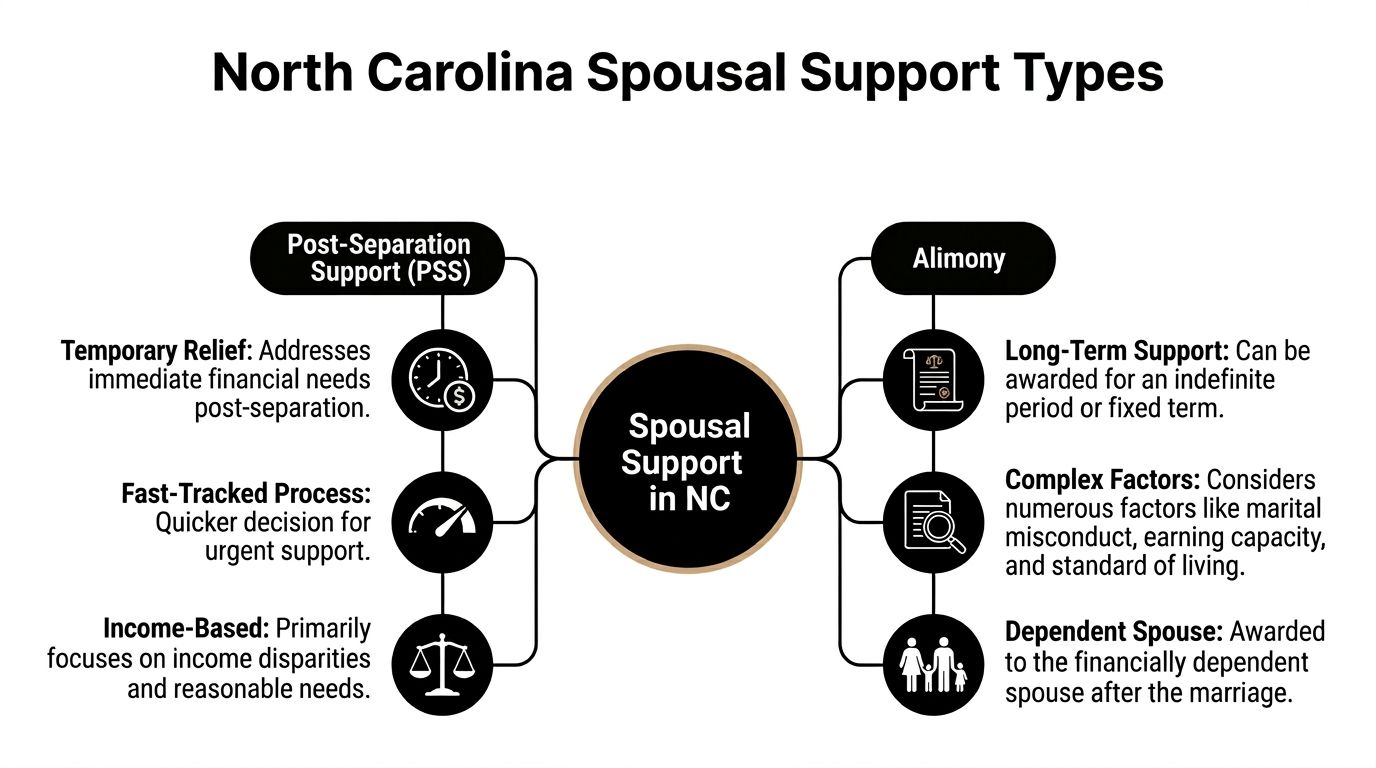
Post-separation support
Post-separation support, often called PSS, is temporary support paid after separation and before the final divorce judgment.
Think of it as a financial bridge. It exists because divorce cases take time, and one spouse may need help meeting immediate expenses while the larger case moves through court or settlement. PSS is often the first support issue that needs attention because people can’t wait months to figure out how they’ll pay rent, utilities, or insurance.
PSS usually focuses on present need and present ability to pay. It’s the quicker, more immediate support question.
Alimony
Alimony is the longer-term support issue decided as part of the divorce process.
Here, the case becomes more detailed. Under N.C.G.S. § 50-16.3A, the court must decide whether one spouse is a dependent spouse and the other is a supporting spouse, then determine whether an alimony award would be equitable after weighing 16 statutory factors. The same authority explains that income disparity by itself isn’t enough, and that courts rely on financial affidavits and other evidence to evaluate need and ability to pay.
Dependent spouse and supporting spouse in plain English
These are legal terms, but the idea is simple.
A dependent spouse is a spouse who lacks sufficient means for reasonable support in light of the lifestyle established during the marriage. A supporting spouse has the greater financial capacity.
That doesn’t mean the dependent spouse has no income. It also doesn’t mean the supporting spouse is wealthy. The court is asking a more practical question: after looking at the full financial picture, did one spouse rely on the other for the standard of living created during the marriage?
Practical rule: A higher income alone doesn't decide alimony. The court wants a documented story about dependence, resources, and fairness.
How the two forms of support often work together
In many cases, PSS comes first and alimony is addressed later.
A spouse may receive temporary support while the divorce is pending, then ask the court for alimony if the long-term evidence still shows dependency. That progression is common in marriages where one spouse paused a career, handled most childcare, or supported the other spouse’s professional advancement.
What clients often get wrong
Several misconceptions cause trouble early:
- “If I work, I can’t receive support.” Not necessarily. A spouse can earn income and still be financially dependent.
- “If my spouse makes more, I automatically get alimony.” Not necessarily. The court still looks at need, reasonableness, and the broader marital context.
- “Temporary support decides the whole case.” It doesn’t. PSS can matter, but final alimony requires a deeper analysis.
The strongest approach is to treat PSS as immediate stabilization and alimony as a full-scale proof case.
The 16 Factors NC Courts Use to Decide Alimony
A judge can hear two spouses describe the same marriage and reach very different conclusions depending on the proof. One spouse says, “I gave up my career so the family could function.” The other says, “You chose not to work.” Alimony cases often turn on which version is supported by records, testimony, and a believable financial story.
North Carolina courts must consider 16 statutory factors under N.C.G.S. § 50-16.3A. There is no calculator. There is no fixed duration tied to years of marriage. The court weighs the facts and decides what is fair in that specific case.
That discretion matters. It also means a list of factors, by itself, does not help much. The essential work is showing the court how those factors fit your marriage, your finances, and your future.
How lawyers use the 16 factors
Experienced alimony work is part financial analysis, part case-building.
I do not treat the factors like a checklist to recite in court. I group them into themes that judges can apply to real life: dependency, ability to pay, the marital standard of living, career trade-offs, child-related limits on work, health, and credibility. That approach helps the court see the whole picture instead of isolated facts.
For example, a spouse may have some income and still qualify for support. The question is whether that income, together with available assets and realistic earning ability, is enough to meet reasonable needs in light of the marriage that existed. In a high net worth North Carolina divorce, that analysis often gets more technical because compensation, business income, investment distributions, and lifestyle expenses may not appear neatly on a paycheck stub.
The 16 statutory factors, and what they usually mean in court
| Factor | How it affects an alimony case |
|---|---|
| Marital misconduct of either spouse | Misconduct can change whether alimony is awarded at all. Illicit sexual behavior gets close attention under North Carolina law. |
| Relative earnings and earning capacities of the spouses | The court compares actual income with realistic earning potential, not just what someone says they could earn. |
| Ages and physical, mental, and emotional conditions of the spouses | Health and age can affect employability, monthly expenses, and whether retraining is realistic. |
| Amount and sources of earned and unearned income of both spouses | Wages matter, but so do bonuses, commissions, rental income, trust income, and investment income. |
| Duration of the marriage | Longer marriages often support a stronger dependency argument, especially if one spouse’s work history changed during the marriage. |
| Contribution by one spouse to the education, training, or increased earning power of the other | Paying bills during school, relocating for a career, or carrying family responsibilities while the other spouse advanced can matter a great deal. |
| Extent to which earning power, expenses, or financial obligations are affected by serving as custodian of a minor child | Childcare duties can limit work hours, travel, job choices, and the timing of a return to work. |
| Standard of living established during the marriage | The court considers how the family lived, including housing, spending patterns, and recurring expenses. |
| Education of each spouse and the time needed to acquire enough education or training to find employment | This factor often shapes whether support should be rehabilitative, longer-term, or denied. |
| Relative assets and liabilities of the spouses | The court looks at what each spouse has and owes, including debt load, liquidity, and access to cash. |
| Property brought to the marriage by either spouse | Separate property can affect the broader fairness analysis, even if it does not end the alimony claim. |
| Contribution of a spouse as homemaker | Running the household, managing children, and supporting the family structure count as economic contributions. |
| Relative needs of the spouses | Judges focus on actual monthly needs, not inflated wish lists or bare-bones numbers designed for litigation. |
| Federal, State, and local tax ramifications of the alimony award | The practical value of any payment depends in part on tax treatment and how the support is structured. |
| Any other factor relating to the economic circumstances of the parties that the court finds just and proper | This gives the court room to address unusual facts that do not fit neatly into the other categories. |
| The fact that income used to value a business in equitable distribution should not be counted again in a way the law does not allow | In business-owner cases, this can become a serious dispute about fairness and double counting. |
Which factors usually drive the result
Judges review all 16. In practice, a smaller group often carries the most weight because those factors explain why support is needed, whether it can be paid, and for how long.
Relative earnings and earning capacity
This factor is more nuanced than “who makes more.”
A spouse earning modest income after years out of the workforce may still have a strong claim if that income does not reflect a realistic path to self-support. On the other hand, a spouse with current low earnings but recent training, marketable skills, and a work history showing higher earning capacity may face a tougher argument for long-term support.
Evidence matters here. Pay stubs help. Employment records help. Job applications, licensing history, expert vocational opinions, and proof of why employment changed can matter even more.
Marriage length, standard of living, and economic dependence
These factors often work together.
A ten-year or twenty-year marriage can create habits, roles, and financial dependence that do not disappear when the complaint is filed. If one spouse handled the home and childcare while the other built earning power, the court may view present income differences as the result of marital choices made over time. The standard of living factor also gives context to monthly budgets. A judge is more likely to trust expenses that match the family’s history than numbers created only for court.
Contributions that never appeared on a W-2
Many spouses undervalue this part of their case.
Keeping a household running has financial consequences. So does following a spouse to another city for a promotion, stepping back from a career because daycare would consume most of the paycheck, or managing a child’s medical or school needs in a way that limited outside employment. Those facts explain reduced earning capacity better than a general statement that someone was “the homemaker.”
Good proof often includes calendars, school records, emails, move history, and testimony from people who saw how the family functioned.
Health, age, and realistic employability
Courts want concrete proof, not broad labels.
If a spouse has chronic pain, anxiety, depression, a physical limitation, or age-related barriers to returning to prior work, those issues should be tied to records and daily consequences. Can that person sit at a desk full-time? Commute? Work evening shifts? Complete retraining? Judges decide cases based on specifics.
Marital misconduct
This is one area where clients can seriously damage a case by treating suspicion as proof.
North Carolina takes marital misconduct seriously in alimony cases, especially illicit sexual behavior. Depending on who engaged in that conduct and how the evidence develops, misconduct can support, reduce, bar, or require an award. These claims need discipline. Phone records, messages, admissions, private investigator evidence, and timing all matter. Anger does not prove misconduct. Evidence does.
Turning factors into a persuasive case
A strong alimony case usually has a theme. The evidence should answer a few practical questions clearly.
- What did each spouse contribute during the marriage?
- Why is one spouse financially dependent now?
- What can each spouse realistically earn today?
- Which expenses are reasonable based on how the family lived?
- What records support the budget and the testimony?
Weak cases often fail because the facts are missing or inconsistent. A spouse claims financial need but lists expenses far above the marital pattern. A supporting spouse claims inability to pay but bank records show discretionary spending, cash withdrawals, or irregular income not disclosed in the affidavit. Judges notice those problems quickly.
The court has discretion in alimony cases. That is exactly why preparation matters. The spouse with the better-documented, more credible explanation of the marriage and the money is usually in the stronger position.
Real-World Alimony Scenarios in North Carolina
You may be sitting at the kitchen table with two fears at once. One spouse is asking, "How am I supposed to pay this?" The other is asking, "How am I supposed to live without it?" In North Carolina, both questions can be legitimate, because alimony is not decided by a calculator. It is decided by how a judge applies the facts of your marriage to the statutory factors.
That discretion frustrates people. It also creates room to build a strong case. The outcome often turns less on any single factor than on how the facts fit together.

A long-term marriage with one primary earner
Start with a marriage where one spouse spent years raising children, managing the home, and adjusting family life around the other spouse's career. By the time separation happens, the wage-earning spouse may say the other can work and should become self-supporting right away.
A judge usually looks past that sound bite and asks harder questions. How long was this arrangement in place? What income did the homemaker spouse give up to support the family structure? Is that spouse now entering a job market with an outdated resume, limited recent work history, or ongoing childcare duties? What did the family spend each month when the marriage was intact?
Those details matter because the 16 factors are not a checklist to skim. They are the framework for telling the court why dependency developed and whether support is fair. In a long marriage, I often see the strongest cases built around a combination of duration, marital standard of living, reduced earning capacity, and the non-financial contributions that made the other spouse's income possible.
A spouse who can work, but cannot recover overnight
Some cases fall in the middle. The dependent spouse is employable, but not yet in a position to replace the marital standard of living or even meet reasonable monthly expenses.
A common example is a spouse who left a profession years ago and now needs time to renew a license, finish training, or rebuild work history. In that setting, the core dispute is often duration, not whether support should exist at all. One side argues for a fixed term tied to retraining. The other argues that the setback is deeper and the road back is longer.
The better-presented case usually includes specifics. What program is required? How long will it take? What jobs are realistically available after completion? What is the expected income range, and how does that compare to the spouse's current shortfall? Judges respond better to a concrete plan than to a vague promise that things will improve.
A high-asset marriage where property does not answer the alimony question
High-asset cases confuse people because wealth and income are not the same thing. A spouse may own substantial property, have advanced degrees, or hold investment accounts and still make a credible claim for support, depending on access to funds, liquidity, income history, and the lifestyle established during the marriage.
That is why these cases require careful analysis of how the assets function. Is the property producing usable income? Would selling it create tax consequences or undermine long-term security? Is one spouse receiving business distributions while claiming low income? Are expenses inflated, or are they consistent with the way the family lived for years?
Those issues come up often in high net worth divorce cases in North Carolina, where compensation may include salary, bonuses, equity, deferred compensation, or closely held business income. In those cases, an alimony argument usually succeeds or fails on financial tracing and credibility, not appearances.
A shorter marriage with strong income disparity
Length of marriage matters, but it does not decide the case by itself.
In a shorter marriage, the court may still consider support if one spouse became financially dependent during the relationship or made meaningful sacrifices that affected earning capacity. A spouse may have relocated, left a stable job, supported the other through professional training, or taken on most household responsibilities while the other spouse's income increased.
That does not always lead to a large or long-lasting award. It can, however, support a narrower claim aimed at helping the dependent spouse transition without carrying the full financial shock of separation alone. The trade-off in these cases is often between a shorter support period and a lower monthly amount versus fighting for a broader claim that the facts may not support well.
Why scenarios matter
Clients often want me to predict alimony with a yes or no answer. North Carolina law rarely works that way. A better approach is to identify which facts a judge is likely to care about most, then build the evidence around those points.
That is how the discretionary nature of alimony becomes more manageable. The law gives the judge room to decide. A strong case gives the judge a clear reason to decide in your favor.
How a North Carolina Alimony Attorney Protects Your Interests
An alimony case can drift badly without a strategy. People disclose too little, too much, or the wrong things in the wrong order. They agree to temporary terms that create long-term problems. They walk into mediation without a clear theory of the case.
A strong alimony attorney nc approach is not just courtroom advocacy. It starts much earlier.

Building the financial record
The first job is usually evidence control.
That means identifying what will prove or rebut dependency, need, and ability to pay. In many cases, the most important documents include tax returns, pay records, bank statements, retirement statements, monthly expense summaries, and records tied to bonuses, commissions, or business distributions.
For the spouse seeking support, the goal is to show a credible monthly need that matches the marital lifestyle and present circumstances.
For the spouse resisting or limiting support, the goal is often to challenge inflated expenses, expose omitted income sources on the other side, or show that the requesting spouse’s earning capacity is stronger than claimed.
Framing the story the judge will hear
Alimony decisions are discretionary. Facts don’t speak for themselves unless someone organizes them persuasively.
An attorney connects the documents to the legal theory:
- Why this spouse is dependent
- Why the other spouse has the ability to pay
- Why the requested amount is fair or unfair
- Why duration should be limited, extended, or denied
At this point, many self-represented parties struggle. They present stacks of paper but no coherent explanation of what the papers mean.
Judges don't award or deny alimony based on who is more upset. They respond to evidence tied closely to the statute.
Negotiation and mediation
Most alimony cases don’t need a trial to reach resolution, but settlement only works when both sides understand the strengths and weaknesses of the evidence.
A lawyer’s value in negotiation includes:
- Pressure testing proposals so you don’t agree to terms that look manageable now but become impossible later
- Drafting clear language on amount, duration, termination events, and enforcement
- Coordinating alimony with property issues so one concession doesn’t undo another
- Reducing avoidable conflict by focusing on provable issues instead of personal grievances
An unsupported demand often collapses in mediation. A documented position usually gets more serious attention.
Courtroom advocacy when settlement fails
Some cases must be tried. When they are, details matter.
The attorney’s role includes examining witnesses, cross-examining the other spouse, introducing records, objecting when necessary, and making the legal argument under the statutory factors. In contested cases, a lawyer also helps protect against surprises, such as late claims about hidden debts, sudden income changes, or allegations of misconduct.
A short explainer can help if you're trying to understand how support disputes get presented in practice:
Enforcement after the order is entered
Winning an order is not the same thing as collecting on it.
If a spouse refuses to pay court-ordered alimony, enforcement may require court action. That can include seeking contempt or other remedies depending on the wording of the order and the facts of the nonpayment. Enforcement work often turns on records of what was ordered, what was paid, what was missed, and whether the failure was willful.
Modification when life changes
Alimony orders don’t always stay fixed forever.
North Carolina law allows modification in some cases based on substantial changed circumstances. Common examples include serious job loss, remarriage, cohabitation, or meaningful shifts in financial ability or need. The key point is that changed circumstances must be proved. A bare statement that money is tighter than before usually isn’t enough.
What an attorney helps you avoid
Three mistakes show up repeatedly in alimony matters:
- Treating support like a simple spreadsheet problem when the court is making a broader equitable decision
- Underestimating the importance of documentation because “the truth should be obvious”
- Signing vague settlement language that creates future fights about duration, termination, or enforcement
The right legal strategy doesn’t guarantee a result. It does give you a much better chance of presenting a position the court can trust and act on.
Frequently Asked Questions About NC Alimony
Can a spouse who owns a business still be ordered to pay alimony
Yes. Business ownership does not shield income from alimony analysis.
A frequent problem in these cases is that the tax return, salary figure, and money available to the owner may not line up neatly. As noted in this discussion of business-owner alimony issues in North Carolina, courts can impute income from retained earnings and other business assets, and these cases often require forensic accounting and expert witnesses to value the business and determine the income available for support.
That makes business-owner alimony disputes more document-intensive than standard wage-earner cases.
Does adultery matter in North Carolina alimony cases
It can matter a great deal.
North Carolina treats marital misconduct as one of the statutory factors, and illicit sexual behavior can have major consequences in an alimony claim. If misconduct is going to be raised, it needs to be handled carefully and with proof. Assumptions, rumors, and emotional accusations usually create more problems than they solve.
This is one of the clearest examples of why alimony is not just about income.
Can alimony be changed after the divorce is final
Sometimes, yes.
Under NCGS § 50-16.9, a court may modify alimony based on substantial changed circumstances such as job loss or remarriage, as discussed in this explanation of the North Carolina alimony modification process. The same discussion notes that many people assume alimony is automatically permanent, but modification can become a real issue after the divorce if finances or living arrangements change enough to justify court review.
The important practical point is that modification requires evidence. Pay records, medical records, proof of changed expenses, and proof of cohabitation may all matter depending on the issue.
Is there an alimony calculator in North Carolina
No.
North Carolina does not use the kind of formula-based calculator people often expect. That’s why online estimates can be misleading. Two marriages with similar incomes can produce different support outcomes if the spouses’ health, caregiving roles, misconduct issues, assets, debts, and earning histories are different.
If you want a realistic assessment, the better approach is to evaluate the facts against the statutory factors rather than looking for a shortcut.
What should I bring to an alimony consultation
Bring anything that helps show your financial reality and the history of the marriage.
A strong starting file often includes:
- Recent income records such as pay stubs or compensation summaries
- Tax returns if available
- Monthly expense information for housing, insurance, food, transportation, and medical costs
- Bank and retirement statements
- Documents showing debts
- Information about the marriage roles such as childcare arrangements, work interruptions, or support for a spouse’s education or career
- Any existing court papers or separation agreements
You do not need a perfect file before talking to a lawyer. But the more concrete information you have, the more useful the legal advice will be.
Secure Your Financial Future with a North Carolina Alimony Attorney
North Carolina alimony law is discretionary by design. That gives judges room to reach fair outcomes, but it also means your case won’t be decided by a shortcut or a calculator. It will be decided by how well the facts are developed, documented, and argued.
That creates risk for both sides.
If you may need support, the risk is understating your dependency, your monthly needs, or the economic value of the role you played during the marriage. If you may have to pay support, the risk is allowing an incomplete or distorted financial picture to shape the outcome.
Post-divorce issues matter too. Alimony can sometimes be modified under North Carolina law when there are substantial changed circumstances. If your income has changed, your former spouse has remarried or is cohabiting, or the existing order no longer reflects reality, you need to act based on evidence and procedure, not assumptions. For many people, choosing the right North Carolina divorce lawyer is what turns a confusing support dispute into a manageable legal strategy.
A careful legal review can clarify where you stand, what the court is likely to focus on, and what steps make sense now. That clarity matters because an alimony order, or a missed opportunity to challenge one, can affect your finances for years.
If you're dealing with spousal support, divorce, or post-divorce modification issues in North Carolina, the Law Office of Bryan Fagan can help you evaluate your situation and build a practical strategy. Schedule a confidential consultation to discuss your rights, your risks, and the next steps to protect your financial future.