Divorce often turns into a financial question before it feels like a legal one.
You may already be asking the same common questions in the first weeks after separation. Who keeps the house? What happens to the retirement accounts? Does it matter whose name is on the car title or the brokerage account? If one spouse earned more, does that change everything? If one spouse handled the children and home, does that count?
Those questions keep people up at night because they touch every part of life after divorce. Housing. Debt. Savings. Stability. The future you expected may look very different now, and uncertainty is expensive.
In North Carolina, equitable distribution is the legal process used to divide property and debt in divorce. Done well, it brings order to a messy financial untangling. Done poorly, it can lock in avoidable losses, valuation mistakes, and missed claims that are hard to fix later.
Many people start with general divorce information, then realize they need answers specific to property division. If you're still getting oriented, this overview of North Carolina divorce law can help frame the bigger picture. But when the concern is your house, accounts, business interests, or debt, you need a strategy built around equitable distribution itself.
An experienced equitable distribution lawyer nc residents trust doesn't just explain the law. That lawyer helps you classify property correctly, value it realistically, file at the right time, and avoid mistakes that can shape your finances for years.
Introduction Navigating Your Financial Future in a North Carolina Divorce
A common situation looks like this. One spouse moves out, the other stays in the home, and both assume they'll “figure out the property later.” Weeks pass. Then months. Mortgage payments continue, retirement statements change, and tension rises over who paid for what during the marriage and after separation.
At that point, people usually aren't looking for abstract legal theory. They want a clear answer about what North Carolina courts do with a shared financial life.
Equitable distribution is the framework for that answer. It is how North Carolina sorts assets and debts, determines what belongs in the marital estate, assigns values, and decides what a fair division looks like. The process applies to ordinary households and high-asset cases alike. The property may include a home, vehicles, bank accounts, furnishings, investment accounts, business interests, and retirement benefits.
The stakes can be significant. For divorcing couples, average U.S. family net worth nears $750,000, though only marital portions are divisible under North Carolina law, according to the North Carolina equitable distribution bulletin.
That doesn't mean every case becomes a courtroom fight. Many don't. But it does mean casual assumptions can become costly. If you rely on title alone, use a tax value instead of a proper valuation, or miss the filing window, you may lose advantage before negotiations even begin.
The goal isn't to “win” every asset. The goal is to protect your financial footing and make sure the law applies to the specific facts of your marriage.
What Is Equitable Distribution in North Carolina
A spouse can walk into my office convinced the house is safe because it was inherited, or certain the retirement account is off limits because only one name appears on the statement. Those assumptions cause expensive mistakes.
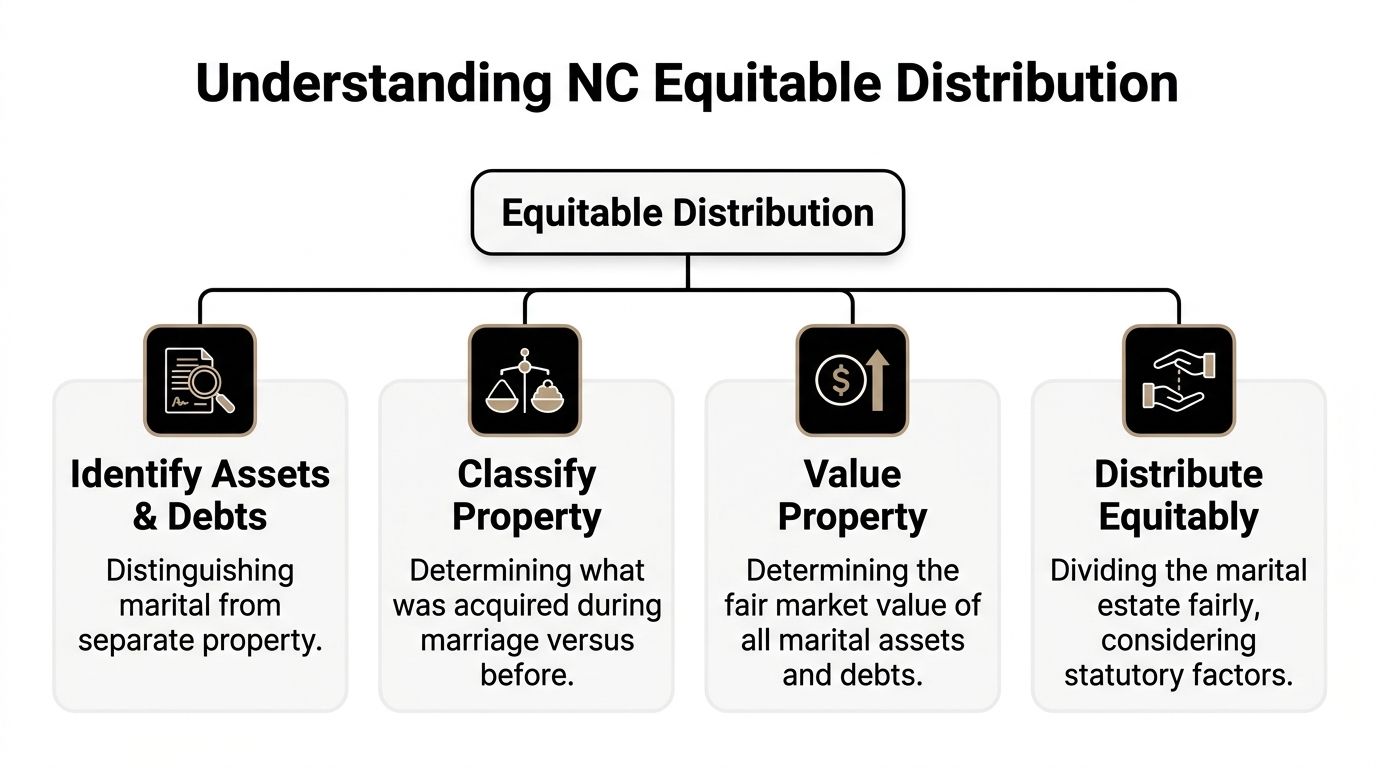
In North Carolina, equitable distribution is the legal process for dividing marital property and marital debt after separation. The court identifies what exists, classifies it, assigns a value, and decides how to divide it fairly under N.C.G.S. §§ 50-20 and 50-21. The law starts with a presumption that an equal division is fair, but that presumption can change when the facts support a different result.
The three property categories that matter most
Most property division cases are decided first by classification. If an asset is placed in the wrong category, the settlement discussion usually starts from the wrong number.
Legal framework: North Carolina equitable distribution requires the court to identify, classify, value, and distribute property and debt.
Here is the practical breakdown.
| Category | Plain-English meaning | Typical example |
|---|---|---|
| Marital property | Property acquired during the marriage and before separation for the benefit of the marriage | A home purchased during marriage, wages saved in a joint or individual account, retirement contributions earned while married |
| Separate property | Property that belongs to one spouse outside the marital estate | Property owned before marriage, certain inheritances, certain gifts to one spouse alone |
| Divisible property | Certain post-separation changes tied to marital property or debt | Passive gains or losses after separation, or post-separation changes connected to a marital asset or liability |
Marital property usually includes far more than people expect. Income earned during the marriage, retirement contributions made before separation, equity built in a home, and debt incurred for the marriage can all be part of the marital estate. Title matters less than timing, source of funds, and use.
Separate property can remain separate, but only if it can be proven. A premarital account that later received marital deposits may be part separate and part marital. An inheritance used as a down payment on the marital home may still support a separate property claim, but tracing becomes harder once funds are mixed. That is one reason records matter.
Divisible property is often overlooked. North Carolina does not ignore every financial change that happens after separation. If a marital account rises or falls in value before trial, or a marital debt changes after separation, that change may still need to be addressed. People who try to settle too quickly, without pinning down these numbers, often give away value without realizing it.
Equal division is the starting point, not the answer in every case
North Carolina begins with a 50/50 division as the presumed fair result under the statutes. The court can order an unequal division if the evidence shows that equal is not fair under N.C.G.S. 50-20(c)(1)-(12).
Those factors can include:
- Length of the marriage
- Income and earning differences
- Contributions as a homemaker or caregiver
- Support for the other spouse's education or career
- Debts and liabilities
- Tax consequences of a proposed division
In practice, an equal split is often a useful benchmark in settlement talks. It gives both sides a place to start. It should not be treated as an automatic result.
A long marriage with one spouse out of the workforce for years may justify a different approach than a short marriage where both spouses kept finances largely separate. A spouse asking for an unequal division needs evidence, not frustration. Bank records, retirement statements, loan documents, and credible valuations usually matter more than broad claims about who was “more responsible” during the marriage.
Why title is often a distraction
Clients focus on whose name is on the deed, the car title, or the brokerage account. North Carolina law asks a different question first. It asks when the asset was acquired, how it was funded, and whether any separate and marital interests were mixed together.
That distinction matters in nearly every serious case.
A house titled in one spouse's name can still have a marital component if it was purchased during the marriage or paid down with marital funds. A business interest owned before marriage may still have a marital portion if its value increased because of marital efforts. A retirement account can contain both separate and marital shares in the same statement.
Lawyers spend a lot of time tracing because classification influences negotiating strength. If the other side overstates a separate property claim and no one challenges it early, that error can shape the rest of the case.
Common valuation mistakes people make without a lawyer
Valuation mistakes usually cost more than classification mistakes because they hide in plain sight. The asset is identified, everyone agrees it exists, and the number is still wrong.
These problems come up often:
- Using tax value for real estate instead of a supportable fair market value
- Ignoring loans, liens, penalties, or built-in tax consequences
- Valuing a business by guesswork, revenue alone, or an outdated balance sheet
- Looking only at the current retirement balance without separating premarital and marital portions
- Failing to account for post-separation changes that may qualify as divisible property
Timing affects valuation strategy. If you file too late, documents disappear, account histories become harder to obtain, and the other side has more room to shape the story. If you rush into a settlement before the values are pinned down, you may accept an “equal” division that is not equal at all.
That is the part many people miss. Equitable distribution is not just a definition in the statute. It is a deadline-driven, evidence-driven process where classification and valuation decisions can change your financial position for years.
The Equitable Distribution Process Step by Step
A spouse files for absolute divorce first because it feels faster. A few weeks later, the other spouse learns the property claim was never preserved. At that point, the conversation changes from "How do we divide this fairly?" to "Do I still have any right to ask the court to divide it at all?" I see that mistake far too often, and it is expensive.
The legal process can protect your financial future, or weaken it. Timing, documentation, and valuation decisions shape the result long before a judge hears testimony.

Filing the claim before you lose the right
In North Carolina, an equitable distribution claim has to be asserted before the divorce is final, or preserved in a valid way before that right is cut off. Waiting too long can end the claim entirely.
That deadline surprises people because property division often feels separate from the divorce itself. It is not. If someone races to finalize the divorce without dealing with equitable distribution properly, the other spouse may lose the chance to ask the court to divide marital property.
The practical question is not whether filing matters. It does. The key question is when filing gives you the best protection.
Timing is strategy, not just procedure
Good timing depends on the facts in front of you. Filing immediately can protect the claim and put formal deadlines in place. Waiting briefly can make sense if productive negotiations are underway and financial information is being shared voluntarily. Waiting with no protections in place is risky.
That trade-off is where many cases go off course.
According to this discussion of timing in North Carolina equitable distribution claims, the choice to file right away, hold off during negotiations, or file after more disclosures can affect bargaining position and the final result.
A few common situations show why timing matters:
- One spouse promises an easy agreement. A short delay may be reasonable if documents are being produced and the claim will still be protected.
- A closely held business is in flux. Delay can make records harder to pin down and valuation disputes harder to resolve.
- One spouse controls the money or the records. Early filing is often the fastest way to get reliable information instead of relying on assurances.
- Retirement accounts or investment accounts are changing fast. If account history is not gathered early, it becomes harder to separate marital value from later changes.
I often tell clients this plainly. Filing early without a plan can create unnecessary friction. Filing late can cost far more.
Discovery turns suspicion into proof
After the claim is filed, the next phase is discovery. That means getting the records that show what exists, what it was worth, what is owed, and who controlled it.
A serious review usually includes:
- Bank and brokerage statements
- Retirement account records
- Loan balances and payoff information
- Real estate documents
- Business records
- Credit card and debt statements
- Employment compensation records
Settlement talks based on partial information often collapse. Worse, they produce deals that look fair on paper and fail in practice.
A spouse may insist there is very little to divide. Then the records show stock compensation, deferred bonuses, a business interest, or an account that was never mentioned. In other cases, debt is presented as marital debt even though the documents point in another direction.
A short video overview can help you visualize how the process unfolds in a real case.
Negotiation and mediation
Most equitable distribution cases settle. They usually settle after both sides have enough facts to make a proposal that can be defended.
Useful negotiations usually rest on three things:
- Clear positions on what is marital, separate, or divisible
- Supportable values instead of rough guesses
- A realistic view of what a judge may do if the case does not settle
Without that groundwork, mediation becomes a debate over unsupported numbers.
With it, settlement becomes more precise. One spouse may keep the house and offset the equity with retirement assets. A business interest may stay with the owner spouse while the other spouse receives value elsewhere. Debt can be assigned in a way that reflects who incurred it, who benefited from it, and who can refinance or pay it.
Trial when settlement does not happen
Some cases need a judge to decide them. That usually happens when the parties dispute classification, accuse each other of hiding assets, disagree sharply on value, or argue that an unequal division is warranted.
Trial is document-driven. The court needs records, testimony, tracing, valuation evidence, and a legal argument tied to North Carolina law. General frustration is not enough. If a party arrives with broad accusations and weak proof, the court has little to work with.
The date of separation often becomes a contested issue here. If the spouses disagree about when the marriage ended, that dispute can affect which property is included, which debts are counted, and how certain assets are valued. That is one reason I push clients to address timing early, preserve the claim properly, and start gathering records before the paper trail gets thinner.
Valuing Your Property Correctly Common Pitfalls
People often think the fight is about who gets what. In many cases, the harder fight is about what an asset is worth.
A bad valuation can distort an entire settlement. If the house is overstated, one spouse may trade away too much retirement. If a business is understated, the non-owner spouse may accept far less than the marital estate supports. If debt isn't netted properly, a supposedly fair deal can become lopsided.

The marital home is not just a Zestimate or tax card number
The house is often the emotional center of the case, which makes valuation harder.
Homeowners commonly rely on a county tax value, an online estimate, or a neighbor's sale. Those numbers may be useful as conversation starters, but they are not always reliable for settlement or trial. Condition, repairs, local market realities, and sale costs all matter. So do liens and mortgages, because the usable number is often the net value, not the gross headline figure.
A practical example. One spouse says the home is worth far more than the other spouse believes. If no one gets a serious valuation, the dispute drags on and both sides negotiate in the dark. An appraisal or other credible valuation evidence usually narrows the problem quickly.
Retirement accounts are easy to overlook and easy to mishandle
Retirement assets create two recurring errors. First, people ignore them because they aren't immediately spendable. Second, they compare balances without asking what portion is marital and how transfer rules apply.
A pension, 401(k), or similar account may require careful division work. In many cases, implementation can involve a QDRO, or qualified domestic relations order, depending on the type of plan. The legal and administrative steps matter. A settlement term that sounds simple can become difficult if the order language is sloppy or the account history is incomplete.
Retirement division is not just math. It is classification, valuation, and proper transfer mechanics.
Timing also matters here again. If the relevant valuation point ties to separation, parties need records that match the proper date and show what happened before and after.
Business interests create some of the biggest mistakes
Business owners sometimes assume the company is “mine because I built it.” Non-owner spouses sometimes assume the business is worth whatever revenue sounds impressive. Both positions can be wrong.
Valuing a closely held business may involve earnings history, assets, liabilities, compensation patterns, retained cash, and whether personal expenses run through the company. Even when a business began before marriage, growth during the marriage may still require close analysis.
That is why cases involving a company usually need a more careful review than ordinary asset division. If your divorce involves a company, this page on business valuation for divorce is a useful starting point.
Personal property and specialty assets still matter
Jewelry, collectibles, firearms, tools, antiques, art, and hobby equipment often create a different kind of dispute. The issue isn't just value. It is whether the item exists, who has possession, and whether the parties are assigning numbers based on sentiment rather than market reality.
A practical approach is often best:
- Create a detailed inventory
- Photograph what exists
- Match items with receipts, insurance schedules, or prior appraisals where available
- Distinguish sentimental value from resale value
A quick comparison of what works and what doesn't
| Asset type | What usually works | What usually doesn't |
|---|---|---|
| House | Current mortgage data and a credible value opinion | Arguing from memory or online estimates alone |
| Retirement | Plan statements tied to the correct period and proper transfer orders | Looking only at today's balance and ignoring marital portion questions |
| Business | Detailed financial review and, when needed, expert analysis | Using revenue alone or the owner's opinion as final value |
| Personal property | Lists, photos, and support documents | Guessing values from sentiment |
The core mistake in valuation is rushing. People want closure, so they assign numbers that feel reasonable and move on. That shortcut can become very expensive.
Common Disputes and How a Lawyer Can Help
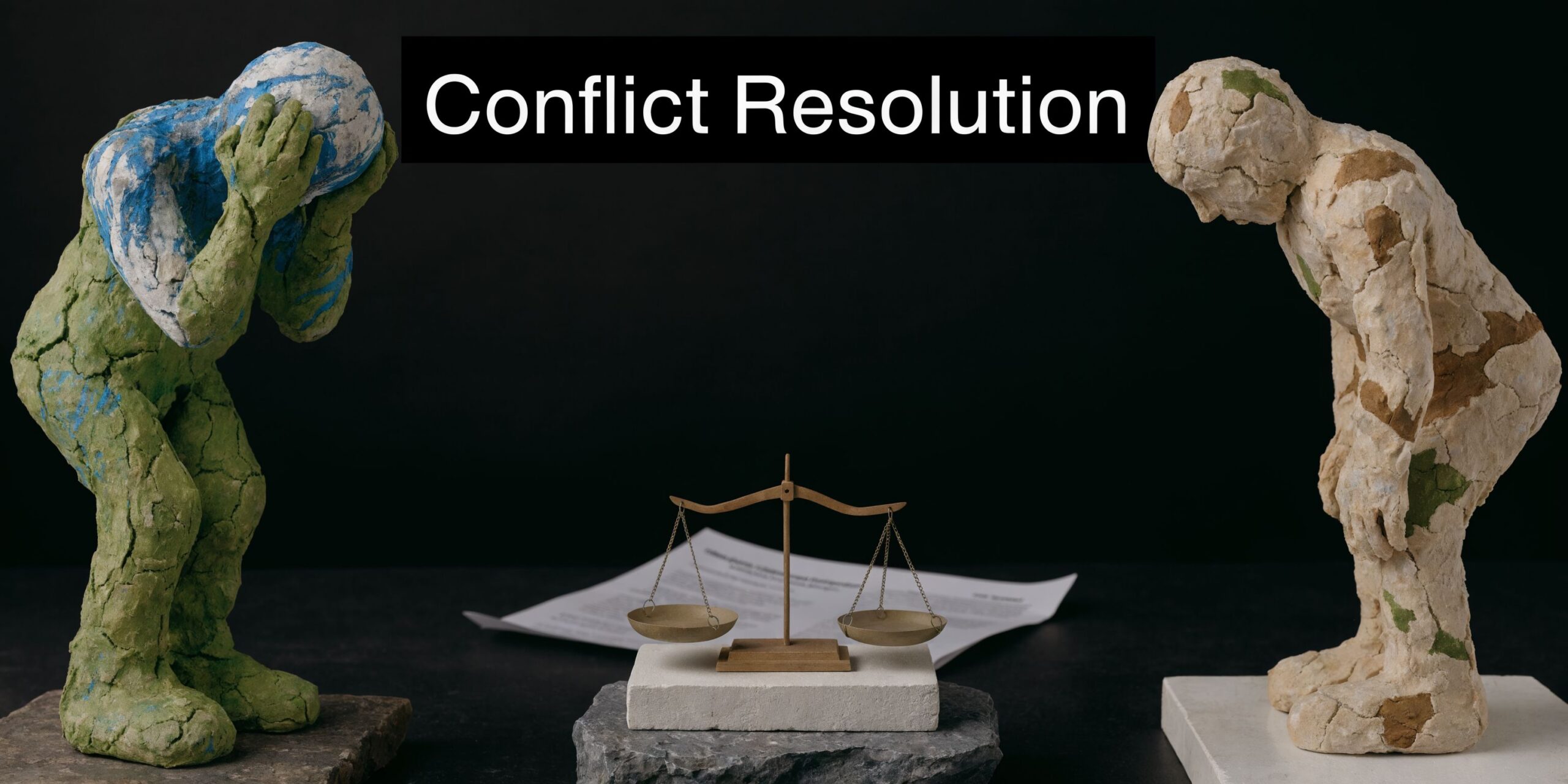
Equitable distribution disputes are rarely about one issue alone. Most difficult cases combine emotion, incomplete records, and different stories about the same money.
The inheritance that stopped looking separate
One common dispute starts with an inheritance.
A wife receives funds from a parent. At first, everyone agrees the money was hers alone. Later, some of that money is used for home renovations, family expenses, or a joint account. When divorce begins, both spouses tell a version that feels obvious to them. One says, “That was always my inheritance.” The other says, “We used it as family money for years.”
That is not a moral dispute. It is a tracing dispute.
A lawyer helps by collecting account records, transfer histories, and documents that show whether the property remained identifiable or became mixed with marital assets. Without that paper trail, a strong separate-property argument can weaken fast.
The spouse who says there are no assets
Another familiar scenario involves incomplete disclosure.
A husband says the parties have basic checking, a vehicle, and a house. The wife knows he has changed jobs, received bonuses, and moved money before, but she doesn't know where everything is. Nothing obvious appears on the surface. In such situations, the legal process matters. A lawyer can use formal discovery tools, document requests, subpoenas, and careful review of financial records to test whether the disclosure is complete. Hidden assets are not always hidden in dramatic ways. Sometimes they are buried in plain sight through vague records, missing statements, or business accounts that were never examined closely.
The argument over the date of separation
Clients often think the separation date is obvious. It isn't always.
One spouse may say the marriage ended when they stopped sharing a bedroom. The other may say it ended only when someone moved out. In some cases, the parties continued paying bills together, taking family trips, or presenting themselves publicly as a couple even after the relationship had broken down.
A disputed separation date can change which assets and debts belong in the marital estate, so small factual details can carry major weight.
A lawyer helps build that issue with concrete evidence. Lease dates, text messages, address changes, utility records, and witness testimony may all matter. The goal is not storytelling for its own sake. The goal is proving the legally relevant timeline.
Unequal division claims
Some spouses believe fairness requires more than an even split.
That can happen when one spouse gave up career opportunities to raise children, supported the other spouse through professional training, or faces a very different financial position at the end of the marriage. It can also arise when debt burdens or tax consequences make a mechanical division misleading.
These arguments need focus. A lawyer doesn't just say, “My client deserves more.” The lawyer ties the request to the statutory factors and presents facts that support an unequal distribution under North Carolina law.
What legal representation changes in a real dispute
An experienced equitable distribution lawyer nc clients retain usually helps in five concrete ways:
- Case framing: Identifies what is worth fighting about and what is not.
- Evidence building: Gathers the records needed to support classification, value, and distribution arguments.
- Pressure testing: Spots weak assumptions before the other side uses them against you.
- Negotiation control: Prevents rushed concessions made just to end the stress.
- Trial readiness: Prepares the case so settlement, if it happens, happens from strength.
People sometimes wait to hire counsel because they hope conflict will cool down on its own. Sometimes it does. Often it doesn't. And by the time they seek help, documents are harder to find, positions have hardened, and bargaining power has diminished.
Your Attorney's Role and Understanding Legal Fees
People usually want two direct answers. What does a lawyer do in an equitable distribution case, and how are fees handled?
The first answer is practical. A lawyer builds and protects the structure of the case. That includes identifying claims, preserving deadlines, organizing financial records, drafting pleadings, conducting discovery, working with appraisers or other professionals when needed, negotiating settlement terms, and presenting the case in court if settlement fails.
The second answer depends on the firm and the complexity of the case. Many family law matters are billed on an hourly basis with an upfront retainer. Some limited services may be narrower in scope, but property division cases often resist flat-fee treatment because no one can predict at the start how much discovery, negotiation, or court time a dispute will require.
A good lawyer should be candid about cost drivers. Cases usually become more expensive when:
- Records are disorganized
- One spouse owns a business
- Asset tracing is disputed
- The other side refuses disclosure
- Trial becomes necessary
That doesn't mean legal help is a luxury. In a meaningful property case, counsel is often part of protecting the value at stake. A lawyer who spots one classification error, one hidden account, or one flawed valuation may change the entire financial result.
This is also why choosing a generalist can be risky. Property division isn't just “part of divorce.” It is its own discipline inside family law. If you're comparing counsel, start with a lawyer focused on North Carolina divorce representation and ask detailed questions about equitable distribution strategy, valuation issues, and trial experience.
The right question isn't “Can I afford a lawyer?” It is “What could a weak property division strategy cost me over time?”
Clients should also ask how the lawyer communicates, how often billing statements are sent, and what tasks may be handled by staff versus the attorney. Clarity on the front end prevents frustration later.
Frequently Asked Questions About NC Property Division
What happens to debt in a North Carolina divorce
Debt can be part of equitable distribution just like assets. The key question is whether the debt is tied to the marriage and how it should be classified and allocated. A credit card balance used for family expenses may be treated differently from debt one spouse incurred for non-marital purposes. The account name matters less than the purpose, timing, and supporting records.
Can I be forced to sell the marital home
Possibly, but not in every case. Some couples agree that one spouse keeps the home and offsets equity through other assets or a buyout structure. In other cases, a sale is the cleanest solution because neither party can refinance, maintain the property alone, or agree on value. The answer depends on affordability, equity, debt, and what other assets exist for tradeoffs.
How is a 401(k) or pension divided in North Carolina
The first issue is identifying the marital portion. The second is determining the proper mechanism to divide it. Some retirement plans require a special court order, often called a QDRO, to carry out the division correctly. If the account existed before marriage or continued to change after separation, records become especially important.
What if my spouse owned a business before we married
That does not automatically remove the business from the case. A business that started before marriage may still involve disputes about growth, income, compensation, and whether marital effort increased its value. These cases often require detailed financial review. The earlier the records are gathered, the better.
Does it matter whose name is on the property
Sometimes, but not as much as people think. North Carolina equitable distribution focuses heavily on classification and acquisition, not just title. A house, account, or vehicle can be marital property even if only one spouse's name appears on it. On the other hand, jointly titled property does not automatically answer every classification question either.
Protect Your Future Schedule a Consultation Today
Property division decisions made during divorce can shape your finances long after the case is over. A rushed agreement, a missed deadline, or a weak valuation can follow you for years.
North Carolina equitable distribution cases require more than broad ideas about fairness. They require careful classification, strategic timing, credible valuation, and disciplined negotiation. That is especially true when the case involves a home, retirement assets, business interests, disputed debts, or arguments about separate property.
If you're searching for an equitable distribution lawyer nc residents can trust, the next step is not to guess. It is to get case-specific advice based on your documents, your timeline, and your goals.
A confidential consultation can help you understand what property may be at issue, what deadlines matter, what records to gather first, and where your biggest risks and opportunities likely are. If you're separated or preparing for separation in North Carolina, now is the time to protect your financial future.
If you're facing divorce or a property division dispute in North Carolina, schedule a consultation with the Law Office of Bryan Fagan. The firm helps clients evaluate marital and separate property issues, address valuation disputes, and build practical strategies for equitable distribution cases across North Carolina.