Facing a child custody case in North Carolina is an incredibly stressful and personal challenge. Your entire focus is on protecting your children and securing their future, but the legal system can feel confusing and overwhelming. An experienced North Carolina child custody attorney is more than just a legal representative; they are your guide, helping you navigate the complexities and work toward a stable, loving outcome for your family.
When your family’s future is on the line, you need clarity, not confusion. This guide is designed to give you a clear, practical understanding of the North Carolina child custody system, walking you through the laws, procedures, and principles that shape every custody decision in the state.
Our goal is to replace uncertainty with real-world knowledge. We’ll break down core legal concepts into plain English, use practical examples to show you how North Carolina law applies, and demonstrate how a dedicated attorney can protect your parental rights while working toward the best possible future for your children.
How Do North Carolina Courts Decide Child Custody?
The single most important principle in any North Carolina custody case is the “best interests of the child” standard. This isn't just a suggestion; it's the law. Found in North Carolina General Statute § 50-13.2, this doctrine gives judges the power to decide custody based on whatever will best "promote the interest and welfare of the child."
It’s a common misconception that courts automatically favor mothers or that having a higher income guarantees you’ll win. The law in North Carolina is explicitly gender-neutral. Instead, a judge will weigh many different factors to get a full picture of the family's situation.
Real-World Scenario: Imagine two parents, Sarah and Tom. Tom earns a high salary but works long hours, while Sarah has a more modest income but has always been the primary caregiver, handling school pickups, doctor's appointments, and homework. A judge won't just look at Tom's income. They will evaluate who provides the most stability and has historically met the child's daily needs, which could favor Sarah's request for primary physical custody.
A judge will consider:
- Each parent's ability to provide a safe, stable, and loving home.
- The child's developmental needs (a toddler has different needs than a teenager).
- Any history of domestic violence, substance abuse, or other behavior that could put the child at risk.
- The strength and nature of the child's relationship with each parent.
Understanding Legal vs. Physical Custody
In North Carolina, the term "custody" is broken down into two distinct parts: legal and physical. It is crucial to understand the difference, as they control different aspects of your parental rights.
- Legal Custody is about decision-making authority. It’s the right to make major choices for your child concerning their education, healthcare (including mental health), and religious upbringing. Parents often share joint legal custody, requiring them to cooperate. In rare cases, a judge might award one parent sole legal custody if the other is unfit or absent.
- Physical Custody is about where the child lives. One parent may have primary physical custody while the other has visitation rights. However, joint physical custody, where the child spends significant time with both parents, is also common. The final schedule is always tailored to the unique facts of your case.
What Are the Key Custody Concepts in North Carolina?

When parents first face a custody case, most think of “custody” as one single thing. But in North Carolina, the law splits it into two completely separate concepts: legal custody and physical custody. Each type gives you a different set of rights and responsibilities, and understanding them is the first step toward building a strong case.
Legal Custody: The Right to Make Major Decisions
Legal custody is all about who has the authority to make the big-picture decisions that will shape your child's future. This isn’t about daily choices like what they’ll wear or eat for breakfast, but the foundational pillars of their upbringing.
In North Carolina, this almost always comes down to decisions about:
- Education: Choosing a school district, agreeing on private education, or creating an Individualized Education Program (IEP).
- Healthcare: Choosing doctors, authorizing medical treatments, and making decisions about mental health support like therapy.
- Religious Upbringing: Guiding the child's religious or spiritual life.
A judge will typically award one of two forms of legal custody:
- Joint Legal Custody: This is the most common outcome. It means both parents have an equal say and must cooperate to make these major decisions.
- Sole Legal Custody: This is rare and usually reserved for situations where there’s a history of domestic violence, substance abuse, or if one parent is completely absent and unable to participate.
Physical Custody: The Child’s Living Arrangement
Physical custody is what most people are thinking of when they talk about custody—it determines where the child physically lives. This is the schedule that governs day-to-day life and which parent’s home is their primary residence.
Under North Carolina General Statute § 50-13.2, the judge's only guide is creating a schedule that is in the child’s best interest.
Real-World Scenario: It's very common for parents to have joint legal custody, requiring them to decide on their child's school together. At the same time, one parent might have primary physical custody, meaning the child lives with them during the school week, while the other parent has visitation every other weekend and on specified holidays. This balances shared decision-making with a stable routine for the child.
The possibilities for physical custody are flexible and can be tailored to a family's needs:
- Primary Physical Custody: One parent is designated as the primary custodian, and the child lives with them for the majority of the time. The other parent has a set visitation schedule.
- Joint Physical Custody: This is when parents share time with the child in a more balanced way. It doesn't have to be a perfect 50/50 split but reflects a schedule where both parents have significant periods of custodial time.
The court order or parenting agreement will lay out the specific schedule. The ultimate goal is always to provide a stable, predictable routine for the child while ensuring they can build and maintain a strong relationship with both parents.
How NC Judges Define a Child's Best Interest
If you're heading into a North Carolina custody case, you'll hear one phrase over and over: the “best interests of the child.” This isn’t just legal jargon—it's the single most important standard a judge will use to decide your family's future. But what does it actually mean in a courtroom?
There’s no simple checklist. Instead, judges are given broad discretion under North Carolina law to look at the entire picture of a child's world. An effective North Carolina child custody attorney builds their entire case around proving how your parenting strengths align with these crucial factors.
The Core Factors in a Best Interest Analysis
While every family is different, North Carolina judges consistently zoom in on a few key areas when creating a custody order.
Key considerations include:
- A Stable Home Environment: The court wants to see which parent can provide a safe, consistent, and nurturing home. This isn't about who has the bigger house. It’s about creating stability, routine, and a positive atmosphere where a child can thrive.
- Each Parent's Caregiving History: Who has historically been involved in the child's day-to-day life? Who helps with homework, goes to doctor's appointments, packs lunches, and handles bedtime routines?
- The Child's Developmental Needs: A toddler's needs are worlds away from a teenager's. A judge will consider the child's specific age, emotional maturity, and unique needs when deciding on a parenting schedule.
- The Child's Key Relationships: Judges will look closely at the bond between the child and each parent. They also consider relationships with siblings and work to preserve those connections.
Debunking Common Custody Myths
Many parents enter custody battles armed with misconceptions that create needless stress. It’s important to separate fact from fiction.
- Myth: Mothers always get custody.
- Reality: North Carolina law is explicitly gender-neutral. There is no automatic preference for mothers or fathers. Decisions are based on parenting abilities and the child's needs.
- Myth: The parent who earns more money will win.
- Reality: While financial stability is a factor, it's far from decisive. A judge is more interested in a parent's ability to provide a loving and stable home than the size of their bank account.
- Myth: My new romantic partner will ruin my case.
- Reality: Unless that person presents a clear risk to the child—such as a criminal record or substance abuse issues—a judge is unlikely to give the new relationship much weight.
The Role of Domestic Violence and Safety
When allegations of domestic violence arise, the court’s focus immediately shifts to protecting the child. Under North Carolina General Statute § 50-13.2(a), a judge must consider any acts of domestic violence when making a custody decision.
A proven history of domestic violence can completely change the outcome, potentially leading to a judge ordering supervised visitation or, in serious situations, denying custody to the abusive parent. The court’s primary duty is to protect the child from physical or emotional harm.
Considering the Child’s Wishes
Parents often ask, "At what age can my child decide who to live with?" In North Carolina, there is no "magic age." The law permits a judge to listen to the preference of a child who is of "sufficient age and maturity" to form a reasonable opinion. Practically, a judge will give more weight to the well-reasoned thoughts of a 16-year-old than to the whim of a 7-year-old. The child’s preference is only one factor among many—it is never the sole deciding factor.
While North Carolina law focuses on these qualitative factors, it’s worth noting that the state received a 'D' grade in a recent national analysis of shared parenting laws. This highlights just how much discretion judges have in their decisions. The variability makes it absolutely essential to build a powerful case centered on these "best interest" factors. You can discover more insights about these findings and what they mean for NC parents.
Navigating the North Carolina Custody Process
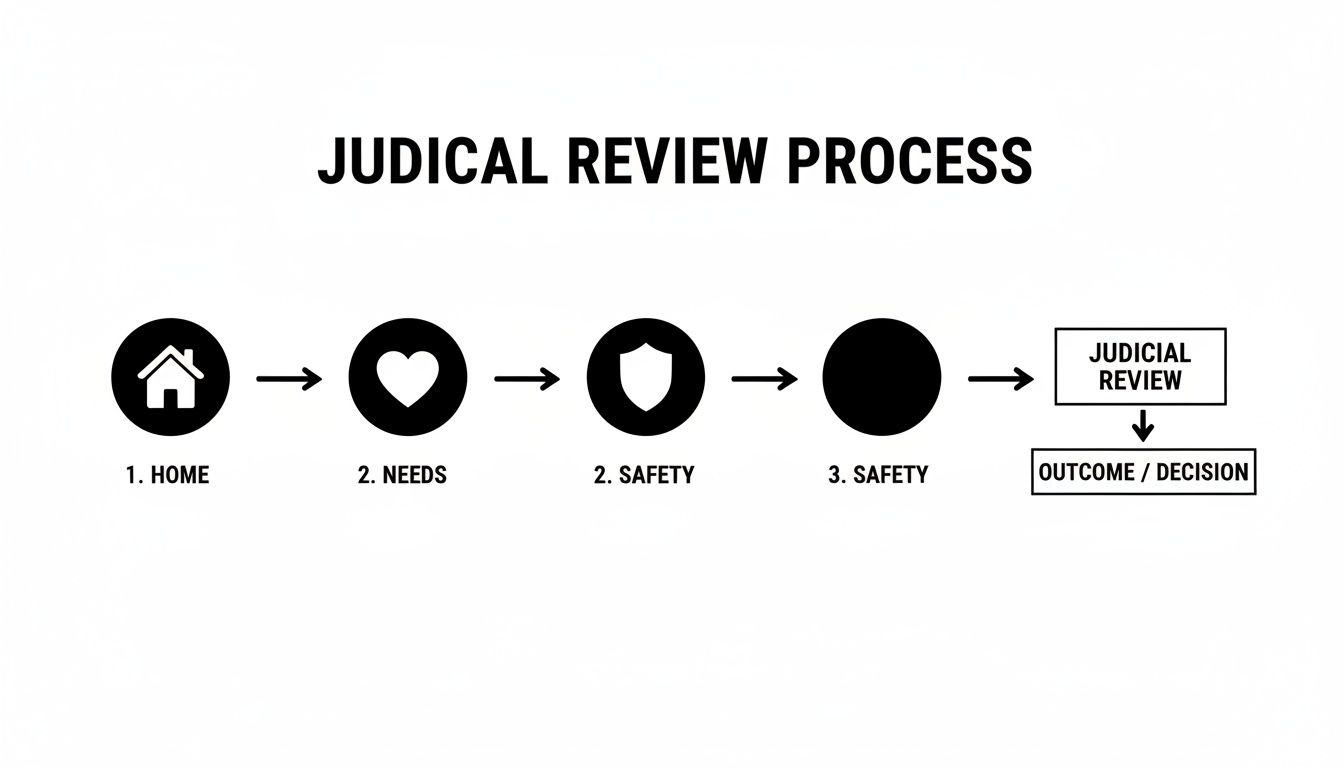
The legal journey of a child custody case can feel like an overwhelming maze. Knowing what to expect can significantly reduce your stress and help you prepare for the road ahead. This is a step-by-step overview of the typical North Carolina custody process.
The Key Stages of a Custody Case
- Filing a Complaint for Custody: The process officially begins when one parent (the Plaintiff) files a legal document called a "Complaint for Custody" with the Clerk of Court.
- Serving the Other Parent: After filing, the other parent (the Defendant) must be formally notified of the lawsuit. The Defendant then has 30 days to file a formal response.
- Mandatory Mediation: Before you can go to trial, North Carolina law requires most parents to attend mediation. This is a confidential meeting with a neutral third party who helps parents try to reach their own agreement.
- Temporary Custody Orders: Because a final trial can take months, either parent can ask for a temporary custody hearing to establish an immediate schedule. This provides stability for the child while the case proceeds. You can learn more about how to get temporary custody in our article.
- Permanent Custody Trial: If parents can't reach an agreement, the case moves to trial. Here, both sides present evidence and testimony to a judge, who makes a final decision based on the child's best interests.
The Crucial Role of Mediation and Temporary Orders
Mediation is a required first step that empowers parents to craft their own parenting plan. An agreement reached in mediation can be signed by a judge and become a legally binding court order.
However, the value of having an attorney cannot be overstated. Broader survey data shows that 79% of U.S. parents in recent custody cases had an attorney. Those with representation reported 70% satisfaction with their outcomes, often achieving joint physical custody at rates as high as 82% when both parents had legal counsel. You can read the full research about these custody case statistics and their implications.
A temporary custody order is one of the most powerful tools in a custody case. It sets the "status quo" for the child's life while the lawsuit is pending. The schedule established in a temporary order often influences the judge's final decision, making this initial hearing incredibly important. Because these early stages can heavily shape the final outcome, presenting a strong case from the beginning is critical.
Building a Strong Case and Parenting Plan

Winning a custody case in North Carolina isn't about dramatic courtroom moments. It comes down to steady preparation, strong evidence, and a forward-thinking plan for your child’s future. Success hinges on showing the judge that your proposal truly serves your child’s best interests.
Gathering Compelling Evidence for Your Case
Evidence is the foundation of a successful custody case. An experienced North Carolina child custody attorney can help you identify and organize proof that highlights your stability and fitness as a parent.
The most effective evidence often includes:
- Communication Records: Organized logs of texts, emails, and app messages can demonstrate your commitment to co-parenting or show a pattern of unreasonable behavior from the other side.
- School and Medical Records: These documents create an official record of which parent attends conferences, communicates with doctors, and stays involved in the child’s daily life.
- Credible Witness Testimony: A teacher, coach, or family friend who has seen your parenting firsthand can provide powerful, unbiased testimony.
- Photos and Videos: A collection of images showing you engaged in everyday life with your child—helping with homework, playing outside, celebrating birthdays—paints a compelling picture of your bond.
The purpose of evidence isn't to attack the other parent. It's to build a fact-based case that showcases your consistent, positive role in your child's life.
Crafting a Rock-Solid Parenting Plan
A parenting plan, or parenting agreement, is a detailed roadmap for how you and the other parent will raise your child after separation. Once approved by the court, it becomes a legally enforceable order. A vague plan is a recipe for future conflict; a well-drafted plan anticipates potential disagreements and sets clear rules.
A strong parenting plan must address:
- A Detailed Physical Custody Schedule: Specify exact exchange times and locations. Define the regular weekly schedule as well as separate schedules for summer vacation and school breaks.
- Holiday and Special Occasion Schedules: Clearly outline who has the child for major holidays (Thanksgiving, Christmas), the child’s birthday, and each parent’s birthday. It is common to alternate these days year to year.
- Transportation Logistics: State exactly who is responsible for picking up and dropping off the child for exchanges to prevent common arguments.
- Communication Protocols: Establish rules for how parents will communicate with each other and when each parent can communicate with the child (e.g., nightly phone calls at a set time).
- A Dispute Resolution Process: Include a clause requiring both parents to try mediation to resolve future disagreements before filing a motion in court.
A comprehensive parenting plan shows the court you are an organized, thoughtful parent focused on creating a stable, low-conflict environment for your child.
Why a Specialized Attorney Is Your Strongest Advocate
When you're facing a high-stakes custody battle, trying to represent yourself is a massive risk. The family court system is complicated, and your family's future is too important to leave to chance. A specialized North Carolina child custody attorney is your strategic partner, your advocate in court, and the buffer you need during a stressful time.
Navigating Complex Rules and Procedures
Child custody law is a complex web of local court rules, strict filing deadlines, and procedural steps that can easily overwhelm a parent. A simple mistake—like filing a document incorrectly or missing a key deadline—can cause serious damage to your case.
An experienced attorney manages these details for you, ensuring every motion is filed correctly and every deadline is met. They know what evidence is admissible, how to argue effectively in mandatory mediation, and how to present your case in the strongest possible light. This expertise lets you focus on your children, not on procedural roadblocks.
Closing the Justice Gap
The need for skilled legal representation in family law is more critical than ever. A 2021 assessment of legal needs in North Carolina uncovered a huge gap in access to justice. The report found there is only 1 legal aid attorney for every 8,000 eligible low-income residents, compared to 1 private lawyer for every 367 residents overall. You can learn more about North Carolina's legal needs findings in the complete report.
Hiring an attorney levels the playing field. It ensures your rights are protected and your voice is heard clearly in a system that is incredibly difficult to navigate on your own. Your lawyer is your dedicated advisor, committed to protecting your parental rights and securing the best possible outcome for your family. To see how our firm can champion your case, check out our guide on choosing a child custody lawyer in NC.
Frequently Asked Questions About NC Child Custody
Going through a custody case brings up a whirlwind of questions. To help bring some clarity, here are answers to the most common concerns we hear from parents across North Carolina.
What happens if the other parent violates our custody order?
If the other parent ignores a court-ordered custody schedule, do not retaliate by withholding visitation. The correct legal step is to file a Motion for Contempt with the court. This alerts the judge to the violations. A judge can enforce the order by requiring make-up visitation time, ordering the other parent to pay your attorney’s fees, imposing fines, or even ordering jail time for severe and repeated violations.
Can I move out of state with my child?
Relocating with your child out of state is a serious action. Once a custody case is filed, you cannot move your child out of North Carolina without either the other parent's written permission or a court order. You must file a motion and prove to the judge that the move is in good faith and serves your child’s best interest, which is a high standard to meet. Unauthorized relocation can severely damage your custody case.
At what age can a child choose who to live with in NC?
This is one of the biggest myths in North Carolina custody law. There is no "magic age" where a child’s preference automatically decides custody. A judge may consider the wishes of a child who has “sufficient age and maturity” to express a reasonable opinion. A mature teenager's opinion carries weight, but a younger child's preference is just one of many factors. The judge's final decision is always based on the child's overall best interests, not their wishes alone.
Is North Carolina a 50/50 custody state?
No, North Carolina is not automatically a 50/50 custody state. Unlike some states with a legal presumption of equal parenting time, North Carolina law gives judges broad discretion to create a custody schedule based on the child's best interests. While a 50/50 joint physical custody arrangement is possible and often ordered when appropriate, it is not guaranteed. The final schedule will depend entirely on the specific facts of your case.
Take the First Step to Protect Your Family’s Future in North Carolina
Protecting your children’s future is everything. To do that effectively in the North Carolina legal system, you need a strategic and experienced advocate who understands local courts and is dedicated to your family's well-being. At the Law Office of Bryan Fagan, we provide the empathetic guidance and strong representation North Carolina families need to achieve stability and peace of mind. We are here to listen to your story, explain your rights, and build a case focused on what matters most: your children.
Don’t navigate this difficult time alone. Schedule a confidential consultation with our team today to discuss your case and find out how we can help. You can learn more at https://bryanfaganlaw-nc.com.