If you're self-employed in North Carolina, child support can feel less like a formula and more like a fight over what your income really is.
A general contractor may have a strong spring, a slow winter, and several clients who pay late. A hairstylist renting a chair may bring in cash, tips, and app payments that don't line up neatly with one monthly number. A parent who owns a small LLC may show one figure on a tax return, another in a profit and loss statement, and a very different reality in the checking account. When a child support claim arrives, the first question is usually the same: how is a court supposed to decide what's fair when income changes constantly?
That anxiety is real for both sides. The parent paying support may worry that ordinary business costs will be ignored and support will be set too high. The parent receiving support may suspect the other side is understating income, running personal spending through the business, or timing payments to make earnings look smaller than they are.
Self-employment changes the way a North Carolina child support case has to be prepared. It affects what documents matter, what expenses will be challenged, and how aggressively each side needs to investigate the numbers. It also creates problems that generic guides usually miss, especially sudden drops in income during the year and business records that blur the line between personal and company spending.

For many parents, the hardest part isn't the legal duty to support a child. It's proving what income exists, what expenses are legitimate, and whether the other side is being candid. In child support for self employed parents nc cases, those details often decide whether the final order is workable or damaging.
Introduction Navigating Child Support with a Variable Income
A self-employed parent usually doesn't get the benefit of simple payroll records. There may be no fixed salary, no standard withholding, and no clean paystub to hand the court. Instead, the case often turns on invoices, bank deposits, expense records, tax schedules, and the credibility of the story those documents tell.
That matters because North Carolina courts don't stop at labels. Calling yourself an independent contractor, sole proprietor, consultant, or business owner doesn't answer the core question. The court still has to determine what income is available for child support.
Why uncertainty drives these cases
The stress usually comes from two competing truths.
First, many self-employed parents do have uneven income. A month with several paid invoices can be followed by a month with almost none. Equipment costs, materials, insurance, subcontractor payments, and travel can all hit at once. Looking at only one short period can produce a distorted picture.
Second, self-employment also creates room for manipulation. Personal expenses can be run through a business account. Cash can disappear from the formal books. Revenue can be delayed. Expenses can be overstated. Courts and lawyers know this, which is why these cases draw more scrutiny than a straightforward W-2 wage case.
Self-employment isn't a loophole and it isn't a penalty. It's a fact pattern that requires better proof.
The practical concern most parents bring to counsel
Most clients aren't asking for anything exotic. They want a support number based on reality. If they're paying, they want credit for actual business expenses that are necessary to stay in business. If they're receiving, they want the court to see past accounting choices that reduce paper income without reducing the parent's real spending power.
That is why preparation matters so much. A self-employed child support case in North Carolina often turns less on broad legal arguments and more on document quality, expense analysis, and whether someone can explain the business in plain English.
The Foundation of NC Child Support for the Self-Employed
North Carolina child support cases involving self-employment usually turn on one basic question. What is this parent able to pay once the business numbers are cleaned up and explained in a way the court can trust?
The guidelines still control the starting point. The difficulty is that a self-employed parent's income is rarely visible from one pay stub or one line on a tax return. The court often has to work backward through business records, owner draws, expense categories, and irregular revenue to decide what income is real and what is accounting.
The guideline system and where self-employment complicates it
In a W-2 case, income is often easy to identify. In a self-employment case, the worksheet is only as reliable as the income figure put into it.
That difference becomes even more important in higher-income cases. North Carolina increased the combined monthly income ceiling for standard guideline application from $30,000 to $40,000 effective January 1, 2023. Above that level, courts have more discretion and may focus on the child's actual needs and the family's standard of living rather than a standard worksheet result, as explained in this summary of North Carolina child support guideline changes.
For self-employed parents, this distinction is significant because income can swing above and below that line during the year. A strong quarter, a one-time contract payout, or delayed receivables can change how the case should be framed. That is one reason I do not treat these cases as simple plug-in-the-numbers matters. Timing, proof, and the story behind the numbers all affect the result.
Important North Carolina terms that affect support
Several terms shape these cases from the start:
- Gross income: For child support, this is broader than many parents expect and may not match taxable income.
- Ordinary and necessary business expenses: Some business costs reduce income for support purposes. Some do not. The primary dispute is usually whether the expense was genuinely required to produce income or whether it gave the parent a personal benefit.
- Self-support reserve: The guidelines include a protection designed to keep lower-income parents from being left without enough for basic living expenses.
- Minimum child support: North Carolina can set a minimum support amount unless the facts justify a different result.
Those terms sound simple. In practice, they create hard judgment calls. A truck payment may be partly business and partly personal. Meals, travel, cell phones, home office deductions, and payments to relatives often draw scrutiny. Mid-year income volatility makes the analysis harder because one side may present a booming month while the other points to a slow season. Courts want a fair number, not a cherry-picked one.
What works and what doesn't
One common mistake is assuming the court will accept the tax return at face value. Usually, it will not. Tax law and child support law ask different questions.
Another mistake is claiming every deduction on Schedule C should reduce support. Judges look closely at expenses that lower paper income without lowering the parent's real spending power. If a business pays for personal vehicles, personal travel, or recurring household costs, expect the other side to challenge those entries.
Practical rule: In a self-employed support case, credibility comes from records that match the parent’s lifestyle, bank activity, and business operations.
The stronger approach is to present the business like a judge is seeing it for the first time. Show how money comes in, when it comes in, what expenses are required to keep revenue coming, and which charges should be added back because they are personal, inflated, or timed to affect support. If hidden income or fraudulent expense reporting is a concern, the case may require a closer review of bank deposits, payment apps, general ledgers, loan applications, and owner benefits instead of relying on the return alone. That is often where these cases are won or lost.
How North Carolina Calculates Your Gross Income
For self-employed parents, the most contested question is usually this one: what counts as income for child support?
North Carolina looks beyond a paycheck because many self-employed parents don't have one. The analysis starts with business revenue, then turns to expenses, then broadens further to other income streams the parent may receive.
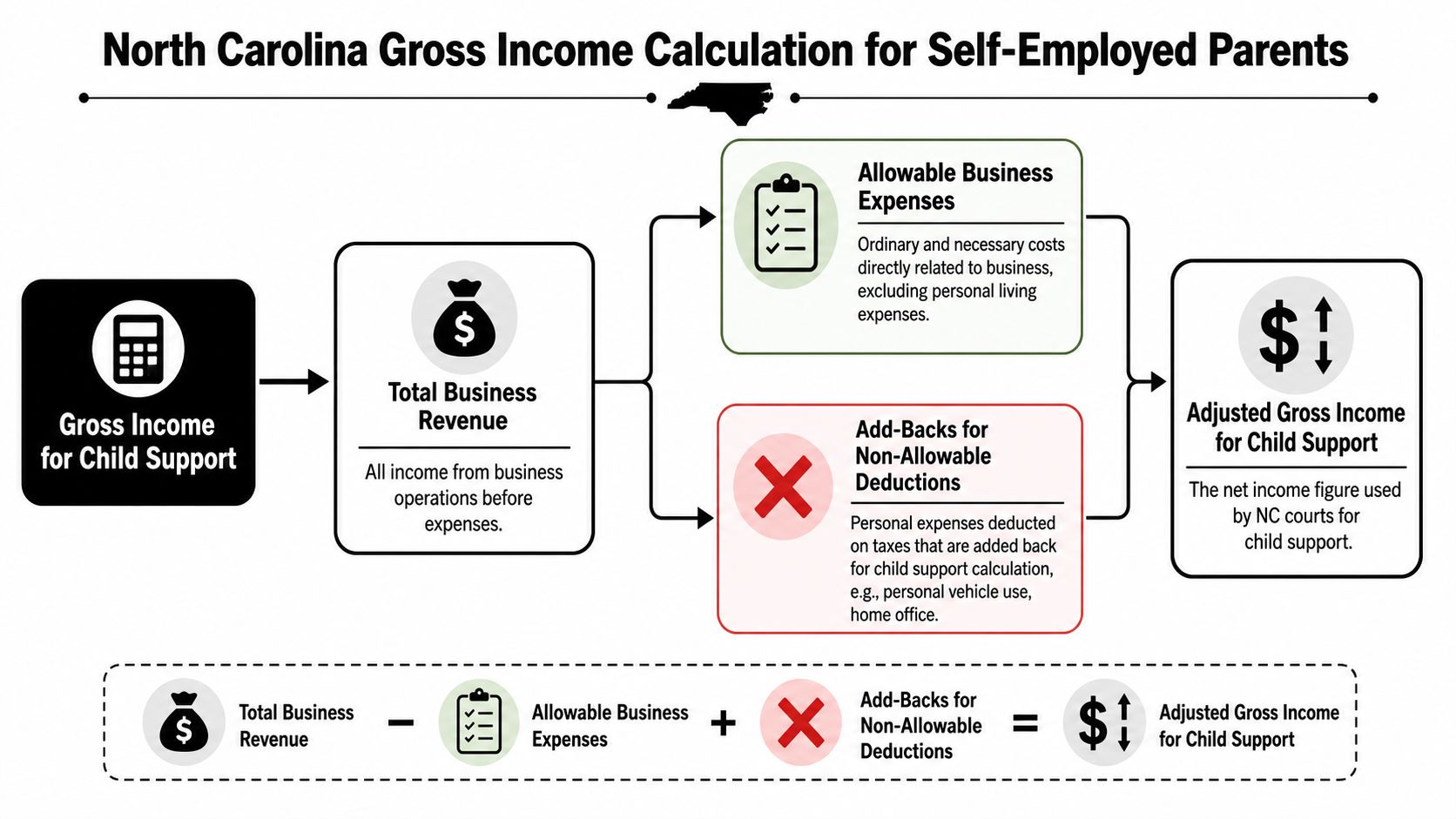
As described in this North Carolina discussion of self-employment income in child support cases, self-employed income includes gross receipts from business operations minus ordinary and necessary expenses, but it can also include rental property income, royalties, and proprietorship of businesses. That same source notes that a court's calculation can differ significantly from what appears on a tax return because the court conducts a broader review of revenue streams.
Start with gross receipts, not take-home pay
Many parents focus on what they personally transferred from the business account to themselves. Courts usually start earlier than that. They often want to know what the business brought in before money was allocated, spent, or characterized for tax purposes.
That means a sole proprietor who says, "I only paid myself this much," may still face deeper questions:
- What did the business receive in customer payments?
- Were deposits made into multiple accounts?
- Were client payments sent through payment processors, apps, or cash transactions?
- Did the parent leave money in the business while still paying personal costs from the company?
What ordinary and necessary expenses usually mean
The phrase ordinary and necessary business expenses matters because it can help or hurt either side depending on the records.
Ordinary and necessary expenses are the operating costs genuinely required to run the business, not personal living expenses dressed up as business deductions.
That distinction becomes clearer in everyday examples.
| Situation | More likely treatment in a child support case |
|---|---|
| Tools used for a contractor's jobs | Often treated as a legitimate business expense if documented |
| Fuel for a vehicle used only for client work | May support a business deduction if records separate business from personal use |
| Entire personal vehicle payment with mixed family use | Often challenged |
| Home internet used by the whole household | May be disputed if no business-only allocation is shown |
| Meals with little supporting detail | Often scrutinized closely |
The court is looking for credibility and connection. If the expense directly supports business operations and records back it up, it stands a better chance. If the expense mirrors ordinary household spending, the court may add it back.
Why tax returns don't end the conversation
Tax returns matter, but they are not the whole case. The same North Carolina source explains that the support calculation can differ significantly from tax documentation and may include a broader review of all income sources.
That is why lawyers often compare several categories of evidence at once:
- Tax returns and schedules to see how income and deductions were reported
- Bank statements to track real cash flow
- Profit and loss statements to test internal consistency
- Business ledgers or accounting exports from tools like QuickBooks
- Payment processor records if clients pay electronically
If you want a starting point for estimating support, a North Carolina child support worksheet can help frame the analysis. For a self-employed parent, though, the worksheet is only as good as the income figure entered into it.
Here is a practical walk-through that many parents find helpful before a court hearing.
A real-world example of where disputes begin
Take a parent who runs a landscaping company. The tax return may show reduced net income after fuel, equipment maintenance, advertising, phone use, and vehicle expenses. The receiving parent may argue some of those charges are personal. The paying parent may respond that without those costs, there is no business.
Both arguments can have some truth in them. The case usually turns on detail. Separate business and personal accounts help. Mileage logs help. Receipts help. Clean bookkeeping helps. Vague testimony rarely helps.
Other income counts too
North Carolina doesn't limit the analysis to one business. The same source states that courts evaluate multiple revenue streams, which may include rental property income and royalties, among others. In practice, lawyers also look for whether a parent receives money from ownership interests or related entities that affect actual financial capacity.
That is why self-employed child support cases should be built from the full financial picture, not just one line on one tax form.
Proving Your Income The Essential Records You Must Keep
In a self-employment case, the parent with the best records usually starts in the stronger position.
Courts don't like guesswork. If your records are incomplete, disorganized, or contradictory, the judge may doubt your credibility even when your underlying explanation is legitimate. If you're accusing the other parent of hiding income, broad suspicion won't carry much weight without documents to support it.
The records that usually matter most
A self-employed parent should expect the court and opposing counsel to focus on records that reveal both income and spending patterns. In practice, that often includes:
- Tax returns with all schedules: The schedules matter because they often show where business income, deductions, depreciation, and related items appear.
- Business bank statements: These help identify deposits, transfers, and recurring expenses.
- Personal bank statements: They can reveal whether business money is paying personal bills.
- Profit and loss statements: Monthly or periodic P&L statements can show whether the claimed trend makes sense.
- General ledger reports: These help trace categories rather than broad summaries.
- Invoices and receivables records: They can show earned income that hasn't yet been paid.
- Loan applications or financial statements: People often present a stronger financial picture to lenders than to a family court.
- Business formation and ownership documents: These help clarify whether income is flowing through an LLC, corporation, partnership, or sole proprietorship.
What works in court
Organized records tell a coherent story. A parent who can walk a judge through deposits, invoices, expenses, and current contracts is usually more persuasive than a parent who says, "My accountant handles that."
If your business valuation issues overlap with support questions, business valuation in divorce can become part of the larger strategy. That is especially true when ownership interests, retained earnings, or related entities affect the support analysis.
Bring records that show patterns, not just snapshots. A single slow month or single strong month rarely tells the whole story for a self-employed parent.
What doesn't work
Three habits cause problems repeatedly.
First, mixing personal and business spending in the same account. That invites arguments that your records cannot be trusted.
Second, relying only on tax returns. As discussed earlier, tax treatment and child support treatment aren't always the same.
Third, waiting until litigation starts to organize your books. By then, missing documents are harder to reconstruct and late cleanup efforts can look self-serving.
A practical preparation step is to gather records by account and by month, then compare them side by side. That often exposes issues early, before the other side does.
Common Disputes and Strategic Courtroom Approaches
Self-employment cases often become less about arithmetic and more about whether the court believes the numbers.
One parent says business is down. The other points to recent purchases, travel, or cash flow that suggests otherwise. One side calls an expense necessary. The other calls it personal. By the time the case reaches a hearing, the central issue is often credibility backed by records.

Hidden income and inflated expenses
A major dispute in these cases is whether the business books reflect reality. As explained in this discussion of self-employed child support disputes in North Carolina, a key challenge is identifying fraudulent or inflated business expense claims, including personal expenses reclassified as business costs. That same source notes that in complex cases, especially cash-intensive businesses, attorneys may need a forensic accountant or CPA to analyze bank accounts, accounting records, and IRS depreciation schedules to identify hidden income patterns.
That becomes highly relevant in businesses where cash, informal payments, or flexible bookkeeping practices are common.
Red flags that deserve closer review
Not every unusual entry proves misconduct, but certain patterns justify attention:
- Business expenses that mirror home life: groceries, family phone plans, or vehicle costs with no clear business allocation
- Repeated transfers with vague descriptions: especially when money moves among personal and business accounts without explanation
- Reported low income paired with high spending: if a parent claims little income but maintains a costly lifestyle, the numbers may need testing
- Cash-heavy operations with thin records: restaurants, personal services, landscaping, and similar businesses often require careful review
- Large deductions with little supporting detail: judges are less likely to accept broad claims than documented necessity
Imputed income and voluntary underemployment
North Carolina courts may also face the opposite problem. Sometimes a parent isn't necessarily hiding money but is reporting far less income than the court believes the parent could earn.
That is where imputed income becomes important. In plain terms, the court may assign income to a parent if it concludes the parent is voluntarily underemployed or manipulating earnings. For self-employed parents, this issue can arise when someone cuts back work without a convincing business reason, shifts income into a new entity, or claims a dramatic drop unsupported by market realities and records.
Judges usually respond better to documented business realities than to unsupported claims of "a bad year."
When forensic work is worth the cost
Not every case needs a forensic accountant. Some cases can be resolved through tax returns, bank statements, and focused discovery. Others need more.
A forensic review may be worthwhile when:
- The records are internally inconsistent.
- The business handles substantial cash.
- Personal and business finances are heavily mixed.
- Depreciation, write-offs, or owner benefits make paper income look artificially low.
- The support impact is large enough that a deeper review could materially affect the outcome.
Courtroom strategy that usually helps
In contested cases, broad accusations are weaker than precise questions.
Instead of saying, "He's hiding money," the stronger approach is often narrower: why did deposits exceed reported receipts, why is the company paying recurring personal expenses, why do loan documents show a different picture, or why do depreciation-heavy deductions reduce taxable income without reducing real cash available for support?
Likewise, a self-employed parent defending the case usually does better by being specific and transparent. Explain the business model. Identify seasonal patterns. Show actual contracts, invoices, and receivables. Tie expenses to operations. If the books are messy, acknowledge that and correct it with documentation rather than argument.
Modifying and Enforcing Self-Employed Child Support Orders
A child support order isn't frozen forever. That matters a great deal when the paying parent is self-employed.
A business can lose a major client, face a seasonal downturn, or experience a genuine collapse in revenue. A business can also rebound faster than expected. Because of that volatility, post-order strategy matters almost as much as the original hearing.

Modification when income changes mid-year
One of the most difficult issues for self-employed parents is a sharp income shift during the period covered by an order. As discussed in this explanation of self-employment and child support modification issues, North Carolina allows modification upon a substantial change in circumstances, but there is limited guidance on a specific threshold for self-employed parents. The same source notes that careful documentation is needed to distinguish a temporary downturn from a more permanent income change.
That means timing matters. Waiting too long can create arrears that keep growing under the existing order. Filing too quickly, without records showing a real and continuing change, can also weaken the request.
What usually helps a modification request
A strong modification case generally shows more than stress or uncertainty. It shows evidence.
Useful proof may include:
- Updated profit and loss reports showing a sustained decline rather than one weak month
- Recent bank statements showing lower deposits
- Contracts lost or canceled if that directly affected revenue
- Business closure or downsizing records if operations materially changed
- Industry-specific explanation showing whether the downturn is temporary or ongoing
If your order no longer fits current income, North Carolina child support modification guidance can help frame the legal next steps.
File based on evidence, not panic. Courts are more receptive when a parent can show a real change and explain why it isn't merely a short dip.
Enforcement when the paying parent is self-employed
Enforcement against a self-employed parent often requires tools other than wage withholding. There may be no traditional employer to serve, and income may arrive from multiple channels.
That changes the collection strategy. The receiving parent may need to focus on where money lands and what assets exist, rather than waiting for payroll-based enforcement.
Tools North Carolina can use
Self-employed support enforcement may involve:
- Direct bank account seizures: funds may be reached from personal or business accounts in appropriate cases
- Tax refund interception: state and federal refund interception can be used for overdue support
- Liens against business assets or receivables: if the parent is owed money by clients or owns business property, those interests may become part of the enforcement discussion
- Discovery and document demands: if the parent isn't being candid, formal financial disclosure becomes critical
What usually fails in enforcement disputes
The receiving parent often gets frustrated by informal assumptions such as "the court will find the money eventually." In self-employment cases, passive enforcement may move too slowly. Specific records, account information, and a targeted strategy are often necessary.
The paying parent makes a different mistake when ignoring the order because business is slow. That usually worsens the problem. If income changed substantially, seek modification promptly. If not, arrears and enforcement pressure can build quickly.
Frequently Asked Questions About NC Self-Employment and Child Support
Does the court only look at my tax return if I'm self-employed
No. A tax return is a starting point, not the full answer.
In many self-employment cases, the dispute is whether the return reflects what you had available to support your child. Judges often need a closer look at bank deposits, profit and loss statements, general ledgers, credit card records, and proof of business expenses. That matters most when income rises and falls during the year, cash payments are common, or personal spending runs through the business.
Can my ex say I'm hiding income just because I own a business
Yes, but suspicion alone does not win the case. The parent making that claim needs documents, account history, expense patterns, or other facts that show the numbers do not add up.
I tell clients this often. Self-employment creates room for misunderstanding, and it also creates room for abuse. If your books are clean, your accounts are separated properly, and your expense records match the business activity, you are in a much stronger position. If you are the other parent and something looks off, broad accusations are not enough. You need a targeted records strategy that focuses on cash flow, owner benefits, and expenses that may be personal rather than business-related.
What if my business income drops after the order is entered
A real drop in income may support a modification, but timing matters. Waiting too long can leave you owing support based on income you no longer earn.
The court will usually want more than a statement that business is slow. The stronger approach is to show what changed, when it changed, and whether the decline looks temporary, seasonal, or long-term. For self-employed parents, that often means comparing monthly records instead of relying on an annual snapshot that hides a mid-year collapse or a short-lived spike.
Can the court count business deductions that lower my taxes but do not reduce my support income
Yes. That issue comes up often.
Some deductions are valid for tax purposes but do not necessarily reduce income for child support in the same way. A court may look past expenses that primarily benefit the parent personally, are unusually aggressive, or do not reflect an actual reduction in available cash. This is one of the biggest differences between tax planning and child support litigation, and it is where many self-employed parents get surprised.
What records help the most in a contested self-employment case
The best records are the ones that let the court follow the money without guessing.
That usually includes business and personal bank statements, bookkeeping reports, invoices, receipts, loan documents, payment processor records, profit and loss statements, prior tax returns, and proof of any large one-time changes in revenue. If your income is volatile, monthly records are often more persuasive than year-end summaries. They show whether a claimed downturn is real or whether income was shifted, delayed, or buried in the business.
What if I believe the other parent is inflating expenses or hiding cash income
Treat that as a proof problem, not just a fairness problem. Courts respond to records, patterns, and contradictions.
In practice, the strongest cases often come from tracing deposits, comparing claimed expenses to the nature of the business, reviewing transfers between personal and business accounts, and looking for payments that never made it onto the tax return. That work is detailed, but it can materially change the support calculation when the reported income is not the whole story.
Secure Your Financial Future with Strategic Legal Guidance
A common scenario looks like this. One parent owns a business that had a strong spring, a weak summer, and a large year-end equipment purchase. The other parent sees a lifestyle that suggests more money than the tax return shows. By the time the case reaches court, both parents are frustrated, and the core dispute is no longer the basic worksheet. It is about which numbers the judge will trust.
Child support for self employed parents nc cases are fact-specific and often higher stakes than wage-earner cases. The court is not working from a single W-2. It is weighing records, timing, credibility, and whether reported income reflects real cash available for support.
For the paying parent, the danger is an order based on income that looks higher on paper than it is in practice, especially when the business has uneven revenue or legitimate expenses that keep it operating. For the receiving parent, the danger is the opposite. Income may be understated through aggressive deductions, delayed payments, cash transactions, or personal spending run through the business.
Good outcomes usually come from early case strategy. That means deciding which records to demand, identifying whether a bad month is a true downturn or a timing issue, testing claimed expenses against the actual business, and building a clear story the court can follow. In many self-employment cases, the side with the better financial proof has a major advantage.
A careless approach can leave a parent stuck with an unfair order for years.
North Carolina parents dealing with self-employment and child support should treat the case like a financial audit with legal consequences. Careful analysis, organized documentation, and a courtroom plan adjusted for variable income can protect your position and your child's financial stability.
If you're dealing with a North Carolina child support case involving self-employment, schedule a consultation with the Law Office of Bryan Fagan. Whether you're trying to prove fluctuating income, challenge questionable business deductions, modify an outdated order, or enforce support against a self-employed parent, the firm can help you evaluate the facts, protect your position, and build a strategy designed for your case.