
If you're trying to figure out child support in a shared custody case, you're probably balancing two worries at once. One is practical: who pays what each month? The other is emotional: will the system reflect how much time your child spends in each home and what each parent can realistically afford?
North Carolina does have a structured method for this. That matters. Even when the numbers feel intimidating, the process isn't random, and it isn't supposed to reward one parent for being louder or more organized. The guidelines are designed to create a support amount that reflects both income and parenting time, while keeping the child's needs at the center.
The confusion usually starts when parents hear the phrase shared custody and assume that equal or near-equal time means no child support. That's often not true. In North Carolina, support can still be owed in a shared custody arrangement because the law doesn't look only at nights with the child. It also looks at each parent's gross income, certain allowable adjustments, and additional child-related costs.
The better way to approach this is to treat the worksheet like a roadmap. Once you know which worksheet applies, what counts as income, and why the formula uses a larger support figure in shared custody cases, the result starts to make sense. That doesn't mean every case is simple. Variable income, self-employment, childcare, insurance, and unusual expenses can make a major difference.
Navigating Child Support in North Carolina Shared Custody Cases
Many parents come into this issue assuming shared custody should mean shared expenses in a perfectly even way. Real life doesn't work that neatly. One parent may earn much more. One may cover health insurance. One may have a bonus-based paycheck that swings from month to month. The law tries to account for those differences without losing sight of the child's daily needs.
North Carolina uses a formula-based system for most child support cases. That's helpful because it gives families a starting point that is more predictable than a purely discretionary approach. It also means the answer usually comes from verified financial information, not broad claims about who buys more groceries or whose house has more bedrooms.
What works in these cases is disciplined preparation. Parents who gather pay information early, document parenting time carefully, and separate emotion from math usually put themselves in a stronger position. What doesn't work is guessing at income, estimating overnights from memory, or assuming an online calculator will capture the full story without careful inputs.
Practical rule: In a North Carolina shared custody case, the hardest disputes usually aren't about the final math. They're about the inputs going into the math.
That is why understanding how child support is calculated with shared custody NC matters so much. The worksheet only produces a fair result if the income numbers are accurate, the custody classification is correct, and added expenses are handled properly.
A good analysis also asks the right "why" questions. Why does North Carolina increase the base obligation in shared custody cases? Why can support still be owed when both parents have substantial time? Why do self-employed parents so often end up in disputes over income? Once those answers are clear, the formula stops feeling arbitrary and starts feeling more understandable.
The Foundation of NC Child Support The Income Shares Model
A parent can feel blindsided by the first worksheet result in a shared custody case. Both parents have substantial time with the child, both are paying day-to-day expenses, and yet one parent may still owe support. That result makes more sense once you understand the model behind the math.
North Carolina uses the Income Shares Model. The central idea is simple. The state estimates what parents would likely spend on their child if they were raising that child in one household, then allocates that amount between the parents based on their respective incomes.
That approach matters because it explains the purpose of child support. The guidelines are designed to preserve a child's financial support across two homes. They are not meant to reward one parent or punish the other. In practice, that gives judges and lawyers a common starting point that is tied to income, not to which parent sounds more reasonable in court.

Why the model matters in shared custody
In shared custody cases, the worksheet does more than total up incomes. It also reflects the reality that a child is being supported in two homes at the same time. That is why North Carolina does not just split the ordinary support amount in half and call it done.
Under the North Carolina guidelines, cases that qualify as shared custody use Worksheet B, which applies when the parenting schedule meets the overnight threshold explained in this North Carolina joint custody overview. Once a case falls into that category, the calculation changes in a meaningful way.
One reason parents are surprised by Worksheet B is the 1.5 multiplier built into the shared custody formula. That multiplier exists for a practical reason. Raising a child in two active households usually costs more than raising that same child in one. Both homes need space for the child, food on hand, transportation arrangements, household supplies, and the ordinary infrastructure of daily life. The law tries to account for those duplicated costs before it applies credits and offsets between the parents.
I often tell clients that this is the "why" behind the higher shared custody pool. The formula recognizes that shared time does not erase expenses. It often spreads them across two addresses and sometimes increases them.
A few points usually drive the outcome:
- Income is central to the process: the worksheet starts with each parent's actual gross income.
- Shared custody changes the expense model: the 1.5 adjustment reflects the added cost of supporting a child in two homes.
- Credits come later: a parent does not get the full benefit of shared time until after the larger support pool is calculated.
- Some costs need closer attention: variable pay, bonuses, self-employment income, childcare, health insurance, and unusual child-related expenses can change the result more than parents expect.
That last point is where many online calculators fall short. If income fluctuates during the year, or if one parent covers recurring expenses that are outside the basics, the worksheet may still be the starting point but not the end of the analysis. Those are the cases where careful documentation makes a real difference.
Shared custody changes the formula because two involved households usually cost more to maintain than one.
Shared Custody vs Primary Custody Defining Your Calculation Path
A parent will often sit in my office and say, "We have joint custody, so support should be low or maybe zero." Sometimes that is true. Often it is not. The first issue is choosing the right worksheet, because the worksheet controls the math before anyone starts arguing about income, credits, or extra expenses.
In North Carolina, support usually follows one of three paths. If one parent has the child most overnights, the case usually goes on Worksheet A. If each parent has at least 123 overnights in a year, the case usually goes on Worksheet B for shared custody. If each parent has primary custody of at least one child, Worksheet C may apply. Parents who are sorting out a schedule often find it helpful to compare legal labels with the actual parenting schedule in a North Carolina joint custody overview.

Counting overnights the right way
For support purposes, overnights usually matter more than hours awake, school pickups, or who takes the child to practice. If the child sleeps in your home, that night is generally what counts.
That sounds simple, but close cases create real disputes. A schedule can feel "basically 50/50" and still miss the shared custody threshold once holidays, teacher workdays, summer weeks, and alternating weekends are counted over a full year. I tell clients to use the actual calendar, not a rough estimate. A mistake of only a few nights can put the case on the wrong worksheet, and that can change the result by a meaningful amount.
Why the label and the math often do not match
Parents also mix up custody language from their court order with support terminology from the guidelines. "Joint custody" does not automatically mean shared custody under Worksheet B. The worksheet asks a narrower question: how many overnights does each parent have?
That distinction matters for another reason. Shared custody does not erase support. In many cases, one parent still pays because the guidelines are not rewarding or punishing parenting time. They are trying to divide child-related costs between two households in a way that tracks both time and income.
That is also why the 1.5 multiplier matters so much in shared custody cases. The formula increases the basic support pool before applying each parent's share, because raising a child across two active homes usually costs more than doing it from one primary home. There may be two bedrooms, two sets of clothes, duplicated toiletries, added transportation, and more day-to-day expenses that do not disappear just because time is split. Many online calculators show the output but do not explain that reasoning, which is why parents are often surprised by Worksheet B results.
The practical consequences of choosing the wrong path
Here is the short version:
| Custody path | Typical worksheet |
|---|---|
| One parent has primary physical custody | Worksheet A |
| Each parent has at least 123 overnights | Worksheet B |
| Parents have primary custody of different children | Worksheet C |
Getting this step right does more than classify the case. It frames the later disputes over income, childcare, health insurance, and unusual child-related expenses. In shared custody cases, those details can swing the number more than parents expect, especially when one parent has bonuses, self-employment income, or pays recurring expenses outside the basics.
Start with the calendar. Then test the numbers against the actual schedule, not the title written on the custody order.
Calculating Gross Income The First Step in the Formula
A shared custody case can look straightforward on paper until the income documents hit the table. One parent is salaried. The other gets commissions, an annual bonus, and some self-employment income on the side. At that point, the child support dispute usually stops being about labels and starts being about proof.
North Carolina begins the calculation with each parent's monthly gross income because Worksheet B is built on proportional responsibility. The court is trying to measure each parent's actual ability to contribute to the child's support across two homes. If the income number is wrong, everything that follows is off, including each parent's percentage share of the support obligation and the credit given for shared time. Parents who want a realistic estimate should start with the same documents required to complete an NC child support worksheet for shared custody cases.

What gross income usually includes
Gross income is broader than wages from a regular job. As discussed in this North Carolina child support article on income issues, courts may look at salary, bonuses, commissions, business income, rental income, retirement benefits, pensions, and capital gains.
That is why a single pay stub rarely answers the whole question.
For a W-2 employee with fixed pay, income may be easy to confirm. For a parent who owns a business, works on commission, receives irregular bonuses, or has multiple income streams, the court often needs a fuller record to determine what income is real, recurring, and available for support.
Useful records usually include:
- Pay records: Recent pay stubs, year-to-date earnings summaries, and compensation statements from the employer.
- Tax documents: Personal tax returns and, where applicable, business returns.
- Self-employment records: Profit and loss statements, bank records, and documentation supporting claimed business expenses.
- Other income records: Lease payments, retirement distributions, investment income statements, or proof of recurring third-party payments.
Variable income requires judgment, not guesswork
Variable income from bonuses, commissions, or self-employment is one of the hardest parts of a North Carolina shared custody case. Online calculators often assume a clean monthly number. Real life rarely works that way.
Courts usually want a pattern, not a snapshot. If income rises and falls, the question is why. Some swings are seasonal. Some reflect an industry commission cycle. Some come from a one-time event, such as a special bonus, a business loss, or a temporary contract. The job is to separate a temporary spike or dip from a fair monthly average.
That distinction matters even more in shared custody cases because the Worksheet B formula already accounts for the higher cost of maintaining two active households through the 1.5 multiplier. Once that higher support pool is set, each parent's income share determines how much of that expanded obligation each parent carries. A distorted income figure can magnify the final number more than parents expect.
What helps your position
The strongest presentations are usually the least dramatic. They are organized, complete, and consistent with the parent's testimony.
These steps often help:
- Use a long enough income history: A broader time frame often gives the court a fairer monthly average when compensation changes from month to month.
- Separate gross receipts from actual income: In self-employment cases, business revenue is not the same as money available for child support.
- Treat recurring bonuses and commissions as consistent income: If they show up year after year, courts are likely to view them as part of income.
- Tie every claim to documents: If a parent says income dropped, the records should show why and when.
I often tell clients that credibility starts before anyone speaks in court. It starts with whether the documents make sense.
Extraordinary expenses and incomplete records can distort the math
Parents also miss another practical issue. A case can become harder when income is variable and the child has significant expenses outside the basic schedule, such as unusual medical costs, specialized educational needs, or activity expenses one parent has been covering directly. Those items are not the same as gross income, but they often shape negotiations about whether the guideline result is fair or whether a deviation should be requested later.
Incomplete records create the biggest problems. Handwritten estimates, missing bank statements, unexplained transfers between personal and business accounts, and last-minute revisions all raise avoidable questions. A judge deciding support in a shared custody case needs a dependable monthly figure, not a rough approximation.
Why this step matters
Gross income is the foundation of the entire calculation. It determines each parent's share of the obligation before childcare, health insurance, and other adjustments are applied. In many shared custody cases, this foundational income calculation often becomes the crucial point of contention, because both parents have substantial parenting time, but only one set of numbers will drive the worksheet.
The Shared Custody Calculation Step-by-Step Using Worksheet B
A parent sits in my office after separating under a 50-50 schedule and asks the same question I hear every week: if we both have the children so much, why would either of us still pay support? Worksheet B answers that question. It does not merely split costs by parenting time. It applies a formula built to reflect two active households, each carrying real child-related expenses.
For a more practical look at the form itself, parents often benefit from reviewing an NC child support worksheet guide.
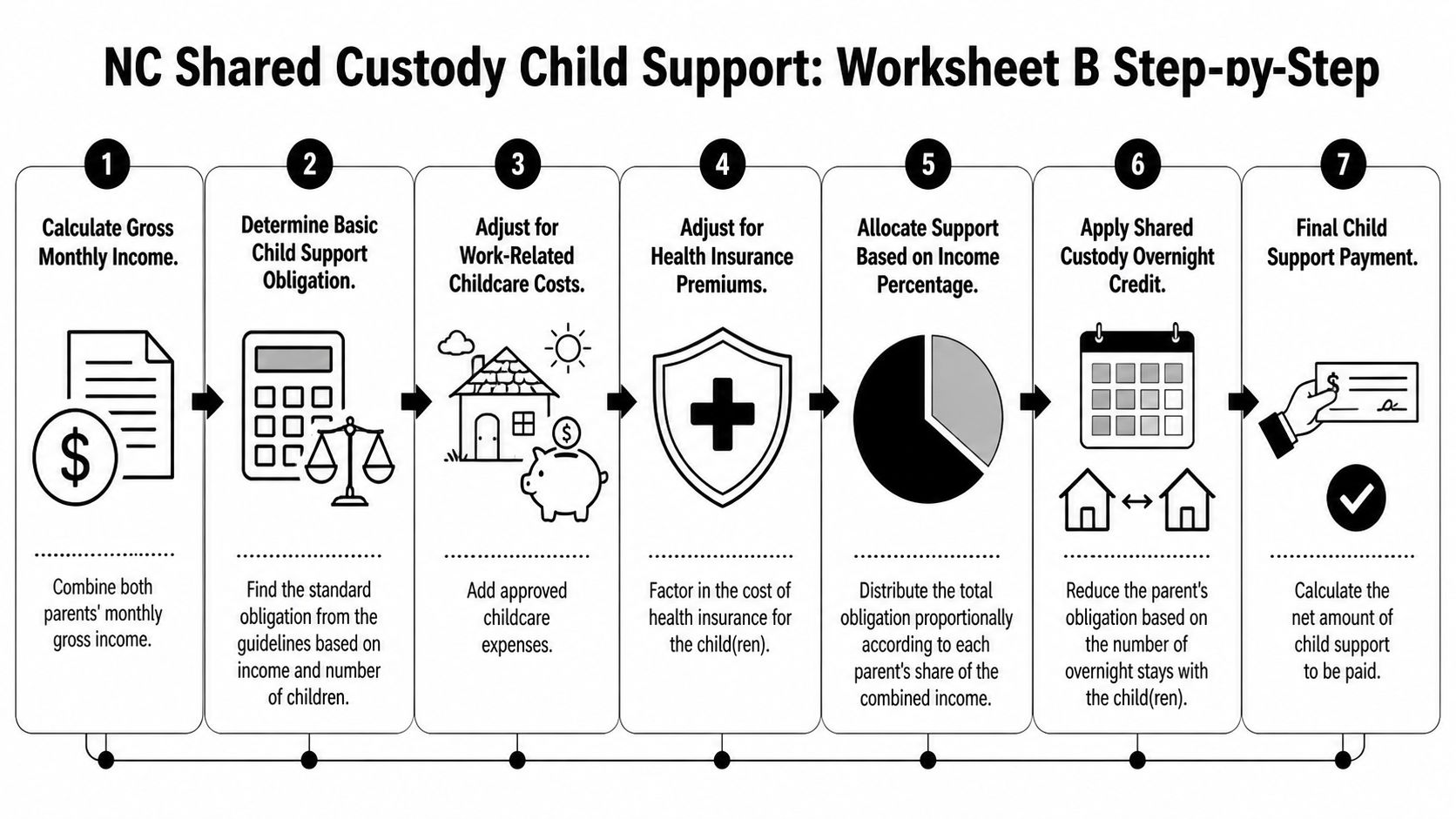
The seven-step logic behind Worksheet B
Worksheet B starts with the same building blocks used in other North Carolina child support calculations, then adjusts for the fact that the child lives substantially in both homes. In practice, the math usually follows this sequence:
Determine each parent's monthly gross income.
The worksheet begins with financial ability. If the income numbers are wrong, every later line will be wrong too.Calculate each parent's percentage share of combined income.
Each parent is responsible for a share of support based on that percentage, not just on parenting time.Find the basic support amount from the guideline schedule.
The schedule uses combined income and the number of children to set a starting point.Apply the shared custody multiplier.
North Carolina increases the base amount by 1.5 in shared custody cases.Allocate that adjusted amount by income share.
Each parent's percentage of the combined income determines that parent's share of the larger shared-custody obligation.Adjust for overnights.
The worksheet factors in how many nights the child spends with each parent over the year.Offset the two amounts to reach the net payment.
After the cross-calculation, the parent with the higher final obligation pays the difference.
The order matters. Parents often assume overnights come first and income comes second. Worksheet B does the opposite because North Carolina's model starts with the cost of supporting the child overall, then allocates that cost between the parents.
Why North Carolina uses the 1.5 multiplier
The 1.5 multiplier is the part that tends to surprise people. Shared custody does not automatically mean support drops to almost nothing. In many families, costs increase because the child has two functioning homes.
That is the reason behind the math. Both parents may be paying for bedrooms, furniture, clothing, food, transportation, utilities, school supplies, and the ordinary costs of daily care. The worksheet recognizes that a child who regularly lives in two homes creates duplicated household expenses that do not exist to the same degree in a primary-custody arrangement.
I tell clients to focus on the policy behind the formula, not just the number. The multiplier is there because the state assumes two engaged households usually cost more than one. Once you understand that, the rest of Worksheet B makes more sense.
A worked example
A standard Worksheet B example helps show the structure. Start with the basic child support obligation from the schedule. In one published explanation of the formula, the basic obligation for two children is multiplied by 1.5 under the shared custody method, then divided between the parents according to their respective shares of the combined income, as described in this North Carolina Worksheet B explanation.
Here is the process in table form:
| Step | Example figure |
|---|---|
| Basic obligation for 2 children | $957 |
| Shared custody multiplier | 1.5 |
| Shared custody basic obligation | $1,435.50 |
| Parent one income share | 45.5% |
| Parent two income share | 54.5% |
| Parent one share of shared obligation | $653.15 |
| Parent two share of shared obligation | $782.35 |
Those figures do not end the calculation. The worksheet then adjusts each parent's amount based on overnights and offsets the two results. That last step is why a parent with substantial custodial time can still owe support. Worksheet B measures both time and financial capacity, then blends them.
Variable income can change the result more than parents expect
In shared custody cases, a small dispute about monthly income can produce a meaningful change in the final number because the worksheet uses each parent's percentage share at multiple stages. Salary cases are usually straightforward. Overtime, bonuses, commissions, self-employment income, seasonal work, and business deductions create harder calls.
That is one reason I caution clients against relying too heavily on quick online estimates. For this reason, online calculators should be treated as estimates, not answers. A calculator may give you a rough range, but it cannot judge whether a recent bonus should count, whether claimed business expenses are legitimate, or whether fluctuating income should be averaged over a longer period.
Where childcare, insurance, and extraordinary expenses fit in
Worksheet B also accounts for certain child-related costs beyond the base support amount. Child health insurance premiums, work-related childcare, and some extraordinary expenses can be added and then allocated between the parents according to their income shares.
These line items deserve close attention. They are often the difference between a rough estimate and a support figure that matches the family's actual financial picture. If one parent pays the child's insurance, covers recurring therapy, or fronts a large childcare bill tied to work, those facts should be documented carefully and presented clearly.
In real cases, the strategic question is not only whether an expense exists. The question is whether it fits the worksheet, whether the proof is clean, and whether the expense is recurring enough to affect the monthly number in a reliable way.
Adjustments and Deviations When the Formula Is Not the Final Word
A shared custody worksheet can produce a clean number and still miss actual pressure points in a case.
I see that most often when one parent has income that rises and falls, or when the child has expenses that do not fit neatly into the standard lines on Worksheet B. The guideline amount is the starting point. It is not always the finish line.
Adjustments built into the worksheet
Some changes happen inside the formula itself. Those are usually easier to address because the Guidelines already expect them. Common examples include:
- The child's health insurance premium: If a parent pays the child's portion of the premium, that amount can be credited in the calculation.
- Work-related childcare: Daycare, after-school care, and similar costs tied to employment can change the support number.
- Extraordinary child-related expenses: Recurring therapy, specialized educational costs, or other unusual expenses may justify an adjustment if the expense is documented and fits the facts of the case.
These entries matter for a reason. The shared custody formula already uses a higher basic support obligation because both homes are bearing more child-related costs. The 1.5 multiplier built into Worksheet B reflects that reality. Even so, the worksheet still depends on accurate inputs. If insurance, childcare, or recurring extraordinary costs are missing or overstated, the final number can swing more than many parents expect.
Documentation often decides these disputes. A premium breakdown, daycare contract, invoices, payment records, and proof that the expense is recurring usually carry more weight than general testimony that the cost exists.
When a deviation may be appropriate
In some cases, even a properly completed worksheet does not produce a fair result. North Carolina courts can deviate from the presumptive guideline amount, but a judge needs a specific legal basis and evidence supporting that request.
A deviation request tends to come up in cases involving:
| Issue | Why it can justify closer review |
|---|---|
| High combined income | The standard schedule may not reflect the child's actual needs or the parents' actual spending pattern |
| Unusual medical, educational, or therapeutic needs | The ordinary worksheet may not account for the full recurring cost |
| Variable or irregular income | A snapshot month can overstate or understate a parent's true earning picture |
| Expense allocations that distort fairness | One parent may be carrying recurring child costs the worksheet does not fully address |
The practical point is simple. Saying the number feels unfair is not enough. The parent asking for a deviation has to show why the guideline amount does not meet the child's reasonable needs, or why applying it strictly would be unjust in that case.
Variable income and extraordinary expenses are where strategy matters
This is the part online calculators rarely handle well.
If income changes from month to month, the fight is often about the right averaging period. A parent with commissions, bonuses, seasonal work, or self-employment income may argue for a longer lookback to smooth out spikes and dips. In other situations, a recent drop in income is real and ongoing, not a temporary bad month. The right approach depends on the records and whether the change is likely to continue.
Extraordinary expenses raise a different problem. Some are recurring and child-focused. Others are occasional, inflated, or only loosely connected to the child's needs. Courts usually respond better when the expense is tied to a clear pattern, supported by bills or treatment records, and presented as part of a practical monthly budget rather than a pile of receipts with no explanation.
That is also why parents should be careful about informal side deals. If one parent has been paying extra therapy costs, travel costs, or school expenses outside the order, that history may matter. But it does not automatically change the support amount unless the issue is addressed properly in court. If your financial picture or child-related expenses have changed enough to affect support, review the process for a North Carolina child support modification before assuming the worksheet can be updated informally.
Good deviation arguments are usually narrow, documented, and tied to the child's needs. Weak ones are broad fairness complaints with little proof. That difference often decides whether the court stays with the worksheet or moves away from it.
Modifying and Enforcing Your North Carolina Child Support Order
A child support order isn't frozen forever. Families change, jobs change, and parenting schedules change. When the facts shift enough, the order may need to change too.
When modification may be necessary
In North Carolina, modification usually turns on whether there has been a substantial change in circumstances. In practice, that often means changes such as:
- Income changes: A parent loses a job, changes compensation structure, or sees earnings move significantly.
- Custody schedule changes: The actual overnights change enough to affect which worksheet applies or how the existing worksheet functions.
- Child-related expenses change: Insurance, childcare, or other recurring costs may rise or fall in a meaningful way.
If your situation has changed, don't assume the old order will fix itself. It won't. Until a new order is entered, the old one generally remains enforceable.
Enforcement is a separate issue from fairness
A parent who believes the order is outdated sometimes stops paying or pays a reduced amount informally. That usually creates a second problem instead of solving the first. Courts distinguish between modifying an order and complying with an order already in place.
If you need to seek a change, do it through the proper legal process. If you need to respond to a change request or enforce an unpaid obligation, get ahead of it early. Waiting usually makes the numbers and the conflict worse.
Parents dealing with post-order issues often benefit from reviewing the legal framework for child support modification in North Carolina.
What helps in post-order disputes
The strongest modification and enforcement cases usually have the same features:
- Current financial records
- Clear parenting-time documentation
- Written proof of paid or unpaid child-related expenses
- Prompt action instead of informal side agreements
If the schedule has changed, or the income picture has materially changed, treat that as a legal issue, not just a co-parenting conversation.
That approach protects both parents. It also protects the child from long stretches of uncertainty and preventable conflict.
Frequently Asked Questions About NC Shared Custody Support
If we share custody, does that mean no one pays child support
No. Shared custody changes the formula, but it doesn't automatically eliminate support. North Carolina still looks at income, overnights, and allowable child-related adjustments. If one parent earns more, that parent may still owe support.
Can parents agree on their own child support amount
Parents can reach agreements, but the court still has to approve child support arrangements in a way that complies with North Carolina law and protects the child's interests. A private deal that ignores the guideline framework may not hold up if later challenged.
What if one parent is self-employed or has irregular income
That usually requires deeper documentation. Business income, commissions, bonuses, and similar earnings often need a broader review over time. In those cases, the quality of the records can matter as much as the numbers themselves.
What happens if a parent is hiding income or understating earnings
The case may require subpoenas, tax documents, business records, bank records, or other evidence to test the claimed income. Courts can evaluate credibility and the actual financial picture based on the evidence presented.
How long does child support usually last in North Carolina
As noted earlier in the article, support generally continues until the child turns 18 or graduates high school, up to age 20 under the guideline framework referenced above. The exact wording of the order still matters, and unusual circumstances can affect the analysis.
Protect Your Rights with an Experienced NC Family Law Attorney
Shared custody child support cases look simple from the outside. They usually aren't. The worksheet may be standardized, but the outcome depends on details like overnight counts, accurate gross income, insurance costs, childcare expenses, and whether there is a legitimate reason to seek deviation or modification.
That is why legal guidance matters. A careful attorney doesn't just plug numbers into a calculator. The job is to verify the right worksheet, test the income evidence, present the facts clearly, and protect your position without losing sight of the child's needs.
If you're dealing with a new support case, a disputed worksheet, fluctuating income, or a change after an existing order, get advice specific to North Carolina law before you make assumptions that could be hard to undo.
North Carolina families don't have to guess their way through child support. Law Office of Bryan Fagan helps parents evaluate shared custody support issues, verify the right numbers, and build a strategy grounded in North Carolina law. If you need guidance on calculation, modification, or enforcement, schedule a consultation to discuss your situation in detail.