
Your former spouse used to earn a strong living. Then the child support case started, and suddenly the story changed. Now they’re “between jobs,” working far below their qualifications, turning down obvious opportunities, or claiming they can’t find anything steady. Meanwhile, groceries, school costs, insurance, and daily expenses keep coming.
That situation is exactly why imputed income exists in North Carolina child support law.
In plain English, imputed income means the court may calculate support based on what a parent could be earning, not just what that parent says they earn today. However, many parents are misled on this point. North Carolina does not impute income just because someone changed jobs, took a pay cut, or decided to work less. The court must make a much more specific finding.
For the parent seeking support, that can be frustrating. You may feel it's obvious, but obvious isn’t enough in court. For the parent defending against an imputation claim, it can feel just as unfair if your income dropped for legitimate reasons and the other side is trying to treat you as if nothing changed.
These cases often turn on details. What job did the parent leave? Why was it left? What efforts were made to find comparable work? Is there medical proof of a limitation? Is this a temporary setback, or a deliberate effort to lower support?
When clients ask about imputed income child support North Carolina, what they usually need is more than a definition. They need to know how judges consider these cases, what evidence matters, how the child support worksheet changes when income is imputed, and what practical steps can help or hurt their position.
Introduction Navigating Child Support When an Ex Is Underemployed
A common call to a family lawyer starts like this. “My ex used to make good money. Now the hearing is coming up, and somehow they’re earning almost nothing.”
Sometimes the facts are dramatic. A parent leaves a professional job and starts working part time. Sometimes they’re subtler. A parent with a solid work history says they’re only taking occasional cash jobs, driving gig work inconsistently, or “figuring things out” while the other parent carries most of the child’s financial load.
Why this issue matters so much
Child support in North Carolina is supposed to reflect a fair picture of each parent’s ability to contribute. If one parent is intentionally earning less than they reasonably could, the worksheet can produce a distorted result. That distortion usually falls on the child first and the other parent second.
That’s why courts may use imputed income as a corrective tool.
A child support case should be based on reality, not on an income figure a parent created to avoid responsibility.
What imputed income means for your case
If you’re the parent asking the court to impute income, your job is to prove more than underemployment. You need to show the court that the reduced income was voluntary and done in bad faith.
If you’re the parent defending against that claim, your job is different. You need to show the court that your current income reflects a legitimate situation, not an attempt to avoid support. Good reasons can include documented incapacity, credible job-search efforts, or a real change in circumstances that wasn’t designed to escape family obligations.
A few practical examples show the difference:
- Likely stronger claim for imputation if a parent quits a well-paying role, turns down similar openings, and offers no convincing reason.
- Likely stronger defense if a parent has medical documentation, has been applying for work consistently, and can explain the income drop with records.
- More complicated case if a parent is self-employed, paid in cash, or works in a field with fluctuating income.
What tends to work and what doesn’t
What works is documentation. Tax returns, wage records, job postings, medical records, employment applications, and credible testimony matter.
What doesn’t work is assuming the judge will “just know” the other parent is gaming the system.
North Carolina imputed income cases are strategic cases. The parent with the cleaner proof usually has the stronger position.
What Exactly Is Imputed Income Under North Carolina Law
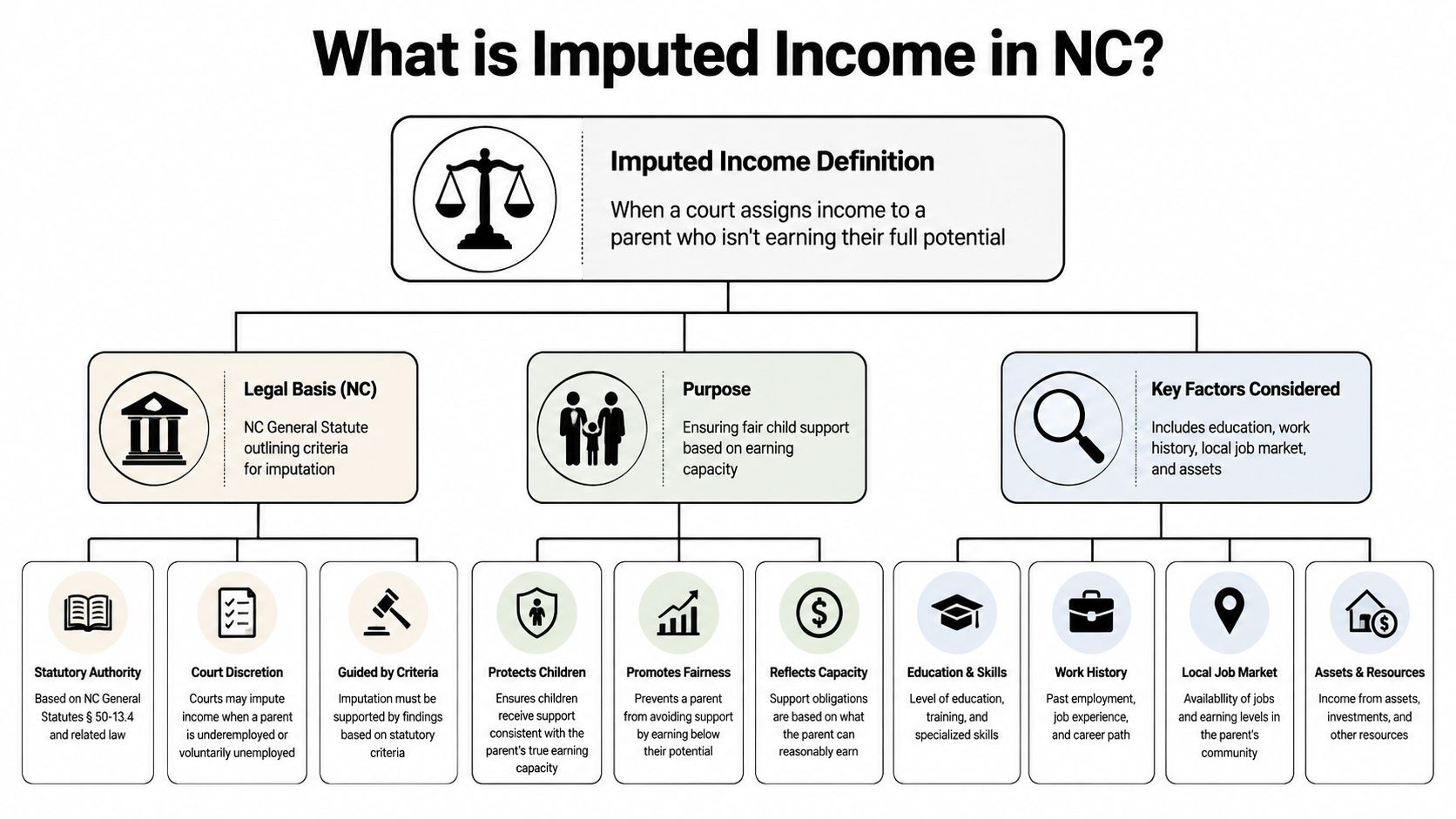
Under North Carolina law, imputed income means the court assigns income to a parent based on earning capacity rather than actual earnings, but only in limited circumstances. The central issue is bad faith.
The rule North Carolina courts apply
North Carolina practice treats imputation as a strict inquiry. A court looks for a three-part showing: the parent’s income is below potential, the reduction is voluntary, and the parent acted in bad faith with intent to avoid or minimize support obligations, as discussed in this North Carolina imputed income overview.
Legal standard: In North Carolina, income may be imputed only when a parent depressed income below earning capacity, did so voluntarily, and did so in bad faith to avoid child support.
That standard is narrower than many people expect.
A parent does not automatically face imputed income because they changed careers, earn less than before, or made a poor employment choice. The court is looking for deliberate conduct tied to avoiding family responsibilities.
Bad faith is the real battleground
Bad faith is where most disputes are won or lost. The court needs evidence that the parent deliberately suppressed income to avoid support. North Carolina guidance makes clear that this requires more than voluntary unemployment alone, and that income cannot be imputed to a parent who is physically or mentally incapacitated, as explained in the UNC School of Government discussion of the updated guidelines.
That distinction matters in real life.
A parent who leaves a demanding job because of a documented medical condition is in a very different position from a parent who leaves a job and then refuses comparable work without a credible explanation. A parent who pauses work because of a true incapacity is different from a parent who says, without records, that working isn’t possible right now.
What the court looks at when assigning earning capacity
When a judge considers whether to impute income, the court typically examines the parent’s actual earning potential. The evidence often includes:
- Employment history including past jobs, wages, and periods of unemployment
- Occupational qualifications such as licenses, education, training, and skills
- Local wage information showing what someone with similar qualifications can earn in the community
- Any legitimate limitation including documented physical or mental incapacity
The question isn’t whether a parent could hypothetically earn more in some abstract sense. The question is whether the evidence shows a real earning capacity that the parent chose not to use in good faith.
What this means for clients
If you’re pursuing imputation, don’t frame the case as “my ex could make more.” Frame it as “my ex voluntarily reduced income and did so to avoid support, and here is the proof.”
If you’re defending the claim, don’t rely on general explanations. Show the court why your current income is genuine and why your choices were not made in bad faith.
That is the core of imputed income child support north carolina cases.
Common Scenarios Where North Carolina Courts Impute Income
The legal test sounds abstract until you put it into everyday situations. Most imputation cases follow familiar patterns.

Leaving a better job without a solid reason
One common example is a parent who leaves higher-paying work shortly before or during a child support dispute. Courts often impute income when a parent deliberately leaves better-paying employment or refuses reasonable job offers, and the Court of Appeals confirmed in Juhnn v. Juhnn that intentional income suppression can justify calculating support based on potential rather than actual earnings, as described in this discussion of Juhnn v. Juhnn and imputed income.
A practical example would be a parent with a long history in sales, management, or skilled trades who suddenly shifts into very limited part-time work without evidence of health problems, layoffs beyond their control, or a serious job search for comparable positions.
That does not mean every career change is bad faith. Some are legitimate. But if the timing and evidence suggest the move was designed to reduce support exposure, the court may treat that very differently.
Refusing available work
Another recurring pattern is refusal to pursue reasonable opportunities.
A parent may insist that only one very specific kind of job is acceptable, even though they have transferable skills and local openings exist. Or they may reject offers that fit their background because the pay would lead to a higher child support obligation.
Judges tend to focus on whether the parent is making sincere efforts to earn at capacity.
- Stronger for imputation when the parent ignores realistic jobs within their skill set
- Stronger against imputation when the parent can show repeated applications, interviews, and a good-faith search
- Mixed cases when the parent is retraining, changing industries, or relocating for reasons that are not tied to avoiding support
Cash work, hidden earnings, and gig income
Some cases involve under-the-table work or self-employment arrangements that make income hard to pin down. Others involve gig work where earnings vary month to month.
When records are thin, the court may become skeptical. If a parent says income is minimal but still appears to maintain a lifestyle inconsistent with that claim, the judge may look closely at whether actual earnings are being concealed.
Courts don't have to accept a low income claim at face value when the surrounding facts point in another direction.
Misconduct and self-created job loss
Another difficult scenario is job loss caused by the parent’s own conduct. If a parent is terminated for behavior within their control and then remains underemployed, the court may view the resulting reduction in income as voluntary in a way that supports imputation.
That issue is fact specific. The key question is still bad faith. But from a practical standpoint, a parent who creates their own employment problem and then asks the other household to absorb the consequences starts from a weaker position.
How Imputed Income Is Calculated on the NC Child Support Worksheet
Once the court decides imputation is appropriate, the next question is practical. What number goes on the worksheet?
North Carolina child support usually relies on guideline worksheets. The current guidelines use worksheets A, B, or C depending on the custody arrangement, and for combined parental adjusted gross income below $40,000 per month courts use the income shares worksheets, while income above that cap is handled differently under N.C. Gen. Stat. § 50-13.4(c) based on the child’s reasonable needs and the family’s accustomed standard of living, as summarized in this discussion of the 2023 North Carolina guideline update.
Step one identifies the earning-capacity figure
The court does not pull a number out of thin air. It should rely on evidence showing what the parent can realistically earn.
That often includes prior W-2s, tax returns, pay stubs, licenses, resumes, and wage data for similar work in the local market. In more contested cases, lawyers may also use vocational evidence or wage surveys to support or challenge the proposed number.
If the evidence is strong, the imputed amount may track prior earnings closely. If the evidence is thinner, the argument becomes much harder.
Step two applies the minimum floor when appropriate
For parents with no recent work history, North Carolina requires imputation of no less than the applicable minimum wage for a full-time 40-hour workweek, and the minimum child support order is $50 per month, as explained in this North Carolina imputed income summary.
That floor matters in cases where a parent says they have no income at all. Zero income does not automatically mean zero support.
Practical rule: If a parent has no recent work history, the court still starts from a full-time minimum-wage baseline rather than treating the parent as having no earning ability at all.
Step three places the income on the worksheet
After the court selects the income figure, that number is entered as the parent’s gross income on the applicable worksheet. From there, the guideline process looks familiar. The worksheet also considers the custody arrangement, health insurance costs, and work-related childcare.
If you want to understand how the forms are structured, this North Carolina child support worksheet guide is a useful starting point.
Here is a simplified comparison to show how the issue works in practice.
| Calculation Factor | Scenario A Using Actual Low Income | Scenario B Using Imputed Potential Income |
|---|---|---|
| Parent’s income used on worksheet | Current claimed low earnings | Court-assigned earning capacity |
| Basis for income figure | Present pay only | Past earnings, qualifications, and local wage evidence |
| Support result | Usually lower | Often higher |
| Key dispute | Whether current earnings should control | Whether bad faith justifies using potential earnings |
A simple example without invented numbers
Assume one parent recently left a better-paying job and now reports income that is much lower than before. The other parent presents prior wage records, proof of qualifications, and evidence that similar jobs are available locally.
If the court finds bad faith, it may reject the current low figure and use the parent’s earning capacity instead. That higher number goes into the worksheet. The support amount then rises because the worksheet reflects what the parent should be contributing based on realistic earning ability.
If the court does not find bad faith, the parent’s current actual income is more likely to remain in the calculation.
What helps and what hurts at the worksheet stage
Helpful evidence includes:
- Past compensation records that show a consistent earning pattern
- Professional credentials such as licenses or training
- Local wage data that ties earning capacity to real jobs in the area
- Reliable expense proof for insurance and childcare so the worksheet is complete
Unhelpful evidence includes unsupported estimates, inflated earning assumptions, and arguments that skip over the bad-faith requirement.
Appellate courts take unsupported imputations seriously. If the trial court does not ground the income figure in actual evidence, the order becomes more vulnerable to challenge.
Evidence and Strategies for Arguing Imputed Income
Imputed income cases are evidence cases. The law matters, but the proof usually decides the outcome.

If you are asking the court to impute income
Start with the parent’s earning history. Past tax returns, pay stubs, W-2s, resumes, licensing records, and public professional profiles can help establish what that parent has earned and is qualified to earn.
Then connect that history to current opportunity. Job postings, wage surveys, and evidence of available work in the community can make the argument concrete rather than speculative.
Useful proof often includes:
- Prior earnings records that show what the parent earned before the drop
- Qualification evidence such as trade certifications, degrees, or active licenses
- Current market evidence showing jobs that match those qualifications
- Contradictory lifestyle evidence if the parent claims poverty but appears to have resources inconsistent with that claim
If the parent’s income is irregular, documentation becomes even more important. Practitioners note that when earnings fluctuate, including in gig work, courts may default to minimum-wage imputation if there is no clear earnings history, which is why parents should keep detailed records of earnings and job-search efforts, as discussed in this North Carolina family law discussion of fluctuating income and imputation.
If you are defending against imputation
The defense is not merely saying, “I’m making less now.” The better defense is showing why that reduction is real, reasonable, and not designed to avoid support.
Strong defensive evidence can include:
- A job search log with applications, interviews, follow-up emails, and rejection notices
- Medical records if physical or mental limitations affect the ability to work
- Retraining records if you are in a legitimate program aimed at returning to stable employment
- Business records if self-employment income varies and you need to show actual cash flow
If your income dropped for a real reason, document the reason as if a judge will need to review it line by line. Because a judge may.
Trade-offs clients often underestimate
Parents seeking imputation sometimes overreach. They ask the court to assign an unrealistically high income without tying it to current job availability or credible evidence. That weakens the whole argument.
Parents defending imputation often make the opposite mistake. They assume sincerity will carry the day without documentation. It usually won’t.
One practical option for parents trying to understand worksheet impact during litigation is to review child support calculation materials and consult counsel who handles North Carolina support disputes, including firms such as the Law Office of Bryan Fagan child support resources.
Using Imputed Income in Child Support Modification and Enforcement
Imputed income is not limited to the initial child support case. It also matters after an order is already in place.
Modification when circumstances change
If a parent who was previously earning at a higher level later becomes voluntarily underemployed, that issue may support a request to modify child support. The court will still focus on facts and proof, but voluntary income suppression can become part of the broader argument that the current order no longer reflects reality.
A parent considering that step should review the process carefully. This overview of North Carolina child support modification explains how modification disputes are typically framed.
The key point is practical. If one parent’s lower income is genuine, modification may be appropriate. If the lower income is self-created and in bad faith, imputation may prevent that parent from benefiting from the reduction.
Enforcement when a parent says they cannot pay
Imputed income also matters in enforcement disputes. A parent who falls behind may argue that payment isn’t possible because earnings are too low. Sometimes that’s true. Sometimes the evidence shows the parent still has earning capacity and chose not to use it.
In those cases, earning capacity can become central to the court’s analysis.
A parent who voluntarily lowers income does not automatically gain a defense to nonpayment.
Why timing matters
Delay can hurt either side.
If you believe the other parent is intentionally underemployed, waiting too long may allow weak records and vague explanations to harden into the “new normal.” If you are the parent whose income dropped for legitimate reasons, failing to seek relief promptly can make the situation look less credible than it really is.
Modification and enforcement cases move on evidence, timing, and consistency.
Frequently Asked Questions About Imputed Income in NC
Can a North Carolina court impute income just because my ex quit a job
No. Quitting a job by itself is not enough. The court must find bad faith, meaning the parent voluntarily reduced income with the intent to avoid family support obligations. The reason for leaving, the job search afterward, and the surrounding facts all matter.
Can income be imputed to a parent who stays home with a very young child
Possibly. The 2023 guideline update removed the old provision that barred imputing income to primary custodians of children under age three, giving judges more discretion to evaluate those cases based on their facts, as explained in this review of the 2023 North Carolina child support guideline changes.
That does not mean every stay-at-home parent will have income imputed. It means the automatic protection is gone, and the facts now matter more.
What if the other parent is self-employed or paid in cash
These cases are often harder, but not impossible. Courts can look at business records, bank records, lifestyle evidence, prior earnings, and credibility. If the records are incomplete, the judge may examine earning capacity more closely.
The cleaner your documentation, the better.
Will the court impute income if a parent goes back to school
Sometimes yes, sometimes no. Returning to school is not automatically bad faith. The court will look at whether the decision was reasonable under the circumstances or whether it functioned as a way to avoid present support.
A short-term training program tied to better employment may be viewed differently from an open-ended educational plan with no clear path and no realistic effort to meet support obligations in the meantime.
What if I cannot work because of a medical condition
That can be a strong defense to imputation if it is supported by credible evidence. North Carolina does not allow income to be imputed to a parent who is physically or mentally incapacitated. Medical records, treatment records, and provider documentation are usually important.
Protect Your Rights and Your Child's Future
Imputed income cases are rarely about one paycheck. They are about whether the court believes the income picture is honest.
In North Carolina, these disputes usually turn on one issue: bad faith. If a parent intentionally lowers income to avoid support, the court may use earning capacity instead of current earnings. If the income drop is legitimate, the court needs proof of that too.
The difference between a strong case and a weak one is usually documentation. Past earnings, job qualifications, medical evidence, wage data, and a credible timeline matter. So does using the right legal framework under North Carolina law.
If you are dealing with an underemployed ex, defending against an unfair imputation claim, or trying to modify an existing support order, it helps to get case-specific advice early. A North Carolina child support lawyer can evaluate the facts, prepare the right evidence, and apply the law to your family’s situation. You can learn more about those services through this page for a North Carolina child support lawyer.
If you need guidance on imputed income child support issues in North Carolina, schedule a consultation with the Law Office of Bryan Fagan. A consultation can help you assess whether bad faith is likely to be an issue, what evidence you need to gather, and how to approach modification, enforcement, or an initial support determination with a clear strategy.