Going through a divorce is one of the toughest challenges you’ll ever face, and the thought of dividing a life you built together can be completely overwhelming. A division of assets attorney is the guide you need to navigate this process, with a specific focus on protecting your financial future under North Carolina law. Their job is to make sure the property, assets, and debts you both acquired during the marriage are divided fairly—which doesn’t always mean splitting everything right down the middle.
Your Guide to Asset Division in a North Carolina Divorce

When a marriage ends in North Carolina, the law doesn't just slice everything in half. Our state follows a legal principle known as equitable distribution, which is one of the biggest points of confusion for people starting the divorce process.
Equitable does not mean equal. It means fair. While a 50/50 split is often the starting point, a judge can order an unequal division if a 50/50 split wouldn't be fair to both spouses.
Think of it like you're dissolving a business partnership. You wouldn't just split the cash in the register and call it a day. You'd have to account for years of hard work, contributions that weren't purely financial, and what each partner needs to move forward successfully. That’s what equitable distribution aims to do under North Carolina law.
Understanding the Foundation of Your Financial Future
The goal of equitable distribution is to set both you and your former spouse on a path toward financial stability after the divorce. To do that, a North Carolina judge must weigh many different factors before making a final decision. Getting a handle on this framework is the first critical step to securing your own financial well-being.
Your division of assets attorney acts as both your advocate and your strategist. They make sure every piece of property is correctly identified, properly valued, and argued for in a way that supports your long-term security. They help you tackle the big questions:
- Who gets the house?
- How are we going to split retirement accounts and pensions?
- What happens to the credit card debt we accumulated together?
- Does my spouse have a right to a piece of my business?
These aren't just logistical hurdles; they are the literal building blocks of the new life you're about to start. Without a skilled attorney in your corner, you could easily overlook valuable assets or agree to a settlement that puts your future at risk. To learn more about this and other key topics, you can explore our comprehensive guide to the North Carolina divorce process.
With the right legal partner, you can face this complex process with confidence, knowing your rights are being protected. The decisions made during asset division will echo for years to come, and getting it right is everything.
Why You Need a Division of Assets Attorney in North Carolina
Trying to divide your marital property on your own can feel like navigating a minefield without a map. A division of assets attorney is more than just a legal representative—they are a strategic partner dedicated to protecting your financial future. Their role is to make sure the final outcome is not just legally compliant, but genuinely fair for your unique circumstances in North Carolina.
With approximately 42-45% of marriages ending in divorce, property division has become a critical issue for countless families. This is especially true here in North Carolina, where our equitable distribution laws require a skilled and nuanced approach. An experienced attorney is essential for valuing complex assets and ensuring you don’t risk losing tens or even hundreds of thousands of dollars due to an oversight. You can explore more findings on marriage dissolution trends to understand the broader context.
Beyond Legal Advice to Strategic Advocacy
An experienced North Carolina attorney provides several critical services that go far beyond just filling out paperwork. Their work is proactive, investigative, and focused on securing your long-term financial stability.
Key functions include:
- Uncovering Hidden Assets: We use legal tools like subpoenas and formal discovery requests to demand financial records, ensuring all marital property is on the table—even assets a spouse may try to hide.
- Accurate Valuation of Complex Property: How do you put a number on a pension, a family business, or stock options? Our attorneys work with forensic accountants and appraisers to assign a precise, defensible value to these complicated assets.
- Strategic Negotiation: A skilled negotiator can often secure a favorable settlement outside of court, saving you significant time, stress, and money. They know what a North Carolina judge would likely consider fair and use that knowledge as powerful leverage.
- Preventing Costly Mistakes: A common mistake is agreeing to take the house without fully accounting for the mortgage, property taxes, and upkeep. An attorney helps you see the complete financial picture behind every asset and debt.
A Real-World North Carolina Scenario
Imagine a marriage where one spouse owns and runs a small business, managing all the family finances. The other spouse, who stayed home to raise the children, has no idea how much the business is worth and has no access to its records. It’s a common and frightening situation for many North Carolinians facing divorce.
This is exactly where a division of assets attorney becomes indispensable. They would immediately start the legal discovery process, compelling the business-owning spouse to produce key documents:
- Business and personal tax returns
- Bank and investment statements
- Credit card statements
- Loan applications and payroll records
By gathering this evidence, the attorney builds an accurate financial picture from the ground up. They ensure the homemaker’s non-financial contributions are given proper weight and fight for their rightful share of the marital estate—including the value of the business.
Without this professional intervention, the less-informed spouse would be at a severe disadvantage, likely accepting a settlement far below what they are entitled to under North Carolina's equitable distribution laws. An attorney levels the playing field and works to ensure the final agreement is truly fair.
Classifying Property in a North Carolina Divorce
Before a single asset can be divided in a North Carolina divorce, we first have to figure out what you own, what you owe, and how the law sees it. This is the foundational step that your entire financial future is built on. An attorney’s first job is to help you create a clear inventory and then categorize every item according to state law.
Under North Carolina General Statute § 50-20, property falls into one of three distinct buckets. Understanding which bucket each asset belongs in is critical because the court only has the authority to divide certain types of property. Getting this wrong can mean losing assets that should have been yours or giving up your fair share of something you helped build.
Marital Property: The Assets of the Partnership
Marital property includes nearly everything you or your spouse acquired from the day you said "I do" until the day you separated. It doesn't matter whose name is on the title or who technically made the purchase. If it came into the picture during the marriage, North Carolina law presumes it belongs to the marriage.
Think of your marriage as a business partnership. Everything earned, bought, or built while the business was running belongs to the partnership itself, not just one partner.
Common examples of marital property include:
- The family home purchased during the marriage.
- Cars, boats, and other vehicles bought while married.
- Income earned by both spouses.
- Retirement funds, 401(k)s, and pensions that accrued value during the marriage.
- Joint bank accounts and investment portfolios.
- Debts taken on during the marriage, like mortgages, car loans, and credit card balances.
Separate Property: What’s Yours Alone
Separate property is anything you or your spouse owned before the wedding. It also covers very specific assets acquired during the marriage that belong solely to one spouse, like an inheritance or a gift from a family member intended for just one person.
For instance, if you owned a rental property before you got married, that property generally remains yours. The tricky part is that separate property can lose its protected status if it gets "commingled," or mixed, with marital assets. If you deposit a large inheritance into a joint bank account and then use those funds for shared family expenses, you risk converting that separate money into marital property.
A critical role for your division of assets attorney is to trace the history of your assets to prove their separate nature, especially if funds have been mixed over the years. This process, known as asset tracing, protects what is rightfully yours from being divided.
Divisible Property: The Post-Separation Gray Area
North Carolina has a unique third category called divisible property. This concept often trips people up, but it’s absolutely essential for ensuring a truly fair outcome. Divisible property accounts for the changes in the value of marital assets that happen after you separate but before your property is officially divided.
This includes both increases and decreases in value. For example, if a joint stock portfolio grows by $20,000 between your separation and your court date, that gain is considered divisible property. On the other hand, if a marital business loses value during that same time, that loss is also shared.
Divisible property also includes compensation that was earned during the marriage but not paid out until after separation, like bonuses or commissions. This rule prevents one spouse from timing a separation just to keep a large, anticipated payment out of the marital pot. An experienced attorney will carefully analyze this post-separation period to make sure every dollar is accounted for.
To help you get a clear picture of these important distinctions, we've put together a simple comparison.
Property Classification in a North Carolina Divorce
This table compares Marital, Separate, and Divisible Property under North Carolina law to help you identify how your assets may be categorized.
| Property Type | What It Is | Common Examples | How It Is Treated in Divorce |
|---|---|---|---|
| Marital Property | All property acquired by either spouse during the marriage and before separation. | Family home, joint bank accounts, retirement funds earned during marriage, shared debts. | Subject to equitable distribution and divided fairly between spouses. |
| Separate Property | Property owned by a spouse before marriage or received as a gift or inheritance during marriage. | A car owned before the wedding, an inheritance from a parent, a gift to one spouse. | Not subject to division; it remains the property of the original owner. |
| Divisible Property | Changes in the value of marital property occurring after separation, plus certain deferred compensation. | Increase in 401(k) value post-separation, a work bonus earned before separation but paid after. | Subject to equitable distribution and divided fairly between spouses. |
Understanding these categories is the first step, but correctly applying them to your unique situation is where skilled legal strategy comes in.
The Equitable Distribution Process Step by Step
Knowing how North Carolina law classifies your property is the first step. The real work begins with the actual division process, legally known as equitable distribution. A division of assets attorney guides you through this journey, which unfolds in three main phases: Identification, Valuation, and Distribution.
Let's walk through this with a hypothetical North Carolina couple, Alex and Jordan. They’ve been married for 15 years, and their shared financial life includes a house with a mortgage, Alex’s 401(k), and debt from a failed business Jordan started. By following their story, these legal steps become much clearer.
First, your attorney will help you sort everything you own and owe into three distinct legal categories, as shown in this graphic.
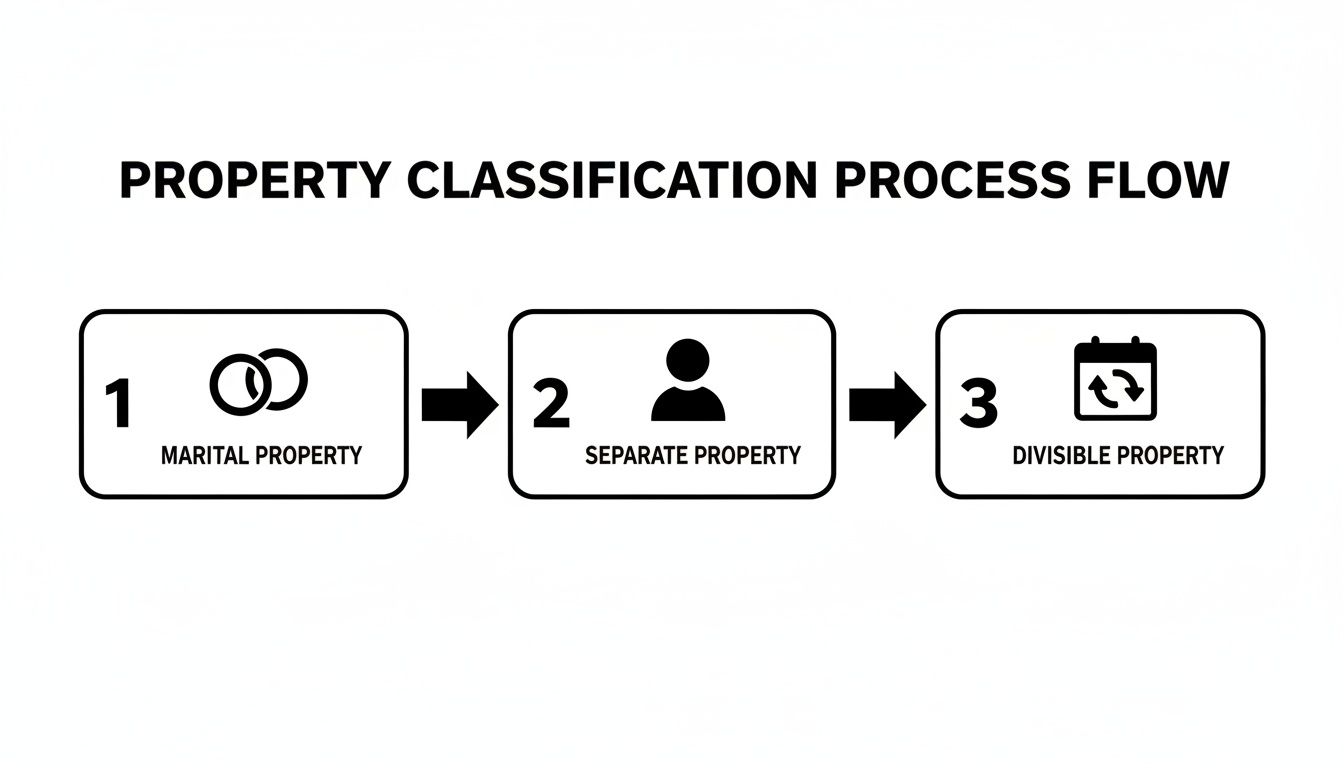
This visual guide is essential for understanding what’s on the table for division (marital and divisible property) and what isn’t (separate property).
Step 1: Identification and Discovery
The first phase is Identification. You can’t divide what you don’t know about. Both you and your spouse are legally required to provide a full and honest disclosure of every asset and debt. This is managed through a formal process called "discovery," where your attorney exchanges all relevant financial information with your spouse's lawyer.
For Alex and Jordan, this means:
- Complete Disclosure: Both must put all their cards on the table. Alex discloses the 401(k) statements, and Jordan provides the loan documents for the business debt. They also exchange bank statements, credit card bills, and the mortgage paperwork for their house.
- Building a Full Inventory: Their attorneys take this information and compile it into an "Equitable Distribution Affidavit." This is a sworn document listing all marital, separate, and divisible property and debts.
This step is all about transparency. If you suspect your spouse is hiding assets, your attorney can use legal tools like subpoenas to get records directly from banks, employers, or other financial institutions.
Step 2: Valuation of Assets and Debts
Once everything is identified, we move to Valuation. Every asset and debt must be given a fair market value as of the date of separation. For something simple like a bank account, that’s easy. For more complex assets, it requires professional expertise.
Let's check back in with our example:
- The Marital Home: Alex and Jordan hire a licensed real estate appraiser to determine the house's current market value.
- Alex’s 401(k): This is more complicated. An expert must calculate the marital portion of the 401(k)—meaning, only the growth in value that happened between the wedding day and the date of separation. A special court order, a Qualified Domestic Relations Order (QDRO), is almost always needed to divide these accounts without triggering massive tax penalties.
- Jordan’s Business Debt: Because the loan for the business was taken out during the marriage, the outstanding balance is valued and classified as a marital debt.
Accurate valuation is critical. It ensures the final division is based on real, verifiable numbers, not guesswork, and prevents one spouse from getting shortchanged. You can get a deeper look at how courts handle this by reading our guide on what equitable distribution entails.
Step 3: Distribution—The Final Division
The final phase is Distribution, where a judge decides who gets what. North Carolina law starts with the presumption that a 50/50 split is "equitable," or fair. However, a judge can order an unequal division based on more than a dozen factors listed in N.C.G.S. § 50-20(c). These factors are there to help create a truly just outcome.
For example, a judge might award one spouse more than 50% of the marital estate if they have a much lower earning capacity, are facing significant health problems, or made substantial non-financial contributions as a homemaker that allowed the other spouse to build a high-earning career.
These battles over what’s fair are common. The U.S. divorce rate, hovering around 2.3-2.5 per 1,000 people, puts tremendous pressure on courts to manage these complex property splits. This is especially true in North Carolina, where equitable distribution laws consider nuanced factors like one spouse’s misconduct or unequal contributions. This is where skilled advocacy from a firm like the Law Office of Bryan Fagan becomes vital.
For Alex and Jordan, a judge would weigh all of these factors to decide how to split their house, 401(k), and debt. An experienced attorney’s job is to build a compelling argument, using the law to advocate for a distribution that protects your financial security today and for the years ahead.
Untangling Your Assets: From the Simple to the Complex in North Carolina

Dividing marital property is almost never as simple as just splitting a bank account down the middle. While some assets are straightforward, many others are tangled and complex, demanding a deep understanding of North Carolina law to get a fair outcome. A skilled division of assets attorney knows how to unravel both.
And it’s not just about assets. Marital debts—like mortgages, credit card balances, and even some student loans—are also on the table. Just like property, they are divided equitably between both spouses.
Dividing Common Marital Assets
Most couples build a life together with a core set of assets. They might seem simple on the surface, but without careful handling, they can easily become major points of contention.
- The Marital Home: This is usually the biggest financial asset—and the most emotionally charged one. We can explore selling it and splitting the proceeds, arranging for one spouse to buy out the other’s share, or even allowing one parent to stay in the home for a set time to provide stability for the children.
- Bank Accounts: Joint checking and savings accounts are typically easy to value. The real work is ensuring a full and honest accounting of every dollar as of your date of separation.
- Vehicles: Cars, boats, and RVs are valued at their fair market value, minus whatever is still owed on the loan. We typically use resources like Kelley Blue Book, but for high-value or classic vehicles, a professional appraisal is a must.
Here’s a real-world example: It’s common for one spouse to have used separate money, like an inheritance, for the down payment on the marital home. An attorney can perform a “source of funds” analysis, tracing that money back to its origin. This allows us to argue that you should be credited for that separate contribution before the remaining equity is split.
Tackling Complex and High-Value Assets
This is where things get really intricate. Complex assets demand a much deeper financial analysis and often require us to bring in outside experts. A mistake in valuing or dividing these assets can be incredibly costly, which makes experienced legal guidance non-negotiable.
Properly valuing these assets is especially critical in high-asset divorce cases in North Carolina, where the financial stakes are significantly higher.
Retirement Accounts (401(k)s, IRAs, and Pensions)
Only the portion of a retirement account earned during the marriage is considered marital property. Figuring out that marital share means carefully combing through years of account statements. To divide these accounts without triggering massive tax penalties, we almost always need a special court order called a Qualified Domestic Relations Order (QDRO). This order directs the plan administrator to create a separate account for the non-employee spouse, protecting your share of the funds.
Family Businesses and Professional Practices
How exactly do you divide a business that one spouse poured their life into building? The first step is hiring a business valuation expert to determine what it’s actually worth. This isn’t just about equipment and inventory; it also includes intangible assets like “goodwill”—the value of the business’s reputation and loyal customer base.
- For instance: A huge part of a doctor’s medical practice value comes from its patient list and reputation in the community. We work to ensure this goodwill is properly appraised and counted as part of the marital estate, so it doesn't get overlooked or undervalued.
Stock Options and Other Investments
Executive compensation like stock options and restricted stock units (RSUs) can be extremely tricky. Many are granted during the marriage but don’t “vest” (become fully owned) until after separation. Your attorney will need to dig into the grant documents and vesting schedules to pinpoint the marital portion that is subject to division.
Common Questions About Asset Division in North Carolina
When you're facing a divorce, it’s the financial unknowns that often cause the most stress. Questions about your home, your savings, and your future can feel overwhelming. Below, we've provided clear answers to some of the most common questions our division of assets attorneys hear from clients across North Carolina.
Does Adultery Affect Asset Division in North Carolina?
In most situations, no. North Carolina’s equitable distribution laws are designed to separate marital misconduct from the process of dividing property. The court's focus is on what’s fair financially, not on punishing a spouse for their behavior.
However, adultery can have a massive impact on alimony. If a dependent spouse is proven to have committed adultery, they can be completely barred from receiving alimony. On the other hand, if a supporting spouse was unfaithful, the court can be compelled to award alimony. An experienced attorney can help you understand how these two separate issues—property division and spousal support—fit into your overall financial strategy.
What Happens to Our House in an NC Divorce?
The marital home is often a family’s largest financial asset and its emotional center. What happens to it depends entirely on your family’s specific circumstances and financial goals. There isn’t a one-size-fits-all answer.
A few common outcomes include:
- One spouse buys out the other, usually by refinancing the mortgage to pay out the other spouse’s share of the home's equity.
- The house is sold, and after the mortgage and any sale-related costs are paid, the remaining proceeds are divided between the spouses.
- One spouse keeps possession of the home for a defined period, which is a common solution when it provides stability for minor children.
We can help you run the numbers on each option, analyzing the pros and cons to determine which path makes the most sense for your new beginning.
Key Takeaway: The "best" solution for the house isn't just about money; it's about finding a path that allows both spouses to move forward on stable financial footing. A thorough analysis is critical before making any agreements.
Is My Inheritance Considered Marital Property?
Typically, an inheritance is not considered marital property. If you received an inheritance, even during the marriage, it is presumed to be your separate property and is not subject to division in a divorce.
The major exception is if those funds become "commingled" with marital assets. For example, if you deposit inheritance money into a joint bank account and use it for shared family expenses over several years, it can lose its protected status. The cleanest way to protect an inheritance is to keep it in a separate account in your name only. If your funds have already been mixed, a skilled attorney can help perform the financial tracing needed to prove their separate origin.
Can I Receive More Than Half of the Marital Assets?
Yes, it's absolutely possible. While a 50/50 split is the starting point and legal presumption in North Carolina, the law specifically allows for an unequal division if a 50/50 split wouldn't be equitable or fair.
To justify an unequal distribution, a judge will weigh several key factors listed in N.C.G.S. § 50-20(c). These might include significant differences in income, the age and health of each spouse, one spouse's contributions as a homemaker, or the need for the parent with primary custody to remain in the family home. Your attorney's job is to build a strong, evidence-based argument that shows a judge exactly why an unequal division is the truly fair outcome in your case.
Protect Your Financial Future with a North Carolina Asset Division Attorney
When a marriage ends in North Carolina, the process of dividing assets carries enormous weight. Your financial stability, your retirement, and your ability to start the next chapter of your life on solid ground all hang in the balance. The rules of equitable distribution are filled with legal complexities and financial traps, and trying to navigate them on your own is a risk you simply can’t afford.
This isn't a time for guesswork or just hoping for a fair outcome. It's a time for a clear, strategic plan. Every step—from identifying every piece of marital and separate property to making sure complex assets are valued correctly—demands precision and legal insight. The difference between a fair settlement and a devastating financial loss often comes down to the skill of the lawyer fighting for you.
Secure the Advocacy You Deserve
An experienced division of assets attorney does far more than just fill out paperwork. They build a case designed to protect what you’ve spent a lifetime working for. Their job is to make sure every asset is accounted for, that your contributions to the marriage are fully recognized, and that the final division is truly equitable under North Carolina law.
The choices you make today will directly shape your financial reality for years to come. Investing in professional legal guidance is not a luxury—it is a necessity for protecting your future.
Whether you're facing a fight over a family business, trying to figure out how to handle a pension, or just need to secure your fair share of the marital home, you need a plan. You need an advocate who understands North Carolina’s unique laws and has the experience to make them work for you.
Take the First Step in North Carolina
Your financial future is too important to leave to chance. If you are a North Carolina resident facing divorce, the time to protect your rights is now. The dedicated team at the Law Office of Bryan Fagan is here to help you understand your options and build a comprehensive strategy for your asset division case.
We are committed to providing the clear, authoritative guidance you need to navigate this difficult time with confidence. Schedule a consultation with us today to secure your financial future.