Late at night, this question tends to hit all at once: Do I need a divorce lawyer in North Carolina, or can I do this myself? You may already be living separately. You may think the two of you agree on everything. Or you may know the marriage is ending but have no idea what happens to the house, retirement accounts, debts, or your time with the children.
That uncertainty is normal. Divorce in North Carolina looks simple from the outside because the court can grant an absolute divorce on a straightforward path. But many people discover too late that ending the marriage and protecting their rights are not the same thing.
A person can often file the divorce paperwork without hiring a lawyer. What usually creates risk is everything around the divorce: the separation agreement, the property claims, support issues, custody terms, and the timing of when those issues must be raised. That is where people accidentally give up rights they assumed would still be there later.
The Crossroads of Divorce When Do You Need a Guide
A common North Carolina scenario looks like this. One spouse moves out. The couple keeps things civil. They agree they “just want it over with.” Someone searches online for forms, sees that North Carolina doesn't require a lawyer for every divorce, and assumes the case is simple.
Sometimes that assumption is correct. Often it isn't.
What matters is not just whether you both want the marriage to end. The essential question is whether there is anything left to divide, preserve, negotiate, or protect. If there's a home, retirement account, debt, request for support, parenting disagreement, or even a loosely worded agreement pulled from the internet, the legal consequences can outlast the divorce itself.
The question clients are really asking
When people ask whether they need a lawyer, they're usually asking something more practical:
- Can I file this myself without making an expensive mistake
- Will a lawyer change the outcome
- Am I dealing with a basic filing or a much bigger financial and family law problem
- If we agree now, what could still go wrong later
Those are the right questions.
A divorce can be easy to start and hard to unwind if important rights were missed on the way in.
North Carolina law creates a narrow lane for a simple divorce. Outside that lane, legal help isn't about adding drama. It's about catching issues before they turn into permanent losses. If you're trying to decide what works and what doesn't in your situation, focus less on whether a lawyer is technically required and more on what is at stake if you proceed without one.
North Carolina Divorce Fundamentals You Must Know
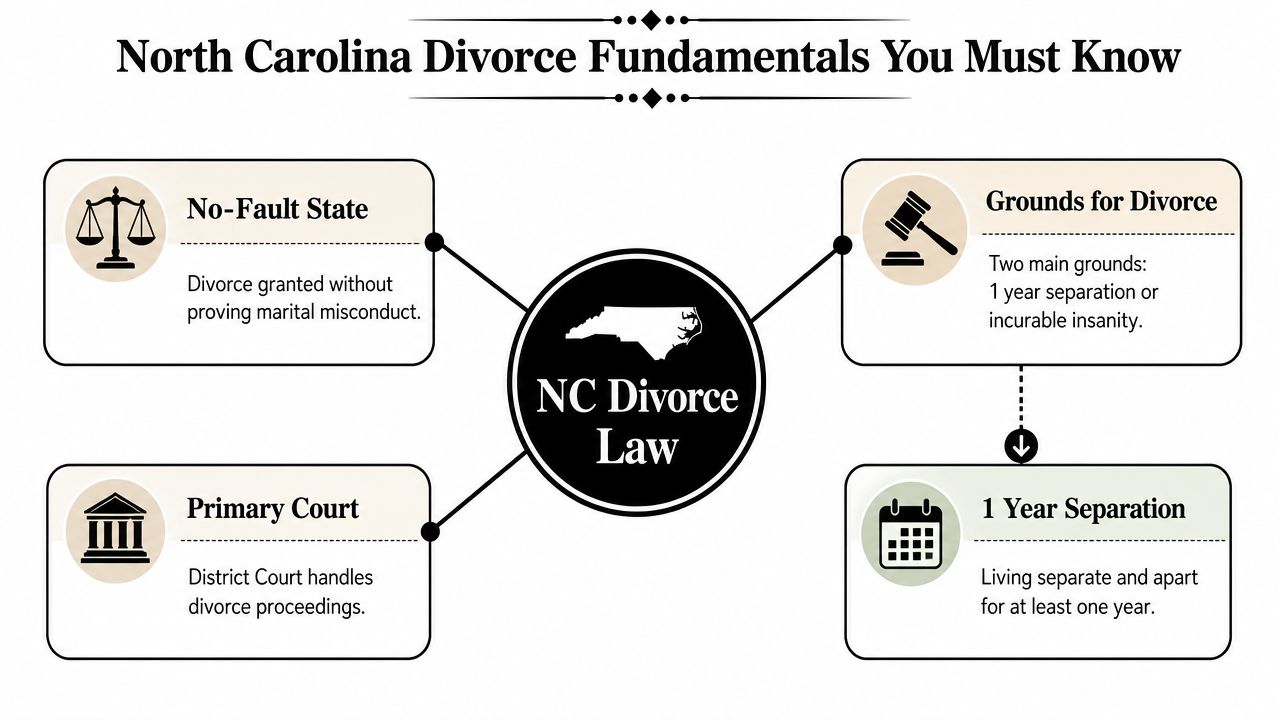
A North Carolina divorce often looks simpler on paper than it is in real life. The court can end the marriage through an absolute divorce, but that order does not automatically deal with the money, the house, retirement, support, or parenting issues that usually matter most.
North Carolina allows a no-fault absolute divorce after the spouses have lived separate and apart for one year, and one spouse must satisfy the state's residency requirement before filing. The filing fee and basic court process are summarized in this North Carolina divorce overview. If you want a broader look at the filing process in an agreed case, this guide to uncontested divorce in North Carolina is a useful starting point.
What absolute divorce does and does not do
An absolute divorce legally ends the marriage.
That is only part of the job in many cases. Unless those other issues are resolved separately, the divorce judgment does not divide marital property, assign debt, award postseparation support or alimony, set child support, or create a custody arrangement. Clients are often surprised by this because they assume the divorce itself closes out everything. It does not.
This is one of the biggest decision points in a North Carolina divorce. A case may be “uncontested” about ending the marriage and still carry real legal risk if there is no clear plan for equitable distribution or a properly drafted separation agreement. A rushed filing can leave one spouse believing everything was settled when nothing legally enforceable was finished.
The one-year separation rule is stricter than many people expect
The one-year separation period is not flexible. Spouses must live separate and apart for a full 12 months before filing for absolute divorce.
Usually, that means separate residences. Living in different bedrooms in the same home usually does not meet the requirement. Filing too early can delay the case and create avoidable expense. Counting the date wrong is one of the most common mistakes I see in self-filed divorces.
North Carolina recognizes another divorce-related claim
North Carolina also has Divorce from Bed and Board. Despite the name, it is not an absolute divorce. It is a fault-based court claim that may apply in specific circumstances, such as misconduct affecting the marital relationship.
For many people, this claim never comes into play. But its existence matters because North Carolina divorce law is not just a forms-and-filing system. Rights can turn on timing, pleading, and whether related claims are raised before the absolute divorce is entered.
That last point deserves attention. In North Carolina, some claims tied to the marriage, especially equitable distribution and alimony, can be lost if they are not properly preserved before the divorce judgment is entered. That is why the real question is rarely just, “Can I file for divorce myself?” The better question is whether anything of value could be waived, overlooked, or made harder to recover if you do.
When You Might Proceed Without a Lawyer The True Simple Divorce
A true do-it-yourself divorce in North Carolina is much narrower than commonly understood. The best candidate is not just a couple that “gets along.” It is a couple with very little to decide.
North Carolina doesn't require a lawyer for an absolute divorce, but self-representation still means meeting technical requirements for residency, separation, filing, and service of process in the correct county court, as explained in this Smithfield divorce filing guide.
What a DIY-friendly case usually looks like
In practical terms, proceeding without a lawyer may be realistic when the marriage is short, there are no minor children, no real dispute over money, no real estate, no spousal support issue, and no concern that one spouse is hiding information.
A “simple divorce” is usually simple because there is nothing meaningful left to fight over, not because the paperwork itself is easy.
| Factor | DIY Divorce Candidate | Legal Counsel Recommended |
|---|---|---|
| Marriage circumstances | Very limited shared assets and debts | Meaningful assets, debt, or financial imbalance |
| Children | No minor children | Custody, visitation, or support issues exist |
| Real estate | No jointly owned home or land | House, refinance, sale, or equity questions |
| Retirement and benefits | No account division needed | Pension, retirement, or employment benefits involved |
| Support | Neither spouse is seeking alimony | One spouse may need or owe support |
| Agreement quality | Clear, complete, and reviewed carefully | Informal promises or unclear written terms |
| Court procedure | Comfortable handling filing and service | Unsure about county procedure or deadlines |
The tradeoff most people miss
Many searchers really want to know when they can skip hiring a lawyer in an uncontested case and what the downside is. The trouble is that “uncontested” often means only that both spouses want the divorce. It doesn't always mean they understand what rights are being preserved or waived.
If you think your situation may fit a low-conflict path, this guide to uncontested divorce in North Carolina can help you compare the process against your facts.
A workable DIY case is the exception. If you have to ask whether the retirement account matters, whether the house equity counts, or whether support can be dealt with later, that usually means you are outside the simple category.
Clear Signs You Need to Hire a North Carolina Divorce Lawyer
Some cases announce themselves as complex from the start. Others look calm until one issue surfaces and changes everything. In North Carolina, the need for counsel often has less to do with the divorce filing itself and more to do with the other claims attached to the breakup.
North Carolina treats property division, alimony, child support, custody, and divorce as issues that may be handled separately. It also uses equitable distribution, which means property is divided fairly, not necessarily equally, as explained by the North Carolina Bar overview of the divorce process.
A quick visual can help you spot the warning signs.
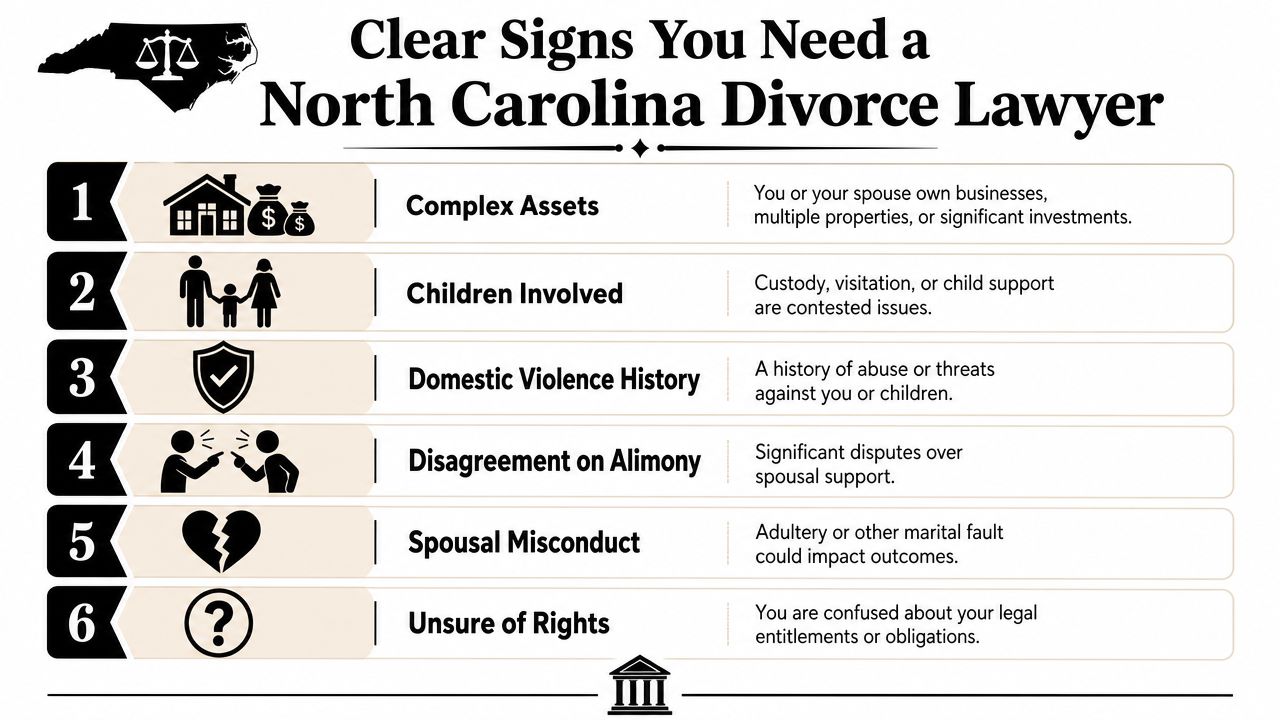
Red flags that usually mean don't go it alone
Your spouse already has a lawyer. Once one side has counsel, the information gap widens quickly. Even polite negotiations can become one-sided if only one person understands the procedural and financial consequences.
You have children and disagree on parenting. Custody and visitation problems rarely improve through vague promises. Parenting terms need to be clear enough to work in real life and strong enough to enforce if conflict returns.
There is a house, retirement account, business interest, or significant debt. These cases require classification, valuation, and careful drafting. “We'll split it later” is not a plan.
One spouse earns much more than the other. Support issues and negotiation leverage change sharply when income is uneven.
You suspect hidden assets or incomplete disclosure. A lawyer can frame requests, gather records, and push the issue in a way self-represented parties often can't.
There is a history of abuse, intimidation, or financial control. In those situations, the legal problem is not just paperwork. It is safety, leverage, and your ability to negotiate freely.
Why these issues change the case
A couple may agree they want out, yet still disagree about what is fair. North Carolina's “equitable” approach is one reason. Fair does not automatically mean half. It can require evidence about what is marital, what is separate, what something is worth, and who should be responsible for which debts.
That's where legal guidance becomes practical, not theoretical. A lawyer helps identify which claims need to be raised, how to preserve them, and how to avoid signing an agreement that sounds balanced but gives away too much.
Later in the process, many people find it helpful to hear a lawyer walk through these issues out loud:
If your case involves children, support, real property, retirement assets, or fear of being outmatched, legal representation is usually a protective measure, not a luxury.
The Hidden Risks of Representing Yourself in North Carolina
The biggest danger in self-representation is not usually a typo on a form. It is misunderstanding what the divorce does not cover.
A common North Carolina blind spot is believing that an uncontested divorce automatically settles property rights. It does not. Without a properly drafted separation agreement or a separate claim for equitable distribution, those rights can be permanently waived once the divorce is final, as discussed in this North Carolina legal Q&A on self-representation risks.
A common real-world pattern
Consider a spouse who says, “We already agreed. She keeps the car, I keep my checking account, and we'll deal with the retirement later.” The divorce gets filed. Nobody raises a separate property claim. The judgment is entered.
Later never comes.
The spouse who assumed the retirement issue could be handled afterward may learn that the legal right to pursue that share is gone. The same thing can happen with home equity, debt allocation, or alimony rights if the agreement was poorly drafted or the necessary claim was never preserved.
Separation agreements are not harmless templates
Another common problem is the do-it-yourself separation agreement downloaded from a generic website or copied from a friend's case. It may sound clear enough to a nonlawyer. It may even feel fair at the kitchen table.
But one sentence can change the outcome completely. Broad waiver language can give up future claims. Vague language can create fights about refinancing, sale deadlines, tax treatment, possession schedules, or who pays which debt if a transfer never gets completed.
A paper that “reflects what we agreed” is only useful if it also preserves the rights you intended to keep.
That's why people who are trying to save money sometimes choose a middle path. They handle what they can themselves, then pay for a lawyer to review the agreement before anything is signed. That kind of review often catches the issue the parties never knew to ask about.
Weighing the Cost of a Lawyer Against the Long-Term Risks
Cost is a real concern. For many people, that is the whole reason the question comes up. They are not trying to be reckless. They are trying to get through a difficult transition without adding another major bill.
That concern is reasonable. It's also why the better question is usually not “Can I avoid hiring a lawyer?” but “What exactly am I risking if I don't?”
North Carolina-specific public guidance often leaves middle-income people stuck between free help and full-service litigation. One useful point from the North Carolina Bar discussion on selecting a divorce attorney is that the cost of a few hours of an attorney's time to draft or review a separation agreement is often only a fraction of the value of the marital assets being protected, such as a retirement share or home equity.
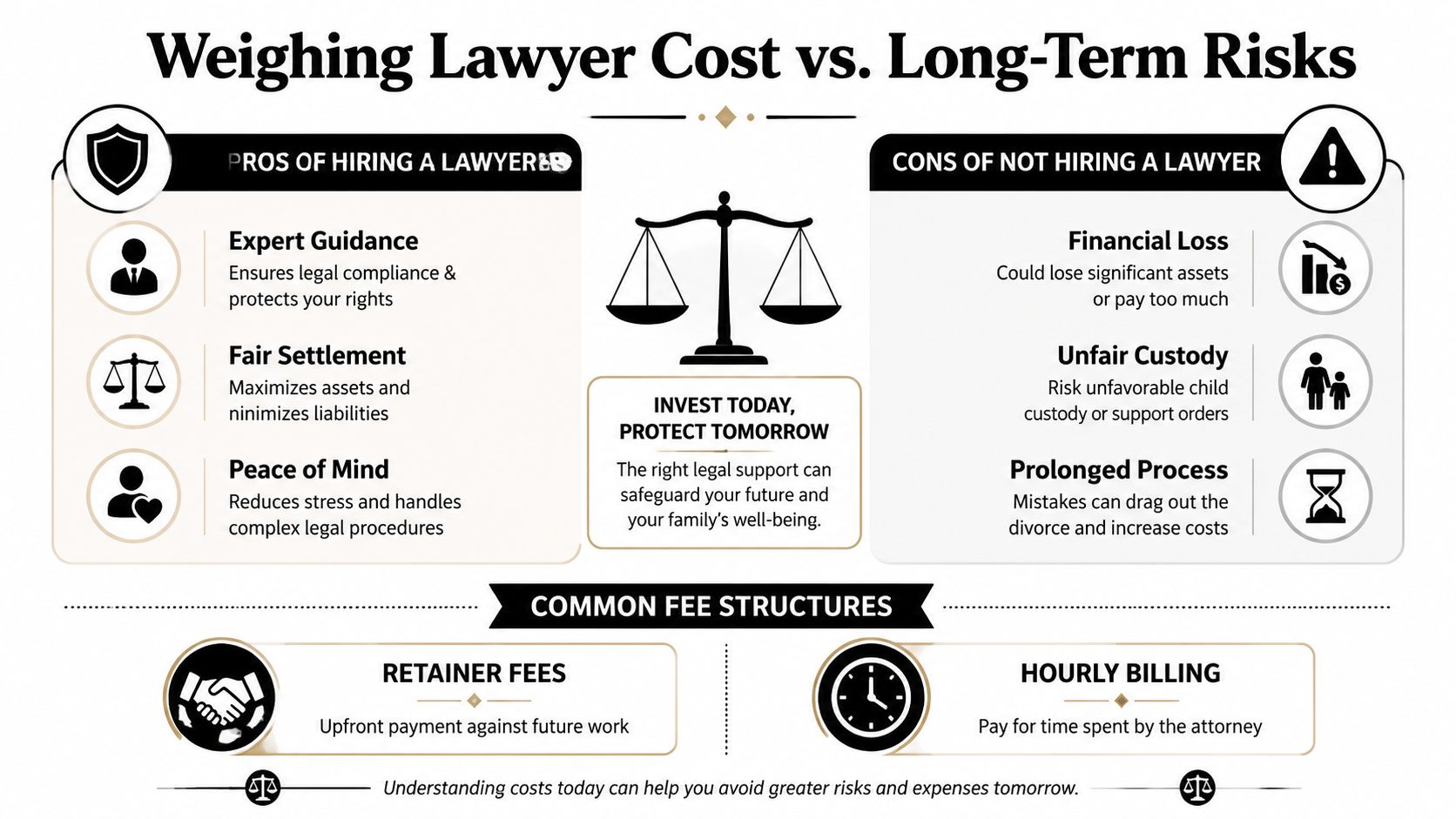
What you're usually paying for
Divorce fees vary because the service varies. A lawyer might be asked to:
- Review a separation agreement before you sign it
- Draft the full agreement from scratch
- Handle only the absolute divorce filing
- Represent you in negotiation or court for custody, support, or property division
Those are very different jobs. Some people need targeted advice. Others need full representation because the facts are contested or the power balance is uneven.
When limited help makes sense
If your case is close to simple but not simple enough to trust a generic template, limited-scope help may be a smart compromise. That can mean paying for strategy advice, agreement review, or help preserving a claim before the divorce becomes final.
For readers comparing service levels and budgeting options, this North Carolina divorce lawyer cost guide gives a practical starting point.
What usually does not work is trying to save money by skipping legal review in a case that involves assets, debt, support, or children. The short-term savings can disappear quickly if the agreement is unenforceable, key rights were waived, or the case has to be reopened through separate litigation.
How to Find and Hire the Right NC Divorce Attorney for You
Once you decide you need help, the next step is not finding a lawyer who promises the most. It is finding one who handles North Carolina family law regularly, explains things clearly, and understands the court practices where your case will be filed.

What to look for in the consultation
Bring the facts that matter most. That usually includes any existing agreement, a rough list of assets and debts, information about the date of separation, and any court papers already filed.
Ask practical questions such as:
- How would you classify my case
- What claims do I need to protect before the divorce is final
- Do I need a separation agreement, court filings, or both
- What part of this case could be handled on a limited basis if I'm cost-conscious
- How do you communicate with clients during the case
The right fit should leave you clearer than when you arrived, not more confused.
One option for North Carolina residents
If you're looking for counsel, the North Carolina divorce lawyer team at the Law Office of Bryan Fagan handles family law matters involving divorce, custody, support, and property division. Whatever firm you choose, look for direct communication, realistic advice, and a clear explanation of scope and fees.
Common Divorce Questions and Your Path Forward
Can my spouse and I use the same divorce lawyer
No single lawyer can represent both spouses in a divorce when their interests may differ. Even in an amicable case, one attorney may draft documents for one party, but the other spouse should understand that the lawyer is not representing both sides.
How long does divorce take in North Carolina
The timing depends first on whether the legal requirements have been met before filing. After that, timing can vary based on filing, service, scheduling, and whether related issues are contested.
If we agree on everything, do I still need legal advice
Sometimes only limited advice is needed. But if your agreement touches property rights, retirement accounts, support, debt, or parenting terms, legal review is often the safest use of money in the whole process.
What if I only want help with part of the case
That may be possible. Some people need full representation. Others need a lawyer only for agreement review, strategy, or protecting a claim before the divorce is finalized.
If you're still asking whether you need a divorce lawyer in North Carolina, that usually means you've already identified some uncertainty worth taking seriously. A short consultation can tell you whether your case is straightforward or whether a hidden issue needs attention before you file or sign anything.
If you're facing divorce in North Carolina and want clear guidance about your options, schedule a consultation with the Law Office of Bryan Fagan. A consultation can help you understand whether your case is suitable for a simple filing, whether you need to protect property or support claims first, and what next step makes sense for your family and finances.