
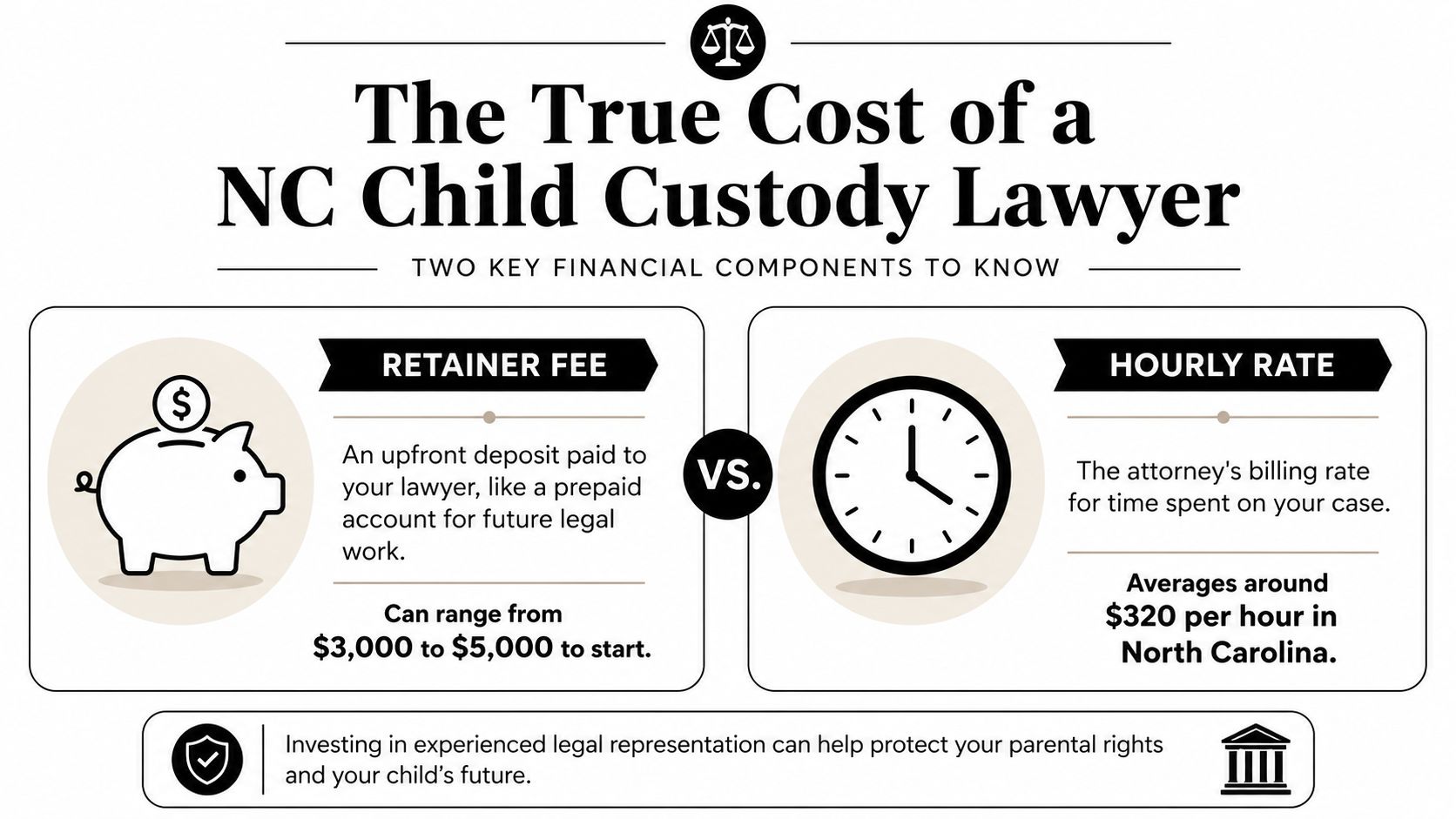
When you're facing a child custody battle in North Carolina, one of the first questions that hits you is almost always, "How much is this going to cost?" It's a stressful question, and the honest answer is there's no single price tag. The cost of a child custody lawyer in North Carolina is built around a retainer fee, which typically starts between $3,000 to $5,000, and the attorney's hourly rate for work performed on your case.
This guide breaks down the financial realities of a North Carolina custody case, helping you understand what drives costs and how you can manage them effectively.
Understanding the True Cost of a NC Child Custody Lawyer
Navigating a child custody case involves more than just emotional turmoil; it demands a clear understanding of the financial commitment ahead. The total cost isn't one set number. Instead, it’s a range that gets shaped by the unique, and often complicated, details of your family's situation. Our goal here is to cut through the confusion and give you a real-world look at the financial side of hiring a child custody lawyer in North Carolina.
By breaking down what actually drives the cost up or down, we can help you set realistic expectations from the start.
Key Financial Components to Expect
In North Carolina, the cost of a custody lawyer is mostly determined by a few key things: the lawyer's hourly rate, the initial retainer, and how contested your case becomes. While traditional family law practices in the state often report average hourly rates around $320, you'll see some firms quoting a wider range, from roughly $100 to $350 per hour.
So what does this look like in practice? Your case will typically begin with that initial retainer, and your attorney will bill against it as they work on your case. You can explore more about these family law cost structures in North Carolina to get a better sense of the market.
What is a Retainer Fee? A retainer fee works like a prepaid account for legal services. It is an upfront deposit your lawyer will draw from as they perform work on your case, such as drafting documents, making phone calls, and appearing in court. It is not the total cost of your case.
This structure means that the more complex or hostile your case gets, the more hours it will require from your attorney. Understanding these two core financial pieces—the retainer and the hourly rate—is the first step toward preparing for the road ahead. Having that clarity helps you make smart decisions for your family's future without getting blindsided by legal fees down the line.
How Conflict Shapes Your North Carolina Custody Case Costs
When clients ask what their child custody case will cost, our answer is always the same: the single biggest factor is the level of conflict between you and the other parent. Every disagreement, every argument, and every point of contention can add billable hours to your case. The difference between a smooth, amicable process and a drawn-out court battle is immense, both emotionally and financially.
Real-World Scenario: Imagine two couples. Couple A agrees on a 50/50 custody schedule and only needs their lawyer to formalize the paperwork. Their total cost might be a few thousand dollars. Couple B argues over every single day in the parenting plan, requiring multiple court hearings. Their legal fees could easily reach tens of thousands of dollars. The outcomes for their children may be similar, but the financial cost is drastically different.
Uncontested Versus Contested Custody Cases
An uncontested custody case is the most straightforward and cost-effective scenario. This happens when both parents agree on all key aspects of the custody arrangement, such as the physical custody schedule and who has legal custody (decision-making authority). Here, your lawyer’s work is streamlined, focusing on drafting a consent order and filing it with the court for a judge’s signature.
In sharp contrast, a contested custody case means you and the other parent have significant disagreements. When parents can’t find common ground, the case demands extensive legal work, including:
- Discovery: The formal process of exchanging information through written questions (interrogatories), requests for documents, and subpoenas.
- Depositions: Out-of-court testimony taken under oath from both parents and any relevant witnesses, which are then transcribed by a court reporter.
- Motions and Hearings: Filing legal arguments with the court and appearing before a judge to resolve specific disputes before a final trial.
- Trial Preparation: Organizing evidence, preparing witnesses to testify, and building a comprehensive legal strategy for the courtroom.
Each of these steps directly translates into more billable hours, dramatically increasing your total legal fees.
The Financial Impact of Litigation
The difference in cost between an amicable case and a litigated one is substantial. Based on North Carolina family law reports, a straightforward, uncontested custody matter might cost between $2,500 and $5,000.
However, heavily contested cases that go to trial can escalate quickly. It’s not uncommon for total fees to reach $20,000, $50,000, or even more in highly complex situations. This figure doesn't even include other expenses like court filing fees, which can add another $200 to $400. You can read more about how these costs break down in North Carolina custody cases for additional context.
The core takeaway is simple: the more you and the other parent can agree on outside of court, the more you will save. Cooperation is the most effective cost-control strategy in any custody case.
It’s also incredibly helpful to understand how judges decide custody in North Carolina. Knowing what factors matter most to the court can help you and your attorney focus your efforts, potentially reducing unnecessary arguments and legal fees.
Understanding Your Lawyer's Fee Structure
To manage the cost of a child custody lawyer in North Carolina, the first step is understanding exactly how attorneys bill for their work. When you hire an attorney, you will review and sign a fee agreement that clearly outlines the entire billing structure. This document is designed to provide financial clarity and prevent any surprises down the road.
Most North Carolina custody cases operate on an hourly billing model with two key parts: the retainer fee and the hourly rate. Think of the retainer as a down payment for legal services—it’s not the total cost of your case, but an initial deposit held in a special trust account just for you.
The Retainer and Hourly Rate Explained
The retainer fee is an upfront payment you make to secure your attorney's services. This amount often ranges from $3,000 to $5,000 or more, depending on the anticipated complexity of your case. As your legal team works, they draw from this fund to cover the time spent.

Every task is tracked in small time increments (usually six-minute blocks) and billed at the agreed-upon hourly rates. You’ll receive a detailed monthly invoice that shows exactly what work was performed and how much of your retainer was used, so you always know where you stand.
Common activities billed against your retainer include:
- Phone calls and video conferences with you, the other parent’s lawyer, or the court.
- Drafting, reviewing, and responding to emails.
- Preparing legal documents like motions, complaints, and discovery requests.
- Court appearances for hearings or trial.
- Legal research specific to the unique issues in your case.
Client Tip: Be mindful that every communication is a billable event. To manage costs, try consolidating non-urgent questions into a single email instead of sending multiple messages throughout the day.
Replenishing Your Retainer
Your fee agreement will also describe what happens when your initial retainer is used. This is known as a replenishment policy. If your retainer balance falls below a certain amount, you will need to deposit more funds to bring it back up to the agreed-upon level. This process ensures your legal team has the resources to continue fighting for you without interruption.
Factors That Drive Legal Fees Up or Down
While parental conflict is the biggest driver of legal fees, several other factors can dramatically impact your total bill. The final cost of a child custody lawyer in North Carolina is rarely a fixed number; it rises and falls based on the actions taken by both parents and the unique details of your family’s situation.
What Tends to Increase Custody Costs
- High-Conflict Co-Parenting: Constant disagreements, poor communication, and fighting over every minor issue force your lawyer to step in far more often. Each email, phone call, and negotiation adds to your billable hours.
- Serious Allegations: If your case involves claims of substance abuse, domestic violence, or child neglect, your attorney must spend significant time gathering evidence, interviewing witnesses, and building a strong argument. These cases frequently require expert witnesses, like psychologists or substance abuse evaluators, which adds another layer of expense. You can learn more by reading about the custody evaluation process in North Carolina.
- Complex Financials: When one parent is self-employed, owns a business, or is suspected of hiding assets, the discovery process gets complicated. Your lawyer may need to hire a forensic accountant to get a true financial picture, which is both time-consuming and expensive.
- Parental Relocation Disputes: When one parent wants to move a significant distance with the child (a "relocation" case), it often leads to a fiercely contested legal battle. These cases can easily end up in a full trial to decide if the move is in the child's best interest, adding thousands of dollars in legal work.
How You Can Help Lower Your Legal Fees
On the flip side, you have more power than you might think to keep your legal costs manageable. Your mindset and organizational skills can make a huge difference in how many hours your attorney needs to work on your case.
Your approach is your best cost-saving tool. A willingness to be efficient, organized, and focused on resolution can dramatically reduce the final cost of your child custody case.
Think about putting these cost-saving strategies to work:
- Be Organized: Before you hand anything over to your attorney, gather and organize all of your relevant documents. This includes financial records, text messages, emails, and anything else that might be important. This simple step saves your legal team from spending billable hours sorting through a messy pile of papers.
- Communicate Efficiently: Instead of making multiple short phone calls or sending a dozen separate emails throughout the day, try to consolidate your non-urgent questions into a single, well-organized email. This respects your attorney's time and, in turn, saves you money.
- Focus on Compromise: You absolutely must stand firm on what is best for your child. However, try to be open to compromising on the smaller issues. Every agreement you reach with the other parent outside of court is a victory for both your child and your budget.
Can a Judge Order the Other Parent to Pay Your Attorney Fees in North Carolina?
The financial strain of a custody case brings up a critical question for many parents: can the other parent be forced to cover my legal costs? The short answer is yes, it's possible under North Carolina law. Judges have the authority to order one party to pay the other’s attorney fees, but this is far from automatic and requires meeting a specific legal standard.
This power is granted by North Carolina General Statute § 50-13.6. The law was designed to level the playing field, ensuring a parent with fewer financial resources isn't at an unfair disadvantage when fighting for their child's best interests.
Meeting the Legal Standard for Attorney Fees
To be awarded attorney's fees, you must prove two things to the court:
- You are acting in "good faith." This means you are pursuing the case for legitimate reasons—like establishing a stable custody schedule for your child—not simply to harass the other parent or drag out the conflict.
- You have "insufficient means" to pay for the lawsuit yourself. The court will compare your income, assets, and debts against the other parent’s to see if there's a significant financial imbalance.
Real-World Scenario: A stay-at-home parent with no independent income is in a custody dispute with a spouse who is a high-earning surgeon. The stay-at-home parent has a strong argument for "insufficient means," and a judge may order the surgeon to pay for their attorney fees to ensure a fair legal process.
The court's decision is highly fact-specific. It hinges on the detailed financial evidence presented by both parties. A request for attorney fees is a powerful tool, but it is never a guarantee.
North Carolina courts interpret "insufficient means" strictly. It is not enough to simply have less money than the other parent; you must demonstrate a genuine inability to afford the litigation. You can learn more about how North Carolina courts handle attorney fee awards in custody cases to better understand these important details.
Actionable Strategies to Manage Your Custody Costs
While your attorney is your guide through the legal system, the actions you take can have a real impact on the final cost of your child custody case in North Carolina. Being strategic can save you a significant amount in billable hours.
One of the most powerful things you can do is get organized. Before your first meeting, gather every relevant document: financial records, text messages or emails with the other parent, and a clear timeline of important events. When you hand this over in a neat, orderly fashion, you prevent your legal team from having to bill you for sorting through a messy pile of papers.
Efficient Communication and Smart Choices
The way you communicate with your lawyer’s office also directly affects your bill. It’s tempting to fire off an email or make a call every time a question pops into your head, but this creates multiple small billing entries that add up fast. A better approach is to keep a running list of your non-urgent questions and send them in a single, organized email.

Beyond good habits, exploring alternatives to litigation is one of the most effective ways to control legal spending. These processes give you more control over the outcome and are often more efficient and less expensive than a courtroom battle.
Consider these cost-effective options for your North Carolina case:
- Mediation: A neutral, third-party mediator helps both parents negotiate a custody agreement. Since mediation is mandatory in most North Carolina custody cases before a trial can occur, entering the process with a genuine desire to find a solution can resolve your case much faster and cheaper.
- Collaborative Law: In this structured process, you, the other parent, and your respective attorneys all sign an agreement to reach a settlement without going to court. The entire focus is on cooperative, out-of-court problem-solving.
By taking these steps, you can play a proactive role in guiding your case toward a more efficient and affordable resolution. Our guide to hiring a child custody lawyer in North Carolina offers even more detail on how to prepare for this journey.
Frequently Asked Questions About NC Custody Lawyer Costs
What is the average retainer for a child custody lawyer in North Carolina?
While there's no official "average," most child custody lawyers in North Carolina require an initial retainer between $3,000 and $5,000. This amount can be higher for cases that are expected to be highly complex or contentious from the start. Remember, this is not the total cost, but a down payment against which your attorney's hourly fees are billed.
Can I get a free consultation with a child custody lawyer in NC?
Many family law firms in North Carolina, including ours, offer a free or low-cost initial consultation to discuss your case. However, this varies by firm. It is always a good idea to ask about any consultation fees when you schedule your appointment to avoid surprises. A consultation is an excellent opportunity to understand your rights and get a feel for the attorney's approach.
Are there other costs besides attorney fees in a custody case?
Yes. In addition to your lawyer's hourly rate, you should budget for other litigation expenses. These "ancillary costs" can include court filing fees (around $150 to start a case), fees to have the other party served with documents, costs for mediation (which are typically split between parents), and potentially significant fees for expert witnesses like child psychologists or custody evaluators if they are needed in your case.
Does the losing parent have to pay attorney fees in NC?
Not automatically. North Carolina is not a "loser pays" state for family law. A judge can order one parent to pay the other's attorney fees, but only if the requesting parent proves they are acting in good faith and have "insufficient means" to afford the litigation, as outlined in N.C.G.S. § 50-13.6. It is a tool for fairness, not a penalty for "losing."
Take Control of Your North Carolina Custody Case
Navigating the costs of a child custody case can feel overwhelming, but you do not have to do it alone. The legal team at the Law Office of Bryan Fagan is committed to providing North Carolina residents with clear guidance, transparent billing, and strategic representation to protect your family and your future. We understand the stress you're under and will work with you to develop a legal strategy that is both effective and mindful of your financial reality.
To discuss the specifics of your case and learn how we can help, schedule a consultation with us today.