Being arrested for Driving While Impaired (DWI) in North Carolina can be a shocking and disorienting experience. Many people mistakenly think it's just a serious traffic ticket, but the reality is much harsher. A first-offense DWI is a criminal charge that triggers immediate consequences for your license and launches a legal battle that can impact your life for years.
The most important thing to understand is that you are now fighting a two-front battle: one in criminal court and a separate, immediate action against your driver's license with the North Carolina DMV. Understanding what lies ahead is the first step in protecting yourself.
What Happens After a First DWI Arrest in NC?
Facing a first-time DWI charge is overwhelming. From the moment of arrest, the clock starts ticking on several legal deadlines. You are not just dealing with a simple violation; you are facing a criminal charge that requires a strategic defense from day one.
It’s critical to grasp that a DWI triggers two parallel processes. Your criminal court case will determine your guilt or innocence and potential penalties like fines, probation, or community service. Simultaneously, the DMV will take administrative action against your driving privileges, completely independent of what happens in court.
The Criminal Court Process
On paper, the penalties for a typical first-offense DWI might not seem that severe, but the true impact goes far beyond the initial fines and court costs. North Carolina uses a unique five-level sentencing system for DWIs, which is outlined in North Carolina General Statute G.S. 20-179.
Most first-time offenders with no "grossly aggravating factors" (which we'll explain later) land in Level 5, the least punitive category. While a Level 5 conviction carries a maximum penalty of 60 days in jail and a $200 fine, judges often suspend the jail sentence in favor of other punishments.
To give you a clearer picture, here is a breakdown of the typical penalties for a standard first-offense DWI conviction.
Initial Penalties for a Typical First DWI Offense (Level 5)
This table summarizes the standard court-ordered penalties for a Level 5 DWI, the most common sentencing level for a first offense without aggravating factors.
| Penalty Category | Potential Consequence |
|---|---|
| Jail Time | Up to 60 days (often suspended in favor of community service) |
| Probation | 12 months of unsupervised or supervised probation |
| Community Service | 24 hours required |
| Fines & Costs | Up to $200 fine, plus significant court costs (often several hundred dollars) |
| Substance Abuse Assessment | Mandatory assessment and any recommended treatment at your own expense |
| License Revocation | One-year revocation upon conviction |
These penalties represent the baseline. The presence of aggravating factors can quickly escalate the sentencing level and lead to harsher outcomes, which is why a strong defense is crucial from the start.
Immediate DMV Consequences
Long before your court date, the DMV takes swift action against your driver's license. Under North Carolina's "implied consent" law, if you were arrested and a chemical test showed a Blood Alcohol Concentration (BAC) of 0.08% or higher, the officer will enact an immediate 30-day civil license revocation.
This is not a criminal penalty—it is an administrative one that happens automatically based on the arrest itself.
Key Takeaway: Your license is revoked for 30 days immediately after your arrest, before you are ever convicted of a DWI. This is a direct consequence handled by the DMV, separate from the criminal charge.
Successfully navigating this initial 30-day period is your first challenge. It’s a preview of the broader fight ahead and highlights why you need to address both the criminal charges and the DMV action simultaneously to protect your rights and your ability to drive.
Understanding North Carolina’s DWI Sentencing Levels
If you're facing a DWI in NC for the first time, you need to understand the state's unique sentencing system. It’s not as simple as a judge picking a penalty from a list. Instead, North Carolina uses five distinct sentencing levels, from the least severe (Level 5) to the most serious (Aggravated Level 1).
A judge is required by law, under G.S. 20-179, to conduct a formal balancing test. They must weigh the facts that hurt your case (aggravating factors) against the facts that help it (mitigating factors). For most first-time DWI charges, this balancing act is the single most important moment in your case.
The Balancing Act of DWI Sentencing
Think of it like a set of scales in the courtroom. On one side, the judge places “mitigating factors”—things like having a clean driving record or proactively getting a substance abuse assessment. On the other side go the “aggravating factors,” such as driving recklessly or having a particularly high BAC.
The final balance determines your sentencing level and the penalties that follow. However, some factors are so significant they tip the scales all by themselves. These are known as "Grossly Aggravating Factors," and just one of them can escalate a standard first offense into something far more severe.
- Grossly Aggravating Factors: These are the game-changers. Examples include a prior DWI within seven years, causing a serious injury, or having a child under 18 in the car during the offense.
- Aggravating Factors: While serious, these aren’t as severe as the ones above. Common examples are a BAC of 0.15% or higher, reckless driving, or driving while your license is already revoked.
- Mitigating Factors: These are the positive elements that can help your case. They include things like having a low BAC (0.09% or less), a safe driving history, or completing a substance abuse assessment before your court date.
This flowchart shows the typical path a DWI case takes, but the outcome is never guaranteed.
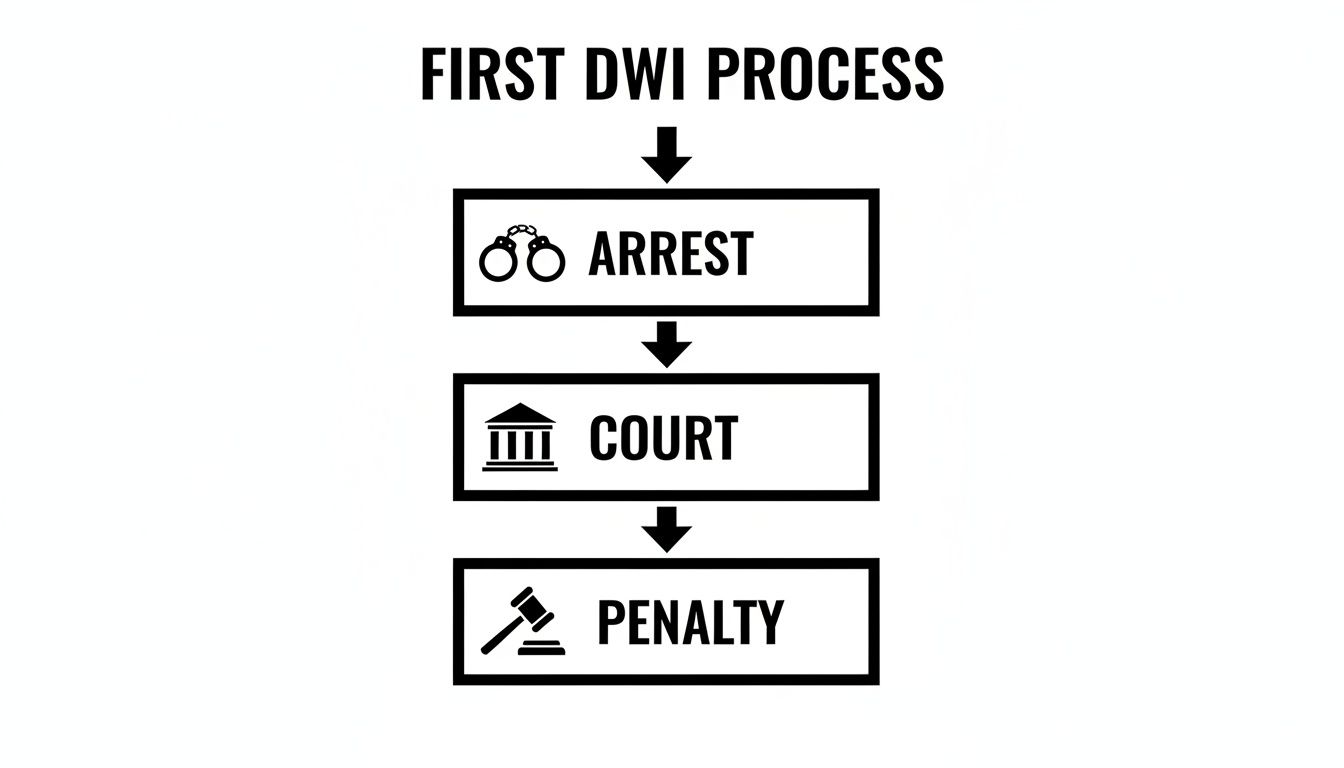
While the process looks straightforward, the specific facts of your case will dramatically influence the final result.
How a High BAC Changes Everything: A Real-World Example
Let's walk through a real-world scenario. Imagine someone is arrested for a first-offense DWI. They have a spotless record and were cooperative with the officer—both potential mitigating factors. If their BAC was 0.10, they would likely be facing a Level 5 sentence.
But what if their BAC was 0.16%? That one number changes everything.
Because a BAC of 0.15% or higher is a significant aggravating factor under North Carolina law, a judge will almost certainly find that it outweighs any positive facts. The sentence is then elevated to a Level 2 DWI, a much harsher outcome.
A Level 2 DWI brings a minimum of seven days in jail (up to one year), fines as high as $2,000, and a mandatory Ignition Interlock Device on your vehicle after your license is restored. That single detail—a high BAC reading—turns what might have been a standard first offense into a serious legal battle with guaranteed jail time and long-term restrictions.
You can learn more about what a conviction means in our guide to drunk driving in North Carolina. Having an attorney who understands how these factors are weighed is crucial for building a defense to protect your future.
The Immediate Impact on Your Driver's License
Long before you ever step into a courtroom, a separate and immediate battle begins for your driver's license. What most people don't realize is that the moment you're charged with a DWI in North Carolina, your ability to drive is already on the line.
This isn't a criminal penalty handed down by a judge later on. It's an automatic administrative action taken right away by the North Carolina DMV.
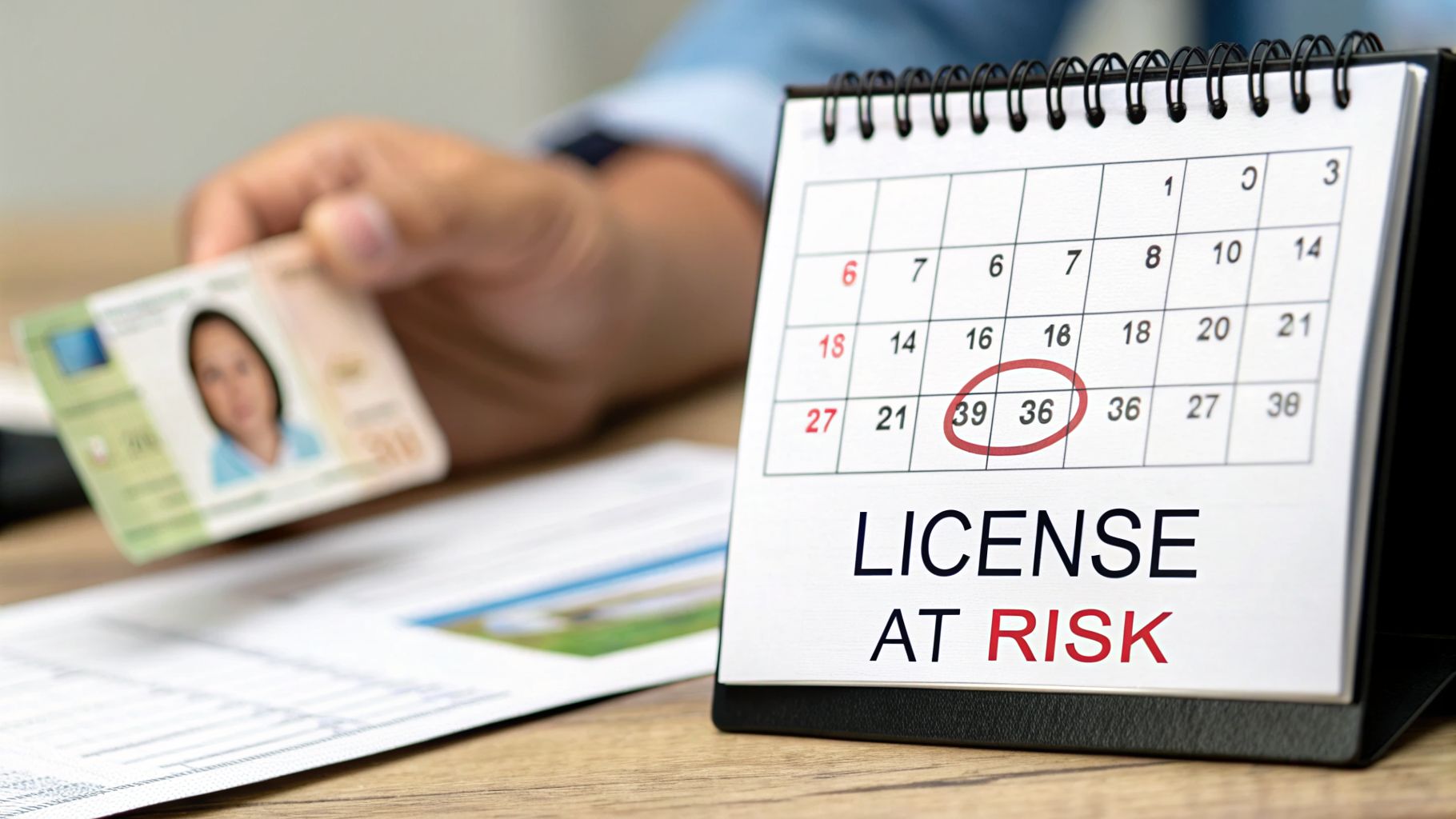
This entire process kicks off because of a legal doctrine known as “Implied Consent.” Understanding this concept is absolutely critical, as it forms the basis for the swift action taken against your license.
Understanding Implied Consent in North Carolina
Under North Carolina General Statute G.S. 20-16.2, the simple act of driving on a public road in this state means you have automatically agreed to submit to a chemical test—like a breath or blood test—if an officer lawfully arrests you with probable cause to believe you were driving while impaired.
You still have the right to refuse a test. But that refusal comes with its own set of severe and immediate consequences.
What This Means for You: By getting behind the wheel in North Carolina, you have already given your consent to a BAC test upon a lawful DWI arrest. Refusing to take it is not a "get out of jail free" card; instead, it triggers a separate and harsh penalty against your driving privileges.
Whether you agree to the test or refuse, the DMV is going to take action. The specific path forward depends entirely on the choice you make in that high-pressure moment.
The Two Paths of Immediate Revocation
After a DWI arrest, your license faces one of two immediate fates. Both of these happen long before your criminal case is ever resolved in court.
- Failing the Test: If you take a chemical test and the result is a Blood Alcohol Concentration (BAC) of 0.08% or higher (or any amount of alcohol for drivers under 21), you will be subject to an immediate 30-day civil license revocation. The arresting officer will usually take your physical license on the spot.
- Refusing the Test: If you willfully refuse to take a chemical test after being informed of your rights, the DMV imposes a much tougher penalty: an automatic one-year license revocation.
This one-year revocation for refusing is completely separate from any suspension you might get later if you are convicted of the DWI. It is a direct and immediate consequence of not upholding your end of the implied consent bargain.
The Critical 10-Day Window for a Limited Driving Privilege
After your arrest and the start of the initial 30-day revocation for a failed test, you have a very small window of opportunity to act. You can petition the court for a Limited Driving Privilege (LDP) after just 10 days of that 30-day period have passed.
To be eligible for this pretrial LDP, however, you must meet several strict requirements:
- Your license must have been valid when the offense occurred.
- You cannot have any other pending DWI charges.
- You must obtain a substance abuse assessment.
- You must provide a DL-123 form from your insurance company, proving you have liability coverage.
Keep in mind, this privilege is not a full restoration of your driving freedom. It only allows you to drive for essential purposes like work, school, or household maintenance, and usually only during standard hours (typically 6 AM to 8 PM, Monday through Friday).
Successfully navigating this process is complex and incredibly time-sensitive. The paperwork must be flawless, and the deadlines are absolute. Missing your chance to secure an LDP could leave you unable to drive for the full 30 days, creating serious problems with your job and family life. An experienced attorney can ensure all requirements are met correctly and on time, giving you the best shot at staying on the road while your main DWI case moves forward.
The Hidden Costs of a DWI Conviction
A DWI conviction in North Carolina does more than just create a criminal record—it casts a long and expensive shadow that can follow you for years. While the court-ordered fines might seem manageable, they are only the tip of the iceberg. The true cost of a dwi in nc first offense is a series of financial and professional consequences that ripple through every part of your life.
Think of it as a "financial echo" that continues long after your case is closed. A judge might only order a $200 fine, but the total out-of-pocket expenses can quickly climb into the thousands.

The Financial Drain Beyond Court Fines
The aftermath of a first-offense DWI in North Carolina isn’t just about the initial penalties. It’s a cascade of mandatory fees and ongoing expenses. A conviction will trigger a license suspension, a required substance abuse assessment and treatment, and possibly random testing during probation.
While a Level 5 DWI fine may be capped at $200, the other costs add up fast. Installing an ignition interlock device (IID) alone can set you back $100-200 upfront, plus $70-150 every month you’re required to have it. Here's a breakdown of common expenses you can expect:
- Court Costs: These are administrative fees separate from your fine and often add hundreds of dollars to your bill.
- Substance Abuse Assessment & Treatment: North Carolina law mandates that anyone convicted of a DWI must complete an assessment and any recommended treatment—all at their own expense. This can range from a few hundred to over a thousand dollars.
- Probation Fees: If you’re placed on supervised probation, you will likely have to pay monthly supervision fees for the entire term.
These costs are not optional. They are the immediate financial price of a conviction, but the biggest and most persistent hit often comes from your car insurance provider.
The Soaring Cost of Car Insurance
For an insurance company, a DWI conviction is a major red flag. Once convicted, you’re reclassified as a high-risk driver, and your premiums will skyrocket. It’s not unusual to see insurance rates increase by 300% or more following a DWI in North Carolina.
This increase isn’t a short-term penalty; it typically lasts for three years. Over that time, you could pay thousands of extra dollars just to stay legally insured on the road. This “DWI tax” on your insurance is often the single most expensive consequence of a conviction.
Professional and Career Consequences
The financial shadow of a DWI extends directly into your professional life. In North Carolina, a DWI conviction creates a permanent criminal record that, for most people, is not eligible for expungement. This record is visible to anyone who runs a background check, including current and future employers.
Key Insight: A DWI conviction is a permanent mark on your public record. It can close doors to job opportunities, prevent you from obtaining professional licenses, and even jeopardize your current employment—especially if driving is part of your job.
For professionals like nurses, pilots, real estate agents, or commercial truck drivers, a DWI can trigger an immediate review by their licensing board. This can lead to the suspension or revocation of the very license you need to earn a living.
Fighting a dwi in nc first offense is about more than avoiding fines and jail. It’s an investment in protecting your career, your financial stability, and your future from these long-lasting consequences.
How a Skilled DWI Attorney Can Protect Your Rights
Many people assume a DWI arrest automatically ends in a conviction. That’s a common, but dangerous, misconception. While facing a dwi in nc first offense charge is certainly serious, it is far from a hopeless situation. A proactive legal defense can completely change the direction of your case.
An experienced DWI attorney doesn't just accept the prosecutor’s version of events. Instead, they start by methodically reviewing every report, document, and video recording tied to your arrest. This deep dive into the details is where the foundation of a strong defense is built.

Scrutinizing Every Piece of Evidence
The first thing a skilled attorney does is challenge the state's case right from the start. This means asking tough questions about the legality of the entire encounter, beginning with the traffic stop itself.
Was the initial reason for pulling you over even valid? An officer can't act on a hunch; they must have a "reasonable, articulable suspicion" that you violated a law. If the stop was improper, any evidence they gathered afterward could be thrown out.
From there, the focus shifts to the evidence of impairment itself. This includes:
- Field Sobriety Tests: Were these tests administered correctly according to the strict standards set by the National Highway Traffic Safety Administration (NHTSA)? Simple mistakes by the officer or improper instructions can make these tests unreliable.
- Breathalyzer (Intoxilyzer) Results: These machines are not infallible. A thorough attorney will investigate the device’s maintenance logs, calibration records, and whether the officer was certified to operate it. Any break in protocol can bring the BAC reading into question.
Using Legal Motions to Weaken the Prosecution's Case
One of the most powerful tools in a defense attorney’s arsenal is the Motion to Suppress. This is a formal request asking the judge to exclude certain evidence from being used against you in court.
For example, if your lawyer can prove the traffic stop violated your Fourth Amendment rights against unreasonable searches and seizures, a judge may agree to suppress all evidence that came from that illegal stop. This could mean the officer’s observations, your statements, and even the chemical test results are excluded from the case.
Why This Matters: A successful Motion to Suppress can gut the prosecutor's case. Without key evidence like a BAC reading, the state may have no choice but to dismiss the charge or offer a significantly reduced plea to a non-alcohol-related offense, like reckless driving.
Negotiating for a Better Outcome
Beyond challenging evidence, a DWI attorney acts as your advocate and negotiator. They know the local court system, the prosecutors, and the judges. This insider knowledge is invaluable when it's time to negotiate a more favorable result.
Even if the evidence seems strong, an attorney can present mitigating factors and argue for a lower sentencing level. This could help you avoid the harshest penalties, like mandatory jail time or an Ignition Interlock Device. For anyone facing criminal charges, having an experienced legal advocate is critical. You can learn more about our approach by exploring our criminal defense practice areas.
Ultimately, hiring a skilled attorney isn't about "getting away with something." It’s about ensuring your constitutional rights are protected and you receive a fair process under the law. It’s about fighting for your future.
Frequently Asked Questions About a First DWI in NC
If you’re facing a charge for a DWI in NC first offense, you’re probably filled with urgent questions. We've put together straightforward answers to some of the most common concerns people have in your situation.
Will I definitely go to jail for my first DWI?
For a standard Level 5 first offense—the most common for first-timers with no aggravating factors—active jail time is not the typical outcome. A judge will often suspend a formal jail sentence in favor of probation and 24 hours of community service. However, this is not a guarantee. If aggravating factors like a very high BAC or reckless driving are present, your sentencing level can increase, making active jail time mandatory.
Is it possible to get my first DWI charge dismissed?
Yes, a dismissal is possible, but it is never automatic. A dismissal is almost always the result of a strong legal defense that exposes a critical flaw in the prosecution's case. For example, your lawyer might prove the officer had no legal reason to stop you, or that the breathalyzer test was administered incorrectly. Whether a dismissal is a realistic goal depends entirely on the specific facts of your case.
How long will my license be suspended for a first DWI in North Carolina?
You face two separate license revocations. First is an immediate 30-day civil revocation if you had a BAC of 0.08% or higher. If you are later convicted of the DWI in court, a separate, one-year revocation will be ordered. For most first-offense cases, you can apply for a Limited Driving Privilege (LDP) that allows you to drive for essential purposes like work and school during your suspension.
Is an Ignition Interlock Device required for a first offense?
An Ignition Interlock Device (IID) becomes mandatory for a first-offense conviction only if your BAC was 0.15% or higher. If so, the judge must order you to install an IID for at least one year after your license is restored. This device, which requires you to provide a breath sample to start your car, comes with significant installation and monthly monitoring costs.
A DWI charge is a serious matter, especially in metro areas with heavy enforcement. With 211,218 total DWI arrests in North Carolina in a recent year, and counties like Wake (949 crashes) and Mecklenburg (901 crashes) leading the statistics, first-time offenders make up a large portion of those charged. You can read more about these trends and drunk driving stats in NC to understand the enforcement climate.
Take Control of Your Case: Schedule a Consultation Today
Being charged with a DWI in NC first offense is a serious legal challenge that can leave you feeling lost and overwhelmed. The North Carolina justice system is complex, and the stakes—your freedom, finances, and future—are incredibly high. Trying to navigate this process alone is a risk you cannot afford to take.
Our firm is dedicated to defending North Carolinians facing serious charges like a first-offense DWI. We understand the law, we know the local courts, and we are committed to building a strong, strategic defense tailored to your specific situation. Every case is unique, and a thorough review of the evidence is the first step toward a better outcome.
Don't let one mistake define your future. Take the most important step you can right now: schedule a confidential consultation to understand your rights and options. Contact us today to discuss your case and let us help you navigate this difficult time with confidence and experience on your side. Visit us online at bryanfaganlaw-nc.com to learn more.