Your finances can change fast after separation or divorce. One month, the support order feels manageable. The next, you've lost a job, your health has changed, or you've learned your former spouse is now living with someone else. In that moment, the natural question to ask is: can spousal support be changed, or am I stuck with the original order?
In North Carolina, the answer depends on more than hardship alone. The court looks at what changed, when it changed, whether the change is serious enough, and, in many cases, whether the support obligation came from a court order or a private agreement. That last point causes a lot of confusion. It also determines whether pursuing a modification of spousal support makes legal sense at all.
Understanding When You Can Change Spousal Support in NC
A common situation looks like this. A paying spouse is laid off and starts burning through savings to keep up with monthly alimony. Or a receiving spouse develops a serious medical condition and can no longer work at the same level as before. In both situations, people often assume the court will automatically adjust support. It won't.
North Carolina courts require proof of a substantial change in circumstances before modifying alimony. That change must be significant, continuous, and must have happened after the original order was entered. Examples can include involuntary job loss, serious illness, disability, retirement, or the dependent spouse's remarriage or cohabitation in a romantic relationship, and the change must have been unforeseen at the time of the original order, as discussed in this North Carolina alimony modification overview.
What substantial change in circumstances means
In plain English, substantial means the change isn't minor or temporary. A brief drop in overtime pay usually won't carry the day. A long-term medical restriction that limits your ability to earn may.
Continuous means the problem isn't already resolving itself. Courts want to see a real shift in financial reality, not a short rough patch.
What usually does not work
Many people make the mistake of filing because life feels tighter than it used to. That isn't enough by itself. Judges expect a clear connection between the new circumstance and the current support terms.
Practical rule: If you can't document how the change affected income, expenses, or need, the court is unlikely to modify support.
Examples that often raise problems include:
- Temporary setbacks: A short gap between jobs may not justify relief.
- Expected life events: If the issue was known and anticipated when the order was entered, the court may decide nothing legally new has happened.
- General frustration: Feeling that the original order was unfair isn't the same as showing a legally relevant change.
A modification case starts with the right question. Not "Is this difficult?" but "Has something substantial and ongoing changed since the order was entered?"
Is Your Alimony Agreement Even Modifiable
Before anyone prepares a motion, the first document to review is the one that created the support obligation. In North Carolina, that distinction matters. A lot.
Some support obligations come from a judge's order. Others come from a negotiated separation agreement signed by both spouses. Those are not treated the same way when someone later wants to change support.
Court order versus separation agreement
If alimony was ordered by the court, it can generally be modified when a party proves a substantial change in circumstances. If alimony was created in a negotiated separation agreement, it generally can't be modified unless the contract itself says modification is allowed. That same rule is addressed in this discussion of termination and modification of alimony in North Carolina.
That difference stops many cases before they start. I've seen people spend weeks gathering pay records only to discover the controlling agreement waived modification.
A related source of confusion is the difference between alimony law and private contracting. General information about North Carolina alimony law can help you understand the framework, but the specific language in your order or agreement usually controls the next step.
Can Your NC Spousal Support Be Modified
| Type of Support Order | Is It Modifiable? | Key Condition |
|---|---|---|
| Court-ordered alimony | Usually yes | Must prove a substantial change in circumstances |
| Alimony in a negotiated separation agreement | Usually no | The agreement must explicitly allow modification |
| Court-ordered alimony with termination issue | Possibly terminable | Remarriage, cohabitation, or death may support early termination |
Why the paperwork matters so much
This isn't just a technicality. It affects strategy, cost, and whether filing is worthwhile.
For example, Separation Agreements in North Carolina can resolve property, support, and custody. That can be useful during separation. But if support terms are written as fixed contractual obligations without a modification clause, changing them later may be far harder than many people expect.
The first legal question usually isn't whether your circumstances changed. It's whether the support arrangement is one the court can change at all.
If you're unsure what you signed, don't guess. Bring the order or agreement to a lawyer and have the language reviewed before you act.
The Official Process for Filing a Motion to Modify
Once it's clear that support is legally modifiable, the process becomes procedural and document-heavy. North Carolina courts expect careful compliance. A strong case can still get delayed if filing or service is done incorrectly.
What filing actually means
A Motion to Modify is the formal request asking the court to change an existing alimony order. Filing means submitting that request in the proper North Carolina court, usually the same court that entered the existing order.
Service matters just as much as filing. You must formally deliver the motion to the other party under the rules. It isn't enough to send a text or mention it in an email.
North Carolina procedure requires the moving party to serve a formal motion on the other spouse, who then has 30 days to respond with evidence. At the hearing, both parties may present testimony, financial affidavits, and documents like pay stubs, tax returns, or medical records, as summarized in the verified North Carolina procedural guidance provided above.
How the case usually moves forward
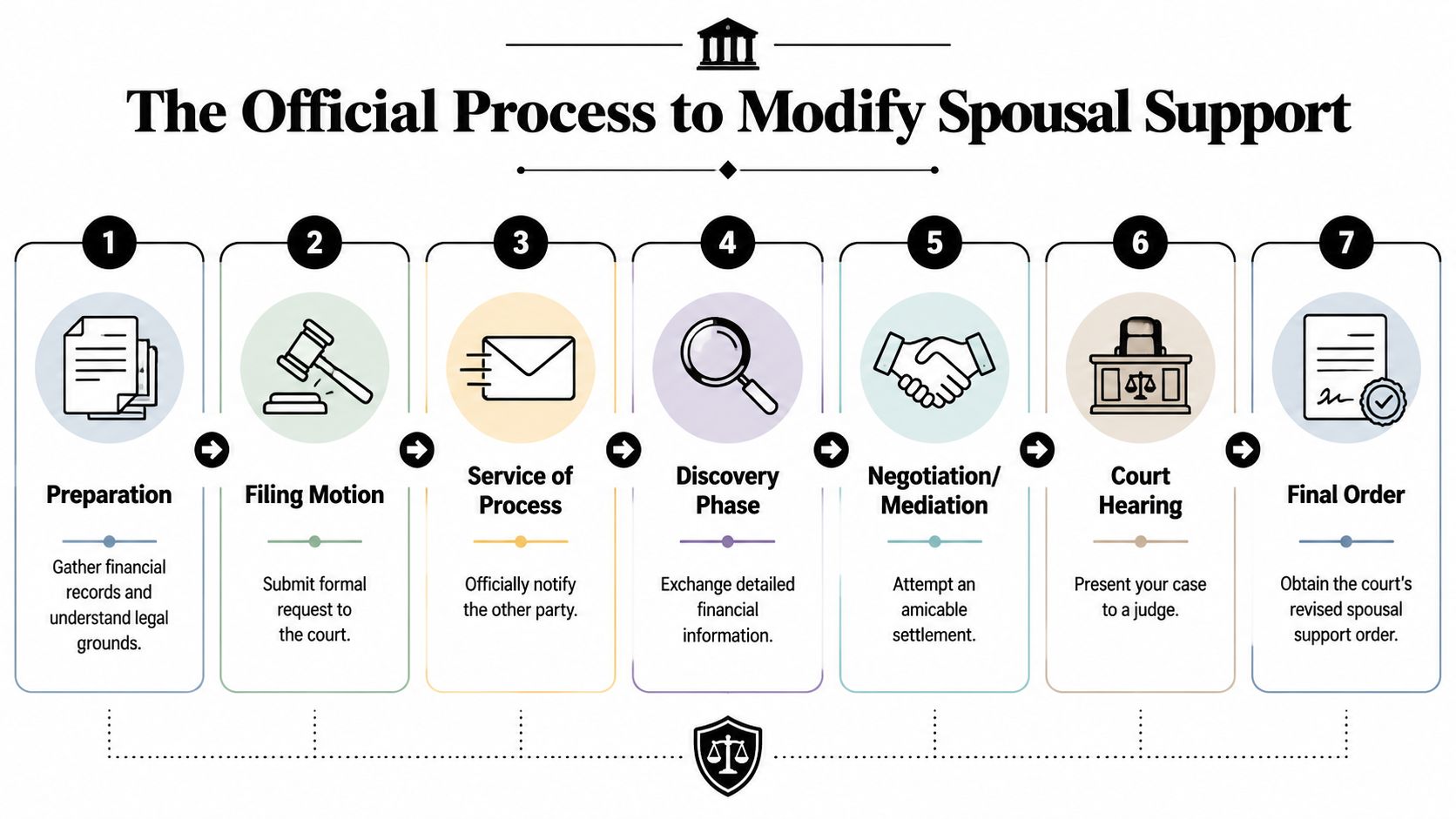
Most cases follow a sequence like this:
- Prepare the motion: State the change in circumstances clearly and tie it to the current support order.
- File with the court: The clerk processes the filing and the case is put on the court's track.
- Serve the other party: Formal service gives legal notice and starts the response timeline.
- Exchange information: The parties often gather updated financial records and other proof.
- Attend hearing or reach agreement: If no settlement happens, the judge decides based on evidence.
This visual captures the flow many clients find hard to picture at first.
Where people get stuck
The legal standard and the court process are separate problems. Some people have a decent factual basis but lose time because they miss service rules, file incomplete paperwork, or show up without organized records.
If you've also dealt with changes to other family court orders, the process may feel familiar. This overview of child support modification in North Carolina can help illustrate how post-order motions often require the same kind of disciplined preparation.
Filing the motion starts the case. It doesn't prove it. Proof comes from records, testimony, and consistency.
Gathering Strong Evidence for Your Case
Evidence decides most modification cases. Not suspicion. Not frustration. Not a believable story with no documents behind it.
The documents that usually matter most
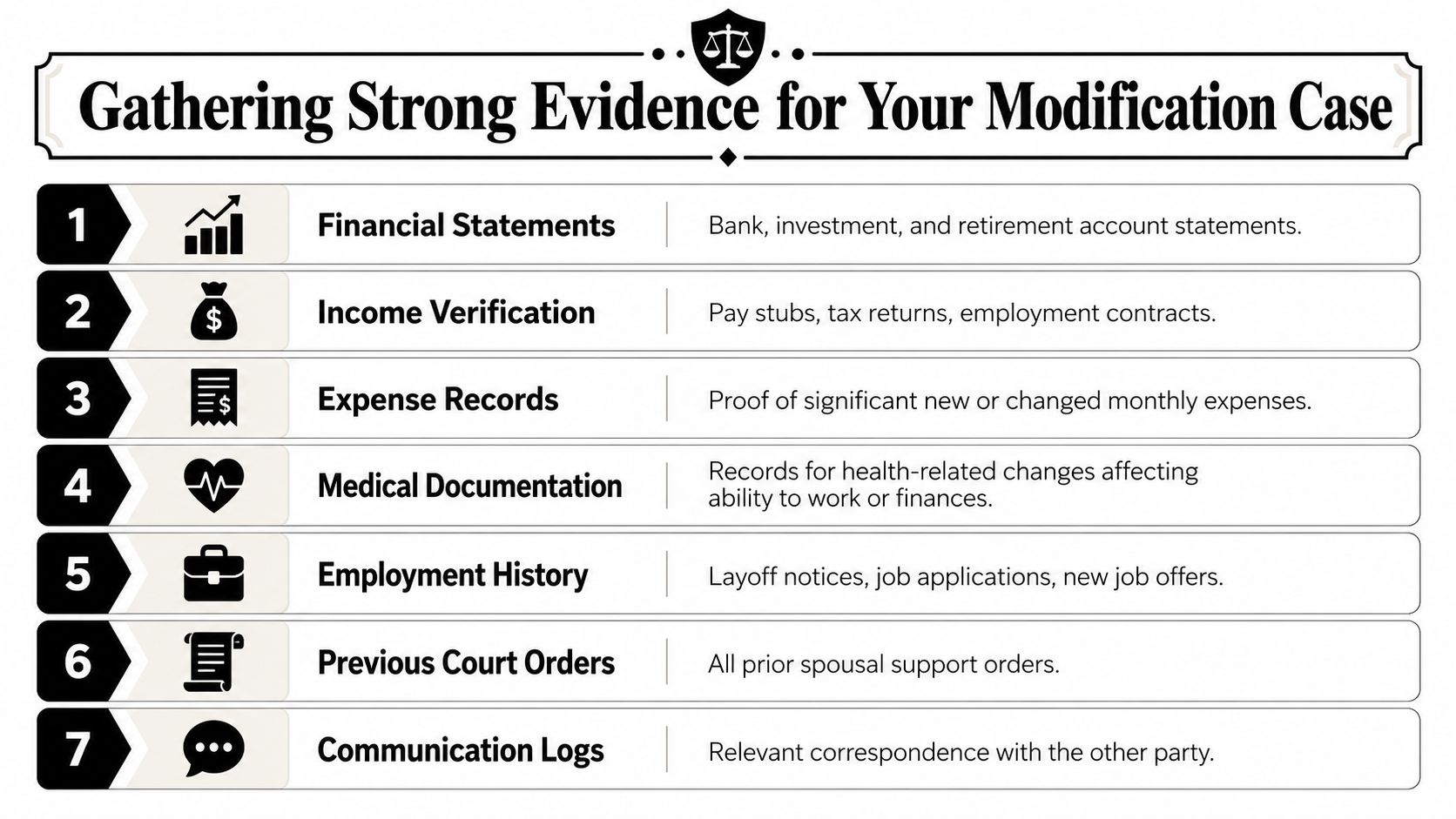
Judges want to compare the old financial picture to the current one. That means you should gather records that show both the change itself and its impact.
Useful evidence often includes:
- Income proof: Recent pay stubs, tax returns, W-2s, or business records if you're self-employed.
- Medical records: Documents showing diagnosis, treatment, restrictions, or disability affecting work capacity.
- Employment records: Layoff notices, termination letters, severance documents, and job search records.
- Expense documents: Mortgage statements, rent, insurance, major recurring medical bills, and other changed expenses.
- Prior orders and agreements: The judge needs the original framework before deciding whether to alter it.
- Relevant communications: Messages or letters that directly relate to support, cohabitation, or changed finances.
Voluntary versus involuntary changes
This issue is one of the most misunderstood parts of modification of spousal support. Courts look closely at whether the income change was forced on you or chosen by you.
Courts rigorously evaluate whether a change in income was voluntary. If a spouse voluntarily quits a job or reduces hours without a compelling reason, courts often deny modification or impute the prior income level. The moving party must prove the change was involuntary and has a significant impact, as noted in this discussion of voluntary and involuntary income changes.
Here is the practical difference:
- Involuntary layoff: A plant closes. You receive a termination notice. You apply for comparable jobs and keep records. That evidence supports a real change.
- Voluntary career shift: You leave a stable job to start a new business or return to school without a clear legal basis for reducing support. That often creates a serious problem.
A judge is more interested in why your income changed than in the fact that it changed.
Build a record before you file
People often wait until the hearing date is near to collect documents. That's backwards. The record should begin as soon as the change happens.
Keep the paperwork. Save the emails. Track applications if you're unemployed. Follow medical advice if health is part of the case. If cohabitation is an issue, don't rely on rumor alone. Courts expect facts they can evaluate.
Negotiation Mediation and Preparing for Court
Not every modification case needs a full hearing. Some should settle. In the right case, negotiation or mediation can save time, reduce conflict, and give both sides more control over the outcome.
When resolution outside court makes sense
A negotiated update often works best when the financial change is obvious and well documented. For example, if one spouse has clear medical restrictions or the other has reliable proof of changed living circumstances, a realistic agreement may be possible without asking a judge to sort through every detail.
Mediation can also help when the parties disagree on amount but not on the fact that something important has changed. A neutral mediator doesn't decide the case. The mediator helps the parties work toward terms they can both live with.
If you're evaluating options, a North Carolina family lawyer, a mediator, or a firm such as the Law Office of Bryan Fagan's North Carolina alimony practice can review whether settlement efforts are practical before significant court expense is incurred.
How post-separation support fits into the conversation
North Carolina distinguishes between post-separation support and alimony. PSS is temporary and based on immediate financial need. Alimony is longer-term. PSS automatically terminates upon entry of an alimony order, dismissal of the alimony claim, or an absolute divorce if no alimony claim is pending, as explained in this overview of post-separation support in North Carolina.
That distinction matters in negotiation because people sometimes use the word "alimony" to describe every support payment after separation. Legally, that can blur the analysis.
If your case goes to hearing
Preparation becomes more exacting when settlement fails. The judge may hear testimony from each party, review financial records, and weigh credibility. Small inconsistencies can hurt a case that otherwise looks strong on paper.
Good hearing preparation usually includes:
- A clean timeline: When did the change occur, and how long has it lasted?
- Organized exhibits: Documents should support the point you're making, not bury it.
- A realistic position: Extreme requests often backfire.
Court is where unsupported assumptions get exposed. Preparation isn't optional.
FAQ on Modifying North Carolina Spousal Support
Can alimony end if my ex is living with a new partner
It can. In North Carolina, cohabitation can be a basis to seek early termination of alimony in the right circumstances. The key issue isn't casual dating. It's whether the facts show a qualifying living arrangement and shared life that fits the legal standard. Proof matters.
What if I retire and can't afford the same payment
Retirement can raise a legitimate modification issue in many support cases, but it isn't automatic. The court will still look at the details, including whether the retirement is genuine and how it affects ability to pay. If retirement is approaching, don't wait until after arrears build up to get legal advice.
How long does alimony usually last in North Carolina
North Carolina doesn't have a strict statutory formula for duration. Courts commonly apply an informal rule of thumb awarding alimony for approximately half the length of the marriage, but duration remains discretionary and is decided case by case, as explained in this discussion of alimony duration in North Carolina.
That means the length of the marriage matters, but so do earning ability, financial need, debts, and the overall circumstances.
Can I stop paying while my motion is pending
No one should assume that filing a motion suspends the existing obligation. Until the court changes the order, the current terms generally remain in place. Stopping payment early can create enforcement problems and weaken your position.
What do clients misunderstand most often
The biggest misconception is that any financial stress justifies a modification of spousal support. Another is that all alimony is modifiable. Neither is true.
People also underestimate how often cases turn on the quality of records. The court doesn't fill in missing proof for either side. If your position depends on changed income, changed need, cohabitation, illness, or retirement, your evidence has to show it clearly.
Schedule Your North Carolina Modification Consultation
A spousal support modification case can look simple from the outside. In practice, the outcome often turns on details people miss early. Was the obligation created by court order or contract? Did the change happen after the original order? Is it ongoing? Can you prove it with records a judge will trust?
Those questions affect whether filing makes sense, how the motion should be framed, and whether negotiation is a better first move. Waiting too long can make a difficult situation harder. Filing too quickly, without the right evidence or without confirming that the obligation is modifiable, can waste time and money.
North Carolina residents dealing with changed finances, cohabitation concerns, retirement questions, or disputes over an existing alimony order should consider getting the order and supporting documents reviewed before making a major decision. A consultation can help identify whether the legal standard is likely met, what evidence is still missing, and what path fits the facts of the case.
If your circumstances have changed and you need guidance on the modification of spousal support in North Carolina, schedule a confidential consultation and get a clear assessment of your options.
If you need guidance on modifying alimony or determining whether your support obligation can be changed at all, contact the Law Office of Bryan Fagan to schedule a confidential consultation. The firm works with North Carolina residents on divorce and post-divorce family law issues, including spousal support disputes, and can help you evaluate the order, the evidence, and the next practical step.