When parents search for how to win a custody case in North Carolina, they're usually not looking for a slogan. They're sitting at a kitchen table, scrolling late at night, worried about where their child will sleep, who will make school decisions, and whether one bad hearing could change daily life for years.
That fear is real. So is the temptation to treat custody like a personal war against the other parent.
That approach usually backfires.
The stronger approach is to treat your case like a proof problem. In North Carolina, custody law became explicitly gender-neutral in 1977, when the legislature removed any statutory preference for mothers or fathers and tied decisions to the child's best interests, as explained in this discussion of whether North Carolina courts favor mothers in custody cases. Today, the parent in the stronger position is usually the one who can show a more stable home, a stronger caregiving history, and better support for the child's needs.
That means the case is rarely won by outrage. It's built with records, calendars, messages, witnesses, and a parenting plan a judge can trust. If you're dealing with a current dispute, working with a North Carolina child custody lawyer early can help you organize the case before mistakes get baked in.
Navigating Your North Carolina Custody Case with Confidence
A common first meeting sounds like this: one parent says the other is manipulative, irresponsible, or impossible to deal with. Then I ask a simple question. “What can you prove?”
That question changes everything.
North Carolina judges don't decide custody based on who sounds more hurt. They look for reliable evidence showing who has been meeting the child's needs and who is most likely to keep doing it. If your child gets to school on time with you, if you handle doctor visits, if you know the teacher's name, if you maintain a steady routine, that matters. But it matters most when you can document it.
Winning means proving fitness, not winning a fight
Parents often use the word “win” to mean “beat the other parent.” In custody court, that mindset usually creates avoidable damage. Judges are looking for the parent who stays child-focused under pressure.
A practical example helps. If the other parent misses exchanges, a weak response is sending angry texts and threatening to “expose” them in court. A stronger response is documenting the missed exchange, confirming the facts in writing, protecting the child from the conflict, and bringing an organized record to mediation or trial.
Practical rule: A persuasive custody case is usually calm, documented, and specific.
The parent who prepares first often gains leverage first
North Carolina custody cases usually follow a process that includes filing a complaint, serving the other parent, and going through mediation before trial. That means early preparation can shape the case long before a judge hears testimony.
If you're waiting for the other side to make the first move, you may already be behind. Start building your file now. Save communication. Request school records. Gather medical information. Write down parenting responsibilities while the details are fresh.
Understanding North Carolina's Best Interests of the Child Standard
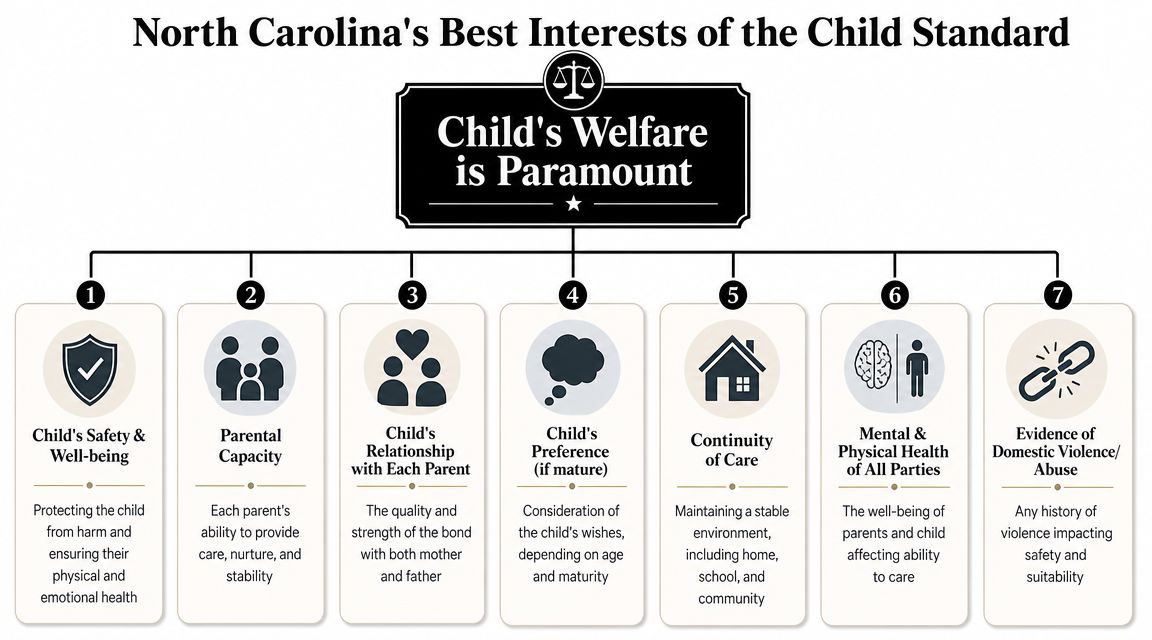
North Carolina custody decisions turn on the best interests of the child. That phrase sounds broad because it is broad. Judges have room to evaluate the facts of each family, but the core question stays the same: what arrangement best protects the child's welfare?
A useful starting point is to understand that the court is not scoring parents on personality. It is evaluating parenting judgment, stability, safety, and the child's needs in real life. For a deeper overview of this framework, review best interests of the child in North Carolina.
What judges usually care about most
No two cases are identical, but these issues tend to matter in a very practical way:
- Safety and well-being. If there are concerns about abuse, violence, dangerous living conditions, or serious instability, those issues can outweigh almost everything else.
- Parental capacity. Judges want to know who handles the child's daily needs, decision-making, supervision, and emotional support.
- Continuity. Courts often pay attention to routines involving home, school, medical care, and community ties.
- The child's relationship with each parent. A strong bond matters, but so does each parent's willingness to support the child's relationship with the other parent when appropriate.
- Health and functioning. Mental and physical health can matter if they affect parenting ability.
- The child's preference. In some cases, a mature child's wishes may be considered, though they are not automatically controlling.
A judge may look at the same household through several lenses at once. For example, a parent with a flexible work schedule may seem available, but if that parent frequently misses school communication and can't keep a routine, availability alone won't carry the case.
Joint custody requests can be strategically stronger than extreme demands
Parents often walk into custody disputes convinced they must ask for sole custody to be taken seriously. That's not always smart strategy.
A peer-reviewed study on child-custody trials found that plaintiffs won only 17.8% of child custody trials, and parties requesting joint custody were 1.74 times more likely to win than those requesting sole custody, according to this empirical study on child-custody trial outcomes. The same study reported that a predictive model based on eight factual findings could forecast outcomes with over 85% success.
Those numbers don't guarantee anything in your case. They do show why credibility and realistic requests matter.
Ask for the arrangement you can defend with facts, not the arrangement that best expresses your anger.
A real-world way judges weigh these factors
Consider two parents in a school-aged child's case. One parent argues, “I'm the better parent because the other one is selfish.” The other parent shows school attendance records, pediatric appointment history, a calendar of parenting time, and messages proposing reasonable schedule solutions. Even if both parents love the child, the second parent is speaking the language courts trust.
That is how to think about how to win a custody case in North Carolina. Not by making the biggest accusation, but by making the clearest showing.
Building Your Case with Compelling Evidence
Most custody cases rise or fall on documentation. North Carolina guidance consistently points parents toward a practical evidence file: school records, medical records, communications, photos or videos, and journaled observations organized into a story about stability and caregiving. This explanation of how a North Carolina judge determines who gets custody captures that approach well.
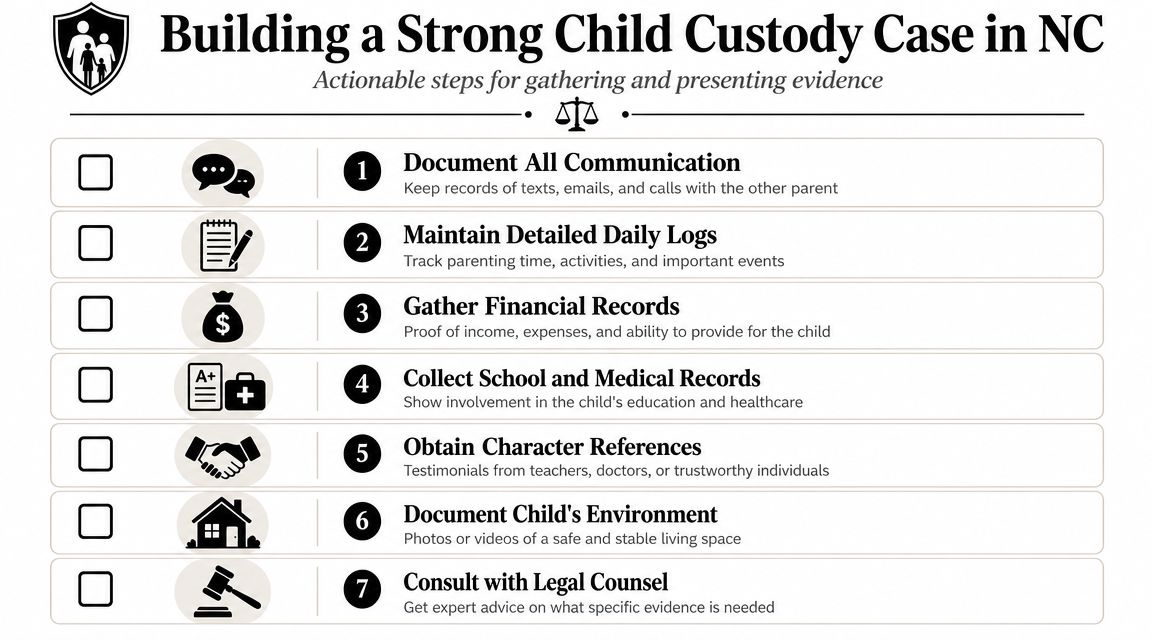
A strong file doesn't just collect paper. It tells a coherent story: this parent knows the child, shows up consistently, makes sound decisions, and protects the child from conflict.
Build your evidence file by category
Start with the most objective records first.
- School records. Attendance, report cards, teacher emails, conference notes, special education records, and proof of your involvement.
- Medical records. Appointment summaries, prescription information, therapy records if relevant, and proof you scheduled or attended care.
- Parent communication. Texts, emails, and app messages showing scheduling, decision-making, and your effort to cooperate.
- Parenting journal. A dated log of exchanges, missed visits, behavioral concerns, homework issues, appointments, and notable child statements.
- Photos and videos. Use these carefully. They should show the child's living environment, routines, or participation in normal life. Avoid staged content.
- Witnesses. Teachers, coaches, childcare providers, counselors, relatives, or neighbors with first-hand knowledge can matter more than people who only know your side of the story.
If your case may involve a professional review, learning the custody evaluation process in North Carolina can help you gather the kind of records evaluators often want to see.
Don't just collect evidence. Organize it.
Parents often bring in hundreds of screenshots and think volume equals strength. It doesn't. Judges and mediators need usable information.
Use a simple structure:
- Create a master timeline with dates of major events.
- Sort records into folders such as school, medical, communication, and exchanges.
- Mark your best exhibits that prove reliability, not just conflict.
- Write a short case summary explaining the child's routine, your role, concerns, and proposed parenting plan.
A concise file beats a chaotic stack every time.
Here's a useful visual overview before you go deeper into your own records:
What works and what hurts
The right evidence usually does one of two things. It either proves your positive parenting, or it shows why a specific concern affects the child's best interests.
A few examples make that clearer:
| Evidence approach | Why it helps |
|---|---|
| School email showing you coordinated tutoring | Shows initiative and involvement |
| Calm text proposing make-up parenting time | Shows cooperation and child-focused problem solving |
| Journal entry with date, time, and facts of missed exchange | Creates usable testimony support |
| Screenshot of an insult-filled argument you started | Usually hurts your credibility |
| Social media rant about the other parent | Suggests poor judgment and conflict escalation |
Keep records as if a judge will read them later. Many times, one eventually does.
Think like a project manager, not a prosecutor
The biggest mistake I see is parents trying to prove the other parent is “bad” in every possible way. That strategy often overwhelms the core issue. Courts care more about what each parent can do for the child than about broad character attacks.
Your case should answer practical questions. Who gets the child ready for school? Who handles medication? Who communicates with teachers? Who follows through? Those details win trust.
One mention is enough here: families often work with private counsel, legal aid resources, or firms such as the Law Office of Bryan Fagan for help turning raw records into a court-ready narrative. The important part is not the label on the office door. It's whether your evidence is organized, admissible, and tied to the child's needs.
Navigating Pre-Trial Procedures and Gaining Leverage
Many parents assume the custody fight happens at trial. In North Carolina, a lot of influence is created much earlier.
Procedure matters. Filing in the wrong county, failing to serve the other parent correctly, or showing up to mediation unprepared can stall a case before the court ever reaches the merits. This guide on filing for custody in North Carolina explains that custody is generally filed where the parent or child resides or where the child is physically present, that the other parent must be served with the summons and complaint, and that the responding parent typically has 30 days to answer or seek more time.
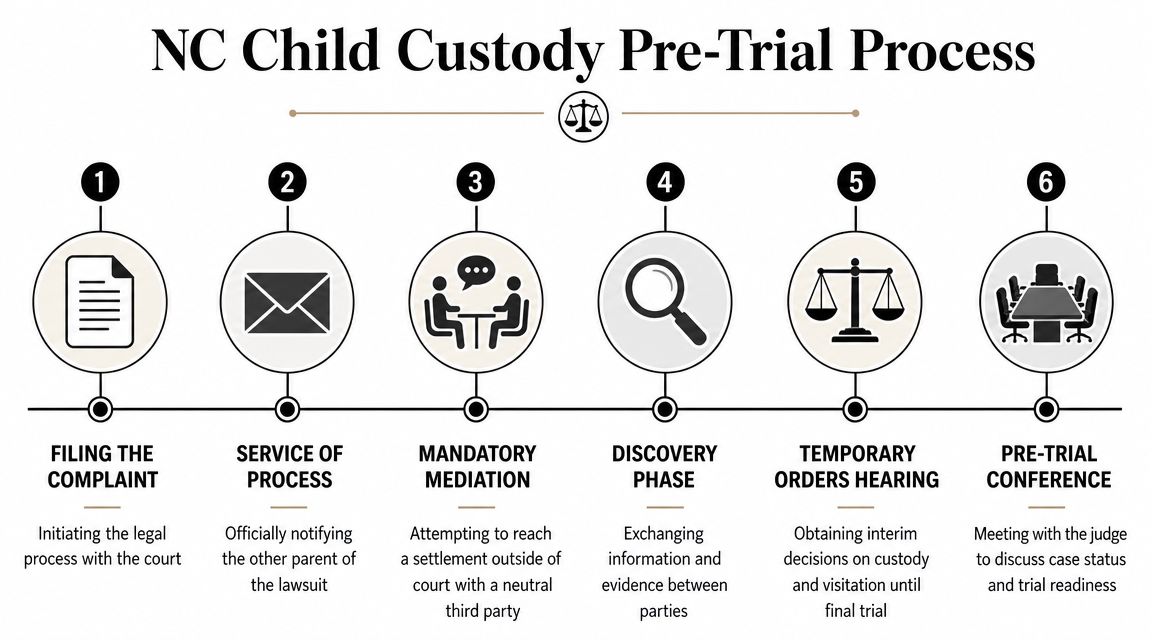
The pre-trial timeline is not just paperwork
A custody case usually unfolds in stages, and each stage affects the next.
- Filing the complaint starts the case and frames your claims.
- Service of process gives legal notice to the other parent.
- Response period gives the other side time to answer.
- Mediation often comes before trial and can produce a binding agreement.
- Temporary orders or emergency relief may shape the child's schedule while the case is pending.
- Discovery and pre-trial preparation determine what evidence is ready and how clearly it will be presented.
Parents who treat these steps casually often lose momentum. Parents who prepare early often arrive at mediation with options, records, and a plan.
Mediation can be a leverage point, not a formality
Public guidance confirms that many North Carolina counties require court-ordered mediation and parenting education before a judge hears the case. That means readiness matters as much as rhetoric in high-conflict disputes, as summarized by North Carolina custody guidance from WomensLaw.
Mediation is not the place to repeat every grievance from the relationship. It is the place to show that you understand the child's schedule, can propose a workable parenting plan, and can negotiate without losing focus.
For example, a parent who walks into mediation saying, “I want full custody because the other parent is impossible,” often gets less traction than the parent who says, “Here is the school-week routine that has been working, here are the exchange points that reduce conflict, and here is how holidays can be handled.”
The side that looks most settlement-ready often looks most parent-ready.
Temporary behavior becomes permanent evidence
What you do while the case is pending matters. A lot.
If there is a temporary order, follow it closely. If you need a change, seek one through proper channels. Don't decide on your own that the order is unfair and stop complying. North Carolina custody guidance commonly warns that violating temporary orders or changing the child's routine unilaterally can damage credibility and undercut a stability argument.
A few practical examples:
- Good move. You document concerns, notify counsel, and request court action.
- Bad move. You keep the child beyond the scheduled return time because you think it's justified.
- Good move. You complete required classes and appear prepared at mediation.
- Bad move. You ignore procedural deadlines because you're focused on the “real issues.”
In high-conflict cases, procedure often becomes substance. The parent who follows the process usually looks more dependable than the parent who fights every rule.
Common Pitfalls and Complex Custody Scenarios
Some custody cases are damaged less by weak facts than by avoidable mistakes. A parent may have a solid caregiving history and still hurt the case by acting impulsively once litigation starts.
That's why part of learning how to win a custody case in North Carolina is learning what not to do.
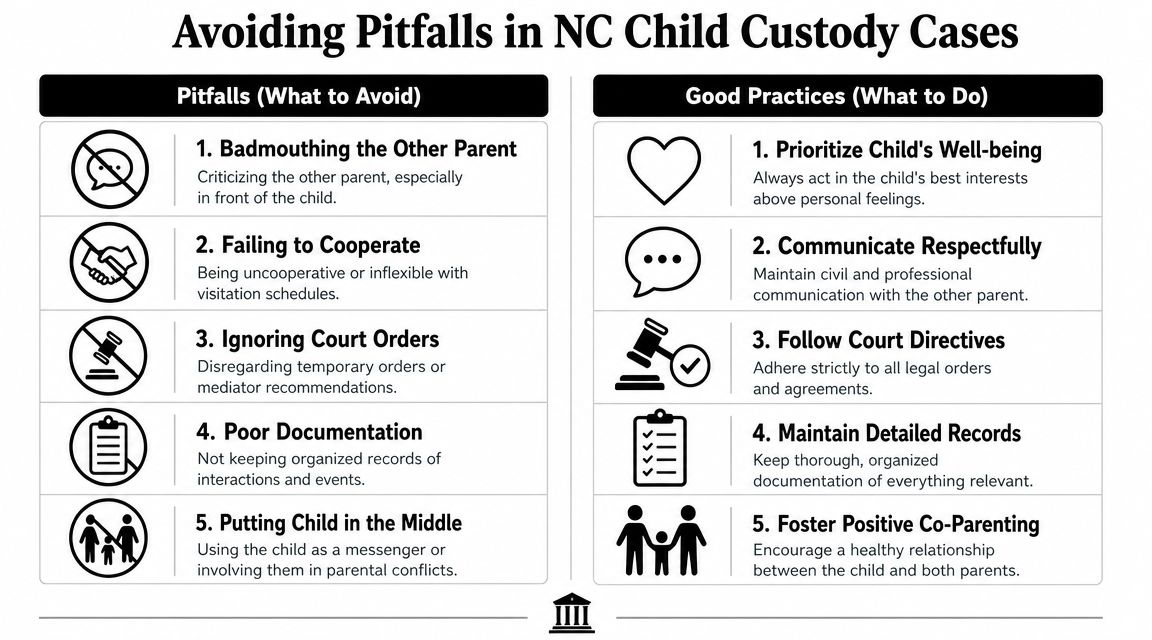
Five mistakes that regularly hurt custody cases
| Pitfall | Why it causes problems |
|---|---|
| Badmouthing the other parent to the child | Suggests poor judgment and emotional harm to the child |
| Posting on social media about the case | Creates evidence you may not control later |
| Ignoring court directives or mediation requirements | Signals unreliability |
| Making unsupported accusations | Can weaken your credibility |
| Putting the child in the middle | Courts want parents to reduce conflict, not recruit the child |
A practical scenario is common. One parent is furious after a missed visit and sends ten hostile texts, posts online, and tells the child the other parent “doesn't care.” The underlying complaint may have been legitimate. The reaction turns the spotlight onto the wrong person.
Good practices are often less dramatic and more persuasive
The parent who does well in custody litigation usually looks steady, not flashy.
- Communicate like your messages may be printed. Short, factual, respectful communication is safer than emotional venting.
- Protect the child from adult issues. Don't use the child as a messenger, source of information, or witness.
- Keep routines consistent. Sleep, school, transportation, medication, and homework matter because they show stability.
- Bring solutions. Courts respond better to practical parenting plans than to vague complaints.
Judges often learn more from a parent's conduct during the case than from that parent's description of the other side.
Unmarried fathers need to address standing first
One of the most overlooked North Carolina custody issues involves unmarried parents. For many fathers, the first custody question is not how to win, but how to get legal footing to ask the court for relief.
North Carolina family law materials note that unmarried mothers are often presumed to have custody unless the father first establishes paternity, as discussed in this article on custody rights for married and unmarried parents in North Carolina. If you're an unmarried father, this can be the critical first move before a custody fight can be pursued effectively.
That changes strategy. If paternity has not been established, don't assume you're already standing in the same position as the other parent. Get legal advice early so rights are preserved correctly from the beginning.
High-conflict and safety-driven cases need a narrower approach
If your case involves domestic violence concerns, abuse allegations, emergency safety issues, or serious instability, broad co-parenting advice may not fit. These cases often require immediate, documented, and court-focused action.
The key is still evidence. Save messages. Keep dates. Preserve medical or school records. Follow emergency procedures where appropriate. And avoid self-help unless immediate safety leaves no other choice. In those cases, the details of what happened, when, and how you responded can matter enormously.
Frequently Asked Questions and Securing Your Child's Future
Parents often want straight answers at the end of all this. Here are some of the most common North Carolina questions.
North Carolina child custody FAQ
| Question | Answer |
|---|---|
| Do North Carolina courts favor mothers? | No. North Carolina custody law is gender-neutral. Courts focus on the child's best interests, not whether a parent is the mother or father. |
| Is asking for sole custody the best way to win? | Not always. An extreme request without strong supporting facts can hurt credibility. A realistic plan you can prove is often stronger. |
| What if the other parent and I can agree? | You may be able to resolve custody through agreement and have the terms entered as a court order, which can avoid a full trial. |
| Can I move with my child during a custody dispute? | Maybe, but unilateral moves can create serious problems. If relocation affects the other parent's time or the child's routine, get legal advice before acting. |
| What matters more, my testimony or my records? | Both matter, but records often make testimony more persuasive because they give the court concrete facts to rely on. |
The final strategic point
Custody cases are emotional because parenting is emotional. But North Carolina courts decide these cases through evidence, procedure, and credibility.
That is why the best custody strategy is usually disciplined rather than dramatic. Document what matters. Follow court rules. Make requests you can defend. Keep the child out of the conflict. And get help before procedural mistakes or poor communication undermine a strong parenting record.
If you're serious about protecting your role in your child's life, don't wait until the hearing notice arrives. Early action usually creates better options, whether your case is headed to mediation, temporary orders, or trial.
If you live in North Carolina and need guidance on a custody dispute, Law Office of Bryan Fagan can help you evaluate your position, identify the evidence that matters, and build a strategy around your child's best interests. Schedule a consultation to discuss your case, your concerns, and the practical next steps for protecting your parental rights.