Navigating a custody case in North Carolina can be an intimidating process, especially for fathers who worry the system is tilted against them. The good news is that this fear is based on a common misconception. The law in North Carolina is built on a foundation of gender neutrality, meaning both mothers and fathers begin on an equal legal footing. A judge's sole priority is the child's best interests—not the gender of the parent.
This guide is designed to provide clear, practical information for fathers in North Carolina. We'll break down the law, address common concerns, and outline the steps you can take to protect your crucial role in your child's life.
The Truth About a Father's Standing in NC Custody Cases
Many fathers enter a custody dispute fearing that the courts are inherently biased. It's an understandable worry, but the legal reality in North Carolina tells a different story. State law provides you with a fair and powerful opportunity to secure your relationship with your child.

The Gender-Neutral Standard: What NC Law Says
One of the most important statutes for any father to know is North Carolina General Statute § 50-13.2(a). This law explicitly states that a custody decision "shall be made on the basis of the best interest of the child… without regard to the sex of the parents."
This is a game-changer. It means there is no legal presumption that a mother is a better caregiver simply because she is the mother. A judge cannot legally favor one parent over the other based on gender; every decision must be grounded in facts and evidence related to the child’s well-being.
Your case will be judged on a set of neutral factors that focus on what truly matters, such as:
- Your history as an active and involved caregiver.
- Your ability to provide a safe, stable, and nurturing home.
- Your willingness to support and foster a positive relationship between your child and their other parent.
North Carolina law ensures that a father's rights and responsibilities are given the same weight and consideration as a mother's.
A Father's Equal Standing Under North Carolina Law
| Legal Area | A Father's Rights & Responsibilities | A Mother's Rights & Responsibilities | Governing Principle |
|---|---|---|---|
| Child Custody | The right to seek both legal and physical custody, on equal terms with the mother. | The right to seek both legal and physical custody, on equal terms with the father. | Best Interest of the Child |
| Decision-Making | The right to participate in major decisions about the child's education, healthcare, and religion. | The right to participate in major decisions about the child's education, healthcare, and religion. | Parental Involvement |
| Child Support | The responsibility to provide financial support based on income and custody arrangements. | The responsibility to provide financial support based on income and custody arrangements. | Income Shares Model |
| Visitation | The right to meaningful time with the child if not the primary custodial parent. | The right to meaningful time with the child if not the primary custodial parent. | Continued Relationship |
This equal footing is not just a suggestion—it's a legal mandate that gives you a powerful and fair starting point. Understanding the foundational principles of child custody laws in North Carolina is the first and most important step toward building a strong case.
How Unmarried Fathers Can Establish Legal Paternity
For an unmarried father in North Carolina, establishing legal paternity is the essential first step to securing your rights. Unlike married couples, where the husband is automatically presumed to be the father, an unmarried man has no automatic parental rights. This can be a shock, especially for fathers who have been present and involved since day one.
Until you take specific legal action, the law defaults to giving the mother sole legal and physical custody. This means you have no legally enforceable right to custody, visitation, or making decisions for your child. The only way to unlock your Fathers' Rights in North Carolina is by legally establishing paternity. You can learn more by exploring our detailed guide on how to get temporary custody.
The Two Pathways to Establishing Paternity
North Carolina law provides two clear ways for an unmarried father to be legally recognized as his child’s parent.
Voluntary Acknowledgment: The simplest method is for both parents to sign an Affidavit of Parentage. This legal document, often available at the hospital after birth, is a sworn statement that you are the biological father. Once properly filed, you are legally established as the father, gaining all associated rights and responsibilities.
Filing a Paternity Action: If the mother will not sign the affidavit or there is a dispute, you must go to court. Under N.C.G.S. § 49-14, you can file a complaint to establish paternity. The court will likely order a DNA test. Once the results confirm you are the father, a judge will issue a court order officially establishing your paternity.
Real-World Scenario: John and Sarah were not married when their son was born. John was present at the birth and helped care for the baby, but they never signed an Affidavit of Parentage. When they separated, Sarah refused to let John see their son. Because he had no legal standing, John had to hire an attorney to file a paternity action. Only after a court-ordered DNA test confirmed his paternity could he proceed to file for custody and visitation.
This is a non-negotiable first step. While it may seem daunting, establishing paternity is the absolute foundation for securing your legal right to be part of your child’s life.
Navigating Child Custody and Visitation Schedules
Once your legal rights as a father are established, the next step is defining your role through child custody and visitation. It's essential to understand the specific terms North Carolina courts use.
In North Carolina, "custody" is divided into two distinct parts:
- Legal Custody: This is the right to make major decisions for your child regarding healthcare, education, and religious upbringing. It is very common for courts to grant joint legal custody, meaning both parents have a say.
- Physical Custody: This refers to where the child physically lives. Primary physical custody means the child lives with one parent most of the time, while the other has a visitation schedule. Joint physical custody involves a more balanced schedule, such as a 50/50 split.
The Best Interests of the Child Standard
How does a judge decide on a custody arrangement? Every decision is guided by a single legal standard: the “best interests of the child.” A judge will weigh many factors to determine what plan will best promote your child’s welfare, happiness, and safety. Because the law is gender-neutral, your ability to provide for your child’s needs is weighed just as heavily as the mother's.
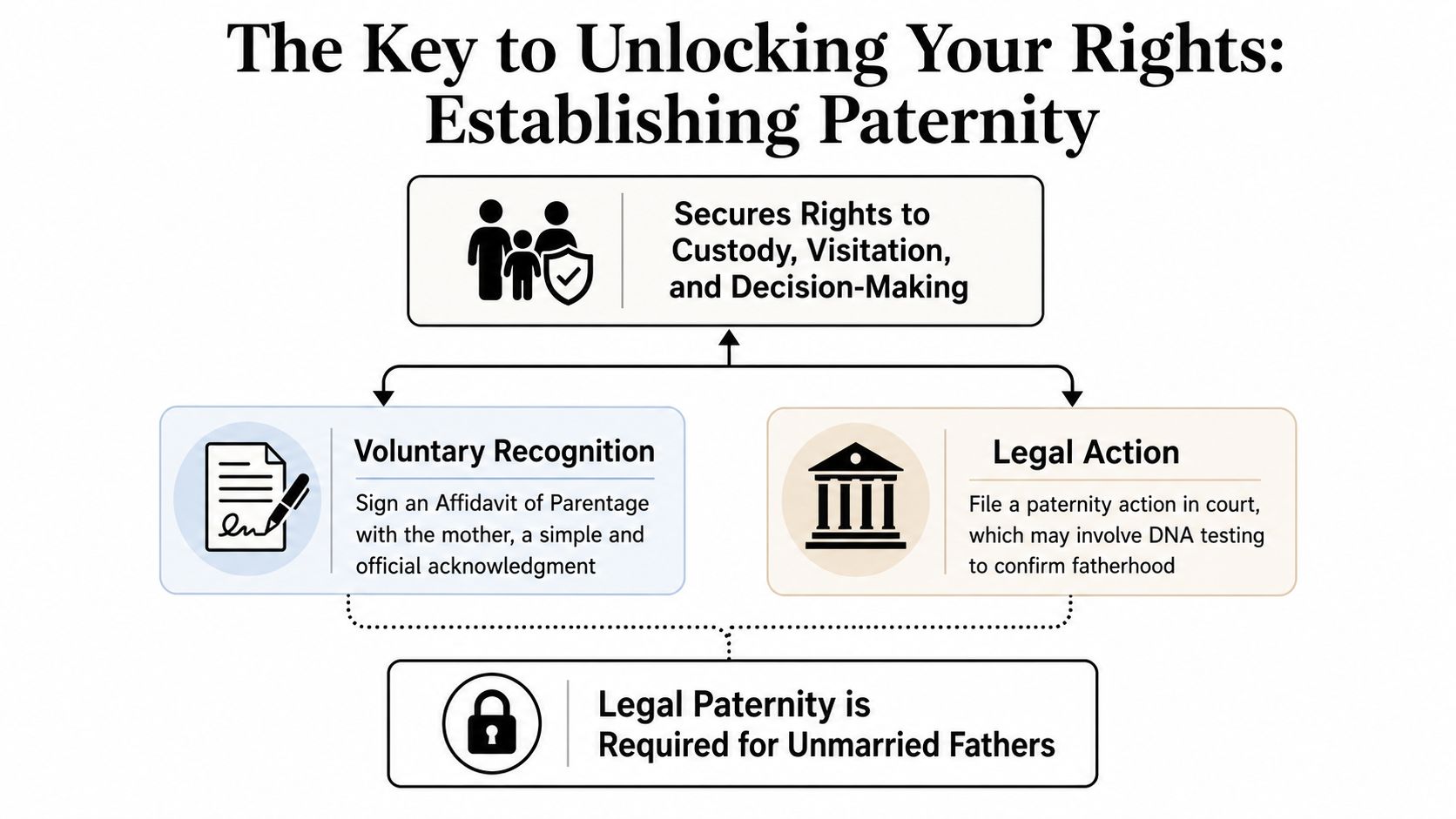
As the flowchart shows, establishing legal paternity is the key that unlocks your ability to fight for a formal custody and visitation order.
Real-World Scenario: Mark, a firefighter with a rotating 24-hour shift, worried a judge would deny him significant time with his daughter due to his unconventional schedule. By working with his attorney to present a detailed calendar showing how he could provide consistent, stable care on his days off, he successfully negotiated a joint physical custody plan that worked around his job and was approved by the court.
Mark's story shows that a father's commitment and proactive planning can overcome what might seem like major obstacles. A mother cannot unilaterally deny court-ordered visitation. A custody order is legally binding, and if the other parent violates it, you have legal remedies to enforce your rights.
Understanding How Child Support Is Calculated in NC
For fathers, it's essential to know that child support in North Carolina isn’t a punishment. It's the legal right of a child to receive financial support from both parents, calculated using a consistent and fair formula.
The process is guided by the North Carolina Child Support Guidelines, which use an "income shares" model. This model estimates the total amount that would have been spent on the child if the parents lived together and then splits that amount proportionally between the parents based on their incomes.
The Inputs of the Child Support Formula
The court plugs several key pieces of information into a worksheet to determine the support amount. These primary factors include:
- Gross Monthly Income: The pre-tax income for both the father and the mother.
- Custody Schedule: The number of overnights the child spends with each parent significantly impacts the calculation.
- Work-Related Childcare Costs: The amount paid for daycare or after-school care is factored in.
- Health Insurance Premiums: The cost for the child's portion of health, dental, and vision insurance is included.
North Carolina's approach is designed to be completely gender-neutral. The formula doesn't care if you're the father or the mother; it only cares about the numbers and the child's needs.
Busting the Myth That Only Fathers Pay
The obligation to pay child support is based on income and custody arrangements, not gender. A father who has primary physical custody will likely receive child support from the mother. Even in a 50/50 custody split, if one parent earns significantly more, they will likely be ordered to pay support to the other to ensure the child has a similar standard of living in both homes.
You can learn more by reading our comprehensive guide on how child support is calculated in NC.
Proactive Steps to Protect Your Parental Rights
Protecting your relationship with your child often starts long before you enter a courtroom. The most effective strategy is to be proactive by taking deliberate actions that document your commitment and involvement.

This record will be invaluable in demonstrating to a judge that your involvement is essential to your child's well-being.
Building Your Case from Day One
Start right now by documenting your involvement and prioritizing a stable, cooperative environment for your child.
Here are a few key measures you can take:
- Document Everything: Keep a detailed journal of the time you spend with your child. Note when you handle daily routines, take them to doctor's appointments, attend parent-teacher conferences, and participate in extracurriculars.
- Maintain a Stable Home: Focus on providing a safe, clean, and nurturing home that is consistently available for your child.
- Foster a Cooperative Relationship: Avoid conflict with the other parent, especially in front of your child. Proving you can co-parent effectively is a major factor courts consider.
Enforcing Your Rights When Orders Are Violated
If the other parent violates a court order—for example, by denying your visitation time—it is critical to use the legal system correctly.
Self-help tactics like withholding child support will damage your case. Child support and visitation are separate legal issues. A judge will see withholding support as a failure to provide for your child, severely undermining your position.
The correct response to a violation is to file a Motion for Contempt. This action asks a judge to hold the other parent accountable. If found in contempt, the judge can order remedies such as:
- Granting make-up visitation time.
- Ordering the other parent to pay your attorney’s fees.
- In severe or repeated cases, modifying the custody schedule in your favor.
By handling violations through proper legal channels, you reinforce your position as a responsible parent focused on your child's best interests. Protecting your Fathers' Rights in North Carolina means playing by the rules, even when it’s frustrating.
Frequently Asked Questions (FAQ)
1. Does signing the birth certificate give a father rights in NC?
Signing the birth certificate is an important first step for an unmarried father, as it is part of creating an "Affidavit of Parentage." However, it does not automatically grant you enforceable custody or visitation rights. To secure those, you must obtain a formal court order. Without a court order, the mother has sole custody by default.
2. Can a mother move out of state with my child in NC?
If you have a custody order in place, the mother typically cannot move out of state with your child without your consent or a new court order permitting the relocation. If there is no custody order, the situation is more ambiguous, which is why it is crucial to establish a formal order as soon as possible to protect your rights and keep your child in North Carolina.
3. How can a father get 50/50 custody in North Carolina?
A father can achieve a 50/50 custody schedule by proving to the court that it is in the child's best interest. This involves showing that you have been a deeply involved parent, can provide a stable home, are able to co-parent effectively with the mother, and that a shared schedule is practical for the child's schooling and activities. Since NC law is gender-neutral, fathers have an equal opportunity to be awarded 50/50 custody.
4. Do I have to pay child support if we have 50/50 custody?
Possibly, yes. A 50/50 custody schedule does not automatically eliminate child support. The North Carolina guidelines still require a calculation based on both parents' gross incomes and other expenses like health insurance and childcare. If there is a significant income disparity, the higher-earning parent will likely be ordered to pay support to the lower-earning parent to ensure the child enjoys a similar standard of living in both homes.
Take the Next Step to Secure Your Parental Rights in North Carolina
As this guide makes clear, North Carolina law is designed to be fair to fathers—but you must be proactive to protect your relationship with your child. The legal system itself is gender-neutral, but achieving the outcome you want requires decisive action and a firm grasp of your rights. Waiting for these issues to resolve on their own is a risky strategy that rarely works.
Whether you are working to establish paternity or preparing for a complex custody battle, experienced legal guidance is invaluable. The stress of these situations can feel overwhelming, but you do not have to face this challenge alone.
Chart Your Course with Confidence
An attorney dedicated to fathers' rights can help you build a strong case by documenting your parental involvement, preparing you for court, and fighting for a custody and visitation schedule that truly serves your child's best interests. Your commitment as a father is a powerful asset in court, but it has to be presented effectively.
The most important takeaway is this: action is power. Securing your rights as a father in North Carolina means using the legal tools available to you. From filing the correct motions to presenting compelling evidence, a clear strategy is your best defense against uncertainty.
We invite you to contact our office for a confidential consultation. We will listen to your story, explain your specific legal options, and help you develop a practical plan for moving forward in North Carolina. Our goal is to fight for the future you want with your child, ensuring your voice is heard and your rights are protected.
Don't wait to protect your family. The team at the Law Office of Bryan Fagan is ready to help you navigate North Carolina family law with confidence. Schedule your consultation with us today and take the first step toward securing your future.