A court order for child support isn't set in stone. Life is unpredictable—incomes go up or down, a child’s needs evolve, and what was fair a few years ago might not be fair today. North Carolina law provides a path for parents to request an NC child support modification, ensuring the payment amount reflects your family’s current reality.
This guide, grounded in North Carolina law, will walk you through when you can ask for a change, what evidence you’ll need, and how to navigate the legal process.
Do You Qualify for a Child Support Modification in NC?
Life doesn’t stop just because a judge signed a child support order. Jobs change, kids grow older, and expenses shift. The legal system in North Carolina recognizes this and provides a way to align your support order with these new realities. But how do you know if your situation meets the legal standard to ask for a change?
The key is proving a "substantial change of circumstances." This isn't just a suggestion; it's a specific legal requirement under North Carolina law. A judge won’t adjust an order for minor, temporary hiccups. They need to see a real, significant shift that impacts a parent’s ability to pay or what the child actually needs.
What Is a Substantial Change of Circumstances?
While the legal term might sound intimidating, it boils down to major life events that significantly alter your financial picture. A court will look at the unique facts of your case to decide if the change is "substantial" enough to justify calculating a new child support amount.
Here are some practical examples that often qualify:
- Significant Income Changes: A parent receives a large promotion, resulting in a substantial pay raise. On the flip side, a parent might be involuntarily laid off from a long-term job.
- Shifts in Custody Time: The parenting schedule changes, and the child now spends far more overnights with the paying parent than when the original order was set.
- New Child-Related Expenses: A child develops a medical condition requiring costly ongoing therapy, or they enroll in a specialized school with high tuition not covered by the original order.
- Changes in Childcare or Health Insurance: A young child starts public school, eliminating a significant monthly daycare bill. Or, a parent's new job has a health plan with premiums that are double the old cost.
Practical Example: Sarah has been paying child support based on her old salary. She was recently laid off from her engineering job and is now earning significantly less while searching for comparable work. This involuntary job loss is a classic example of a "substantial change" that would warrant filing for a modification. The change must have occurred after the date your last child support order was entered.
The Three-Year and 15% Rule: A Simpler Path
Proving a substantial change can sometimes feel like a high bar to clear, especially if your financial situation has changed gradually. To make it more straightforward, North Carolina law provides a helpful shortcut. Under G.S. 50-13.7, there is a legal presumption that a substantial change has occurred if you can show two things:
- It has been at least three years since your last child support order was finalized.
- A new calculation based on today’s incomes and expenses would change the child support amount by 15% or more (either up or down).
This rule is a powerful tool. If you meet both the three-year and 15% requirements, the court automatically assumes a substantial change has taken place. You don’t have to offer any other proof, which can streamline the entire process. You can learn more by exploring insights on NC child support modifications.
How the 2026 Guidelines Change Your Calculation
If you're looking to modify a child support order in North Carolina, the rules have changed. A major update to the state's child support guidelines took effect on January 1, 2026, and it fundamentally reshaped how support is calculated for many families.
This isn't a minor tweak. These new guidelines will directly impact your modification case if you're filing now, so understanding the shift is key.
Before 2026, the standard North Carolina Child Support Guidelines had a ceiling. They only applied to families with a combined monthly gross income up to $30,000. If you and the other parent earned more than that, you were in a gray area. Judges had to determine support based on a child’s “reasonable needs,” which left outcomes unpredictable and often led to expensive court battles.
Expanded Predictability for Higher-Income Families
That uncertainty largely disappeared when the new law took effect. The most significant change was the dramatic increase in the income threshold for the guidelines. The combined monthly gross income limit was raised to $50,000.
This expansion brings much-needed consistency to middle and high-income families who previously had to navigate uncertain court hearings. If your combined income now falls within this new, higher range, your modification case will most likely be decided using a predictable worksheet calculation.
Let’s look at a real-world scenario:
- Before January 1, 2026: A family with a combined gross monthly income of $40,000 was considered "off-guideline." Their support amount was left to a judge's discretion, and the final number could vary widely.
- After January 1, 2026: That same family with a $40,000 combined income now falls squarely within the new $50,000 guideline limit. The court will use a standard worksheet to calculate the presumptive support amount. The process is more streamlined, and the outcome is far more predictable.
Key Takeaway: The 2026 guideline update means more families will have their child support calculated with a formula. This reduces uncertainty and can make the modification process faster and less contentious.
Impact of 2026 NC Child Support Guideline Changes
These changes, effective January 1, 2026, have created a more standardized system. Here's a quick comparison of the old rules versus the new ones for key aspects of child support that may affect your modification.
| Guideline Aspect | Rule Before January 1, 2026 | Rule After January 1, 2026 |
|---|---|---|
| Guideline Income Cap | Applied to families with combined income up to $30,000/month. | Applies to families with combined income up to $50,000/month. |
| Self-Support Reserve | Based on 150% of the federal poverty level for one person. | Increased to 180% of the federal poverty level for one person. |
| Extraordinary Expenses | Often handled outside the standard calculation, left to judicial discretion. | More specific rules for inclusion within the worksheet calculations. |
Understanding these updates is crucial because they set the new baseline for what a judge will consider a fair and appropriate support amount in your modification case.
Other Important Changes in the 2026 Guidelines
The new income cap wasn’t the only change. The 2026 updates also brought other important adjustments you need to be aware of when pursuing an NC child support modification.
A significant update is the increase to the self-support reserve. This is the minimum amount of income a paying parent is presumed to need for their own basic living expenses. The new guidelines raised this reserve to 180% of the federal poverty guidelines, which offers greater financial protection to paying parents, especially those with lower incomes.
Additionally, the new rules refine how costs for health insurance and certain extraordinary expenses are handled within the calculations. For a complete overview of how support is calculated, you might be interested in our comprehensive guide on child support in NC laws.
Filing Your Motion to Modify Child Support
Once you’ve confirmed a substantial change in circumstances has taken place, it’s time to formally ask the court to modify your child support order. This isn’t something that happens automatically; you have to take specific legal steps to get your case in front of a judge.
The process starts by filing a Motion to Modify Child Support. This is the official document that tells the court and the other parent that you believe the current order is outdated and needs to be recalculated based on your new situation.
Initiating the Legal Process
To kick things off, you'll need to file the correct form with the Clerk of Court in the same North Carolina county where your original child support order was issued. The official form you need is the "Motion and Notice of Hearing for Modification of Child Support Order," also known by its form number, AOC-CV-608.
Getting this form filled out correctly is critical. You'll need to provide your basic information, the original case file number, and a clear explanation of why you’re asking for a change—in other words, what substantial change has happened.
Filing this motion sets a crucial legal clock in motion. In North Carolina, any modification to child support can generally only be applied retroactively to the date you file. If you wait, you could lose out on months of adjusted payments, a common and costly client concern.
Serving the Other Parent
After you file the motion, you can’t just mail a copy to the other parent. North Carolina law requires formal "service of process," the legal term for officially notifying the other parent that you’ve filed an action against them.
Proper service is non-negotiable. It ensures the other parent knows about the hearing and has a fair chance to respond. Common ways to handle service in NC include:
- Certified Mail, Return Receipt Requested: A common method where the signed green card from the post office serves as your proof of delivery.
- Sheriff's Department: You can pay a fee to have the Sheriff’s Office in the other parent's county deliver the paperwork in person.
- Acceptance of Service: If you and the other parent are on good terms, they can sign an "Acceptance of Service" form, waiving the need for formal delivery.
Common Misconception: Many people believe that because they talk to the other parent regularly, formal service isn't needed. This is incorrect. Failure to properly serve the other parent can get your case thrown out, forcing you to start over.
The Financial Affidavit and Required Documentation
Along with your Motion to Modify, you’ll also need to complete and file a Financial Affidavit. This is a sworn statement that gives the court a complete picture of your current financial life—your income, monthly expenses, assets, and debts. Be thorough and honest; misrepresenting your finances can bring serious legal consequences.
You’ll also need to gather the paperwork to back up everything you’ve claimed. Start collecting documents like:
- Recent pay stubs (at least the last two months)
- Your last two years of tax returns
- Proof of how much you pay for the child's health insurance premiums
- Invoices or receipts for work-related childcare costs
- Documentation for any extraordinary expenses, such as tutoring or therapy bills
Having this evidence organized and ready is essential, whether you end up negotiating a settlement or going before a judge.
Gathering the Evidence to Prove Your Case
Winning a child support modification in North Carolina takes more than just filing the right paperwork. A judge can only rule on the evidence you present, so your ability to clearly prove a “substantial change in circumstances” is everything.
Simply telling the court your income dropped isn’t enough. You have to show them with organized, credible documentation. Think of it as building your case, piece by piece.
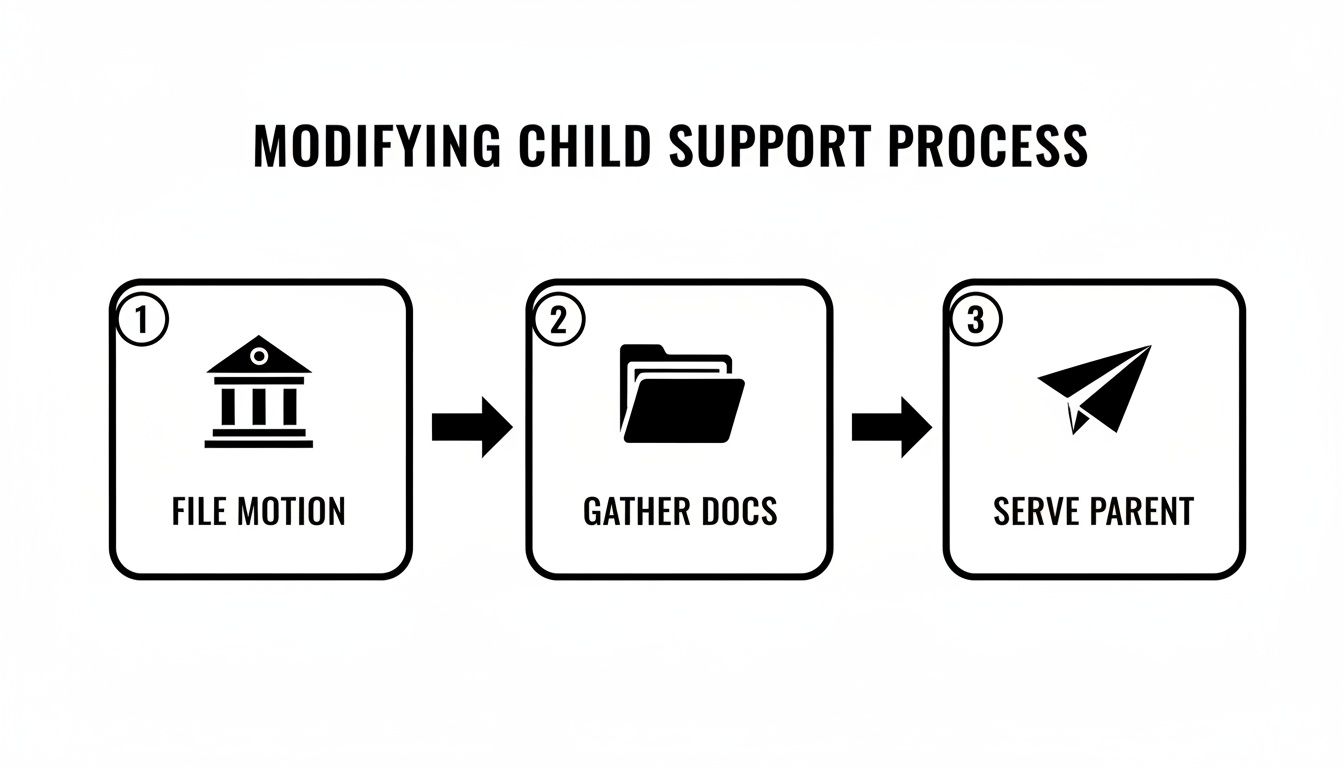
The process starts with filing your motion, but collecting your evidence happens right alongside it. It's a foundational step, not an afterthought.
Proving Changes in Income
If a change in income is the core of your modification request—whether it's yours or the other parent's—your documentation needs to be direct and indisputable.
For a decrease in your income, you’ll want to gather:
- Termination Letter: Official proof of your job ending.
- Final Pay Stubs: These show your year-to-date earnings and establish your previous income level.
- Unemployment Statements: If you're receiving benefits, this documents your current income.
- Job Search Log: A detailed record of applications, interviews, and emails proves you're actively looking for work and not "voluntarily impoverished."
If you believe the other parent’s income has increased, you'll need documents like pay stubs, W-2s, or employment contracts. For a self-employed parent, you may need to seek Profit & Loss statements, bank records, and full tax returns to get an accurate picture.
Practical Tip: Don't just hand the judge a stack of pay stubs. A simple summary sheet that compares your income and key expenses (like health insurance) from when the last order was entered to today gives the court a clear, at-a-glance comparison that makes your point instantly.
Documenting Your Child's Changing Needs
Sometimes, the reason for the modification has everything to do with the child. If your child’s needs have evolved, you must prove those new costs with receipts, bills, and invoices. To help you get organized, here is a checklist of essential documents.
Documentation Checklist for NC Child Support Modification
| Reason for Modification | Primary Documents to Gather | Secondary/Supporting Documents |
|---|---|---|
| Involuntary Job Loss | Termination letter or notice | Final pay stubs; Proof of unemployment benefits |
| Significant Income Change | Current pay stubs (at least 2-3 months) | Previous year's W-2; Employment contract or offer letter |
| Change in Health Insurance Cost | Statement from HR or insurance provider showing premium breakdown per person | Pay stubs showing the new deduction amount |
| New Childcare Costs | Invoices or statements from the daycare/provider | A signed letter from your employer confirming work schedule |
| New Extraordinary Expense | Invoices for tutoring, therapy, or medical care; Private school tuition statement | Doctor's recommendation or court order for the expense |
This checklist is a great starting point, but every case is unique. The timing of these changes is also critical. A judge needs to see when the change occurred to determine when a new support amount should begin. To learn more about how timing impacts your case, it’s helpful to understand the rules around retroactive child support in North Carolina.
Common Mistakes and How to Avoid Them
When you’re seeking a child support modification in North Carolina, even small missteps can undermine an otherwise strong case. Understanding what not to do is just as important as knowing the right steps to take. Let's walk through the most common pitfalls so you can protect your rights and avoid unnecessary delays.
Relying on Informal Agreements
It often starts with a simple conversation. You and the other parent are on good terms, so you agree to lower or pause payments. What could go wrong? A lot, actually.
A verbal promise or a text message exchange is not a legally enforceable agreement. If the other parent has a change of heart, they can go to court and demand the full amount owed under the original order, and the judge will side with them.
Crucial Takeaway: No matter how amicable your relationship is, you must formalize any change. A signed consent order from a judge is the only way to make your new agreement official and protect yourself from future claims of non-payment. This is not a guarantee of outcome but a statement of legal procedure.
Stopping Payments Before an Order is Modified
Losing your job or facing a medical crisis can make paying child support feel impossible. It can be tempting to just stop or reduce your payments on your own, but this is one of the most damaging mistakes you can make.
Until a judge signs a new order, your original child support obligation remains in full force. Defying a court order, even if you feel you have no choice, can lead to serious consequences in North Carolina:
- Accruing arrears (past-due support), often with interest.
- Contempt of court charges, which can result in fines or jail time.
- Destroying your credibility with the judge who will eventually hear your case.
Waiting Too Long to File Your Motion
Time is not on your side when your income drops. In North Carolina, a child support modification can only be retroactive to the date you officially file your Motion to Modify. It cannot be backdated to the day you lost your job.
Practical Example: If you lose your job in January but don't file your motion until April, you are on the hook for the higher child support amount for January, February, and March. The court cannot erase that debt. Filing quickly is the only way to get the financial relief you need as soon as possible.
Misrepresenting Your Financial Situation
When you file for a modification, you must submit a sworn Financial Affidavit detailing your income, assets, and expenses. Lying on a sworn legal document is perjury in North Carolina. If the other side discovers it—and they often do—your credibility with the judge will be gone. This can sink your entire case and may even lead to legal penalties. Be honest and be prepared to provide documents that back up every number you claim.
Ignoring the "Voluntary Impoverishment" Rule
Some parents assume they can quit a stressful, high-paying job for a less demanding, lower-paying one and automatically have their child support reduced. North Carolina courts look much deeper than that.
If a judge believes you are voluntarily impoverished—meaning you deliberately reduced your income in "bad faith" to shrink your support obligation—the court can “impute” income to you. This means your child support will be calculated based on what you should be earning, not what you actually make. To avoid this, you must be ready to prove that your job loss or income reduction was for a legitimate reason.
Frequently Asked Questions About NC Child Support Modification
Navigating this process often brings up specific questions. Here are clear, North Carolina-focused answers to some of the most common concerns we hear from clients.
Can I modify child support if it has been less than three years?
Yes, absolutely. The three-year rule is a common misconception; it's a shortcut, not a requirement. If a major event occurs—like an involuntary job loss, a significant change in the child's needs, or a large promotion for the other parent—you can file a motion to modify at any time. You just need to prove that the event qualifies as a "substantial change of circumstances" under North Carolina law.
Do we have to go to court to change our child support agreement?
Not always, but a judge must sign off on any changes to make them legally binding. If you and the other parent agree on a new support amount, you can formalize it by signing a Consent Order. This document outlines the new terms and, once signed by both parents and a judge, replaces your old order. This approach can save you time, money, and stress, but it still requires judicial approval. A verbal or text agreement is unenforceable.
How does a change in custody affect child support in North Carolina?
A change in the overnight schedule is one of the most common reasons for an NC child support modification. North Carolina uses an "income shares" model, and the number of overnights each parent has with the child is a direct input in the calculation worksheet (Worksheet A for primary custody, Worksheet B for joint custody of at least 123 nights). A significant shift in parenting time almost always justifies a new support calculation. You may also want to read our guide on when child support ends in North Carolina.
What happens if I quit my job to try to lower my payments?
North Carolina courts call this "voluntary impoverishment." If a judge believes you have intentionally reduced your income in bad faith to avoid your support obligation, they have the power to impute income to you. This means they will calculate child support based on your earning potential or your previous salary, not your current, lower income. To avoid this, you must prove your career change was made in good faith for a legitimate reason.
How much child support is ordered in North Carolina?
The amount varies dramatically based on parents' incomes, the custody schedule, and costs like health insurance and daycare. While state guidelines set a minimum payment of $50 per child per month, there is no official cap. In the most recent reporting period, North Carolina managed 401,750 active cases and collected over $691 million for children. You can review the data at NC child support statistics and collections.
Get a Clear Strategy for Your North Carolina Child Support Case
The laws governing an NC child support modification are complex, and the outcome will affect your family's finances for years to come. Navigating this on your own while facing a stressful life event is a daunting task. At the Law Office of Bryan Fagan, we provide strategic, client-focused representation to protect the rights of North Carolina residents.
Our experienced attorneys can help you build a persuasive, evidence-based case, negotiate a fair agreement, and advocate for you in court. We are committed to helping you find a sustainable solution that reflects your family's current reality. Schedule a consultation today to discuss your situation and build a plan to secure the right support order for your family. Visit us at https://bryanfaganlaw-nc.com.