Dealing with child support can be a challenge, especially when you're trying to cover costs from the past. In North Carolina, retroactive child support is the legal process for seeking financial support for a period before a formal court order was ever signed by a judge.
This process is designed to ensure a child receives the financial benefit of support from both parents, even for time that has already passed. It's a critical tool for parents who have been shouldering the costs of raising a child on their own.
Understanding Retroactive Child Support in NC

When parents live apart without a formal support agreement, one parent often ends up shouldering the entire financial load of raising their child. Retroactive child support is North Carolina’s way of correcting that imbalance.
It gives the parent who has been providing care the ability to ask the court to order the other parent to contribute to the child-rearing expenses that were paid out-of-pocket before a lawsuit was ever filed. Think of it as a way for the court to "true up" the financial accounts and ensure both parents share in the responsibility from an earlier date.
Retroactive Support vs. Back Child Support (Arrears)
One of the biggest points of confusion for parents is the difference between retroactive child support and "back child support," also known as arrears. They are not the same, and knowing the difference is critical for your North Carolina case.
Retroactive child support is for a period before a court order existed. In contrast, back child support (arrears) is the unpaid amount that has accumulated after a court order was already in place.
A claim for arrears is about enforcing an existing order that was ignored. A claim for retroactive support is about creating a new financial obligation for a past period where no order existed.
Why This Matters for North Carolina Parents
This legal concept is vital in several common situations. If you've been providing for your child alone without financial help, this is your primary tool for seeking reimbursement for those past costs. It’s particularly relevant for parents dealing with:
- Paternity Establishment: After paternity is legally confirmed for a child, the mother can ask the court to award retroactive support.
- Separation Without an Order: Couples who separate but wait a long time to file for divorce or support can use this to cover the financial gap.
- Informal Agreements Gone Wrong: If the other parent promised to pay support but never did, or paid less than they should have, a retroactive claim can formalize that past-due obligation.
The table below breaks down the key differences between these two types of support claims to make it crystal clear.
Retroactive Support vs. Back Child Support (Arrears)
| Attribute | Retroactive Child Support | Back Child Support (Arrears) |
|---|---|---|
| Time Frame | Covers the period before a child support order is created. | Covers missed payments after a child support order exists. |
| Legal Basis | A new claim filed to establish a past-due obligation under NC law. | Enforcement action for violating an existing court order. |
| Example | A parent files in 2024 to get support for the period from 2021 to 2024. | A parent fails to make their court-ordered $500/month payment. |
Understanding which type of support applies to your situation is the first step in building a strong case and pursuing the financial resources your child deserves.
How Far Back Can Retroactive Child Support Go in NC?
When it comes to retroactive child support, the first question on every parent’s mind is, “How far back can I really go?” In North Carolina, the law gives a very clear and firm answer. This time limit, known as a statute of limitations, is one of the most critical parts of your case because it sets the absolute maximum amount of past support you can recover.
North Carolina's Three-Year Rule Explained
North Carolina law establishes that the deadline for filing a retroactive child support claim is three years. This rule comes from North Carolina General Statute § 1-52, which covers various types of legal claims. Our state’s courts have consistently applied this statute to retroactive child support, meaning you can only seek support for the three-year period immediately before the date you formally file a complaint with the court.
This rule was created to strike a difficult but necessary balance. On one hand, it upholds a child’s fundamental right to be supported by both parents. On the other, it protects a parent from being blindsided by a massive, indefinite financial demand stretching back a decade or more, which could be financially devastating.
Let’s walk through a real-world scenario to see how this plays out.
Real-World Scenario:
Maria has a seven-year-old son, Leo. She has raised him entirely on her own since birth, without a formal child support order or any consistent financial help from Leo's father. If Maria files a Complaint for Child Support on June 1, 2024:
- Look-back period: Her retroactive claim can only cover the time from June 1, 2021, to May 31, 2024.
- Excluded period: The first four years of Leo’s life—from his birth until May 31, 2021—are now outside the statute of limitations for a retroactive claim.
Even though Leo's father had a moral and legal duty to support him for all seven years, the court can only legally enforce that duty for the last three. This is why acting promptly is so important for custodial parents.
The Clock Starts When You File
The three-year countdown doesn’t start from your child’s birthday or the day you separated. It works backward from the exact day you file your legal complaint. This is a critical detail many parents miss—the power to start the clock and define that three-year window is entirely in your hands.
A common misconception is that you can claim retroactive child support all the way back to when the child was born. In North Carolina, this is not true. The law strictly limits the claim to the three years immediately preceding the filing date of your court action.
This rule means that every single day you wait to file is another day of potential support that you can no longer recover. The three-year "look-back" window is constantly moving forward with time.
How NC Courts Calculate Retroactive Support Owed
Once a North Carolina court confirms a retroactive child support claim is valid and falls within the three-year limit, the next question is: how much is owed? Many parents assume they need a mountain of paperwork—a shoebox stuffed with old receipts for diapers, daycare, and doctor visits—to prove their case.
The good news is, the process is much more straightforward. North Carolina courts rely on a standardized and predictable formula.
Applying the NC Child Support Guidelines Retroactively
The foundation for calculating retroactive support is the exact same tool used for all current child support cases: the North Carolina Child Support Guidelines. A judge will apply these official guidelines "retroactively" to the three-year period before the claim was filed.
Here’s how it works. The court will look back at each of the past three years and determine what the child support obligation would have been if an order had been in place all along. To do this, the court needs critical information: both parents' gross incomes for each of those years, along with costs for work-related childcare and health insurance for the child.
Key Takeaway: Calculating retroactive child support in North Carolina is not about adding up old receipts. It is about applying the official child support formula to the parents' past incomes and relevant expenses.
For example, if you file a claim in October 2024, the court will focus on the parents' incomes and expenses from October 2021 through September 2024. The judge will then use the appropriate Child Support Worksheet (A, B, or C, depending on the custody situation) to determine the total support owed for that entire period.
This infographic simplifies the three main stages of a retroactive claim.
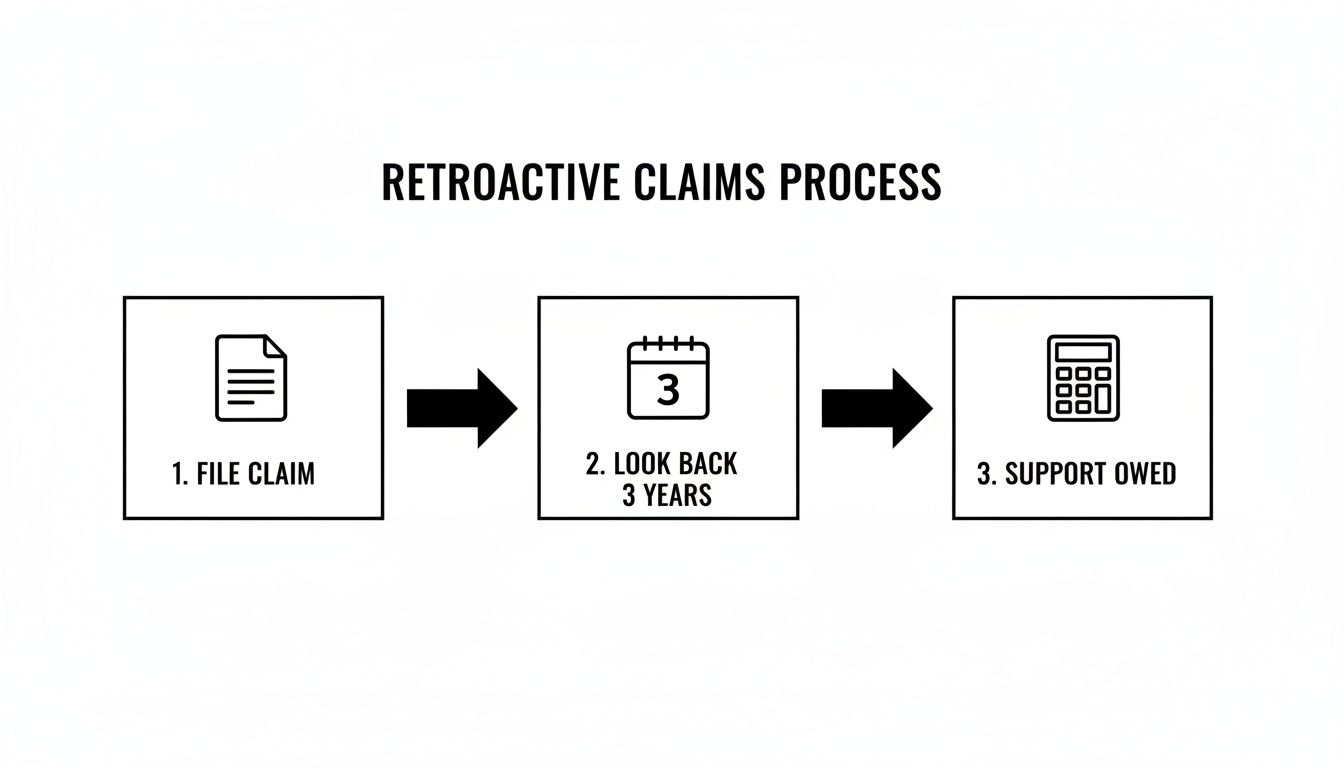
As you can see, the process flows from the initial filing to a detailed financial review of the three-year look-back period, ending with a precise calculation of the support owed based on the Guidelines.
Proving Past Income Is Essential
Building a strong case for retroactive support hinges on gathering accurate income data. The court needs solid evidence, not guesswork. The most effective forms of proof are direct and clear:
- Tax Returns: Federal and state tax returns are the gold standard for showing a person's annual gross income.
- Pay Stubs: W-2s and recent pay stubs clearly show earnings, bonuses, and sometimes overtime.
- Bank Statements: For self-employed individuals or those with inconsistent pay, bank deposits can help establish a clear income picture.
If the other parent is uncooperative and refuses to provide this information, your attorney can use the formal "discovery" process. This is a set of legal tools that compels them to produce the necessary financial documents.
What if the Other Parent Hides Income?
One of the most common worries we hear is what to do when the other parent is paid in cash, deliberately works less, or simply refuses to hand over financial documents. North Carolina law gives judges the power to address these tactics.
If a parent is voluntarily unemployed or underemployed to avoid their support obligation, a judge has the authority to impute income. This means the court calculates support based on what that parent should be earning, considering their:
- Education and training
- Recent work history
- Potential earning capacity in the local job market
Essentially, the court won't let a parent avoid responsibility by quitting a good job or hiding their income. This powerful tool ensures that the child’s needs are prioritized, even when one parent isn't cooperating.
Building and Defending Your Case in Court
Whether you're seeking retroactive child support or defending against a claim, the court process can feel overwhelming. Success on either side comes down to building a strong, evidence-based case. Knowing the right procedures and legal arguments is the first step toward protecting your rights and securing a fair outcome in a North Carolina courtroom.
For the parent seeking back support, the journey begins by filing a formal Complaint for Child Support. This legal document officially starts the case and must be properly served on the other parent. From that point forward, your case will depend on the quality of your evidence.
What the Parent Seeking Support Needs to Prove
Your main jobs are to establish parentage and clearly document both parents' incomes during the three-year look-back period. Strong evidence isn't just helpful; it's essential. You'll need to gather documents that leave no room for doubt.
Key evidence includes:
- Proof of Parentage: This could be a birth certificate listing both parents, a signed Affidavit of Parentage, or a court order establishing paternity.
- The Other Parent's Income: This is the most critical piece for calculating the amount owed. Collect any tax returns, pay stubs (W-2s), or business records you can find.
- Your Own Income Information: The court considers both parents' incomes, so you must be ready with your own financial records.
- Childcare and Health Insurance Costs: Records of payments for work-related childcare and the child's health insurance premiums for the three-year period are also required.
If you don't have the other parent's income information, your attorney can use the formal "discovery" process to legally request these documents. This compels the other parent to produce the necessary financial records for the court to review.
Common Defenses Against a Retroactive Claim
If you're the parent being asked to pay, you have rights and potential legal defenses. An award of retroactive support is not automatic. A judge will consider valid arguments that might reduce or even eliminate the amount you owe.
It’s a common misconception that if you’re asked to pay retroactive support, you have no options. North Carolina courts will listen to valid defenses, especially those backed by clear financial proof.
Here are some of the most effective defenses in North Carolina retroactive child support cases:
- Statute of Limitations: As we've covered, the claim is strictly limited to the three years before the complaint was filed. Any request for support reaching beyond that three-year window is legally barred.
- Credit for Past Support Paid: Did you make voluntary payments directly to the other parent to help with the child’s expenses? If so, you may be entitled to a credit. This is one of the strongest defenses, but you must have proof. Bank statements, canceled checks, or digital payment records (like Venmo or Zelle) with clear memos are vital.
- Unfair Conduct (Laches): In rare cases, you might argue that the other parent unreasonably delayed filing their claim in a way that is fundamentally unfair to you. For instance, if they intentionally hid the child's existence from you for years, a judge might find it inequitable to order a large retroactive payment.
Real-World Scenario:
Mark receives a complaint for retroactive child support from his child's mother, Sarah, covering the past three years. However, during that entire time, Mark was directly depositing $400 every month into her bank account with the memo "Child Support." He can present these bank statements to the court as solid evidence. The judge will almost certainly credit him for those payments, which will dramatically reduce or even eliminate the final retroactive amount he owes.
The specifics of your case can also affect how ongoing support is handled. If circumstances change down the road, you may need to file for a modification. You can learn more by reading our guide on how to handle a child support modification in NC. Navigating these defenses requires careful strategy and compelling evidence, making experienced legal guidance crucial.
How Retroactive Support Payments Are Managed
Once a judge orders retroactive child support, the next logical question is: how does it actually get paid? The court knows that demanding thousands of dollars in a single lump-sum payment is unrealistic for most people and could create an impossible financial strain.
Instead, North Carolina courts focus on creating a practical and manageable payment plan.

The total retroactive support amount is calculated and then added to the regular, ongoing monthly child support payment. This approach spreads the debt over a reasonable period, ensuring the child receives the support they are owed without financially derailing the paying parent.
The Structure of a Payment Plan
A judge has significant flexibility when setting up a repayment schedule. The main goal is to create a plan that is both fair and sustainable for everyone involved. The court will order a specific additional amount to be paid each month on top of the current support until the entire retroactive balance is paid off.
Here’s a common example of how it works:
- Total Amount Owed: The court first confirms the final retroactive support figure—for instance, $7,200 covering the past three years.
- Monthly Installment: The judge then sets a reasonable monthly payment toward that debt, like $200 per month.
- Total Payment: This installment is simply added to the regular support payment. If ongoing support is $500, the new total monthly payment becomes $700.
- Duration: These payments continue until the retroactive balance is cleared. In this scenario, it would take 36 months to pay off the $7,200 debt.
This structured method provides consistency and makes it much easier to track payments and enforce the order if they are missed. In most cases, these payments are routed through North Carolina Child Support Services to create an official payment history.
How North Carolina Compares to Other States
North Carolina's approach fits into a larger, nationwide effort to balance parental accountability with realistic repayment terms. Some states handle this differently. For example, Texas family law allows claims for retroactive support going back four years, and in some cases, all the way to the child's birth.
North Carolina's strict three-year rule provides more predictability for both parents. This ongoing adjustment in laws across the country, which you can read about in family law discussions on this topic or on government sites like the HHS website, shows how states are constantly working to make their laws support children in a way that is fair and effective.
FAQ: Common Questions About Retroactive Support in North Carolina
Navigating a retroactive child support claim can be confusing. Here are answers to some of the most common questions we hear from clients across North Carolina.
1. Can I get retroactive child support back to my child's birth in NC?
No. This is a common misconception. In North Carolina, there is a firm three-year statute of limitations under N.C.G.S. § 1-52. This means a court can only order back-support for the three-year period immediately preceding the date you file your lawsuit. It does not matter if your child is five or fifteen; the look-back period is capped at three years.
2. What if I don't know the other parent's income?
This is a very common and solvable problem. You are not expected to have all the other parent's financial records. A family law attorney can use the formal legal process called “discovery” to legally require the other parent to provide their financial documents, such as tax returns and pay stubs. If they refuse or try to hide income, a judge can impute income to them based on their earning potential.
3. I made voluntary payments. Do I still owe retroactive support?
Maybe, but those payments can be used as a defense. If you can provide proof of direct payments made for child support (e.g., bank statements, canceled checks, Venmo/Zelle records with clear memos), a judge will likely give you credit for those amounts. If your voluntary payments were less than what the NC Child Support Guidelines would have required, you may still owe the difference for the three-year period.
4. How is a retroactive child support award actually paid?
A court will not demand a large lump-sum payment. Instead, the total retroactive amount is typically converted into a monthly payment plan. This amount is added on top of the regular, ongoing child support obligation. For example, if ongoing support is $500 and the retroactive payment is set at $150 per month, the total monthly payment would be $650 until the retroactive balance is paid in full.
5. Does a retroactive claim also establish future child support?
Yes. A Complaint for Child Support that includes a retroactive claim will also result in an order for ongoing, current child support moving forward. The court will use the parents' current financial information to calculate the monthly support amount that will be due until the child is no longer eligible for support. You can learn more about when child support payments end in NC.
Get Help with Your North Carolina Case Today
Retroactive child support cases can quickly become complicated and emotionally charged. Whether you are a parent seeking the financial support your child has been owed or you are defending against a claim, the stakes are incredibly high for your family's financial stability.
Navigating North Carolina's laws, from the three-year statute of limitations to the rules on imputing income, is a major risk to take on your own. An experienced family law attorney does more than file paperwork; they build a strategic case, gather the right financial evidence, and ensure the state's complex guidelines are applied correctly. Most importantly, they will be your advocate in court.
You do not have to face this stressful process alone. We invite North Carolina residents to schedule a confidential consultation with our team to get clear, honest answers about your situation. With the right legal support, you can confidently address these issues and work towards a fair outcome. For more background, you might find our overview of child custody matters in North Carolina helpful.
Contact the Law Office of Bryan Fagan to schedule a consultation by visiting us at https://bryanfaganlaw-nc.com.