Facing a divorce can feel overwhelming. The legal rules, the emotional strain, and the uncertainty about your future—it’s a lot to carry. You don't have to navigate this journey alone.
Understanding the specific laws that govern divorce in North Carolina is the first step toward regaining control. A knowledgeable NC divorce attorney is more than just a legal representative; they are your strategist and guide, helping you make informed decisions when it matters most. This guide will walk you through the essential aspects of North Carolina divorce law, using practical examples and clear language to empower you.
Navigating Your North Carolina Divorce Journey

Starting the divorce process in North Carolina can feel like stepping into a complex maze without a map. The good news is that the right legal partner can light the way, turning confusing legal jargon into a clear, practical roadmap. Think of this not just as an ending, but as the beginning of your next chapter. To start that chapter on solid ground, it's essential to understand the unique rules that govern divorce in our state.
North Carolina Is a "No-Fault" State
Unlike some states that require you to prove a spouse was "at fault" for the marriage ending (like abuse or adultery) just to get divorced, North Carolina is primarily a no-fault divorce state. This means you don’t have to air private grievances in a courtroom simply to be granted a divorce.
Instead, the overwhelming majority of divorces in our state are granted based on a single, clear requirement.
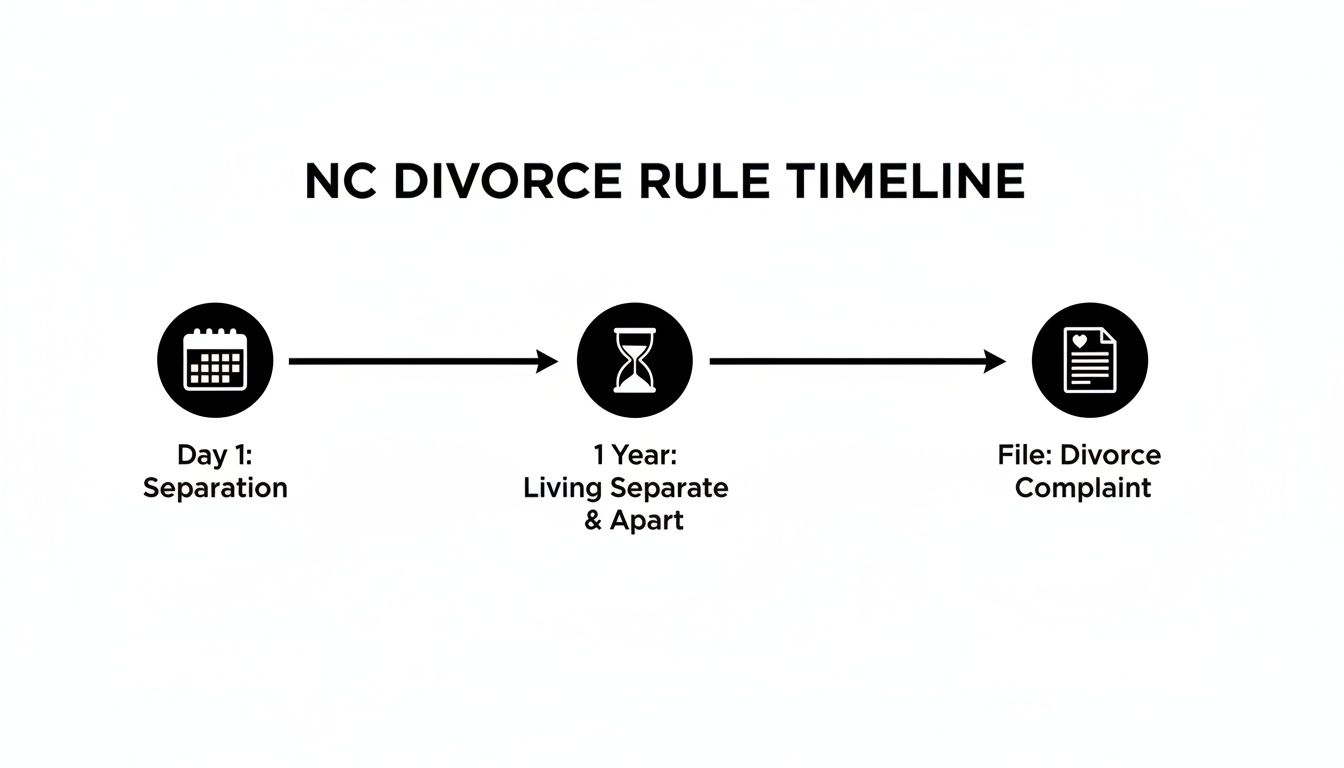
The cornerstone of North Carolina divorce is the mandatory one-year physical separation. This rule, laid out in North Carolina General Statutes § 50-6, dictates the entire timeline and is the first major milestone on your journey.
What This Means for You
Grasping this separation rule is key. It means that from the day you and your spouse begin living in separate homes—with the intent to remain apart—a one-year clock starts ticking. Only after that full year has passed can either of you file for an "absolute divorce" to legally end the marriage.
Our goal is to empower you with the knowledge needed to face this process with confidence. You can learn more about the specifics by exploring our detailed guide on the role of a divorce attorney in North Carolina. By turning uncertainty into a clear plan, you can begin to build your new future, one informed step at a time.
Understanding NC Divorce Law: The One Year Separation Rule
If you’re considering divorce in North Carolina, there’s one non-negotiable rule you need to understand right from the start. The entire process hinges on this one critical requirement: the one-year separation rule.
Before you can ask a court for a final or absolute divorce, you and your spouse must have lived separate and apart for at least one full year. This requirement, found in North Carolina General Statute § 50-6, shapes the entire timeline and strategy of a North Carolina divorce. It’s the first piece of the puzzle, and our attorneys build every case strategy around this fact.
The Two Grounds for Divorce in North Carolina
North Carolina law keeps things very straightforward. According to statute, there are only two legal grounds for an absolute divorce in our state:
- One Year of Separation: This is the foundation for over 99% of all divorces filed in North Carolina. It simply requires proving that you and your spouse have lived physically separate and apart for a full year with the intent to end the marriage.
- Incurable Insanity: This is an exceptionally rare and complex ground. It requires proving a spouse has been institutionalized for incurable insanity for three consecutive years before a divorce can be granted.
Because of its prevalence, the one-year separation rule is the path that almost every couple takes. An experienced NC divorce attorney will focus on navigating this timeline effectively from day one.
What Does "Living Separate and Apart" Mean?
This is where many people get tripped up. What does it legally mean to be “separate and apart” in the eyes of a North Carolina court? It’s much more than just sleeping in different bedrooms.
To meet the legal standard for separation in North Carolina, you must reside in two different homes. Crucially, at least one spouse must have the intent for the separation to be permanent.
Living under the same roof, even in a finished basement or a separate guest suite, does not count as legal separation. The clock for your one-year requirement only starts ticking once one of you has physically moved out.
Real-World Scenario:
Sarah and Tom agree their marriage is over. Tom moves into a new apartment on June 1st, 2025. This is their date of separation. Even if they talk regularly about their kids' schedules, they are living separate and apart. They will become eligible to file for an absolute divorce on June 2nd, 2026.
What Is a "Divorce From Bed and Board"?
Another term that often creates confusion is "Divorce from Bed and Board." Despite the name, this is not a divorce. Think of it instead as a court-ordered legal separation initiated due to one spouse's misconduct.
A Divorce from Bed and Board is a type of lawsuit one spouse can file against the other based on marital fault, such as:
- Adultery
- Abandonment
- Cruel or barbarous treatment
- Substance abuse that makes life intolerable
This legal action does not end the marriage, but it can be used to legally force a separation and obtain court orders for post-separation support or child custody before the one-year mark is up. For a deeper look into the formal process, check out our guide on how to file for separation in NC. It is a powerful strategic tool that an NC divorce attorney might recommend in certain high-conflict situations.
The Big Three: Custody, Support, and Property in a North Carolina Divorce
Getting the final divorce decree officially ends your marriage, but that single piece of paper doesn't solve the issues that truly shape your future. The real work of a divorce happens when you untangle your lives. This means making firm decisions on three core matters: child custody, financial support, and how you’ll divide your property.
These critical issues aren't settled by the simple divorce filing itself. They must be resolved, either through a negotiated Separation Agreement outside of court or by a judge’s order. Understanding how North Carolina law treats each of these areas is the first step in building a strategy that protects what matters most to you.
Child Custody: The "Best Interest of the Child" Standard
For any parent, nothing is more important than their children's well-being. North Carolina law agrees. Every custody decision is guided by one single, powerful principle found in North Carolina General Statute § 50-13.2: what is in the “best interest of the child.” This isn't just a phrase; it's the legal yardstick a judge uses to measure every family's unique situation.
A judge will look at any factor that affects a child's welfare and happiness. Some of the most common considerations include:
- Each parent's ability to provide a safe, stable home.
- The existing relationship the child has with each parent.
- Which parent has historically been the primary caregiver.
- Any history of domestic violence, substance abuse, or neglect.
- The child’s own wishes, if they are old enough and mature enough to express a reasonable preference.
It's also important to know that North Carolina splits custody into two types:
- Physical Custody: This determines where the child physically lives. It can be sole (living with one parent most of the time) or joint (where parents share time, though not always 50/50).
- Legal Custody: This is about the right to make major decisions for your child—things like education, non-emergency healthcare, and religious upbringing. It’s very common for parents to share joint legal custody even if one parent has primary physical custody.
Real-World Scenario: Let's say Maria and David are separating. Maria has always handled school pickups, homework, and doctor visits. David works long hours but is a devoted dad on weekends. A judge might award them joint legal custody, allowing both to have a say in big decisions. For physical custody, Maria might be granted primary custody during the school week to keep the child’s routine consistent, while David gets a generous schedule on weekends, holidays, and summer breaks.
Child and Spousal Support: Balancing Formulas and Fairness
Once a parenting schedule is set, the next logical question is money. How will the children’s needs be met? Will one spouse need financial help from the other? North Carolina has clear guidelines for child support but takes a much more case-by-case approach to spousal support.
The one-year separation period is more than just a waiting game; it's the prime window for negotiating these crucial financial matters before the divorce is finalized.
For child support, the NC Child Support Guidelines use a formula. It's almost like a math equation based on both parents' gross monthly incomes, the number of overnights the child spends with each parent, and costs for health insurance and work-related childcare. This makes the amount fairly predictable.
Spousal support, on the other hand, is far more subjective. There are two kinds:
- Post-Separation Support (PSS): Think of this as temporary spousal support. It's paid from the date you separate to help a financially dependent spouse cover their immediate needs while the divorce is pending.
- Alimony: This is longer-term support that can be awarded after the divorce is final. There’s no simple formula here. A judge weighs factors like marital misconduct, each spouse's earning capacity, the length of the marriage, and the standard of living during the marriage.
Key Takeaway: Marital misconduct—specifically "illicit sexual behavior"—plays a massive role in alimony cases. Under NC law, if a dependent spouse is proven to have committed adultery before separation, they are completely barred from receiving alimony. If the supporting spouse is the one who committed adultery, the court is required to award alimony to the dependent spouse.
Equitable Distribution: Dividing Your Marital Property Fairly
Finally, there's the task of dividing everything you acquired together during the marriage. North Carolina is an equitable distribution state, a concept you absolutely need to understand.
"Equitable" means fair, not necessarily an equal 50/50 split. The law starts with the presumption that an equal division is fair, but a judge can order an unequal division if the circumstances justify it.
The following table breaks down how North Carolina's system differs from community property states.
Equitable Distribution vs. Community Property in North Carolina
| Feature | Equitable Distribution (North Carolina) | Community Property (Other States) |
|---|---|---|
| Core Principle | Assets and debts are divided fairly (equitably). | Assets and debts are divided equally (50/50). |
| Initial Presumption | A 50/50 split is presumed fair but can be changed. | A 50/50 split is generally mandatory. |
| Judicial Discretion | Judges have significant discretion to order an unequal split based on statutory factors (e.g., income, health, misconduct). | Judges have very little discretion to deviate from the 50/50 rule. |
| Property Types | Property is classified as marital, separate, or divisible. | Property is classified as community or separate. |
| Goal | To achieve a fair and just outcome based on the specific facts of the marriage. | To achieve a mathematically equal division of all assets acquired during the marriage. |
As you can see, North Carolina's approach allows for a much more customized outcome based on your family's unique circumstances. The process itself follows three key steps:
- Identify: Make a complete inventory of all property owned by you and your spouse.
- Classify: Categorize each asset as either marital, separate, or divisible property.
- Value & Distribute: Assign a fair market value to the marital property and divide it between the spouses.
Marital Property is generally anything you or your spouse earned or acquired from the date of marriage until the date you separated. This includes the house, cars, bank accounts, investments, and retirement account growth during the marriage. Separate Property includes anything you owned before the marriage or inheritances and gifts given just to you during the marriage.
Sorting through this requires deep knowledge of state law. You can learn more in our detailed guide about what is equitable distribution. An attorney's job is to ensure every asset is found, correctly classified, and properly valued to protect your financial security.
What a Great NC Divorce Attorney Actually Does for You
When you hire an experienced NC divorce attorney, you’re getting much more than someone to fill out paperwork. You are bringing a legal strategist, a skilled negotiator, and a dedicated advocate into your corner. The true value of a great attorney lies in protecting your rights and securing your future during one of life's most challenging transitions.
An attorney's work begins the moment you separate. They don't just react to problems; they build a proactive strategy designed to achieve your specific goals, safeguarding your financial stability and preserving your parental rights.
Your Attorney as a Strategist and Investigator
One of the most critical roles an attorney plays is that of an investigator, especially when financial complexities or a lack of trust are involved. If you’re worried your spouse is hiding assets or downplaying their income, your attorney has powerful legal tools to uncover the complete financial picture.
This process is called discovery. Through discovery, your lawyer can formally request financial documents that your spouse is legally required to provide, such as:
- Bank and credit card statements
- Personal and business tax returns
- Loan applications and business profit-and-loss statements
- Retirement and investment account records
A common client concern is, "My spouse handled all the finances. I'm worried they'll hide money." A great NC divorce attorney uses subpoenas and formal discovery requests to compel banks, employers, and financial institutions to turn over records, ensuring transparency and a fair division of assets under the law.
Your Attorney as a Skilled Negotiator
The vast majority of North Carolina divorce cases are settled out of court. This is where your attorney’s skill as a negotiator becomes invaluable. Their primary goal is often to craft a comprehensive Separation and Property Settlement Agreement.
This legally binding contract can resolve all major issues of your divorce—child custody, child support, property division, and alimony—without ever stepping foot in front of a judge. A well-drafted agreement provides clarity and, most importantly, keeps you in control of the outcome.
How This Works in Practice:
Imagine a contentious custody situation is developing. Your attorney can work with your spouse's lawyer to negotiate a detailed parenting plan covering everything from the weekly schedule to holidays, vacations, and medical decision-making. By de-escalating conflict and focusing on practical solutions, your attorney helps you avoid a costly and emotionally draining court battle.
Your Attorney as a Courtroom Advocate
While negotiation is almost always preferred, your attorney must also be prepared to be a strong litigator. If your spouse is unreasonable or refuses to negotiate in good faith, you need an advocate who is ready to fight for your rights in a North Carolina courtroom.
This means preparing evidence, cross-examining witnesses, and making compelling legal arguments to a judge. Whether it’s arguing for a specific custody arrangement that is in your child's best interest or presenting a detailed financial case for alimony, your attorney is your voice and your shield in court. Hiring a skilled NC divorce attorney ensures you are prepared for any turn your case might take.
How to Choose the Right NC Divorce Attorney for You

Of all the choices you face during a divorce, selecting the right attorney is one of the most critical. This person will be your strategist, advocate, and guide. The right choice can lead to a smoother, more secure future, while the wrong one can add unnecessary conflict and expense.
Think of finding a lawyer not just as hiring help, but as forming a partnership. You need someone whose experience, communication, and legal philosophy align with your specific goals. This is about finding the best NC divorce attorney for your unique case.
Look for a Dedicated Family Law Specialist
Not all attorneys are the same, and North Carolina family law is a highly specialized field. A lawyer who handles everything from personal injury to real estate is a generalist. They won't have the deep, nuanced understanding of local court procedures and judicial tendencies that a dedicated family law practitioner possesses.
When your financial security and parental rights are at stake, you need a specialist. An attorney who dedicates their practice 100% to North Carolina family law will be up-to-date on the specific statutes, case law, and strategies that directly impact your case. This focused experience gives you a meaningful advantage.
Vet Candidates and Prepare for Your Consultation
Before you schedule any meetings, do some initial homework. Vetting candidates beforehand helps you narrow your list down to a few strong contenders. Here’s a practical checklist:
- Read Client Reviews: Look for consistent themes in feedback on Google and other legal sites. Do clients repeatedly mention strong communication, strategic advice, and feeling supported?
- Check for Peer Endorsements: Awards from services like "Super Lawyers" or "Best Lawyers" are often based on nominations from other attorneys, which signals respect within the legal community.
- Review Their Website: Does their content specifically address North Carolina law? Does it show genuine authority and provide helpful information, or is it vague and generic?
Once you have a shortlist, it's time to schedule consultations. Treat this meeting as a two-way interview. You are evaluating them just as much as they are evaluating your case.
Ask Powerful, Specific Questions
To get the most out of your consultation, arrive prepared with questions that get to the heart of what matters. Vague questions get vague answers. Instead, ask targeted questions that reveal an attorney's experience, strategy, and approach.
Questions to Ask a Potential NC Divorce Attorney:
- What percentage of your practice is dedicated to family law cases in my county? (This demonstrates local, hands-on experience.)
- Based on what I’ve shared, what is your initial strategic approach for a case involving these types of financial and custody issues?
- Who in your office will be my main point of contact, and what is your firm’s policy on returning client calls and emails?
- Can you explain your billing process? What is the retainer, what are the hourly rates for you and your staff, and what other costs can I expect?
- What is your philosophy on when to settle versus when to fight in court?
The answers to these questions will reveal much more than a simple "yes, I can help you." They will give you insight into the attorney's practical experience and whether their approach is a good fit for you. Your goal is to find a trusted partner who can provide both expert legal guidance and the peace of mind needed to move forward.
Frequently Asked Questions about Divorce in North Carolina
1. How much does a divorce cost in North Carolina?
The cost of a divorce in North Carolina varies significantly based on one factor: conflict. An uncontested divorce, where you and your spouse agree on all major issues (property, custody, support) through a Separation Agreement, is the most affordable route. Costs rise dramatically with litigation. If your case requires court battles over custody, complex assets, or alimony, legal fees will be substantially higher due to the extensive time and preparation involved.
2. Can I date during my one-year separation in NC?
While you legally can, experienced NC divorce attorneys will almost always advise against it. Under North Carolina law, dating during your mandatory one-year separation can be used against you as evidence of "illicit sexual behavior." This isn't just a moral judgment; it has serious financial consequences. A judge's finding of illicit sexual behavior can completely bar a dependent spouse from receiving alimony or, conversely, force a supporting spouse who engaged in it to pay alimony. It's a massive legal risk with very little upside.
3. Do we have to go to court to get divorced in NC?
Not necessarily. In fact, most North Carolina divorces are resolved without either spouse ever stepping inside a courtroom. If you and your spouse can negotiate and sign a comprehensive Separation and Property Settlement Agreement that resolves all issues of property division, support, and custody, the final divorce can be a simple administrative process after your one-year separation is complete. Court becomes necessary only when you cannot reach an agreement.
4. Do I need a lawyer for an uncontested divorce in North Carolina?
While you are not required to have a lawyer, it is highly recommended. A Separation Agreement is a complex legal contract that will affect your rights for years to come. A mistake or an overlooked detail in the agreement could have devastating financial consequences. Having an experienced NC divorce attorney draft or review your agreement ensures your rights are protected and the document is legally enforceable.
Your Next Step Toward Clarity and Confidence in North Carolina
You've taken an important first step by seeking information. Facing a North Carolina divorce can feel isolating, but you don't have to navigate it alone. The confusion and stress you're feeling are valid. The single most powerful tool you have right now is a clear legal strategy built on the realities of North Carolina law. This is your chance to move from a place of uncertainty to one of control.
We invite you to schedule a confidential consultation with one of our experienced NC divorce attorneys.
What to Expect in Your Consultation
This first meeting is a protected, private space for you to get straightforward answers about your North Carolina case. Our only focus is giving you a realistic assessment of your situation—no false promises, just clear legal guidance tailored to you.
We will:
- Listen carefully to understand your priorities and unique circumstances.
- Explain your legal options under North Carolina statutes in plain English.
- Start outlining a path forward designed to protect your rights, your assets, and your family.
A consultation is more than a sales pitch; it's your opportunity to ask tough questions and decide if an attorney is the right partner to protect your future. We don't guarantee outcomes, but we promise clarity and a commitment to your best interests.
Start Building Your New Beginning in North Carolina
Successfully navigating equitable distribution, child custody, and support requires a guide who is deeply familiar with North Carolina's legal landscape. Your attorney is your advocate and strategist, working to secure a stable foundation for your future.
Taking this next step is about shifting from reacting to what’s happening to proactively planning for what's next. Your new beginning starts with having a dedicated advocate in your corner.
Ready to take control? schedule a confidential consultation with us today to discuss your case with a dedicated North Carolina family law attorney and start building the framework for your future.