Facing a divorce in North Carolina can feel overwhelming, but you don’t have to go through it alone. A skilled North Carolina divorce attorney is more than just a lawyer for court; they are your strategic guide through the state’s specific legal system, helping you understand your rights and options from the mandatory separation period to the final property division agreement.
Your Partner Through a North Carolina Divorce
Think of an experienced divorce attorney as your personal advocate for one of life’s most complex transitions. Their main job is to protect your interests by helping you understand North Carolina law, set realistic goals for your financial future, and build a clear strategy to secure it. They turn a confusing legal process into a series of manageable steps, giving you clarity and confidence when you need it most.
While divorce is always a challenge, recent trends show a slight decline in North Carolina's divorce rate, which dropped from 5.1 divorces per 1,000 residents in 2000 to just 2.7 per 1,000 in 2023. Even with this shift, the need for client-focused legal support remains critical to minimize conflict and protect your long-term stability. You can explore additional North Carolina divorce statistics to learn more about these trends.
The Role of Your Attorney
An attorney’s responsibilities go far beyond just filing paperwork. Their role is to provide essential support across every key area of your case, acting as your:
- Strategic Advisor: Helping you understand the nuances of North Carolina law, including the critical one-year separation requirement mandated by state statute.
- Skilled Negotiator: Working to resolve disputes over property, custody, and support outside of court through methods like mediation or collaborative law.
- Staunch Advocate: Representing your best interests in court should litigation become necessary.
- Objective Counselor: Providing a level-headed perspective during an emotionally charged time, helping you make decisions based on logic, not just emotion.
Common Misconception: Many people believe hiring an attorney means you are preparing for a fight. In reality, an experienced attorney often works to prevent a courtroom battle by facilitating productive negotiations that lead to a fair and durable settlement. This approach saves you time, money, and emotional stress.
Your attorney plays several vital roles, each designed to protect your interests and guide you toward a stable future. The table below breaks down what you can expect when you hire a dedicated North Carolina divorce lawyer.
Key Responsibilities of a North Carolina Divorce Attorney
| Service Area | What It Means For You |
|---|---|
| Legal Strategy & Counsel | Your attorney explains how North Carolina's laws on equitable distribution, alimony, and custody apply to your specific situation, helping you set achievable goals. |
| Negotiation & Mediation | They act as your representative in settlement talks, working to reach a fair agreement on all issues without the stress and expense of a trial. |
| Courtroom Advocacy | If an agreement can't be reached, your attorney will build a strong case and advocate for your rights and interests before a judge. |
| Document Preparation | From the initial complaint to the final settlement agreement, your lawyer ensures all legal documents are filed correctly and on time, protecting you from costly errors. |
| Objective Guidance | Your attorney provides a calm, rational perspective, helping you make sound decisions about your finances and family, free from emotional pressure. |
Ultimately, a good attorney ensures that no detail is overlooked and that your rights are protected at every turn.
How an Attorney Protects Your Interests
Hiring a divorce attorney in North Carolina is about proactively securing your future. They meticulously analyze your financial and family situation to protect your rights, especially concerning property division. In North Carolina, this follows the "equitable distribution" model—meaning assets are divided fairly, but not always an exact 50/50 split.
They also guide you through the North Carolina Child Support Guidelines and the "best interest of the child" standard for custody matters, ensuring your parental rights are upheld.
Your attorney acts as your personal advocate, ensuring every decision made throughout the divorce is informed, strategic, and aligned with your long-term goals. They provide the structure and legal expertise needed to transition to the next chapter of your life with confidence and security. This partnership is designed to bring order to chaos and protect what matters most to you.
The North Carolina Divorce Process Explained
When you’re considering divorce in North Carolina, one of the first questions is usually, “How does this actually work?” The path to a final divorce isn’t instant—it’s a structured journey with a specific timeline defined by state law. Understanding these steps from the very beginning is key to managing the process with confidence.
Before you can even file a divorce complaint, two non-negotiable requirements must be met. First, you or your spouse must have lived in North Carolina for at least six months. Second, you must have lived completely separate and apart for one full year. A divorce attorney is your guide to making sure every box is checked correctly.
The Mandatory One-Year Separation Rule
North Carolina General Statute § 50-6 is crystal clear: a court cannot grant a divorce until you and your spouse have been continuously separated for one full year. This isn't just a suggestion; it's a mandatory "cooling-off" period with a specific legal meaning.
- Living in Separate Homes: This means you must physically live in different residences. Sleeping in separate bedrooms under the same roof will not satisfy the legal requirement for separation in North Carolina.
- Intent to End the Marriage: At least one of you must have intended for the separation to be permanent.
Even though you are still legally married during this year, it’s anything but a waiting game. This is the most critical time to work with your attorney to resolve the big issues tied to your divorce—property division, child custody, and any potential spousal support. Getting these settled in a formal Separation Agreement before you finalize the divorce is the most strategic move you can make.
Crucial Insight: One of the most costly mistakes people make is finalizing their divorce before resolving property and alimony claims. If you sign that final divorce decree without a court order or a signed agreement for equitable distribution (property division) or alimony, you lose your right to ask for them forever. An experienced attorney will make sure this doesn't happen.
The journey often moves from initial confusion to final clarity, but only with a solid plan in place.
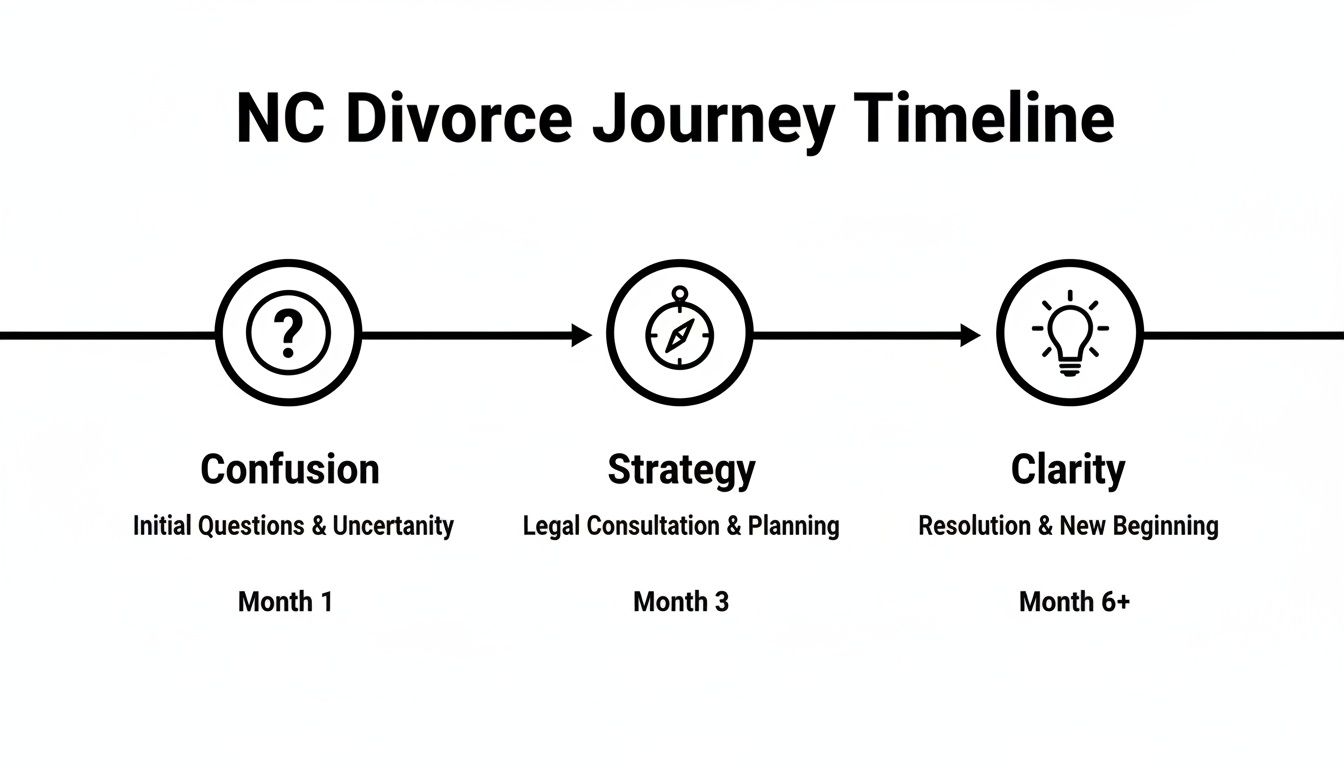
As this shows, the process is designed to move you from a state of uncertainty toward strategic planning and, finally, legal resolution.
From Filing the Complaint to the Final Decree
Once you’ve met the one-year separation requirement, you can start the formal legal process. Here’s a straightforward look at what happens next:
- Filing the Complaint for Divorce: Your attorney will draft and file a legal document called a "Complaint for Absolute Divorce." This is filed with the Clerk of Court in the right county and officially asks the court to end your marriage.
- Serving Your Spouse: Your spouse has to be formally notified that you’ve started the divorce action. This step, known as "service of process," is usually handled by a sheriff's deputy or certified mail to deliver a copy of the complaint and a summons.
- The Answer and Waiting Period: After being served, your spouse has 30 days to file a formal "Answer" with the court. They can also request a 30-day extension if needed.
- Getting the Final Divorce Judgment: Once all the legal boxes are checked and all related issues like property are formally resolved, the judge can sign the "Absolute Divorce" judgment. This is the final court order that officially and legally dissolves your marriage.
A North Carolina divorce attorney manages this timeline for you, ensuring that every deadline is met, all paperwork is filed perfectly, and your rights are protected at every turn. This prevents simple procedural mistakes from turning into major, expensive problems down the road.
How Property Is Divided Under NC Law

Figuring out who gets what is one of the toughest parts of any divorce. In North Carolina, this process is legally known as equitable distribution. That name can be a little confusing—"equitable" means fair, which doesn't always mean a perfect 50/50 split.
The law, specifically North Carolina General Statutes § 50-20, gives judges a three-step method for dividing property. An experienced North Carolina divorce attorney is your best asset for navigating this system and protecting what you've worked for. The entire process hinges on identifying every asset, classifying it correctly, and then distributing it fairly.
The Three Categories of Property
Before anything can be divided, every asset and debt has to be sorted into one of three distinct piles. This classification step is the bedrock of the whole process because it determines what’s on the negotiating table and what’s not.
- Marital Property: This is the big one. It includes almost all assets and debts acquired by either you or your spouse from the day you got married until the day you separated. It doesn’t matter whose name is on the title. Your family home, cars, bank accounts, and the retirement funds you both earned during the marriage all fall into this category.
- Separate Property: This is property that belongs to one spouse alone. It typically includes anything you owned before the marriage, as well as any inheritances or gifts you received personally, even during the marriage. This property isn't up for grabs in the divorce.
- Divisible Property: North Carolina has a unique third category. It accounts for changes in the value of marital property that happen after you separate but before the assets are officially divided. For example, if a marital investment account grows by $10,000 after your separation date, that gain is considered divisible property and will be split.
Practical Example: A common mistake people make is thinking that if an asset is in their name, it’s automatically theirs. In North Carolina, what matters is when it was acquired. If you bought a car during the marriage with your paycheck and put only your name on the title, it’s still considered marital property.
Getting these classifications right is absolutely critical. A sharp attorney will use the discovery process to make sure every single asset is accounted for and correctly categorized, so your separate property stays yours and no marital assets get overlooked. If you want to dive deeper into the specifics, you can learn more about what equitable distribution means in North Carolina.
How Judges Determine a Fair Division
Once everything is classified, the starting point for a judge is to assume that an equal (50/50) split of all marital and divisible property is fair. But it’s not the final word. A judge has the power to order an unequal division if they believe an even split just wouldn’t be equitable.
To make that call, the judge weighs a list of specific factors laid out in the statute. These factors give the court the flexibility to do what’s truly fair based on your family’s unique situation.
Key Factors a Judge Considers:
- The income, property, and debts of each spouse.
- How long the marriage lasted.
- The age and health (both physical and mental) of both spouses.
- The need for the parent with child custody to live in the family home.
- Contributions one spouse made to the other’s education or career.
- Non-financial contributions, like being a homemaker or primary caregiver.
For example, a judge might award more of the marital estate to a spouse who stayed home for 20 years to raise the kids and now has very different career prospects. The goal is a division that's truly fair, not just a simple mathematical calculation. Presenting a strong case for why an unequal division is justified in your situation is where the guidance of a North Carolina divorce attorney becomes indispensable.
Child Custody and Support in North Carolina

When children are part of a divorce, their well-being isn't just a priority—it's the only thing that truly matters to the court. Every custody decision in our state is driven by one guiding principle: the "best interest of the child."
This standard, found in North Carolina General Statutes § 50-13.2, empowers judges to create a living situation that will best foster a child’s security, happiness, and overall welfare. For parents, this is often the most emotionally draining part of a divorce. An experienced North Carolina divorce attorney helps you stay focused on building a stable future for your children while firmly protecting your own parental rights.
Our goal is always to create a clear, practical plan that reduces conflict and gives your children the foundation they need to thrive.
Legal Custody vs. Physical Custody
In North Carolina, the term "custody" isn't a single concept. It's actually a bundle of rights and responsibilities split into two distinct parts. Understanding this difference is the first step toward crafting a solid parenting plan.
- Legal Custody: This is about decision-making authority. It’s the right and responsibility to make important choices about your child’s life, including their education, healthcare, and religious upbringing. North Carolina courts generally favor joint legal custody, encouraging both parents to remain involved in these big-picture decisions.
- Physical Custody: This simply determines where the child will live. It can be sole physical custody, where the child lives primarily with one parent while the other has visitation, or joint physical custody, where the child spends significant time with both parents.
Common Misconception: Many parents think "joint custody" automatically means a perfect 50/50 time split. The reality is that joint physical custody can be any number of schedules—from one parent having the kids every other weekend to a week-on, week-off arrangement. The right schedule is whatever works best for your child's stability and routine.
Creating a Practical Parenting Agreement
Instead of leaving these deeply personal decisions to a judge who doesn't know your family, most parents work with their attorneys to negotiate a Parenting Agreement. This document becomes the roadmap for your co-parenting journey, providing much-needed clarity for everyone.
Real-World Scenario: Sarah and Mark are divorcing with two school-aged children. Their attorney helps them design an agreement that covers all the bases:
- A Regular Schedule: The kids live with Sarah during the school week to keep their routine consistent and with Mark from Friday afternoon until Sunday night.
- Holiday and Vacation Plans: They agree to alternate major holidays like Thanksgiving and Christmas each year. They also spell out how summer vacation time will be divided, ensuring both parents get to enjoy extended time.
- Communication Rules: The agreement states that all non-urgent communication about the kids will be handled through a co-parenting app. This keeps conversations documented and focused on what's important.
A detailed plan like this heads off future arguments before they can even start. Your attorney’s job is to make sure your agreement is legally sound and anticipates any potential conflicts down the road.
Understanding North Carolina Child Support
Child support is not a penalty; it's a legal framework to ensure children receive financial support from both parents, no matter their living arrangements. North Carolina uses a structured formula, the North Carolina Child Support Guidelines, to calculate the payment amount.
This calculation hinges on a few key financial factors:
- Each parent's gross monthly income
- The number of overnights the child spends with each parent
- Any work-related childcare costs
- The cost of the child's health insurance premium
The guidelines produce a presumptive amount that is considered fair and appropriate. For instance, if one parent earns significantly more and the child spends more time with the other parent, the support obligation will naturally be higher. Our firm can provide additional resources if you'd like to learn more about child support laws in NC.
An experienced divorce attorney makes sure all income is reported accurately and that every allowable expense is factored in. We can also argue for a deviation from the guidelines if your family has extraordinary expenses, such as for a child’s special needs or private school tuition. The ultimate goal is a final support order that is fair and truly meets your children’s needs.
Choosing the Right Divorce Attorney for Your Case

Of all the decisions you'll make during your divorce, picking the right attorney might be the one that matters most. This person is more than just a legal representative; they become your strategist, your advocate, and your guide through one of life’s most demanding chapters.
Finding the right fit goes far beyond a convenient office or a flashy website. You need to find an attorney you can trust—someone whose approach lines up with your goals and whose expertise gives you confidence. This relationship sets the tone for your entire divorce.
Key Questions to Ask During a Consultation
Think of your initial consultation as a two-way interview. You aren't just there to get legal advice; you're there to see if the attorney is the right person to handle your case. Come prepared with questions that get to the heart of what matters.
Here are some essential questions to ask a potential divorce attorney in North Carolina:
- Experience & Focus: “What percentage of your practice is dedicated to family law in North Carolina?” Follow up with, “How many cases have you handled with issues similar to mine, like high-asset division, a military divorce, or a complex custody dispute?”
- Case Strategy: “Based on what I’ve shared, what are your initial thoughts on a potential strategy?” and “Do you find that most of your cases settle through negotiation, or do you lean more toward litigation?”
- Communication & Team: “If I hire you, who will be my main point of contact?” and “What’s your firm’s policy for returning calls and emails?” You should also ask, “Will paralegals or other attorneys work on my case? If so, what are their roles?”
These questions help you look past the sales pitch and truly understand if their working style fits your needs.
Remember, the "best" attorney isn't always the most aggressive one. The right attorney is the one who understands your unique situation, respects your goals, and has the skill to implement the right strategy, whether that’s collaborative negotiation or aggressive litigation.
Comparing Attorney Approaches: What's Right for You?
Not all attorneys practice law the same way. Some are aggressive litigators who thrive in the courtroom, while others are skilled negotiators who excel at finding common ground. Understanding these different philosophies is key to finding a lawyer whose style aligns with your goals and the complexity of your case.
This table can help you identify which approach might be the best fit for your situation.
| Attorney Style | Best For Cases Involving… | Potential Pros & Cons |
|---|---|---|
| The Aggressive Litigator | High-conflict disputes, hidden assets, a history of abuse, or an uncooperative spouse. | Pro: Can be very effective in protecting your rights against a difficult opponent. Con: Can increase costs and animosity, making co-parenting harder later. |
| The Collaborative Negotiator | Spouses who are willing to work together, a desire to maintain an amicable co-parenting relationship, and a focus on privacy and creative solutions. | Pro: Often less expensive and stressful than court battles. Con: Requires both parties to be transparent and cooperative to succeed. |
| The Practical Problem-Solver | Moderate-conflict cases where spouses disagree on some issues but are open to reasonable compromise. | Pro: Balances firm advocacy with a focus on efficient, cost-effective resolution. Con: May not be aggressive enough for a highly contentious opponent. |
Ultimately, the best attorneys are versatile. They should be skilled negotiators who are also fully prepared to go to court if that's what it takes to protect your interests. Discussing these styles during your consultation will give you a much clearer picture of what to expect.
Understanding Legal Fees and Costs
Concerns about legal fees are completely normal and are a source of stress for many people facing divorce. A trustworthy attorney will be upfront and transparent about their costs right from the start.
In North Carolina, most divorce lawyers use two common fee structures:
- Retainer Fee: This is an initial payment you make to the law firm, which is then held in a trust account. As the attorney works on your case, they bill their time against this fund. Think of it as a down payment for their future services.
- Hourly Rate: Your attorney will bill you for their time at a set hourly rate, often in small increments. This rate applies to all work done on your case, including phone calls, emails, drafting documents, and court appearances.
During your consultation, insist on a clear, written fee agreement. Ask what the initial retainer covers, what the hourly rates are for everyone who might work on your case, and when you might be asked to replenish the retainer.
Getting clarity on the financial side of your case is crucial for your peace of mind. To get personalized advice on what to expect, consider scheduling a consultation with a qualified North Carolina divorce lawyer. This proactive step can provide clarity on both legal strategy and potential costs, helping you plan effectively.
Frequently Asked Questions About NC Divorce
Do I have to go to court to get divorced in North Carolina?
Not necessarily for the final divorce itself. If you and your spouse resolve all your issues (property, custody, support) in a signed Separation Agreement, the final divorce can often be handled through paperwork without you ever stepping into a courtroom. However, if you cannot agree on these issues, litigation may be required to resolve them.
What is the difference between separation and divorce in NC?
In North Carolina, separation is the mandatory one-year period where you and your spouse must live in different homes with the intent to end the marriage before you can file for divorce. The divorce (or "Absolute Divorce") is the final legal decree from a judge that officially dissolves your marriage. You remain legally married during the separation period.
Can I get alimony in North Carolina?
It's possible, but not guaranteed. Alimony (or spousal support) may be awarded to a financially dependent spouse. A judge considers many factors, including each spouse's income and expenses, the standard of living during the marriage, and marital misconduct (like adultery). An attorney can assess your specific situation to determine if you have a valid claim or defense regarding alimony.
Take the Next Step: Schedule a Consultation to Protect Your Future
Reading this guide was an important first step. You now have a foundational understanding of North Carolina’s divorce laws, from property division to the standards for child custody. But knowledge alone isn’t enough—the next move is to get strategic advice tailored to your specific situation.
Facing a divorce can feel isolating and uncertain, but you don’t have to navigate it by yourself. Having an experienced family law attorney in your corner can transform a confusing legal maze into a clear, strategic path forward. Your financial stability, your children’s well-being, and your future are on the line.
Build Your Divorce Strategy with an Experienced Advocate
A confidential consultation is your opportunity to stop worrying and start planning. It is your dedicated time to sit down with a legal professional who knows what’s at stake and can help you build a strategy that aligns with your goals. We are committed to giving North Carolina residents the clear, client-focused, and strategic representation they need.
This isn’t just a legal case; it’s your life. A consultation is where you turn uncertainty into action. It’s your chance to ask the tough questions, get straight answers, and start taking back control of your future.
We believe every person deserves a strong advocate who will listen carefully and fight to protect what matters most to them. Whether you’re just starting to think about separation, are in the middle of a complex custody battle, or need to protect significant assets, our team has the experience to guide you.
Your Next Chapter Starts Today
Don’t wait for things to get more complicated. The proactive decisions you make now can prevent future conflicts and set the stage for a secure, stable new beginning. The agreements and orders made during a divorce will impact your finances and your family for years to come.
Make sure your rights are protected from the very beginning. Contact us to schedule a confidential consultation and start building a solid foundation for the next chapter of your life.
At the Law Office of Bryan Fagan, we provide the dedicated legal support you need to move forward with confidence. Schedule your consultation today to discuss your case with a trusted North Carolina divorce attorney.