When a spouse refuses divorce in NC, you're probably already living the hard part. One person has accepted that the marriage is over. The other keeps saying no, ignores papers, refuses to move out, or uses every conversation to start the same fight again.
That situation leaves many people feeling trapped. They assume divorce requires mutual agreement, a signature, or some kind of permission from the spouse who wants to stay married. In North Carolina, that's usually not how it works.
A common real-world version looks like this. You and your spouse have effectively split up emotionally, but you're still dealing with the same house, the same bills, and the same tension. One spouse says, “I'm not signing anything.” Sometimes that statement is about control, not law. It may slow things down. It may increase conflict. But it usually does not give that spouse the power to block the divorce forever.
North Carolina law gives people a path forward even when the other side refuses to cooperate. The key is understanding what matters legally, and what only feels like a roadblock. In many cases, the divorce itself is straightforward once the legal requirements are met. The harder parts are often the day-to-day realities: getting through an in-home separation, handling children, protecting finances, and dealing with a spouse who won't participate forthrightly.
A spouse's refusal can create delay, pressure, and expense. It usually can't create a permanent veto.
You are not powerless here. You do need a plan, careful timing, and a clear understanding of what the court can do and what it can't do. That starts with the rules North Carolina uses for no-fault divorce.
Introduction You Are Not Stuck Even If They Say No
The first thing to know is simple. North Carolina is a no-fault divorce state. That matters because you do not need to prove your spouse cheated, abused you, abandoned you, or otherwise “caused” the marriage to end in order to get an absolute divorce.
The legal focus is separation, not permission.
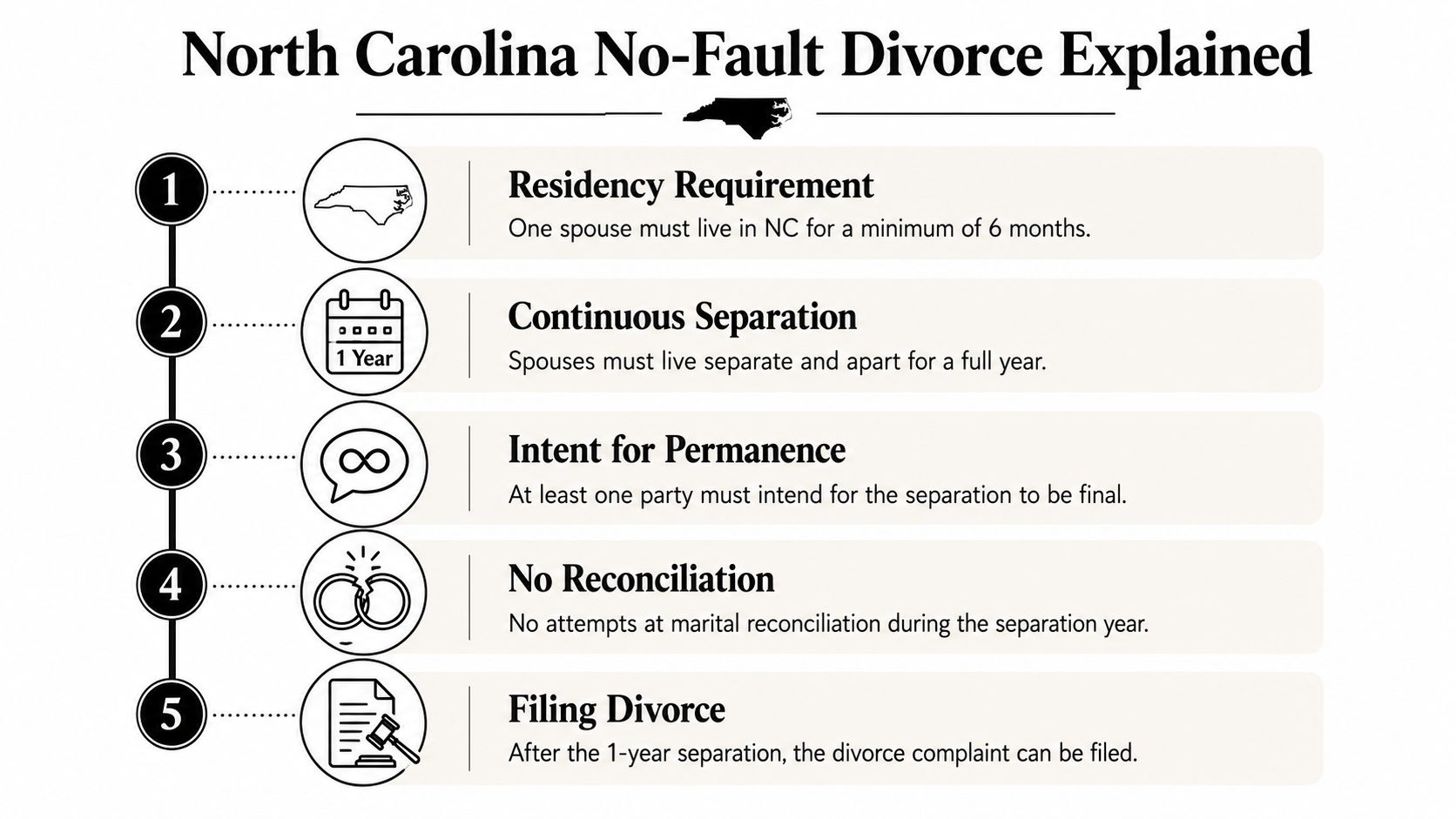
Under North Carolina law, a spouse's refusal to sign divorce papers does not stop an absolute divorce if the legal requirements are met. The spouses must live separate and apart for at least 1 year and 1 day, and at least one spouse must have been a North Carolina resident for 6 months before filing, as explained in this North Carolina divorce overview.
What separate and apart usually means
In plain English, separate and apart means living in different residences. It is not just sleeping in different bedrooms. It is not “we're basically done.” It is not a private understanding that the relationship has ended while you both remain under the same roof.
That distinction matters because people often lose time by assuming emotional separation counts as legal separation. It usually doesn't.
A practical example: if one spouse moves to an apartment and intends the separation to be permanent, that is usually the kind of separation the court is looking for. If both spouses stay in the marital home and continue operating as one household, that usually creates problems.
The waiting period is frustrating, but it matters
That 1 year and 1 day requirement is often the part people hate most. If your spouse says no, you may want immediate relief. The law usually doesn't offer immediate final divorce. It offers a process.
That process begins with lawful separation and runs on a calendar, not on your spouse's approval.
A few practical points help:
- Track the date carefully. The separation date affects when you can file.
- Act consistently. Mixed messages about reconciliation can create complications.
- Get advice before filing related claims. Property, support, and custody decisions often need strategic timing.
What doesn't work
Clients often ask whether they can force a faster divorce by gathering proof of bad conduct. In a no-fault case, that usually misses the point. Fault may matter in some related disputes, but it is not what enables the absolute divorce itself.
What also doesn't work is waiting for cooperation that may never come. If the legal requirements are met, the path forward is based on procedure, not consent.
How to File and Serve Papers Without Cooperation
Once the divorce is legally ripe to file, the next problem is often practical. Your spouse won't accept papers, won't answer messages, or pretends they can stop the case by refusing to engage.
They can't stop it by ignoring it. But you do have to do service correctly.

Start with the complaint
The divorce case usually begins with filing a Complaint for Absolute Divorce in the appropriate North Carolina court. That document tells the court the basic legal basis for the divorce.
If you're trying to understand the filing sequence in more detail, this guide on how to file for divorce in North Carolina is a useful starting point.
What matters at this stage is accuracy. Names, dates, residency, and separation details all need to be handled carefully. Small mistakes can create delay that an uncooperative spouse will gladly exploit.
Service matters more than argument
Many people think the major challenge is persuading the other spouse to be reasonable. Procedurally, the bigger challenge is often service of process. That means giving formal legal notice in a way the court recognizes.
Common approaches may include having the sheriff serve the papers or using certified mail where appropriate. If a spouse is evasive, the issue becomes proof. The court needs confidence that the responding party received proper notice, or that the law's substitute methods were followed.
Practical rule: Don't rely on text messages, family gossip, or “they definitely know about it.” Legal notice and actual knowledge are not always the same thing.
If a spouse is actively dodging service, more advanced steps may be necessary. That usually calls for careful planning, because bad service can derail an otherwise valid case.
What happens after service
Once the complaint is served, the responding spouse generally has 30 days to answer. If no response is filed, the case can move forward by default, meaning the court can grant the divorce without the other spouse's participation, as discussed in this article on overcoming divorce obstacles in North Carolina.
That deadline changes the posture of the case.
- If they ignore it, default may become available.
- If they respond, the case may remain simple as to divorce but become contested on related issues.
- If they respond just to create chaos, the court process still continues. It just becomes more structured and more formal.
A short explanation of the process can help if you're trying to visualize the next steps:
Don't confuse silence with victory
If your spouse doesn't answer, that doesn't mean every problem disappears. It means the divorce itself may be able to move forward on a default track if service was proper and the filing is otherwise in order.
Silence does not automatically resolve parenting disputes, support issues, or financial claims. It only removes one obstacle from the absolute divorce path.
Using Default Judgments and Temporary Orders for Relief
A spouse can refuse to cooperate. They cannot keep daily life from becoming the court's concern when the facts support relief.
That distinction matters most in the house. Many North Carolina cases are not stalled because the divorce cannot be filed. They are stalled because two people are still under one roof, tension is rising, and one spouse is using the living arrangement to control money, parenting time, privacy, or access to the home.

Default can end the divorce case if they do nothing
If your spouse was properly served and does not respond on time, the court may allow the absolute divorce to proceed without their participation. That is often the moment people realize that "I won't sign" and "I can stop this" are two different things under North Carolina law.
Courts still expect clean procedure. Service must be valid. The pleadings must be in order. The separation requirement must be met and provable. Default helps when the other side stays out of the case. It does not fix bad paperwork or rushed filing decisions.
Temporary relief deals with the problem you are living with now
For many people, the pressing issue is not the final divorce hearing. It is getting through next week.
If you are still sharing the home, the conflict often centers on daily control. Who sleeps where. Who pays which bills. Who picks up the children. Whether one spouse is watching the other's movements, starting confrontations, or making the home feel unsafe. A final divorce judgment does not solve those immediate problems fast enough.
North Carolina separates the divorce itself from support, custody, and property claims. As a result, a spouse may be unable to block the divorce but still make the in-home separation miserable. Temporary orders and other forms of relief are often the tools that make the situation workable while the larger case continues.
If your spouse refuses to leave the marital home
Clients are often surprised by this part. Being ready for the marriage to end does not automatically give you the right to remove the other spouse from the house.
In many situations, one spouse cannot force the other out without a court order. Depending on the facts, a Divorce from Bed and Board or a Domestic Violence Protective Order may create a legal basis to exclude a spouse from the home, as explained in this resource on when a spouse refuses to move out in North Carolina.
The trade-off is straightforward. Asking the court for possession of the home or protective relief can bring stability faster, but it also raises the stakes. You need facts, documentation, and a filing strategy that matches what you can prove.
Steps that usually help in a high-conflict in-home separation
Some practical moves matter a great deal before any hearing:
- Document specific conduct. Save texts, photos, call logs, and notes about threats, property damage, intoxication, interference with parenting, or attempts to control access to the home.
- Secure records and necessities. Gather financial documents, IDs, medications, school records, insurance information, and anything you would struggle to replace quickly.
- Do not try to force the issue yourself. Lock changes, utility shutoffs, and confrontational removals often create legal problems and can hurt your credibility.
- Ask for the right relief. In some cases the primary need is temporary custody or child support. In others, it is exclusive possession of the residence or limits on contact.
Good case strategy starts with identifying the immediate pressure point. If the hardest part of your separation is happening in the hallway, the kitchen, or the children's bedrooms, the legal response should address that reality directly.
Contested Issues Versus a Simple Divorce
A spouse who can't stop the divorce may still fight about nearly everything around it. That's the distinction many people miss.
The absolute divorce can be straightforward. The surrounding issues can become contested, expensive, and emotionally draining. Those are different tracks, and they need different expectations.
What stays simple and what doesn't
If your spouse doesn't respond after service, the divorce may proceed on a relatively clean path. If your spouse does respond, the case may still end in divorce, but disputes over property, support, and children can continue.
That doesn't mean the process becomes endless. It means it becomes structured. Pleadings get filed. Mediation may become part of the process in certain disputes. Hearings and, in some cases, trial become the mechanism for decision-making.
If you want a fuller picture of that more adversarial path, this page on contested divorce in North Carolina gives a useful overview.
Default Divorce vs. Contested Divorce in North Carolina
| Factor | Default Divorce (Spouse does not respond) | Contested Divorce (Spouse responds and disputes claims) |
|---|---|---|
| Participation | The other spouse does not file a response after proper service | The other spouse appears and challenges issues |
| Main court focus | Whether the filing requirements and service are in order | Whether the court must decide disputes beyond the divorce itself |
| Typical pressure point | Getting service completed correctly | Managing conflict over custody, support, or property |
| Decision path | Often more procedural and limited | Often requires negotiation, mediation, hearings, or trial |
| Client workload | Usually lighter once filing and service are complete | Usually heavier because documents, strategy, and evidence matter more |
| Emotional pattern | Frustrating silence or avoidance | Open conflict and repeated disagreements |
The trade-off clients need to understand
Some spouses refuse to cooperate because they believe delay gives them an advantage. Sometimes they're right in a narrow sense. Delay can increase stress. It can complicate finances. It can make settlement harder.
But delay is not the same thing as legal control.
The better question is not “Can my spouse make this unpleasant?” They often can. The better question is “What exactly are they fighting about, and what is the best procedural response?” That shift in thinking helps people make practical decisions instead of reacting emotionally to every hostile message.
Frequently Asked Questions About Uncooperative Spouses
Can my spouse stop the divorce by refusing to sign papers?
Usually, no. In North Carolina, refusal to sign does not usually block the divorce if the legal requirements have been met and the spouse is properly served. The court process does not depend on cooperation alone.
What if we are still living in the same house?
That is often the hardest part in real life. It can create constant friction and confusion. But living under the same roof may also create problems for proving a true legal separation. If your spouse won't leave, the question often becomes whether there is a lawful basis to seek court-ordered relief about possession of the home or safety.
Will an uncooperative spouse make the case more expensive?
Often, yes. Not always because the divorce itself is legally complicated, but because resistance creates extra steps. Service issues, hearings, contested motions, and disputes over temporary arrangements can all increase the amount of work required.
Can I date during separation?
That question needs individualized legal advice. The answer can depend on your goals, your facts, and whether claims involving support or fault-related issues are in play. Many people assume dating is purely a personal choice once they've separated. In family law, personal choices can still affect legal strategy.
What should I do first if my spouse refuses to move out?
Focus on safety, documentation, and planning. Don't assume you can legally remove them on your own. If there is abuse, intimidation, or conduct that may justify court intervention, speak with a North Carolina family law attorney promptly about the available remedies.
Take Control of Your Future Today
If your spouse refuses divorce in North Carolina, the law still gives you a path forward. The marriage does not continue indefinitely just because the other person says it should. What their refusal often changes is the level of conflict, the timeline, and the need for strategic legal action.
The hardest cases are not always the ones with the most complicated law. They are often the ones where daily life becomes unbearable while the legal process catches up. That is why it is so important to treat the in-home conflict, parenting issues, and financial pressure as legal issues that can be addressed, not just personal stress you have to absorb.
A careful strategy can help you avoid common mistakes. Filing too early, mishandling service, making informal deals you can't enforce, or trying to force a spouse out without a court order can create new problems. A better approach starts with facts, timing, and a clear plan specific to North Carolina procedure.
If you're ready to move from uncertainty to action, speaking with a lawyer is the next practical step. A North Carolina family law attorney can evaluate whether you are legally separated, whether filing now makes sense, what relief may be available while the case is pending, and how to handle a spouse who refuses to cooperate. You can learn more about working with a North Carolina divorce lawyer for guidance on your specific situation.
You don't need your spouse's permission to start protecting your future. You do need a strategy that fits your facts.
If you're dealing with a spouse who won't cooperate, schedule a consultation with the Law Office of Bryan Fagan. The firm works with North Carolina clients on divorce, custody, support, and property disputes, and can help you assess your options, your timing, and the next steps in your case.