If you're splitting time with your child equally in North Carolina, you're probably asking the same question many parents ask in my office: If we have 50/50 custody, why would anyone still pay child support?
That question makes sense. On the surface, equal time sounds like equal responsibility in every respect. One home. Then the other. Same number of overnights. Same parenting role. Many parents assume that means support should be zero.
In North Carolina, that's usually not how the law works. The court doesn't stop at the calendar. It also looks at income, health insurance, work-related childcare, and other child-related costs. So, regarding the question of child support if parents share custody equally nc, the answer is more nuanced than yes or no. Equal time can reduce support. It can change the worksheet. But it doesn't automatically erase a payment.
The 50/50 Custody Myth and North Carolina Child Support
A common scenario goes like this. Two parents separate. They agree to alternate weeks, or they build a schedule that comes out to a true 50/50 split. They both stay active in school decisions, doctor visits, activities, and transportation. Then one parent is shocked to learn that child support is still on the table.
That surprise usually comes from a simple misunderstanding. Custody time and child support aren't the same issue. A 50/50 schedule tells the court how parenting time is shared. It does not, by itself, answer how the child's financial needs should be divided between the parents.
Take a practical example. One parent earns substantially more. The other parent pays more of the day-to-day child expenses, or covers daycare, therapy, or insurance. Even with equal overnights, those facts matter. North Carolina's system is designed to account for that imbalance rather than pretend it doesn't exist.
Equal custody changes the method of calculation. It doesn't create an automatic zero.
That's why parents often feel like the result is unfair until they see the worksheet. The law isn't trying to declare one parent the "winner" and the other the "loser." It's trying to assign financial responsibility in a way that reflects the child's needs and each parent's ability to contribute.
What works is approaching the issue with records and realistic expectations. What doesn't work is assuming the judge will cancel support just because the schedule looks even on paper.
Why Equal Custody Does Not Equal Zero Child Support
North Carolina child support is grounded in N.C.G.S. § 50-13.4, and the basic idea is straightforward: both parents are expected to contribute financially to the child's support. The law treats custody and child support as legally separate issues, even though the parenting schedule affects the calculation. A North Carolina family-law summary puts it plainly. Custody determines where the child lives and who makes decisions, while support ensures both parents contribute financially. That same summary notes that 86.93% of cases had a court order for child support in the reported period, which shows how central financial support remains in the system (North Carolina child support and custody discussion).
Think of support as a shared financial pot
North Carolina uses an income shares model. In plain English, the court looks at what both parents together can provide, then divides responsibility between them based on their incomes and relevant child-related costs.
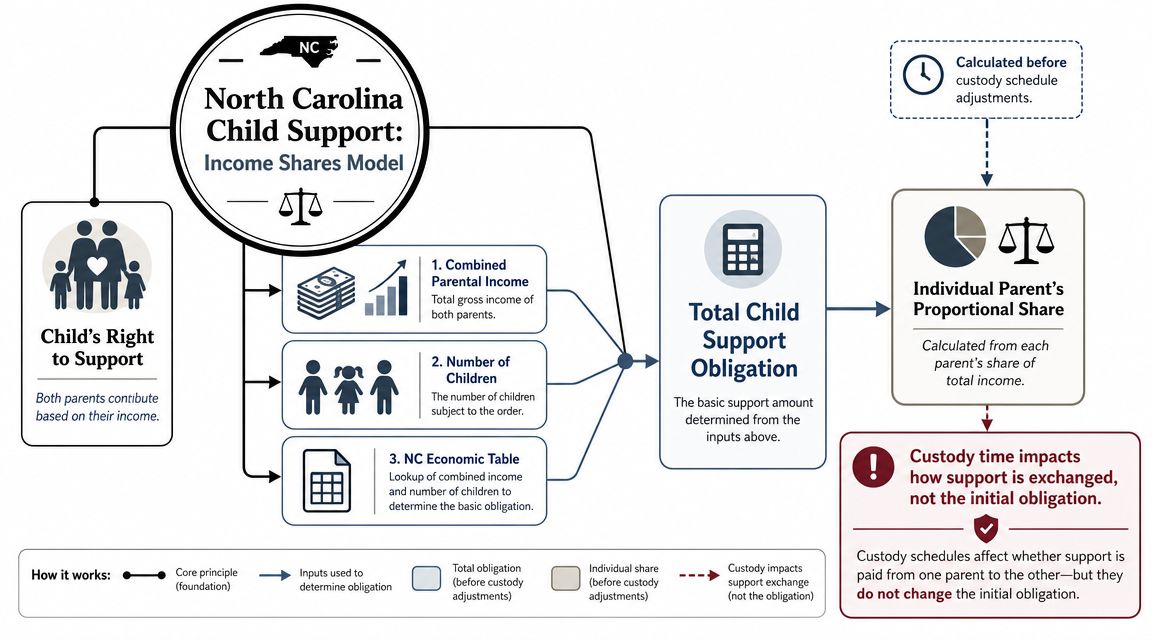
Here's the practical point that many online summaries miss: the court first asks what the child's support obligation is under the guidelines. Only after that does the schedule affect how support is adjusted or exchanged between households.
If one parent earns much more, that parent usually carries a larger share of the total child support obligation. If one parent pays the health insurance premium, that matters too. If one parent handles work-related daycare, that matters as well.
What parents often get wrong
Parents often focus only on fairness in time. Courts focus on both time and money.
A few common misconceptions:
- "We have equal time, so nobody should pay." North Carolina doesn't use a simple custody-winner model. It uses a financial formula.
- "If I buy clothes and groceries during my weeks, that should end support." Those direct expenses matter in context, but they don't automatically cancel a guideline obligation.
- "The judge will just split everything in half." The law doesn't split by instinct. It calculates using income and recognized child-related expenses.
Practical rule: In an equal-custody case, the central question usually isn't who loves the child more or who has more nights on paper. It's who pays what, who earns what, and how the worksheet handles both.
Worksheet A vs Worksheet B The Key to NC Support Calculations
The first question in many North Carolina support cases is simple: Which worksheet applies? If you use the wrong worksheet, the support number can be wrong from the start.
When Worksheet A applies
Worksheet A is generally used when one parent has primary physical custody. In practical terms, that means the other parent has the child for fewer than 123 overnights per year.
That arrangement often fits more traditional schedules. One parent has most school nights. The other has alternating weekends and perhaps some holiday or summer time. In those cases, support is typically structured as one parent paying the other under the primary-custody formula.
When Worksheet B applies
Worksheet B applies when each parent has the child for at least 123 overnights per year. That's the shared custody worksheet. North Carolina's public guidance and legal explainers consistently treat that overnight threshold as the trigger for the shared-custody calculation.
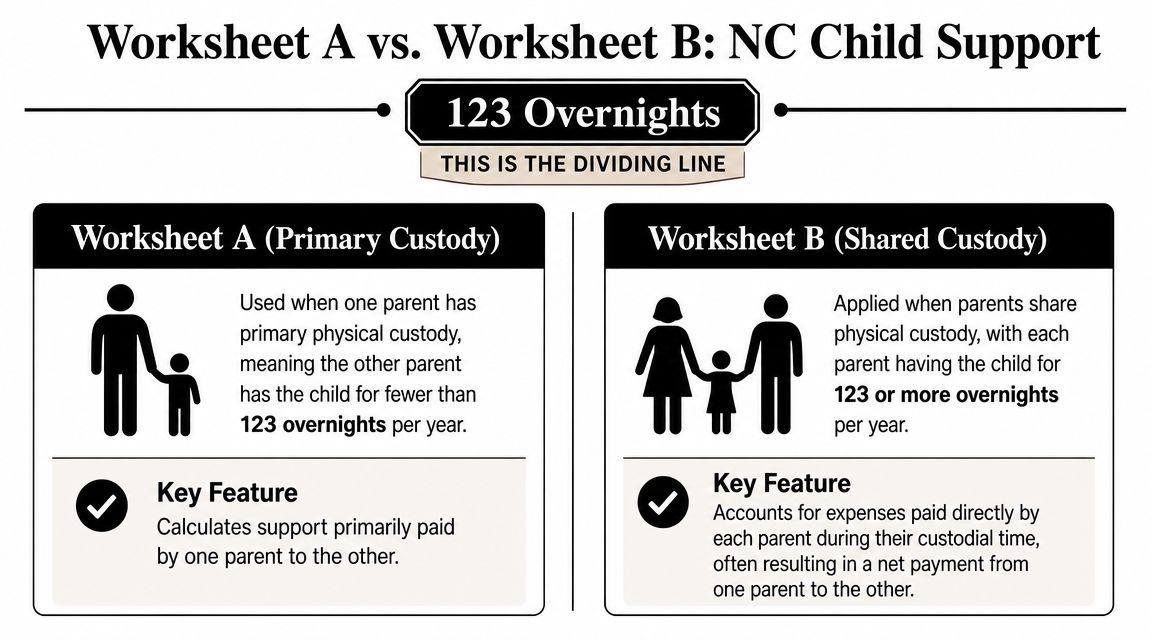
If your schedule is week-on, week-off, or otherwise close to equal, Worksheet B is usually the form to examine. If you want a practical breakdown of how that shared-custody worksheet works in real cases, this guide on Worksheet B child support in NC is a useful starting point.
Why the overnight count matters so much
The overnight threshold isn't a technical detail. It often determines the entire method used to calculate support.
A few examples show why:
- Alternating weeks: Usually points toward Worksheet B because each parent has substantial overnights.
- Every other weekend plus one dinner visit: Usually points toward Worksheet A because dinners don't equal overnights.
- A schedule that shifts often: The court may need calendars, messages, app records, or other documentation to determine the actual pattern.
If your actual schedule doesn't match your written order, the paperwork can become just as important as the parenting plan.
Parents sometimes negotiate a "shared custody" label in an agreement and assume the label controls. It doesn't. The actual overnight count usually matters more than the title you give the arrangement.
How NC Calculates Support in a 50/50 Custody Case A Step-by-Step Example
The quickest way to understand child support if parents share custody equally nc is to look at the logic behind Worksheet B. The exact amount in any case depends on the guideline tables and the facts entered into the worksheet, so I won't invent numbers that aren't in the official materials. But the process itself is very clear.
A core rule from the North Carolina guidelines is this: in shared custody cases with 123 or more overnights, Worksheet B increases the basic child support obligation by 50% to reflect the cost of maintaining two homes for the child, and the amount is then allocated using each parent's share of income and overnights (North Carolina Child Support Guidelines Worksheet B guidance).
To make the process easier to follow, start with the visual summary below.
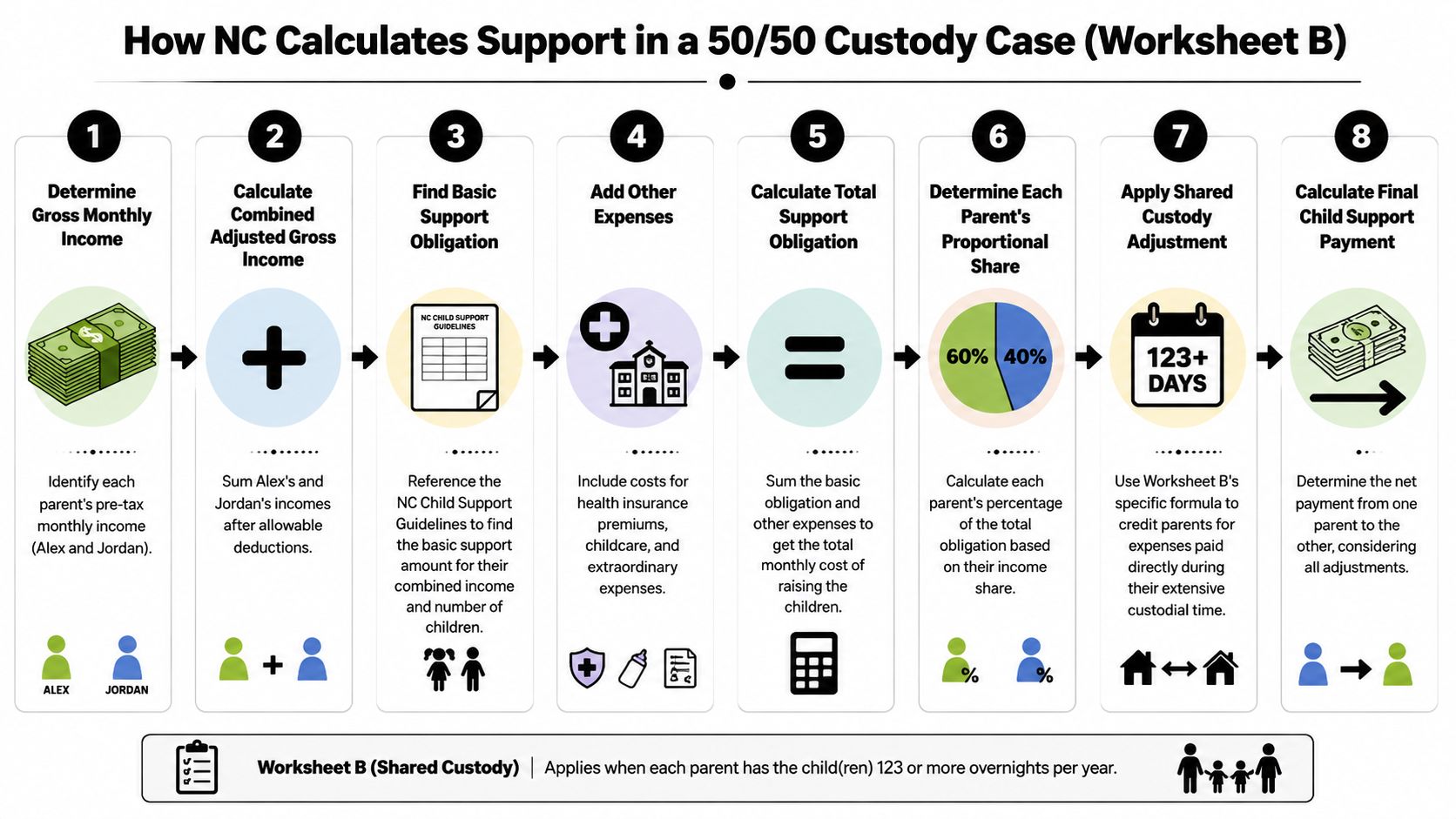
A practical example using Alex and Jordan
Assume Alex and Jordan share one child on a true 50/50 schedule. The child spends the same number of overnights with each parent. Even then, support may still be owed if one parent earns more or covers fewer of the recognized child expenses.
Here is the sequence the worksheet follows:
Identify each parent's gross income.
The worksheet starts with each parent's gross monthly income. If Alex earns more than Jordan, Alex's percentage of the combined income will be higher.Combine the incomes.
The worksheet uses the parents' combined income to locate the basic child support obligation under the North Carolina guidelines.Apply the shared-custody adjustment.
Because this is Worksheet B, the basic obligation is increased by 50% to reflect the duplicated costs of two homes.Add child-specific expenses.
Health insurance premiums for the child, work-related childcare, and certain other allowed expenses are then considered. This is often where parents are surprised. If Jordan pays daycare and Alex does not, that affects the bottom line.Assign each parent a share of the total.
Each parent's percentage of the combined income determines that parent's share of the support obligation.Account for overnights.
Because Alex and Jordan have equal time, the overnight portion may appear balanced. But balanced time doesn't cancel out an unequal income share.Offset the obligations.
The worksheet compares what each parent would owe after the shared-custody calculation. The result is often a net payment from the higher-earning parent to the lower-earning parent.
For a broader overview of North Carolina support calculations, including where worksheet selection fits into the process, see this explanation of how child support is calculated in NC.
What usually changes the result
The same 50/50 schedule can produce very different support outcomes depending on details such as:
- Income disparity: A larger gap usually pushes the result toward a payment from the higher earner.
- Health insurance: If one parent carries the child's insurance, the worksheet gives that fact significance.
- Daycare and after-school care: Work-related childcare can materially affect the final number.
- Education or medical costs: Certain recurring child expenses may change the calculation or support a request for a different amount.
A short video can also help if you learn better by hearing the process explained:
What works and what doesn't
What works is bringing organized income records, proof of insurance costs, daycare statements, and a reliable custody calendar. What doesn't work is showing up with a rough estimate and the belief that "we split time evenly, so the math should be simple."
Support disputes in equal-custody cases are rarely just about the calendar. They're usually about the numbers behind the calendar.
Deviating from the Child Support Guidelines
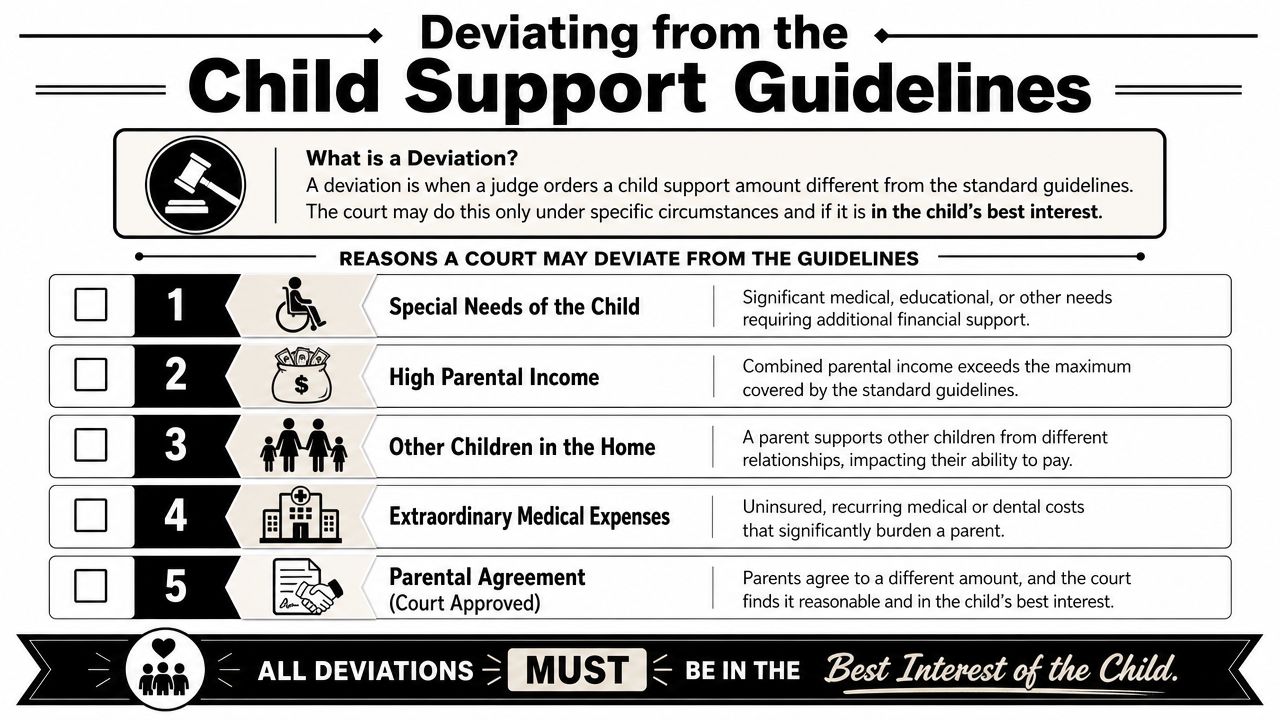
The guideline amount is presumed to be correct in North Carolina, but it isn't untouchable. A judge may order a different amount if the guideline figure would be unjust or inappropriate. North Carolina guidance also notes that the standard calculation now applies up to $40,000 per month in combined income, following the 2023 increase from $30,000 per month, and cases above that amount often require a different approach rather than a routine worksheet calculation (North Carolina child support guideline update).
When deviation may make sense
A deviation is not something a parent gets just because the guideline number feels harsh. The court needs a legally supported reason tied to the child's needs and the circumstances of the family.
Examples that often deserve a closer look include:
- Extraordinary medical or therapy costs: If a child has recurring uninsured treatment needs, the worksheet may not fully capture the burden.
- Education-related expenses: Some cases involve schooling needs that are more complex than ordinary school costs.
- High-income cases: Once combined income is above the guideline cap, the standard tables may no longer fit the family's circumstances.
- Unusual transportation or visitation costs: Long-distance parenting arrangements can create expenses the standard formula doesn't address well.
A realistic courtroom example
Consider parents who share custody closely, but their child has ongoing therapy and specialized educational support. One parent pays most of those bills directly. The standard worksheet may not fully reflect that reality. In that situation, the court may hear evidence about the child's actual needs and decide the presumptive amount should be adjusted.
Courts don't deviate to reward a parent. They deviate when the guideline amount doesn't fit the child's actual needs or the family's actual circumstances.
Another common scenario involves higher-income households. Once a family is above the standard cap, the dispute often shifts away from plugging numbers into a form and toward proving what expenses are reasonable, child-focused, and supported by documentation.
What helps a deviation request
A strong deviation request usually includes:
- Specific records: Bills, invoices, insurance statements, or school documents.
- A child-focused explanation: The court wants to know why the expense is necessary for this child.
- Consistency: If a parent claims a major recurring expense, the documents should show a real pattern.
What hurts is asking the court to "just be fair" without evidence. In child support cases, fairness usually has to be proven through records.
Modifying and Enforcing Shared Custody Support Orders in NC
A child support order isn't meant to freeze your life in place. Jobs change. Daycare ends. Insurance costs rise. Parenting schedules drift away from what the order says. When those changes are meaningful, a North Carolina court may consider modification.
The legal standard is generally a substantial change in circumstances. In shared-custody cases, that often means more than irritation or a temporary bump in expenses. It usually takes a real shift in income, expenses, or the overnight schedule.
Common reasons to seek modification
Parents frequently return to court when one of these things happens:
- Income changes: A parent loses a job, changes employment, or starts earning substantially more.
- Childcare changes: A child ages out of daycare, starts a new program, or incurs new recurring costs.
- Insurance changes: The cost of covering the child rises, falls, or shifts from one parent to the other.
- Custody changes: The actual schedule no longer supports the worksheet used in the existing order.
North Carolina family-law commentary on shared parenting time notes that courts may consider calendars, app data, and other evidence to determine the actual schedule, and that temporary changes in income or expenses can matter if they amount to a substantial change in circumstances (shared-parenting documentation and modification issues in NC).
If you're evaluating whether an existing order should be updated, this page on child support modification in NC outlines the general process.
Enforcement matters too
When a parent doesn't pay as ordered, the problem doesn't solve itself. The receiving parent can seek enforcement through the court, and in some cases through Child Support Services. The specific remedy depends on the order, the amount owed, and the procedural posture of the case.
Practical proof matters
Keep records. That includes:
- Parenting calendars: Especially when the schedule is close to the Worksheet A or B line.
- Payment history: Save proof of direct payments and reimbursements.
- Expense records: Daycare invoices, insurance deductions, and medical receipts can become central later.
If your support order no longer matches your real life, waiting usually makes the problem more expensive.
Frequently Asked Questions About NC 50/50 Custody Child Support
Common Questions on 50/50 Custody and Support in NC
| Question | Answer |
|---|---|
| Does 50/50 custody automatically mean no child support in North Carolina? | No. Equal parenting time may trigger the shared-custody worksheet, but support can still be owed if one parent earns more or if one parent pays more of the child's recognized expenses. |
| What counts as an overnight for child support purposes? | The focus is usually where the child actually sleeps. If parents dispute the schedule, courts may look at calendars, app records, messages, and other evidence showing the real overnight pattern. |
| If both parents earn about the same amount, will support always be zero? | Not always. Similar incomes can reduce the likelihood of a large payment, but the result may still be affected by insurance, childcare, and other child-related expenses. |
| Can parents agree that nobody will pay support in a 50/50 case? | Parents can make agreements, but a court order is what controls enforceability. If the agreement doesn't fit the law or the child's interests, the court may not accept it as written. |
| What if our schedule says 50/50, but real life doesn't match it? | The actual schedule can matter. If one parent is consistently exercising fewer overnights than planned, the existing support amount may need to be reviewed. |
Two questions that come up often in practice
One is whether buying groceries, clothing, and school supplies during your own parenting time replaces formal support. Usually, it doesn't. Those are ordinary parenting expenses. The worksheet still looks at broader financial responsibility.
The other is whether an informal side deal is enough. It usually isn't. If you want a different support arrangement to be enforceable, get it documented properly and approved through the right legal process.
Navigate Your North Carolina Child Support Case with Confidence
Shared custody cases often feel like they should be simple. In reality, they rarely are. North Carolina doesn't decide support by looking only at whether the calendar seems even. It looks at the larger financial picture, including income, insurance, childcare, and the worksheet that fits the schedule.
That's why so many parents get stuck on the same issue. They aren't really fighting about 50/50 custody. They're fighting about what 50/50 means once money enters the conversation.
A well-prepared case usually turns on details. Which worksheet applies. What the actual overnight count is. Who pays insurance. Whether daycare is work-related. Whether the guideline amount fits the child's real needs. Those are legal and factual questions, and small mistakes can affect the outcome in a meaningful way.
If you're dealing with child support if parents share custody equally nc, get advice based on your actual numbers and your actual schedule. A general internet answer won't tell you what a court is likely to do with your facts.
North Carolina parents who need clear advice on child support, shared custody, modification, or enforcement can schedule a consultation with the Law Office of Bryan Fagan. The firm handles North Carolina family law matters and can review your parenting schedule, income information, and expense records to help you understand your options and next steps.