If you're asking whether can child support be increased without court nc, you're probably already in a stressful spot. Maybe the other parent got a raise and agrees the current amount no longer covers what your child needs. Maybe you've already worked it out by text. Maybe extra money has started coming in, and you're wondering whether that solves the problem.
In North Carolina, parents can absolutely cooperate. One parent can voluntarily pay more. But if you want the increase to be official and enforceable, a private agreement alone usually isn't enough. A child support order remains in place until a judge signs a new order.
That gap between what parents agree to and what the court can enforce is where many people get hurt. I see parents rely on good intentions, only to find out later that the old order still controls.
Is a Simple Agreement Enough to Increase Child Support?
A common situation looks like this. Two parents have a child support order already in place. A year later, one parent's income improves, or the child's expenses go up. They talk, stay civil, and exchange a few texts agreeing that support should increase.
That feels sensible. It also feels efficient.

But here's the hard answer. In North Carolina, that text thread or verbal promise usually does not replace the existing court order. It may show cooperation. It may explain why someone paid more for a while. It usually does not create the same legal protection as a signed court modification.
What parents can do versus what the court will enforce
One parent can choose to send more than the ordered amount. Parents can even put their agreement in writing. Those things can help reduce conflict in the short term.
What they can't do on their own is turn that informal agreement into a binding replacement for the court's order. If you need a basic overview of how support works in this state, North Carolina child support laws are a useful starting point.
Practical rule: Voluntary extra payments are allowed. An enforceable change usually requires court approval.
Why this matters right away
The issue isn't whether parents can cooperate. They can. The problem is what happens when cooperation ends.
If the paying parent later drops back to the old amount, the receiving parent may learn that the original order never changed. If the parents disagree about what the extra money was for, the dispute can get messy fast. That's why a simple agreement may feel good today but still leave your child financially exposed tomorrow.
The Problem with Handshake Child Support Agreements in NC
An existing child support order is a legal command from the court. It doesn't fade out because the parents made a better plan in the kitchen, over the phone, or through a banking app. Until a judge signs a new order, the old one usually remains the one that matters.
A lease is a useful comparison. If your written lease says the rent is one amount, and you casually tell the landlord you'll pay more or less for a few months, that side conversation doesn't usually rewrite the lease. Child support orders work much the same way. The enforceable document is the court order.
Why informal agreements break down
Parents often make side agreements with honest intentions. Then life changes. A job is lost. A new partner enters the picture. A disagreement over school, travel, or medical costs spills into support.
At that point, each parent may remember the agreement differently.
One parent may say, "We agreed this was the new monthly support amount." The other may say, "I was only helping temporarily." If there's no signed court order, that argument becomes much harder to untangle.
According to this discussion of modifying a child support order in NC, North Carolina materials emphasize that there is "no modification without court order," and that support already accrued generally can't be changed retroactively. That's the legal fragility people miss when they rely on a side agreement.
Three very different situations
These situations often get lumped together, but they are not the same:
Voluntary extra payments
A parent pays more than required for a period of time. Helpful, but not the same as a modified order.A written stipulated agreement
Parents reduce their agreement to writing and prepare it for submission. Better than a text exchange, but it still needs court approval to become enforceable.An actual court modification
A judge signs a new order. This is what changes the legal obligation.
A side agreement may show cooperation. It usually doesn't give you the enforcement power people assume it does.
What works and what doesn't
What works is cooperation followed by formal paperwork. What doesn't work is assuming that good faith alone will protect either parent months later when memories, finances, and expectations change.
That distinction is the center of this issue. People asking whether child support can be increased without court in NC are usually asking whether they can avoid a courtroom fight. In many cases, yes. They usually cannot avoid a court-approved order if they want legal certainty.
How to Legally Increase Support Without a Court Battle
A common situation looks like this. One parent gets a raise, agrees by text to pay more, and sends the higher amount for a few months. Then overtime dries up, the extra payments stop, and the other parent is left trying to prove what was agreed and from when. That is the gap between cooperation and enforceability.
North Carolina law does give parents a way to increase support without a courtroom fight. The goal is usually a signed order entered by the court, even if no one argues in front of a judge.
Use a consent order when both parents agree
If both parents agree that support should increase, a consent order is often the most efficient path. The terms are drafted formally, financial information is exchanged, and the proposed order is submitted for judicial approval. Once signed, the new amount becomes enforceable.
This option works well when the parents agree on the numbers and can document income, health insurance, daycare, and other child-related expenses. It also works when the relationship is civil enough to finish the paperwork on time. Cooperation helps, but paperwork protects.
A consent order avoids many of the problems I see with private side deals. If a parent pays extra under an informal arrangement, there can be a later dispute about whether those payments were gifts, temporary help, or a true change in support. A signed order removes that argument.
Child Support Services can help structure the process
Some cases move through North Carolina Child Support Services, especially when the agency is already involved in collection or enforcement. That can help when direct communication is strained and one parent wants a more structured review process.
The agency can gather information, review the existing order, and help move the case toward a formal modification. Parents still need a new official order at the end of that process. Agency involvement does not replace that requirement.
A lawyer can prepare the modification without turning it into a fight
Many parents want a legal result without escalating the conflict. That is often realistic. A private lawyer can prepare the proposed modification documents, calculate guideline support, and present the agreement in a form the court is more likely to approve.
This is especially useful when income has changed and the parents agree in principle but disagree about what the new number should be. In those situations, it helps to review how child support changes when income changes in North Carolina before anyone signs off on a figure that does not match the guidelines.
Choose the path that gives you an enforceable result
The right approach depends on where the friction is.
- Use a consent order if both parents already agree on the amount and can exchange financial records.
- Use Child Support Services if the case already involves the agency or communication needs more structure.
- Use a private attorney if you want the paperwork done correctly and want to avoid turning an agreement into a later enforcement problem.
The practical rule is simple. If you want the increase to count, put it in a court-approved order. An informal agreement may feel easier today, but it often creates the exact dispute parents were trying to avoid.
NC's Legal Grounds for a Child Support Increase
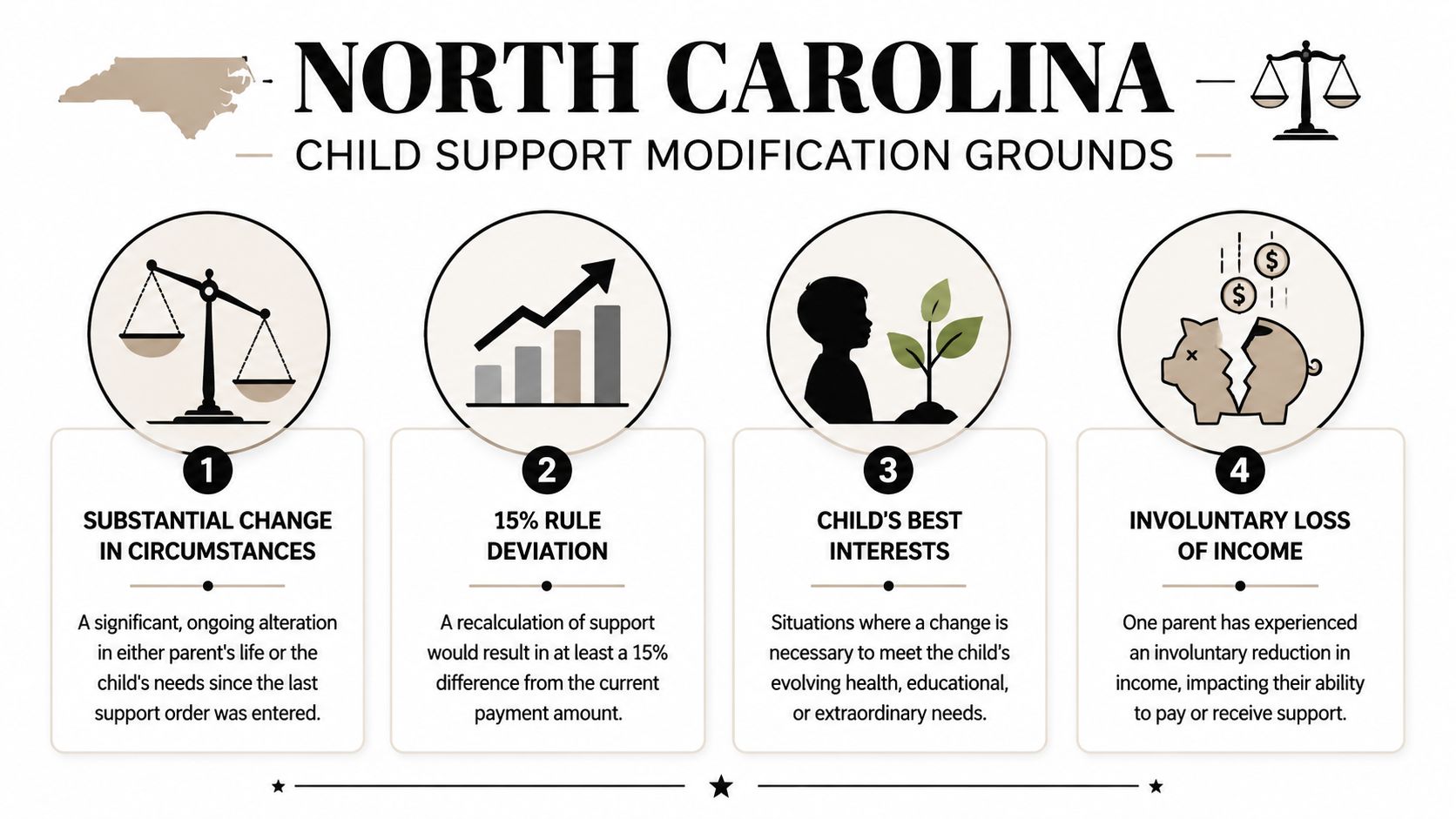
A parent can be paying more for months and still owe only the old amount under the last signed order. That is the enforceability gap that catches families off guard. To increase child support in North Carolina, the court needs a legal basis to modify the existing order, even if both parents agree the current amount no longer works.
The three-year review and guideline variance
North Carolina recognizes a common modification path when enough time has passed. If at least 3 years have gone by since the order was entered or last changed, the court can compare the current order to a new guideline calculation. If that new figure differs enough from the existing amount, the court may presume modification is appropriate, as discussed in this North Carolina child support modification overview.
That rule matters because many support cases do not change overnight. A parent gets raises over time. Health insurance costs shift. A child gets older and the household budget looks very different than it did when the order was signed.
When less than three years have passed
If the order is newer, timing alone usually will not carry the case. The parent asking for an increase must show a material and substantial change in circumstances.
Courts often see that issue in a few recurring situations:
Custody has changed
The child is spending substantially more overnights with one parent than the current order assumed.The child's needs have changed
Ongoing medical treatment, therapy, tutoring, or school-related expenses now exist and were not part of the original order.Income has changed in a meaningful way
One parent's earnings have increased or the other parent's income has dropped, and the guideline amount would now be different.
Income changes are one of the most common reasons parents revisit support. If that is the issue in your case, review how child support changes when income changes in North Carolina before agreeing to a number that may not match the guidelines.
The court still follows a two-step analysis
Judges generally look at modification in two parts. First, is there a legally sufficient change in circumstances? Second, if there is, what does the support amount look like under the current guidelines and facts?
That distinction matters in practice. Parents often come in with real frustration and real expenses, but frustration is not evidence. A parent saying, "everything costs more now," may be factually true and still not enough by itself. The court needs updated income information, proof of changed expenses when those expenses matter, and a record that ties those facts to the legal standard for modification.
Why the legal ground matters as much as the new amount
Parents often focus on the number and skip the reason. That is a mistake.
Suppose both parents agree to raise support by a few hundred dollars after the paying parent gets a new job. If no one can show the court current income, guideline support, and the basis for modification, the agreement may stall when it is submitted for approval. Or worse, it never gets submitted at all. Then the receiving parent budgets around money that is not legally required, and the paying parent later insists the extra payments were temporary help.
The safer approach is to match the facts to a recognized ground for modification before anyone relies on the new amount.
Paths to modify child support in North Carolina
| Method | Is it Legally Enforceable? | Best For… | Key Risk |
|---|---|---|---|
| Private verbal agreement | No, not by itself | Short-term cooperation | Terms may be disputed later |
| Text or email agreement | No, not by itself | Documenting discussions | Still doesn't replace the court order |
| Consent order submitted for approval | Yes, once signed by a judge | Parents who agree and want to avoid a fight | Delays if paperwork is incomplete |
| Formal motion to modify | Yes, if granted | Disputed cases or unclear finances | More time, more conflict, more evidence needed |
The Financial Risks of Off-the-Books Support Changes
A support increase can feel settled until the first month someone stops paying it.
Scenario one with a voluntary increase that disappears
A parent gets a raise and starts sending an extra few hundred dollars each month. Everyone is relieved. The child's expenses are easier to cover, and the receiving parent adjusts the household budget to match what has become the new normal.
Then the extra payments stop.
That is where the enforceability gap causes real damage. The budget was built around money that felt dependable but was never turned into a court order. Rent, child care, school costs, and transportation do not shrink just because the legal paperwork was never finished. In practice, the receiving parent is left trying to cover a shortfall while the paying parent points back to the old order.
Scenario two with conflicting stories about what the money meant
I see this dispute often. One parent says, "We agreed support went up." The other says, "I was just helping out for a few months."
Bank records may show the transfers. They usually do not explain whether those payments were meant as ongoing support, reimbursement for a specific expense, or a gift. If the case ends up in front of a judge, that missing step matters. Courts enforce signed orders. They do not enforce assumptions that were never formally approved.
Why informal increases create financial chaos
The biggest risk is not only that the extra money stops. It is that each parent may have been acting on a different understanding from the start.
The receiving parent may treat the increase as permanent and make ordinary decisions around it, such as signing a new lease, enrolling the child in activities, or covering uninsured medical costs. The paying parent may believe the extra amount was temporary and expect credit for being cooperative. When the relationship sours, both parents feel blindsided, and the child ends up in the middle of a preventable dispute.
North Carolina courts generally work from the existing order until a new one is entered. As noted earlier, waiting to "fix it later" can leave you with months of confusion and no clean way to enforce what both sides supposedly agreed to.
The amount you can count on is the amount in the signed order, not the amount that showed up for a while.
The safer response
If both parents mutually agree that support should increase, put that agreement into a proper filing and get judicial approval before anyone relies on it long term. Until that happens, treat extra payments as voluntary.
That advice is not about being difficult. It is about preventing avoidable damage. A formal modification protects the parent receiving support, gives the paying parent clear terms, and reduces the chance of a later fight over what the money was supposed to cover. If you need help turning an informal agreement into something enforceable, speak with a North Carolina child support modification lawyer before the payment history and the parties' expectations drift further apart.
When a Formal Court Motion is Your Only Option
Sometimes cooperation is over before it starts. In those cases, trying to negotiate a side agreement wastes time and often makes the record messier.
A formal motion is usually the right move when the other parent refuses to discuss support, denies obvious changes in the child's needs, or gives shifting explanations about income. It's also the better path when you believe the other parent is hiding earnings, understating resources, or using delay as a strategy.
Signs you should stop negotiating informally
- The other parent won't provide financial information
- The facts are disputed
- The child's expenses are real, but the other parent keeps minimizing them
- You need a clear filing date to protect your position
- Past promises have already fallen apart
In higher-conflict cases, enforceability matters more than convenience. The court process creates deadlines, requires notice, and produces a result that doesn't depend on ongoing goodwill.
If your situation is moving in that direction, speaking with a North Carolina child support modification lawyer can help you decide whether filing now is the cleaner strategy.
North Carolina Child Support Modification FAQ
Can we just sign a paper ourselves and skip the judge
You can sign a private agreement, but that doesn't give it the same enforceability as a court-approved order. If you want the support increase to be legally binding, the safer route is to submit the agreement for judicial approval.
If the other parent already started paying more, should I still file
Yes, in many situations you should still move quickly to formalize the change. Voluntary payments can stop. The whole point of modification is to turn a temporary practice into an enforceable obligation.
Does a judge automatically increase support because my child costs more now
Not automatically. The court still looks for a valid legal basis for modification under North Carolina law. Increased expenses may matter, but they still have to fit into the modification standard.
Can I recover the difference if we had an informal agreement for a higher amount
That can be difficult. As discussed earlier, North Carolina generally doesn't allow retroactive modification of support that has already accrued, and informal agreements create proof problems.
What if we agree on everything except the start date
That issue needs to be handled carefully in the formal paperwork. Timing can affect what amount is enforceable and from when. This is one of those details that seems minor until it becomes the entire dispute.
A good agreement is not just about the monthly number. It's also about making the start date and terms enforceable.
Protect Your Child's Financial Future in North Carolina
Cooperation between parents is valuable. For many families, it keeps stress lower and helps children avoid unnecessary conflict. But cooperation alone doesn't replace legal protection.
If you're asking whether child support can be increased without court in NC, the practical answer is this. You may be able to avoid a courtroom fight, but you should not rely on an informal increase if you need a result that holds up later. The safer path is a formal modification, often by consent if both parents agree.
That protects the parent receiving support, the parent paying support, and the child, whose daily needs depend on a stable plan. When the amount matters, enforceability matters.
If you're dealing with a support amount that no longer fits your family's reality, the Law Office of Bryan Fagan can help you evaluate whether a North Carolina child support modification makes sense, whether a consent order is workable, and when filing a formal motion is the smarter option. Schedule a consultation to get advice specific to your facts, your county, and your current court order.