A parent calls after a frightening weekend. The other parent sent messages about leaving North Carolina with the child. Or a child came home with injuries and a story that doesn't sit right. Or the issue is less dramatic but still urgent: school starts next week, nobody agrees on where the child will live, and the current arrangement is chaos.
In those moments, many individuals search for one phrase: emergency custody vs temporary custody NC. They want a fast answer because the stakes feel immediate. They also want to know which filing best fits the facts, because filing the wrong thing can waste time and hurt credibility.
North Carolina law gives parents more than one way to ask the court for quick help, but these options are not interchangeable. Emergency custody is reserved for a narrow category of serious danger. Temporary custody is the broader tool courts use to stabilize a case while the larger dispute moves forward. Knowing that difference can shape what evidence you gather, how fast the court acts, and what kind of order you can realistically expect.
When Your Child's Safety Is on the Line
A custody crisis rarely arrives in a neat legal package. It usually shows up as panic, confusion, and a flood of practical questions. Is this serious enough for emergency court action? Do I need police involvement first? What if the judge thinks I'm overreacting? What if I wait too long?

One parent may be facing a true safety issue. Another may be dealing with a child who hasn't been returned on time, repeated instability, or threats about school and travel. Both situations feel urgent. But North Carolina courts separate legal emergency from serious family conflict, and that distinction matters.
Practical rule: If the problem is immediate danger to the child, emergency custody may be on the table. If the problem is instability, access, scheduling, or decision-making, temporary custody is often the better fit.
That doesn't mean the second situation is minor. It means the court uses a different procedural path. Parents often lose valuable time by labeling every urgent custody problem an “emergency” when the facts point toward a temporary hearing instead.
A careful strategy starts with one question: What is happening right now, and what proof exists today? If the answer involves current threats of bodily injury, sexual abuse, or taking the child out of North Carolina, the law treats that very differently from ordinary disagreement, even when the disagreement is intense.
Defining the Two Paths to Immediate Custody in NC
A lot of parents call my office using the word "emergency" when what they really need is a fast temporary order. That distinction matters because the judge will not focus on how stressful the situation feels. The judge will focus on the legal standard you can prove right now.
What emergency custody means in North Carolina
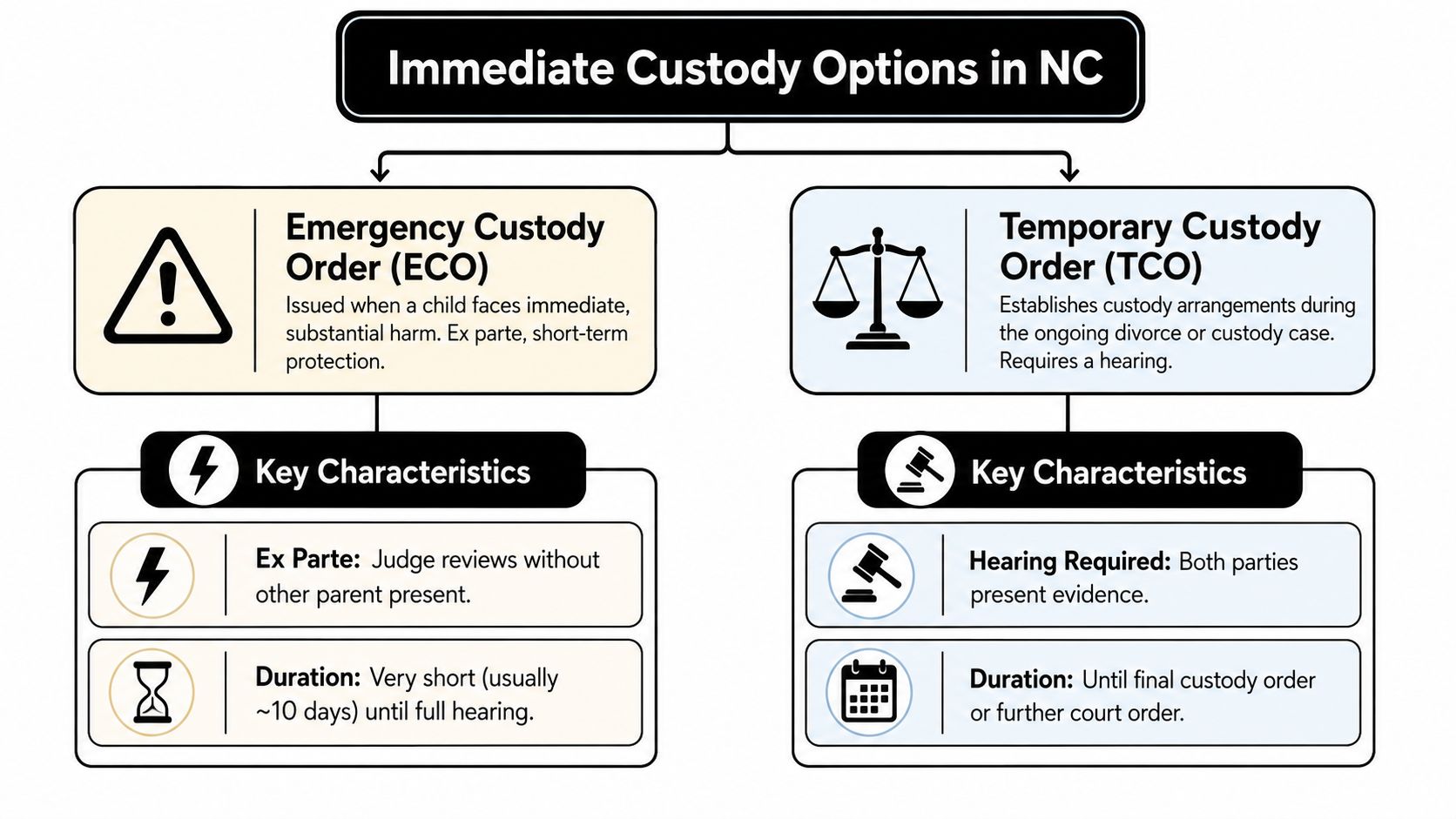
Emergency custody is a narrow remedy for immediate danger. Under North Carolina law, a judge may enter an ex parte order, meaning without the other parent present at the first stage, only in a limited set of circumstances. The concern must involve a substantial risk of bodily injury, sexual abuse, or abduction or removal from the state, as reflected in North Carolina General Statute 50-13.5(d)(3).
That is a demanding standard. Missed exchanges, poor communication, inconsistent parenting, or a home you believe is unhealthy may still support a custody case, but those facts do not automatically justify emergency relief. Judges usually want sworn facts with dates, recent events, and a clear explanation of why the child cannot wait for the regular hearing process.
In practice, emergency custody does three things:
- It allows the court to act quickly before full notice if the facts meet the statute.
- It aims to protect the child from a current safety threat.
- It lasts only long enough to get the parties into a prompt follow-up hearing.
Parents often lose time by filing for emergency custody first and learning, after the denial, that their facts fit a different procedure better.
Here's a short video that helps frame the issue before diving deeper into the details.
What temporary custody means in North Carolina
Temporary custody serves a different purpose. It gives the court a workable parenting arrangement while the larger case is pending, usually after notice to both sides and a hearing where each parent can present evidence.
That order can address where the child stays, the parenting schedule, transportation, school decisions, medical decision-making, and other day-to-day issues that cannot wait until final trial. For a fuller explanation of how that interim process works, this guide to a temporary custody order in North Carolina is a helpful companion.
Temporary custody is often the better choice when the problem is serious, disruptive, and affecting the child, but the facts do not show immediate danger in the statutory sense.
Why people mix them up
The confusion is understandable because both options deal with short-term custody and both can affect where the child lives right away. But they ask the court to solve different problems.
Emergency custody asks, "Is the child in immediate danger?" Temporary custody asks, "What arrangement should govern this family until the case can be fully decided?" That is the practical decision point. Choosing the right path at the start can affect how fast you get heard, what evidence you need, and whether the judge sees your filing as credible.
Core Differences Between Emergency and Temporary Custody
The practical differences matter more than the labels. A parent deciding between these filings should focus on standard, process, notice, and duration.
| Criterion | Emergency Custody | Temporary Custody |
|---|---|---|
| Legal purpose | Immediate protection from serious, current danger | Interim structure during a pending custody case |
| Core standard | Substantial risk of bodily injury, sexual abuse, or abduction/removal from the state | A temporary arrangement to govern the case while the dispute is pending |
| How it begins | May start ex parte | Usually requires notice and a hearing |
| Notice to other parent | Not required before the initial ex parte review | Generally required |
| Speed | Fast-moving emergency procedure | Scheduled under the court's regular interim process |
| Typical duration | Designed to last only until the prompt follow-up hearing | May stay in place until later court action or resolution |
| Best use | True safety crises | Serious but non-emergency disputes over parenting arrangements |
The legal standard is the biggest divide
Under North Carolina law, emergency custody is a narrow, fast-moving remedy that can be granted ex parte only when a child faces a substantial risk of bodily injury, sexual abuse, or abduction or removal from the state. It is designed to last only until a full hearing can be held, typically within 10 days according to this North Carolina emergency custody explanation.
That means emergency custody is not the answer to every urgent problem. Judges do not treat missed exchanges, communication failures, or long-running conflict as automatic emergencies. Even serious frustration may still belong in a temporary custody motion rather than an ex parte emergency request.
Temporary custody works differently. The issue is not whether the child faces the kind of immediate danger required for emergency relief. The issue is how the court should create a workable arrangement while the larger case unfolds.
The court process is very different
Emergency custody is built for speed. A parent files sworn allegations asking the judge to act immediately. Because the court may consider the request without the other parent present, the factual showing needs to be specific and current.
Temporary custody follows a more traditional route. The other side gets notice. A hearing is scheduled. Both parents have a chance to present their side before the judge enters an interim order.
That difference shapes strategy. If your facts support emergency relief, waiting for a normal hearing may expose the child to risk. If your facts don't support emergency relief, filing ex parte may distract from the stronger temporary case you could have presented.
Notice changes the tone of the case
Ex parte emergency filings are exceptional because they ask the court to act before hearing from both sides. Judges know that. They often look carefully at whether the affidavit states concrete facts rather than conclusions.
Temporary custody, by contrast, assumes adversarial presentation from the start. That allows the court to hear competing evidence about routines, stability, school, communication, travel, and parenting logistics.
Courts take emergency filings seriously, but they also expect restraint. A weak emergency filing can make a parent look reactive instead of credible.
Duration affects what each order can realistically accomplish
Emergency custody is a stopgap. It addresses immediate danger and preserves safety until the prompt return hearing. It is not meant to resolve the entire case.
Temporary custody can last much longer. It often becomes the operating framework for the family while the permanent custody dispute is litigated or negotiated. That matters because a temporary order can influence school routines, transportation, communication expectations, and day-to-day parenting patterns.
Common misconceptions that cause problems
Parents often get tripped up by a few recurring mistakes:
- Calling every urgent dispute an emergency: Urgency alone doesn't meet the emergency standard.
- Relying on suspicion instead of proof: Courts want sworn, fact-based allegations supported where possible by documents or other evidence.
- Expecting an emergency order to be permanent: It won't be.
- Ignoring the temporary-hearing route: In many cases, temporary custody is the more effective and realistic path.
What works and what usually does not
What works in emergency cases is specificity. Dates, recent incidents, medical records, police involvement, threatening messages, or facts showing imminent removal from the state are the kinds of details that help the court assess immediate danger.
What usually does not work is broad character evidence. Saying the other parent is selfish, unstable, manipulative, or irresponsible may describe a bad co-parenting relationship, but those labels alone rarely justify emergency ex parte relief.
For temporary custody, the court usually wants a fuller picture. Stability, caregiving routines, school issues, transportation, communication, and the child's day-to-day needs often matter more than dramatic accusations.
The Filing Process Step by Step for Each Order
Choosing the right type of custody request is only half the job. The filing process often decides whether the judge sees a credible, organized case or a rushed dispute that is not ready for immediate action.

How emergency custody usually gets filed
Emergency custody filings are built for speed, but speed does not excuse sloppy proof. Judges want sworn facts tied to a current risk to the child. Dates matter. Documents matter. The sequence of events matters.
In practice, a parent usually files a verified pleading and supporting affidavit that explains the immediate danger with enough detail for a judge to act without waiting for the normal hearing schedule. If you need a focused explanation of the remedy itself, this page on emergency custody in North Carolina gives that background.
A typical emergency filing process looks like this:
Collect the recent evidence
Save text messages, emails, photos, medical records, police reports, and anything else that shows what happened and when.Draft sworn allegations carefully
The filing should explain the immediate threat to the child and why ordinary notice would expose the child to further harm or a serious risk of removal.File the request with the clerk
The paperwork is submitted to the court for prompt review under local procedure.Present the matter for judicial review
In some counties, the judge may review the papers the same day. In others, local practice controls how quickly the request is placed before a judge.Prepare for the next hearing right away
An emergency order is short-term relief. The follow-up hearing usually arrives fast, and the other parent will have a chance to respond.
What happens after an emergency order is entered
Parents often assume the hardest part is getting the first order. Usually, it is not.
After an emergency order is signed, the court sets a prompt follow-up hearing. At that hearing, the judge hears from both sides and decides whether the order should stay in place, be changed, or end. North Carolina court guidance explains the emergency and ex parte process in more detail through the state Judicial Branch's child custody help topic.
Treat that hearing as a full preparation deadline. Bring organized exhibits, witnesses if appropriate, and a clear timeline. A parent who files strong emergency papers but shows up unprepared for the return hearing can lose ground quickly.
How temporary custody usually gets filed
Temporary custody follows a more standard path. The goal is not to prove an immediate crisis. The goal is to give the court enough evidence to put a workable parenting structure in place while the larger case is pending.
That usually means:
- Filing a custody complaint or claim for custody
- Serving the other parent properly
- Requesting temporary custody through motion or local scheduling procedure
- Completing any required mediation or local case management steps
- Preparing for a noticed hearing where both parents can present evidence
This process usually gives the court more time to review the family's day-to-day situation. That can be a real advantage. If the problem is school instability, repeated schedule changes, missed exchanges, poor communication, or disagreement about who has been handling daily care, temporary custody often gives the judge a better framework for making a useful interim decision.
The practical difference in preparation
Emergency custody requires a narrow presentation. The question is whether the child needs immediate protection before the other parent can be heard in the usual way.
Temporary custody requires a broader presentation. The court will often want to see calendars, school information, medical routines, childcare plans, transportation details, communication records, and testimony showing who has been meeting the child's daily needs.
That difference matters because parents sometimes choose the faster-sounding option when the stronger legal option is the regular temporary hearing. A good filing strategy is not about filing the most aggressive motion first. It is about choosing the path that fits the proof you have.
Which Path Is Right for Your Situation Real-World Scenarios
Most parents don't need another abstract definition. They need to know where their own facts fit. That's where the emergency custody vs temporary custody NC question becomes practical.
Scenario one credible threat of abduction
A parent learns the other parent has packed the child's belongings, bought travel arrangements, and sent messages saying the child won't be returned to North Carolina. That situation may fit emergency custody because the risk is immediate and tied to removal from the state.
The key is proof. The court will care far more about dated messages, travel confirmations, or witness statements than about a general fear that “I think they might leave.” In this kind of case, speed matters, but so does precision.
Scenario two school enrollment and parenting time chaos
Parents separate. There's no court order yet. One parent keeps changing the schedule, refuses to confirm where the child will attend school, and threatens to withhold weekend time. The child is caught in the middle.
That situation can feel urgent, and it often is. But it usually points to temporary custody, not emergency custody. Readers often want help with exactly these kinds of issues, including school enrollment, travel restrictions, and contested parenting time, yet those disputes may be better handled through temporary hearings and mediation pathways rather than emergency filings, as discussed in UNC custody procedure materials.
This is a common place where strategy beats emotion. A focused temporary motion may do more good than an overreaching emergency request.
Scenario three suspected substance abuse without clear current danger
This is one of the hardest gray areas. A parent believes the other parent is abusing substances. There may be troubling behavior, erratic calls, or unexplained absences. But there may not be recent medical evidence, a police event, or a direct incident involving the child.
That may or may not support emergency relief depending on what concrete facts exist. Suspicion alone usually won't carry an ex parte request. But the court may still take the custody dispute seriously in a temporary hearing, especially if you can show instability affecting the child's routine, supervision, or safety.
Here, careful evidence gathering matters. Dates. Screenshots. Witnesses. School observations. Any factual pattern that shows current impact on the child.
Scenario four a child returns with injuries
A child comes home with bruising and gives a concerning explanation. The parent also has recent messages from the other parent that suggest volatility in the home.
This may justify emergency filing if the facts support immediate risk of bodily injury. But filing first and asking questions later isn't always the smartest move. If the child needs medical attention, that comes first. If law enforcement needs to be involved, that may also be part of the immediate response. The legal filing should then align with the objective evidence created by those events.
Scenario five a grandparent or third party is trying to protect the child
Grandparents often ask whether they can step in when both parents appear unable or unavailable to protect a child. The answer depends heavily on the family's legal posture, the existing rights of the parents, and the factual basis for third-party standing.
A grandparent with serious safety concerns should get legal advice quickly. Third-party custody issues in North Carolina can become complicated fast. The court will still care about the same central question at the emergency stage: is there immediate, statutorily defined danger to the child? If not, the better route may be a non-emergency custody filing, depending on the facts and the third party's legal footing.
Many difficult custody problems are urgent without qualifying as emergencies. Choosing the correct filing is often the first strategic win in the case.
A simple decision lens
If you're trying to sort your facts quickly, ask:
- Is there immediate danger recognized by statute? If yes, emergency custody may fit.
- Do I have sworn, specific facts and supporting proof? If no, the emergency request may be weak even if your concern is sincere.
- Is the primary problem instability rather than imminent harm? If yes, temporary custody is often the better path.
- Would a judge need to hear both sides to sort this out fairly? If yes, that usually points toward temporary custody.
Frequently Asked Questions About NC Custody Orders
Parents usually ask these questions when something has already gone wrong. The right answer depends less on labels and more on two practical points: what you can prove now, and what result the court can realistically give you on short notice.
Can a grandparent file for emergency custody in North Carolina
Sometimes. A grandparent cannot step in because they believe they would make better choices than a parent.
North Carolina courts look closely at whether the grandparent has legal standing to file, what the current custody situation is, and whether the facts support immediate court action. If a grandparent is calling because a child may be in danger today, that is the point to speak with an NC emergency custody attorney before filing. Third-party cases can become procedurally complicated very quickly.
What proof do I need for emergency custody
Emergency custody requests succeed or fail on specifics. A judge will want sworn facts showing an immediate risk that fits the legal standard, not a general sense that the other parent is unsafe or irresponsible.
Useful proof often includes recent texts, police reports, medical records, photographs, school records, witness statements, or other neutral evidence tied to a current event. Dates matter. Details matter. If the concern is real but the proof is thin, filing for temporary custody may be the stronger strategy.
What if the judge denies emergency custody
A denial can still leave you with options. In many cases, it means the court does not see enough evidence of immediate danger for emergency relief, even though the child may still need a more stable arrangement.
That often shifts the case into a temporary custody track, where both sides can be heard and the judge can address ongoing problems in a more complete way. I often tell clients that a denied emergency request is not the end of the case. It is a signal that the court wants a different procedural path.
Can I get emergency custody because the other parent keeps violating our schedule
Usually no, at least not based on missed exchanges alone. Judges generally treat schedule violations as enforcement or modification issues unless those violations are tied to immediate danger, abduction risk, or another serious safety concern.
Repeated interference with parenting time still matters. It can affect credibility, future custody decisions, and the court's view of whether the current order is workable.
How much will this process cost
The cost depends on the county, whether you are starting a new case or filing within an existing one, how quickly hearings are set, and how contested the facts become. Emergency filings can require fast document preparation and short-notice court appearances. Temporary custody disputes may involve more hearing time, more evidence, and more attorney work over a longer period.
A consultation should give you a more useful answer than generic online estimates. The better question is not only what the case will cost, but which filing gives you the best chance of protecting your child without spending time and money on the wrong remedy.
Protect Your Child's Future with an Experienced NC Attorney
Custody decisions made in a crisis can shape the case for months. That's why choosing the right remedy matters. Emergency custody can protect a child when the facts justify immediate intervention. Temporary custody can create much-needed stability when the problem is serious but doesn't meet the emergency threshold.
An experienced attorney helps in ways that go beyond drafting paperwork. Counsel can identify whether the facts fit emergency relief, organize evidence for the strongest presentation, anticipate local procedure, and prepare for the hearing that follows. If your situation may involve an urgent filing, speaking with an emergency custody lawyer in North Carolina can help you avoid costly mistakes and move with purpose.
This article is informational only. It isn't legal advice for your specific case. North Carolina custody disputes turn on detailed facts, local court practice, and the quality of the evidence available at the time you file.
If your child may be at risk, don't wait for the situation to sort itself out. If your issue is urgent but not clearly an emergency, don't assume you're out of options. The right strategy starts with a careful review of what happened, what can be proven, and what filing gives the court the clearest path to protect your child.
If you're dealing with a custody crisis in North Carolina, the Law Office of Bryan Fagan can help you assess whether emergency custody, temporary custody, or another legal step makes the most sense for your situation. Schedule a consultation to get clear guidance, a practical plan, and focused advocacy suited to your family's needs.