
When you search for an emergency custody lawyer nc, you are usually not browsing casually. You are trying to decide what to do in a moment that feels dangerous, fast-moving, and personal.
North Carolina law does allow emergency custody in limited situations. But the hard truth is that many frightened parents hear the word "emergency" and assume the court will treat any serious parenting problem as an immediate crisis. That is not how these cases work. Judges apply a narrow legal standard, and they expect strong proof right away.
If your child may be in danger, you need two things at the same time. You need to act quickly, and you need to act carefully.
Understanding the High Bar for Emergency Custody in NC
Fear does not have to be exaggerated to be real. Parents often contact a lawyer because something feels badly wrong. Sometimes they are right that the child needs immediate court protection. Sometimes the problem is serious, but it does not meet the legal test for an emergency order.
Under N.C. Gen. Stat. § 50-13.5(d)(3), North Carolina limits emergency custody to three specific situations: a substantial risk of bodily injury, a substantial risk of sexual abuse, or a substantial risk that the child will be abducted or removed from North Carolina to evade the court's jurisdiction. A North Carolina overview of emergency custody explains that the order is issued ex parte, meaning without the other parent present at first, and that the law is intentionally narrow to prevent misuse while protecting children in real danger (King Law Offices on emergency custody orders in North Carolina).

What counts as a true emergency
A court wants to see an immediate and substantial threat, not a general concern.
Examples that may support an emergency filing include:
- Physical violence or a credible threat of violence involving the child
- Evidence of sexual abuse or grooming behavior that puts the child at risk
- Specific signs of planned removal from the state to avoid North Carolina court authority
- Danger supported by documents, such as medical records, police reports, witness statements, or saved communications
A common example is a parent who has recently assaulted the child or made direct threats, and there are photographs, medical treatment records, or law enforcement involvement. Another is a parent who has bought travel, packed belongings, withdrawn the child from school, and said they are leaving North Carolina so the other parent "will never see the child again."
Those facts are very different from a dispute where one parent is angry, inconsistent, or difficult.
What usually does not qualify
Many bad custody situations are not emergency custody situations.
A judge will often view these as issues for a regular custody motion rather than an emergency request:
- Parenting style disagreements
- A new boyfriend or girlfriend in the home, without evidence of imminent harm
- Late exchanges or visitation disputes
- Claims that the other parent is irresponsible, without proof of immediate danger
- General concerns about alcohol, drugs, or instability if there is no concrete evidence linking that concern to an urgent threat to the child
That does not mean the court ignores these issues. It means the court addresses them through the standard custody process, temporary custody requests, modification actions, contempt, or protective orders when appropriate.
Key point: Emergency custody is not the court's tool for fixing every unsafe or frustrating co-parenting problem. It is reserved for immediate child protection.
Why judges draw the line so sharply
An emergency order can change physical custody without first hearing from the other parent. Because that is such a serious step, judges look closely for exaggeration, weak inferences, and unsupported accusations.
That high bar protects children and also protects due process. Courts know that custody fights can involve fear, anger, and conflicting stories. They want evidence showing that the danger is happening now, or is about to happen, not that something concerning happened once and might happen again someday.
A practical way to assess your case
Ask these questions:
- What exactly happened?
- When did it happen?
- How does it show immediate danger to the child?
- What proof can I put in front of a judge today?
If you can answer those questions with specifics, your case may be appropriate for emergency relief. If your answer depends mostly on suspicion, assumptions, or old events with no present threat, the better path may be a non-emergency custody filing.
Your First Steps Documenting Evidence for the Court
In a real emergency, the first hour matters. Not because you need dramatic language, but because details disappear quickly. Messages get deleted. Bruises fade. Witnesses forget exact wording. Rooms get cleaned. Social media posts vanish.
Judges do not grant emergency custody because a parent is frightened. They grant it because the evidence shows immediate risk.
Start with a clean timeline
Write down the events in order while your memory is fresh.
Include:
- Dates and times as closely as you can remember
- Who was present
- What was said
- What the child said or showed
- What you personally observed
- What happened next, such as a doctor visit, police call, or school report
Keep your wording factual. "He was drunk and scary" is less useful than "At pickup, he smelled strongly of alcohol, was slurring his words, could not keep his balance, and the child said she was afraid to get in the car."
Preserve electronic evidence correctly
Texts, emails, call logs, voicemails, photos, and social media can matter, but only if you preserve them in a way that is easy to present.
Focus on:
- Screenshots that show the date, time, and sender
- Backups saved to a secure device or cloud account
- Voicemails downloaded or preserved in their original form if possible
- Social posts captured before they disappear
- Call records that support your timeline
Do not edit screenshots. Do not crop out context unless you also keep the full version. If a thread shows threats before and after one message, save the whole thread.
Photograph conditions, not just injuries
Parents often think only visible injury matters. Unsafe conditions can matter too, if they directly support imminent harm.
Take clear photos of things like:
- Visible injuries
- Broken doors, smashed objects, or signs of violence
- Accessible drugs, weapons, or dangerous items near the child
- Filthy or hazardous living conditions
- Packed bags or travel documents if removal from the state is threatened
If possible, keep the original image files. Those often contain helpful date information.
Reach out to third-party witnesses
Neutral witnesses can make a major difference.
Consider whether any of these people have firsthand information:
- Teachers
- Doctors
- Counselors
- Daycare staff
- Neighbors
- Relatives who directly observed events
Do not pressure anyone to "take your side." Ask whether they are willing to describe what they saw or heard. Courts care more about firsthand observations than opinions.
Practical tip: A short, factual witness statement is often more useful than a long emotional letter.
Get records, not summaries
If police responded, ask how to obtain the report. If the child was treated by a doctor, preserve discharge papers or records you already have access to. If there is a domestic violence protective order, keep a copy ready.
A parent who says, "The police were called a lot," is making an assertion. A parent who files a police report, medical note, photographs, and texts is giving the court something concrete to evaluate.
Evidence checklist for emergency custody filings
| Type of Risk | Primary Evidence Examples | Supporting Evidence Examples |
|---|---|---|
| Bodily injury | Medical records, photographs of injuries, police reports | Text threats, witness statements, domestic violence protective orders |
| Sexual abuse | Medical documentation, forensic interview records if available, reports to authorities | Child disclosures documented by qualified professionals, witness observations, concerning messages |
| Removal from North Carolina | Travel plans, messages stating intent to leave, school withdrawal records | Packed belongings, witness statements, prior threats to disappear, location-related communications |
A real-world pattern that often works better than one dramatic claim
Many emergency cases are not built on one perfect piece of evidence. They are built on several smaller pieces that fit together.
For example, a parent may have:
- text messages threatening to take the child out of state,
- photos of packed luggage,
- a screenshot showing a school withdrawal request,
- a witness who heard the same threat,
- and proof that the child has lived in North Carolina long enough for the state to act as the child's home state.
That collection is far more persuasive than one unsupported accusation. North Carolina generally exercises custody jurisdiction only if the state is the child's home state, meaning the child has lived with a parent here for at least six months, or since birth if the child is younger than six months, as discussed in the emergency custody overview cited earlier.
What not to do
Avoid these mistakes:
- Do not coach the child on what to say
- Do not alter messages or organize them misleadingly
- Do not file based on fear alone if you have no present facts
- Do not wait too long if there is real danger
- Do not confront the other parent recklessly if that could increase risk
When the facts are strong, careful documentation lets the judge see the emergency clearly. When the facts are weak, no amount of emotional language fixes the problem.
How an Emergency Custody Lawyer Strengthens Your Case
Emergency custody is one of the least forgiving filings in family court. A parent can be sincere, worried, and completely unable to present the case in a way that fits the statute.
That is where an experienced lawyer changes the situation.

The court is skeptical by design
North Carolina courts rarely grant emergency custody orders, and experienced practitioners report that judges deny them approximately 90% of the time because the statute requires proof of immediate and substantial risk (Apple Payne Law on emergency custody in NC).
That number matters because it changes how you should think about filing. This is not a motion you file just to "see what happens." A weak filing can fail fast, damage credibility, and give the other side a preview of your case.
A lawyer turns facts into a legal argument
Most parents come in with a folder of alarming material and no clear sense of what the judge needs first.
A lawyer helps by sorting evidence into the legal categories the court uses:
- Does this show bodily injury risk?
- Does this support sexual abuse concerns?
- Does this point to planned removal from North Carolina?
- Does the evidence show immediacy, not just history?
That framing matters. Judges are not looking for a life story. They are looking for a focused, sworn showing that the statutory threshold has been met.
The affidavit often decides the first hearing
The sworn affidavit is not just paperwork. It is the backbone of the emergency request.
A strong affidavit usually does several things well:
- It states facts in a precise sequence.
- It separates direct observation from suspicion.
- It attaches or references supporting documents.
- It avoids overstatement.
- It explains why the danger is immediate.
Parents filing alone often include too much background and not enough legally relevant detail. Or they write in a way that sounds emotional but not provable. A lawyer strips the story down to what a judge can act on.
Procedure can sink a good case
A parent can have valid concerns and still lose because the filing is incomplete, poorly supported, or procedurally defective.
An attorney helps manage issues such as:
- county-specific forms,
- where to file,
- how to request the ex parte review,
- what exhibits to attach,
- and how to make sure service happens correctly after an order is entered.
For broader context on custody actions in North Carolina, many parents also review this guide to a child custody lawyer in NC.
Lawyers prepare for the second hearing from day one
Some parents focus only on getting the initial order. That is a mistake. If the judge grants emergency custody, the case does not end there. The other side will have a chance to respond very soon.
That means your lawyer is already thinking about:
- what the other parent will deny,
- what records must be subpoenaed or obtained quickly,
- whether a witness can appear,
- and whether the emergency request should connect to a larger custody strategy.
Here is a helpful overview of the topic:
Representation also helps clients avoid self-inflicted damage
In crisis, parents sometimes make choices that hurt their case:
- sending threatening texts,
- blocking all contact without legal advice,
- withholding the child in ways not supported by an order,
- or making allegations they cannot back up.
A lawyer acts as a filter. That matters more than many people realize. The emergency filing is not just about proving danger. It is also about showing the court that you are credible, organized, and focused on the child's safety rather than revenge.
Takeaway: In emergency custody matters, legal counsel is not just for courtroom argument. It is for evidence strategy, procedural control, and protecting your credibility from the first filing forward.
The Process for Filing an Ex Parte Custody Order
The filing process moves quickly, but each step has a purpose. If you understand the flow, the court's actions make more sense and the case feels less chaotic.
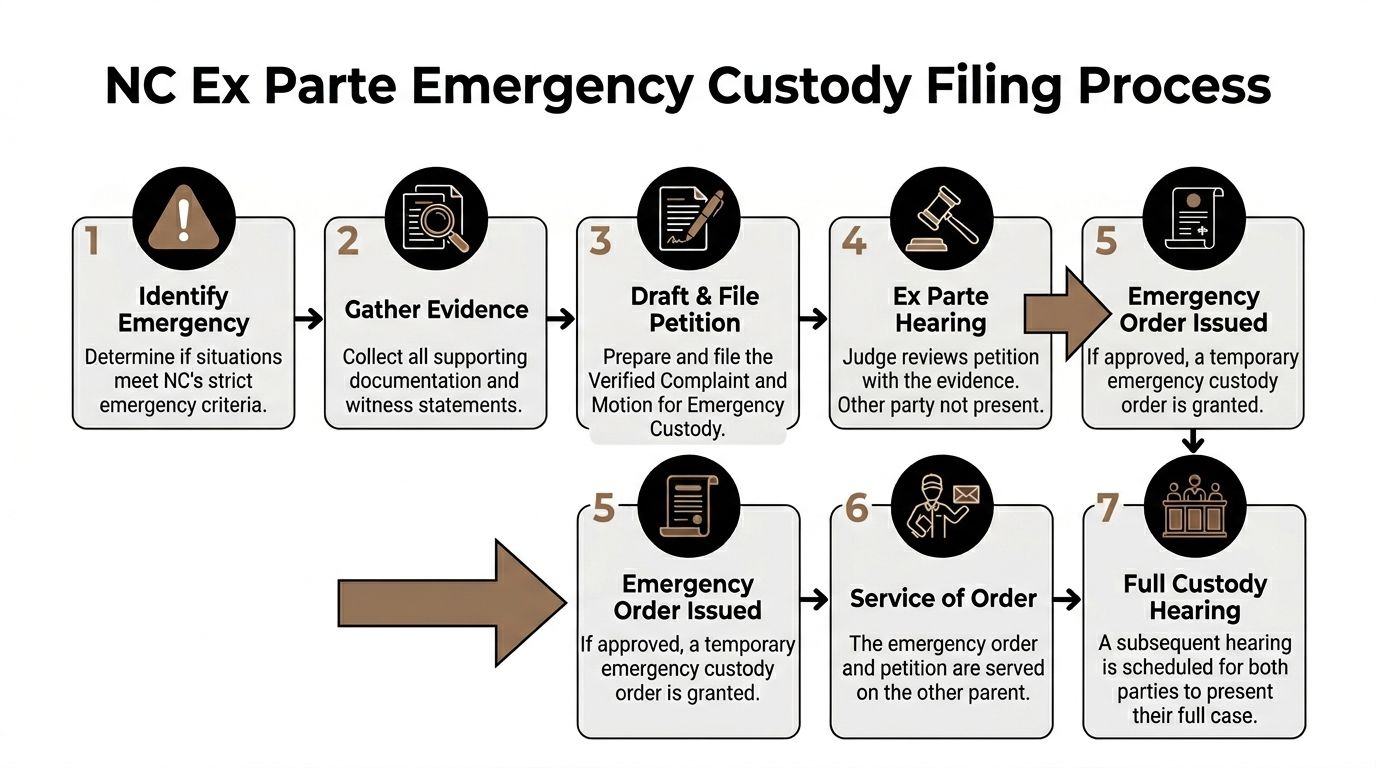
What ex parte means in plain English
Ex parte means the judge initially reviews the request with only one side present. The other parent is not there for that first emergency decision.
North Carolina uses this process because some situations cannot wait for ordinary notice and scheduling. But the court balances that speed by requiring a quick follow-up hearing where both sides can be heard.
The filing package the court expects
A North Carolina emergency request generally begins with a motion or complaint supported by a sworn, notarized statement describing the imminent danger. A practical guide to the process explains that if the ex parte order is granted, it gives immediate temporary custody and must be followed by a hearing with both parties within 10 days to determine whether the order stays in place, changes, or is dissolved (Ley Law on emergency child custody requirements and process).
That sworn statement matters because it tells the judge, under oath, why immediate action is necessary.
Step by step through the court process
Identify the correct county
Filing usually happens in the county with jurisdiction, often where the child lives or where an existing custody case is pending.Prepare the pleadings
This may include a complaint or motion for custody relief and the affidavit. The affidavit should be factual, specific, and notarized.Attach supporting proof
Records, photos, messages, and witness statements should support the affidavit rather than repeat it.File with the clerk of superior court
Once filed, the matter can be presented for emergency review.Request the ex parte hearing
In many cases, this happens the same day or within a short period.Appear before the judge
The judge reviews the documents and may ask questions. This is usually brief and focused.If granted, enforce the order
The order may give immediate temporary physical custody and, in some cases, involve law enforcement if immediate child recovery is necessary.Serve the other parent properly
This step is critical. The other party must receive the order and notice of the follow-up hearing.
For related guidance on interim custody issues, some parents also review information on how to get temporary custody.
What the judge is looking for at the first hearing
This is not a full trial. The judge is making a rapid decision based on the sworn filing and attached proof.
The judge usually wants clear answers to these questions:
- Is the child facing one of the narrow emergency risks recognized by North Carolina law?
- Is the threat immediate?
- Is the evidence credible enough to justify temporary action without hearing the other side first?
Vague filings fail here. So do filings loaded with history but short on present danger.
Service is not a technical side issue
Many self-represented parents underestimate service. They think winning the order is the hard part. Sometimes service is where the case starts to unravel.
The other parent must be properly served with:
- the emergency order,
- the filed pleadings,
- and notice of the return hearing.
If service is mishandled, the court may have procedural concerns even if the original emergency was real. In family court, process matters because the court is protecting both child safety and basic fairness.
Practical point: Treat service as part of the emergency case itself, not as an administrative errand after the fact.
After the Hearing What Happens Next
The first hearing gives you an answer, but not final peace. From there, the case usually goes down one of two paths.
If the judge grants the emergency order
A granted order brings immediate relief, but it also starts a very short preparation window. The next hearing is where the other parent gets to respond, explain, deny, and attack your evidence.
The first priority is safety. Make sure the child is somewhere stable, school personnel know who may pick up the child if necessary, and you follow the order exactly as written. Do not add your own terms because you think they make sense.
Then turn to preparation.
Useful next steps often include:
- Organize every exhibit that supports the emergency filing
- Update the timeline with any new incidents
- Confirm witness availability
- Preserve communications after entry of the order
- Avoid unnecessary conflict with the other parent
A granted emergency order is temporary. It often becomes part of a broader custody case, whether through a temporary custody arrangement or a later permanent hearing.
If the judge denies the emergency request
Denial feels crushing, especially if you still believe your child is at risk. But denial does not always mean the judge thinks you are lying. It may mean the court did not see enough proof of immediate danger under the narrow emergency statute.
That distinction matters.
In that situation, the next move may involve:
- filing for regular temporary custody,
- seeking modification of an existing order,
- gathering stronger documentation,
- or pursuing another protective remedy if the facts support it.
Parents often need to think beyond the emergency label and ask what legal tool fits the facts. If your concern is ongoing but not immediate, a modification case may be the better vehicle. For that kind of follow-up issue, this overview of how to modify a custody agreement can help frame the next step.
Why representation matters even more after the first ruling
The risk is not only denial. It is also reversal or loss of momentum if the case was not built correctly from the start. One North Carolina discussion of emergency custody notes that parents without a lawyer face a significant risk because unrepresented parties are generally less likely to succeed, and that challenge becomes sharper under North Carolina's strict imminent-harm threshold (Triad Law on emergency custody in NC).
That problem shows up in both directions.
If the order was granted, the parent who filed may assume the hard part is over and arrive underprepared for the next hearing. If the order was denied, the parent may react emotionally, send damaging messages, or give up when a more suitable filing path still exists.
What works: staying disciplined after the first hearing, preserving evidence, and matching the next filing to the actual legal issue.
What does not: assuming the emergency label itself will carry the case forward.
The larger custody case still matters
Emergency custody is a crisis tool. It is not the whole custody case.
The court will still care about long-term stability, the child's needs, each party's credibility, compliance with court orders, and whether the evidence supports a continuing change in custody. A parent who keeps the focus on child safety and follows court procedure usually stands in a stronger position than a parent who treats the emergency filing as a weapon.
Common Questions About Emergency Custody in NC
Can grandparents file for emergency custody in North Carolina
Sometimes, yes. But the answer depends on the facts and the person's legal standing to seek custody. A grandparent or another third party usually needs to show more than concern. The court will look closely at the child's circumstances, the rights of the parents, and whether the emergency facts fit the statute.
If you are a grandparent caring for a child or responding to a crisis, get legal advice before filing. Standing issues can be as important as the danger allegations themselves.
How fast can I get an emergency custody order
An ex parte request can move very quickly, sometimes the same day or within days depending on the county and the court's availability. Speed does not lower the legal standard. Judges still expect a sworn filing and evidence that shows immediate danger.
The faster your evidence is organized, the better positioned you are to seek relief.
Do I need a police report to file
No single document is required in every case. A police report can help, but not every valid emergency begins with law enforcement involvement. Courts may consider medical records, photos, texts, witness statements, and other credible documentation.
What matters is whether the evidence, taken together, proves the legal emergency.
What if the other parent violates the emergency order
Document the violation carefully and speak with your lawyer promptly. Save messages, note dates and times, and gather witness information. Depending on the facts, enforcement options may include law enforcement involvement, contempt proceedings, or emergency follow-up motions.
Do not respond by violating the order yourself. Courts notice which parent followed the written order and which parent decided to improvise.
Will filing for emergency custody hurt my case if I lose
It can if the filing was exaggerated, unsupported, or obviously tactical. It may not if the concern was genuine and the issue was that the evidence did not meet the emergency threshold. Credibility is one of the most valuable assets in family court.
That is why careful screening matters before filing. The goal is not to file the fastest motion possible. The goal is to file the right motion, with proof that matches the law.
If your child may be in immediate danger, do not wait to get legal guidance. The Law Office of Bryan Fagan helps North Carolina parents and families evaluate emergency custody situations, prepare evidence, and pursue the legal option that fits the facts. Schedule a consultation to discuss what is happening, what the court is likely to require, and what steps may best protect your child.