If you're dealing with a spouse who argues about everything, rewrites history, or uses the children, money, or communication itself to gain an advantage, your case needs more than a standard divorce checklist. In a high-conflict North Carolina divorce, the first priority isn't winning every exchange. It's containing the conflict so it doesn't control your finances, your parenting time, or your mental bandwidth.
A sound divorce strategy in North Carolina for a high-conflict case is usually built around structure. You reduce unnecessary contact. You preserve proof. You make temporary arrangements enforceable. You stop treating every crisis as an emergency and start deciding which issues belong in court. That approach protects you better than reactive fighting ever will.
Your First Moves A Strategic Blueprint for a High-Conflict NC Divorce
The first days and weeks after separation often feel chaotic. That's when people make avoidable mistakes. They argue by text, hand over documents informally, trust verbal promises, or wait too long to get legal advice because they hope the other party will calm down.
In North Carolina, timing matters from the start. Spouses must live separate and apart for one full year before filing for absolute divorce, and at least one spouse must have been a state resident for 6 months before filing, as noted in North Carolina separation and divorce timing guidance. In a high-conflict case, that year is not dead time. It's the period when smart case preparation happens.
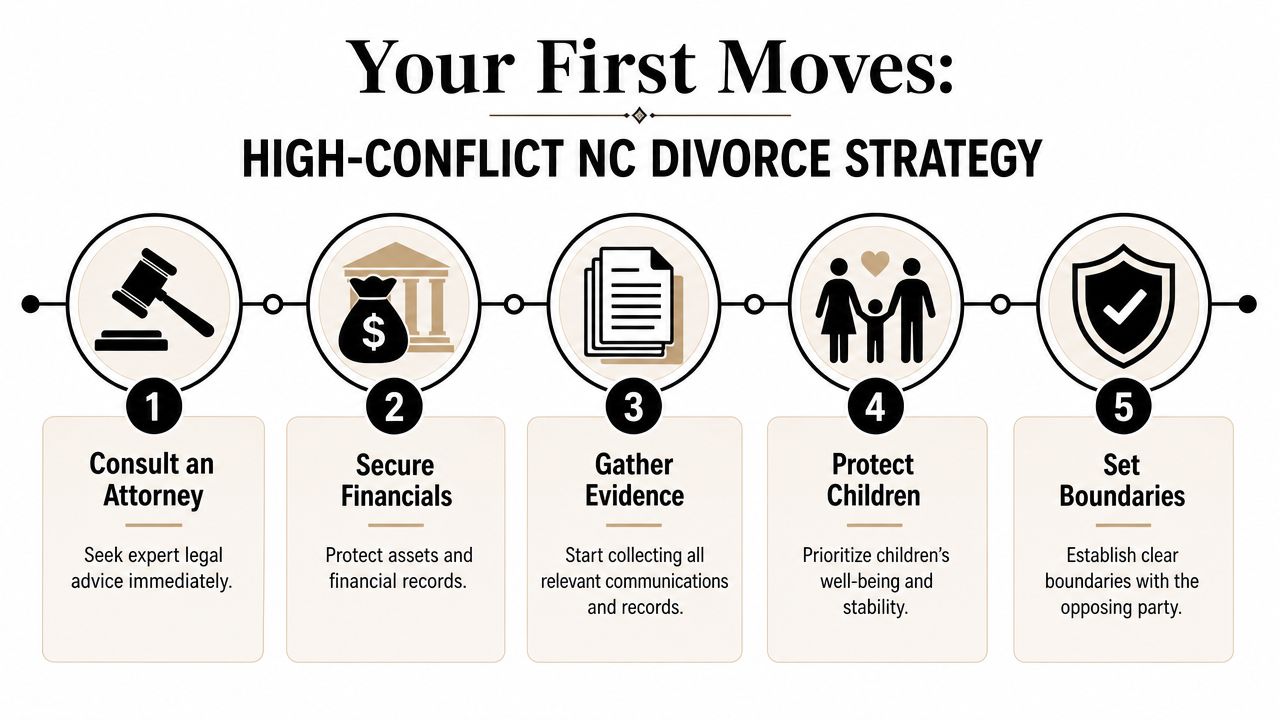
Protect stability before you argue about fault
If you're newly separated, focus first on practical control points:
- Secure core records. Gather bank statements, tax returns, pay stubs, retirement account statements, loan documents, insurance records, and anything tied to household expenses.
- Separate access where appropriate. That may include opening an individual account for income and living expenses, changing passwords, and reviewing shared subscriptions or cloud storage.
- Stabilize the children's routine. School attendance, medical appointments, and predictable exchanges matter more than scoring points in an argument.
- Limit improvised communication. High-conflict spouses often bait the other side into angry replies that later become exhibits.
A common early problem is suspected asset manipulation. One spouse starts moving money between accounts, delays disclosure, or suddenly claims not to have access to records they handled for years. The right response usually isn't a dramatic confrontation. It's quiet documentation, fast preservation, and legal planning.
Practical rule: If a document helps explain money, parenting, or living arrangements, save it now. You may not get a second chance to retrieve it later.
Use the separation year strategically
The one-year separation period under N.C.G.S. § 50-6 often frustrates people who want immediate closure. In high-conflict matters, though, that waiting period can work in your favor if you use it well.
During that time, you can:
- Create a clean financial picture of accounts, debts, recurring expenses, and unusual withdrawals.
- Track parenting patterns such as missed exchanges, late pickups, school issues, or refusal to share information.
- Establish boundaries that reduce conflict instead of feeding it.
- Prepare for custody, support, and property disputes before they become rushed courtroom problems.
The clients who do best in these cases usually stop trying to persuade the other spouse and start preparing for a decision-maker. That's a different mindset. You're no longer asking, "How do I get them to be reasonable?" You're asking, "How do I protect myself if they aren't?"
If you're at the very beginning, a focused consultation with a North Carolina divorce lawyer can help you decide what to preserve, what to stop doing, and which issues need immediate action.
Building Your Case The Power of Meticulous Documentation
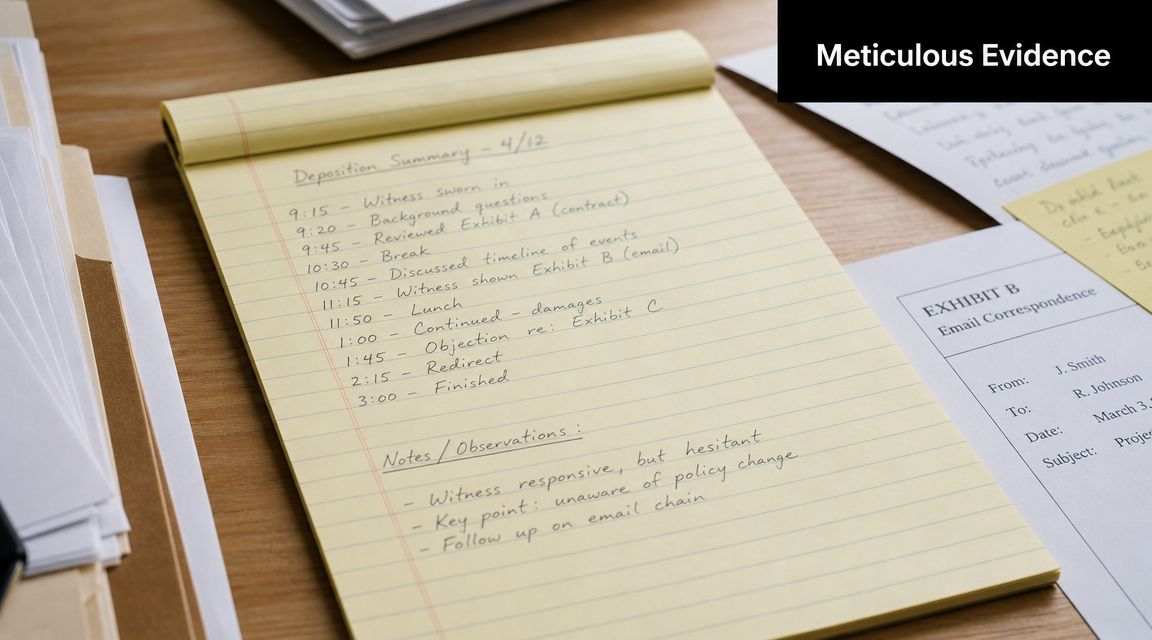
High-conflict cases often look messy from the inside and simple from the bench. A judge or mediator doesn't live in your inbox. They don't hear every argument. They see what can be proved. That's why documentation matters so much.
North Carolina-focused guidance on high-conflict divorce strategy recommends turning every material interaction into a contemporaneous record by preserving emails, texts, and social posts, maintaining a dated incident log, and keeping financial records, custody exchanges, and order violations in one evidentiary file, as explained in guidance on handling a high-conflict divorce with care and compassion.
What contemporaneous really means
A contemporaneous record is a note or saved item made at or near the time something happened. That matters because it carries more weight than a vague memory months later.
If an exchange went badly, don't write, "He always intimidates me." Write what happened. Note the date, time, location, who was present, what was said, whether the children observed it, and whether the exchange happened as scheduled. If a support payment was missed, save the payment record and log the date. If the other parent sent abusive or manipulative messages, preserve the full thread, not just the worst line.
Build one file, not a pile of screenshots
Clients sometimes bring hundreds of disorganized screenshots. That isn't useless, but it isn't efficient. A strong file is organized by issue.
Consider a simple working structure:
| Category | What to save | Why it matters |
|---|---|---|
| Communication | Emails, texts, app messages, voicemails | Shows tone, agreements, refusals, and patterns |
| Parenting | Exchange logs, school notices, medical updates | Helps prove consistency or instability |
| Finances | Statements, receipts, tax records, account activity | Supports support and property claims |
| Violations | Missed visits, denied calls, ignored orders | Shows noncompliance and repeat behavior |
Courts and mediators use documentation to evaluate credibility and patterns of conflict. A calm record often speaks louder than an emotional explanation.
What works and what backfires
What works is neutral, dated, and complete. What backfires is selective editing, dramatic commentary, or retaliation disguised as evidence gathering.
Use tools that naturally create a record. Written communication is usually safer than phone calls in high-conflict situations. If a co-parenting app becomes appropriate later, it can help preserve the communications in one place. For now, the key is discipline.
- Save full conversations. Partial screenshots invite arguments about context.
- Keep your own messages brief. Judges notice which parent escalates and which parent communicates about logistics.
- Avoid editorializing in your log. Facts first. Conclusions later.
- Send records to your lawyer in batches. Monthly folders are easier to review than random late-night message dumps.
If your case feels like a nonstop stream of incidents, that's exactly why documentation matters. It turns a chaotic story into a timeline a court can understand.
Securing Temporary Orders for Immediate Stability
Temporary orders often decide whether a high-conflict case becomes manageable or unbearable. If there are disputes over the children, support, use of the home, or day-to-day financial control, waiting for a final resolution can leave too much room for pressure tactics.
A temporary order can set rules while the case is pending. In practice, that can mean a temporary custody schedule, temporary child support, temporary spousal support where appropriate, or temporary possession of the home. The point isn't to litigate everything at once. The point is to create stability fast enough that the other party can't keep changing the rules.
Why temporary relief matters in high-conflict cases
Without temporary orders, a difficult spouse may treat every week like a fresh negotiation. Pickup times move. Bills go unpaid. Access to the children becomes conditional. Information is withheld unless you concede on something unrelated.
A clear court order changes that dynamic. It gives both sides an enforceable framework. It also creates a baseline. If one parent has been following a temporary custody schedule well, that consistency can matter later when the court evaluates what arrangement serves the child best.
Consider a common scenario. Parents separate, and one parent starts cancelling visits or changing exchange terms at the last minute. The other parent keeps trying to "work it out" informally and ends up with no reliable record and no predictable schedule. A narrowly focused temporary custody motion can stop that cycle by putting dates, times, exchange responsibilities, and communication expectations into an order.
Ask for specifics, not slogans
In high-conflict matters, broad language creates future disputes. "Reasonable visitation" often becomes unreasonable conflict. "Keep each other informed" sounds good until one party decides what counts as information.
Temporary requests should be concrete. That may include:
- Defined exchanges. Exact pickup times, locations, and who transports.
- Communication limits. Written communication only, except genuine emergencies.
- Expense expectations. Who pays which recurring household or child-related bills while the case is pending.
- School and medical access. Clear expectations for sharing records and notices.
If you're dealing with immediate custody instability, this overview of a temporary custody order in North Carolina is a useful starting point. The core strategy is simple. Temporary orders don't just preserve peace. They reduce opportunities for manipulation while the larger case develops.
Navigating High-Conflict Child Custody and Support
A common pattern in high-conflict custody cases looks like this. One parent sends a stream of accusatory texts, changes pickup times with little notice, and turns routine school or medical decisions into a power struggle. The legal question is rarely which parent is more frustrating. The primary question is what structure will protect the child and reduce the openings for more conflict.
North Carolina judges decide custody based on the best interest of the child. In a high-conflict case, that usually means building a plan that lowers the child's exposure to adult disputes and leaves less room for manipulation. Parents often want the court to condemn the other side's behavior. A better strategy is to ask for terms that contain it.
Structure usually beats good intentions
High-conflict custody cases tend to follow a familiar course. The fights are not always about major parenting decisions. They often grow out of the space between them. Vague language about exchanges, late pickups, phone access, extracurriculars, or travel gives a difficult parent room to create new disputes over old issues. A detailed order closes many of those openings before they become motions, contempt hearings, or emergency filings.
A strong parenting plan in a high-conflict case may address:
- Exact exchange logistics including time, place, transportation, and what happens if someone is late
- Holiday and school-break schedules written out in plain terms
- Decision-making authority for education, medical care, and extracurricular activities
- Travel rules including notice requirements and itinerary sharing
- Communication limits so messages stay child-focused and in writing
That level of detail is not about control for its own sake. It is about reducing ambiguity. In these cases, ambiguity is expensive.
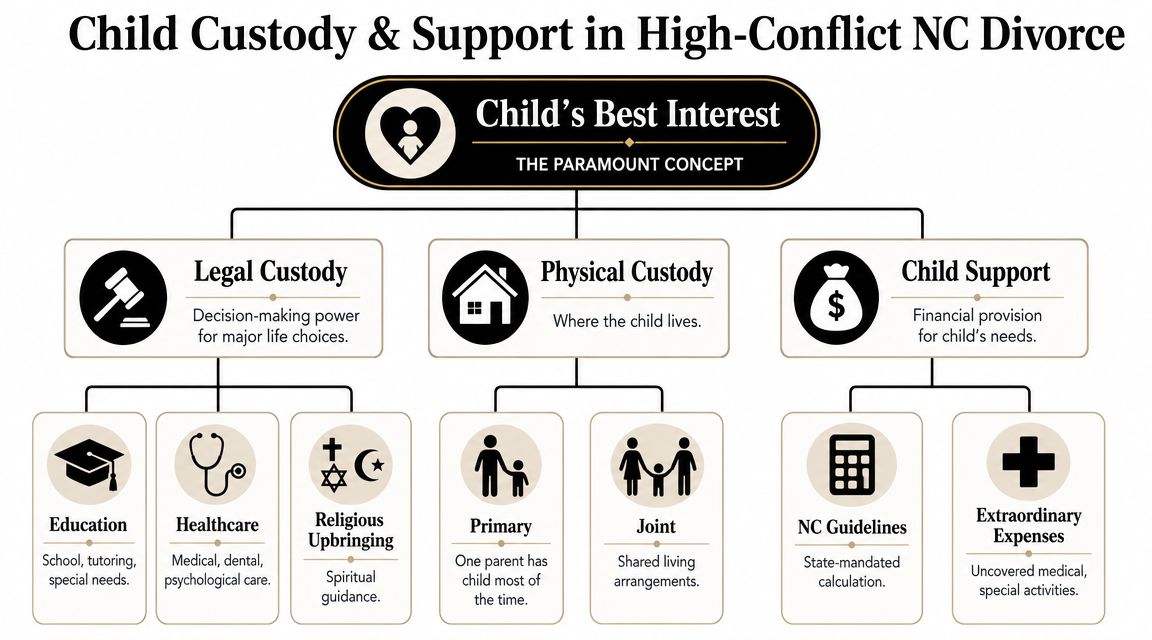
Support issues raise a related problem. The formula matters, but conflict usually centers on incomplete income information, disputed expenses, and orders that are too vague to enforce. If you need a baseline on how support is calculated, the North Carolina child support guidelines are the starting point. In practice, I spend just as much time making sure the numbers are documented and the final terms are specific enough that a missed payment or hidden income issue can be addressed quickly.
This visual helps separate the custody and support concepts families often confuse.
What a low-conflict protocol looks like
The goal is not warm co-parenting. The goal is a workable system.
In a high-conflict case, a low-conflict protocol usually means fewer direct interactions, fewer judgment calls, and fewer chances to argue about what was said. Written communication helps. So do set exchange locations, fixed deadlines for sharing school and medical information, and clear rules about when a parent can call, text, or request schedule changes.
One example shows the difference. If face-to-face exchanges keep turning into arguments, pickup from school or daycare may be far better than handoffs at a parent's home. If ordinary texting turns into harassment or baiting, communication through a co-parenting app may give both sides a cleaner record and lower the temperature. If routine implementation disputes keep returning, a parenting coordinator may help contain those smaller fights before they grow into repeated court action.
Custody strategy is also conflict containment
Many parents worry that asking for detailed rules will make them look rigid. In court, thoughtful detail often makes you look prepared and child-focused, especially when the history shows that informal cooperation has failed. Judges see the difference between a parent seeking order and a parent seeking control.
Your conduct matters here. The parent who follows the schedule, shares information on time, keeps messages brief, and avoids hostile exchanges is usually in the stronger position. That does not mean tolerating bad behavior. It means building a record that shows you are solving problems in a measured way while the other parent keeps creating them.
That is the core strategy in a high-conflict North Carolina custody and support case. Do not wait for the next blowup and then react. Set up a parenting and support structure that limits the other side's ability to create one.
Negotiation Vs Trial When to Settle and When to Fight
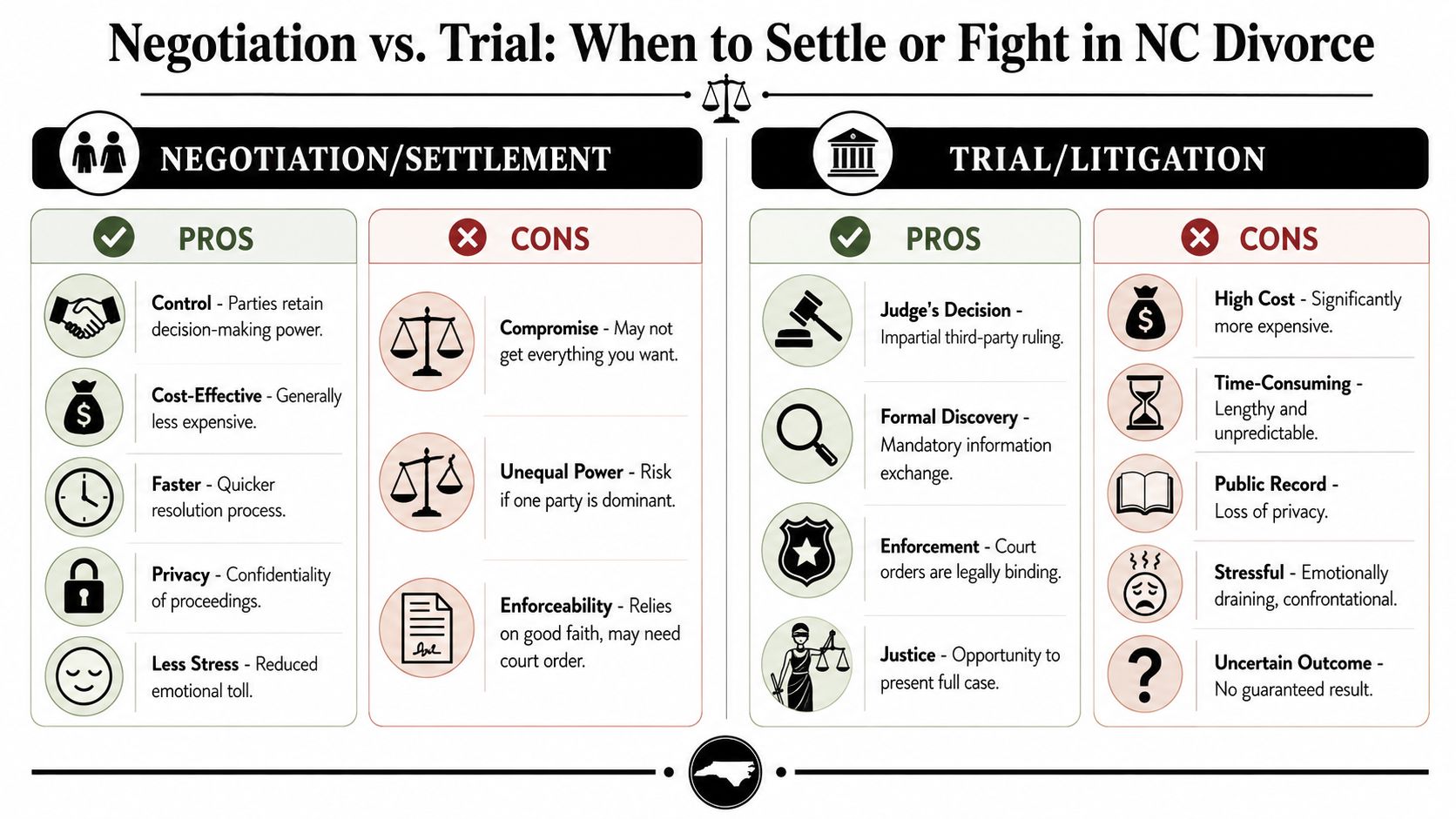
People often frame this as a moral choice. Settle if you're reasonable. Go to trial if you're strong. That's not how high-conflict divorce strategy works in North Carolina. Settlement and litigation are tools. The right choice depends on whether the other side will engage in a process that can produce a safe, enforceable outcome.
When settlement makes strategic sense
Settlement is often the better path when the other party may be difficult but still capable of exchanging information, evaluating risk, and following a written agreement. In that setting, negotiation can narrow issues, preserve some privacy, and give the parties more control over detail than a crowded court calendar ever will.
Mediation is commonly used in high-conflict North Carolina divorce matters to reduce the number of contested issues that survive into litigation. But settlement should never mean vague terms for the sake of peace. In a high-conflict case, a weak agreement postpones the next fight.
A reasonable settlement usually has these features:
| Sign of a workable settlement path | Warning sign that court pressure may be needed |
|---|---|
| Information is exchanged with some reliability | Records are withheld or manipulated |
| Proposed terms can be made specific | The other side insists on broad, flexible language |
| Safety and child stability can be protected | The process itself is being used for control |
| Violations are occasional and fixable | Violations are repeated and strategic |
When litigation is the smarter tool
When mediation fails or isn't safe, the strategy changes. North Carolina high-conflict guidance points toward requesting highly specific court orders for stricter schedules, limited flexibility, neutral exchange locations, and potentially a parenting coordinator or supervised visitation, as explained in North Carolina guidance on parenting plans and court tools in high-conflict cases.
That shift matters because some people misuse "co-parenting" language to avoid accountability. If one party lies about finances, ignores boundaries, or uses the child as a messenger, more negotiation may only give them more room to stall.
The test isn't whether settlement sounds nicer. The test is whether the process can produce an order detailed enough to hold under stress.
A practical way to decide
Ask three questions.
- Can the other side follow a written rule?
- Is missing information blocking fair negotiation?
- Would a vague compromise create future enforcement problems?
If the answer to those questions points toward instability, formal motion practice may protect you better than continued informal bargaining. That doesn't mean every issue must go to trial. It means you use court pressure where needed and negotiate from a position that isn't exposed.
In many high-conflict cases, the strongest posture is selective. Fight hard over safety, the children, accurate financial disclosure, and enforceable wording. Be flexible on issues that don't change long-term outcomes. That's how you conserve resources without surrendering advantage.
High-Conflict Divorce FAQ for North Carolina
Is a high-conflict divorce the same as domestic violence
You wake up to 27 texts, three missed calls, and a threat that your spouse will "make sure you never see the kids." That is not just a communication problem. It may be evidence of harassment, coercion, or conduct that calls for immediate court action.
A high-conflict divorce can involve constant arguments, manipulation through communication, repeated motions, or refusal to cooperate. Domestic violence is a separate legal issue with separate remedies under North Carolina law.
If there are threats, stalking, physical harm, intimidation, or serious safety concerns, treat that as a safety issue first. The right strategy may include protective relief, tighter contact boundaries, and a plan for where you stay, how exchanges happen, and how communication is documented. Labels do not control the case. Facts do.
Should I keep talking to my spouse to show I'm cooperative
Cooperation does not require unlimited access to you. In high-conflict cases, open-ended calls and constant texting often give the other party more chances to provoke a reaction or create confusion about what was said.
A better strategy is controlled communication that reduces friction and creates a usable record. Written messages, limited topics, and a set response pattern often do more to contain conflict than trying to talk things out.
- Use written channels when possible. They preserve timing, wording, and tone.
- Keep messages to logistics. Focus on the children, schedules, medical issues, school matters, and agreed expenses.
- Do not answer every accusation. A reply is not required solely because a message was sent.
- Write as if the judge may read it. That habit improves both content and tone.
The goal is not to seem warm. The goal is to be steady, reasonable, and hard to bait.
Can I record conversations in North Carolina
Maybe, but do not assume a recording will help just because it feels dramatic. Recording raises legal and strategic issues, and the safer course is to get legal advice before you do it.
I often tell clients this. A clean timeline, saved messages, and records that show a pattern are usually more useful than one heated audio clip with no context. Even when a recording may be lawful, it can complicate the case if it inflames the other side, affects the children, or creates a side dispute about how it was obtained.
Ask first. Then decide whether the recording serves a real purpose in your case.
What if my spouse won't follow informal agreements about the children
Repeated failure to follow informal agreements usually means the case needs more structure. Verbal understandings work only when both parents are acting in good faith. In a high-conflict case, they often become one more area for denial, revision, and blame.
At that point, the strategic move is to reduce discretion and tighten the terms. That may include:
- Specific exchange terms instead of broad parenting language
- Neutral pickup locations if home exchanges trigger conflict
- Written communication requirements if calls lead to arguments
- Clear enforcement language so violations are easier to prove and address
This is how conflict gets contained. The less room there is for improvisation, the less room there is for disruption.
Does misconduct matter in a North Carolina divorce
Sometimes. It depends on the issue before the court.
North Carolina family law does not treat every bad act the same way. Conduct that may affect alimony does not automatically decide custody. Conduct that may matter in custody does not necessarily change property division. That is why broad complaints rarely carry a case by themselves.
The stronger approach is to match the proof to the legal standard. If the issue is support, focus on the facts that affect support. If the issue is custody, focus on the facts that affect the child's welfare and the parent's judgment. That keeps your case disciplined and makes it harder for the other side to drag you into side fights that do not improve the outcome.
If you're facing a high-conflict divorce, early strategy can make a major difference in how much control you keep over your case, your children's routine, and your financial stability. The Law Office of Bryan Fagan works with North Carolina residents who need clear advice, strong structure, and practical legal planning in difficult family law matters. Schedule a consultation to discuss your situation, your risks, and the next steps that make sense for you.