Your child support order may have made sense when it was entered. Then life changed.
A layoff hit. A promotion changed both households’ finances. Your child started needing new medical care, or childcare costs shifted, or the overnight schedule stopped matching what the order assumes. At that point, many North Carolina parents ask the same question: do I really need a child support modification lawyer nc, or can I just work this out with the other parent?
Sometimes parents do agree on the numbers. The problem is that agreement alone does not change a court order. Until a judge signs a new order, the old one still controls. That is where many people get into trouble. They rely on side deals, pay less or accept less, and later find themselves dealing with enforcement, arrears, or a hearing they did not expect.
North Carolina law does allow child support to be modified when circumstances have materially changed. But the legal standard, the financial documents, the filing rules, and the strategy all matter. A good modification case is not just about proving that something changed. It is about proving the right kind of change, with the right evidence, in the right court, using a process the judge can enforce.
If you are trying to understand whether your case is worth filing, reviewing the basics of North Carolina child support representation can help frame the bigger picture. Modification cases often look simple from the outside and become technical very quickly once income records, custody schedules, or interstate issues come into play.
Introduction
Parents usually call about child support modification when pressure has already built.
One parent has been covering expenses that were not part of the original order. The other has seen income fall and cannot keep up. Sometimes both parents know the current amount is outdated, but neither knows how to fix it without making matters worse. That uncertainty is normal.
In North Carolina, child support is not meant to stay frozen when family circumstances have clearly changed. The court can modify an existing order, but only through a formal legal process. That process matters because child support is not a private arrangement. It is a court obligation tied to the child’s support and enforceable by the court.
A lawyer’s role in these cases is not only to file paperwork. It is to identify whether the facts meet the legal standard, organize evidence in a way a judge can use, and avoid procedural mistakes that can delay or sink the request. That is especially important when the case involves self-employment income, disputed overnights, a parent who moved, or a family with higher income where the standard guideline approach no longer controls.
Many online articles stop at the phrase “substantial change in circumstances.” That phrase is real, but it does not tell most parents what to do on Monday morning. It does not explain which records matter, when to file, how to avoid unenforceable side agreements, or why interstate and high-income cases require a different analysis.
A practical approach starts with three questions:
- Has something important changed since the last order
- Can that change be documented clearly
- Is North Carolina the right court to decide the issue
A child support order does not update itself. If the current amount no longer reflects reality, delay usually helps no one.
Understanding Your Eligibility for a Modification in NC
A parent loses a job, the other parent starts earning much more, or the child’s medical and childcare costs look nothing like they did when the order was entered. Those facts often feel like enough. Sometimes they are. Sometimes they are not.
In North Carolina, the court can modify child support under N.C. Gen. Stat. § 50-13.7 if there has been a substantial change in circumstances. North Carolina also recognizes a common review point after three years if a new guideline calculation would change the monthly amount by 15% or more, as summarized in this North Carolina child support modification discussion.
The legal standard is familiar. The hard part is proving that your facts fit it.

What substantial change usually looks like
Judges look for a real change from the circumstances that supported the last order. The question is not whether life became harder or more expensive in a general sense. The question is whether something material changed in income, expenses, or the child’s needs and whether that change can be shown with records.
Common examples include:
- Income loss from a layoff, demotion, disability, or business decline
- Income increase from a raise, promotion, bonus pattern, or stronger business revenue
- Childcare changes if work-related daycare begins, ends, or shifts significantly in cost
- Health insurance changes if coverage changes or the premium attributable to the child rises
- Medical or educational needs that create recurring out-of-pocket expenses
- Custody schedule changes that materially affect overnights and the worksheet the court should use
In practice, I tell clients to compare the old order’s assumptions to current facts. If the old order assumed stable W-2 income, equal insurance costs, and one schedule, but today’s records show different income, different premiums, and a different overnight count, the case starts to take shape.
The three-year and fifteen percent rule
This rule helps in many cases, but parents often misunderstand it.
Three years passing by itself does not guarantee a new order. The updated numbers still have to be calculated correctly, and the court still needs reliable financial information. A small input error in gross income, insurance, daycare, or overnights can swing the result enough to change whether the 15% threshold is met.
That matters most in cases with variable compensation, self-employment, commissions, or closely held businesses. If a parent owns part of a company, income for support purposes may look different from the number shown on a simple paystub. In those situations, records used in a business valuation for divorce and family law disputes can also help clarify actual earnings, retained profits, and whether reported income reflects reality.
The best eligibility argument is usually the one supported by clean numbers and documents, not the one driven by frustration.
How guideline cases differ from higher-income cases
Many online guides stop once they mention “substantial change.” That leaves out two of the most important eligibility questions in real cases. Does the North Carolina guideline worksheet control, and does North Carolina still have authority to modify the order?
For many families, support starts with the state guidelines and the Income Shares Model. Higher-income cases are different. Once income pushes a case beyond the usual guideline structure, the court examines the child’s reasonable needs, the parents’ resources, and the standard of living more closely. Those cases are usually more fact-intensive because one parent may argue that the child’s actual needs are lower than requested, while the other argues the prior order no longer matches the family’s financial reality.
That is why high-income modification work requires more than plugging numbers into a worksheet. The proof has to connect the child’s present needs to the parents’ present financial circumstances in a way a judge can follow.
Interstate cases can change the eligibility analysis
A strong factual change does not help much if the wrong state is being asked to modify the order.
If one parent, the child, or all parties have moved, jurisdiction becomes a threshold issue under UIFSA. North Carolina may still have authority. It may have lost it. Another state may need to take over. Before filing, a lawyer should confirm which court has continuing exclusive jurisdiction and whether registration of the existing order is required first. This is one of the biggest blind spots in do-it-yourself modification attempts, especially when parents assume the child’s current home state automatically controls.
Situations that sound strong but need careful framing
Some modification requests are legally possible but strategically weak if filed too early or with poor documentation.
| Situation | Why it may support modification | Where cases often weaken |
|---|---|---|
| Job loss | A genuine drop in income may justify lowering support | The court may treat the loss as temporary, voluntary, or insufficiently documented |
| New raise or bonus | Increased earnings may support a higher amount | Bonus income can be irregular and disputed if records are incomplete |
| More overnights | A new parenting schedule may change the worksheet | Informal schedule changes are harder to prove than written agreements or consistent logs |
| New child expenses | Recurring medical, educational, or childcare costs may matter | Judges usually give more weight to documented ongoing expenses than estimates |
Timing is part of strategy. Support generally does not adjust backward to the date life changed just because the change was real. If the current order no longer matches the facts, waiting usually increases the arrears risk, the reimbursement dispute, or both.
Gathering Your Financial Evidence to Build a Strong Case
Judges do not modify support because a parent sounds credible. They modify support because the evidence shows a legally meaningful change.
That is why preparation matters so much. A child support modification lawyer nc will usually spend a large part of the case on document collection, income analysis, and expense verification before the hearing date ever arrives.
What to collect before filing
Start with the records that show current finances, prior finances, and the child’s current expenses.
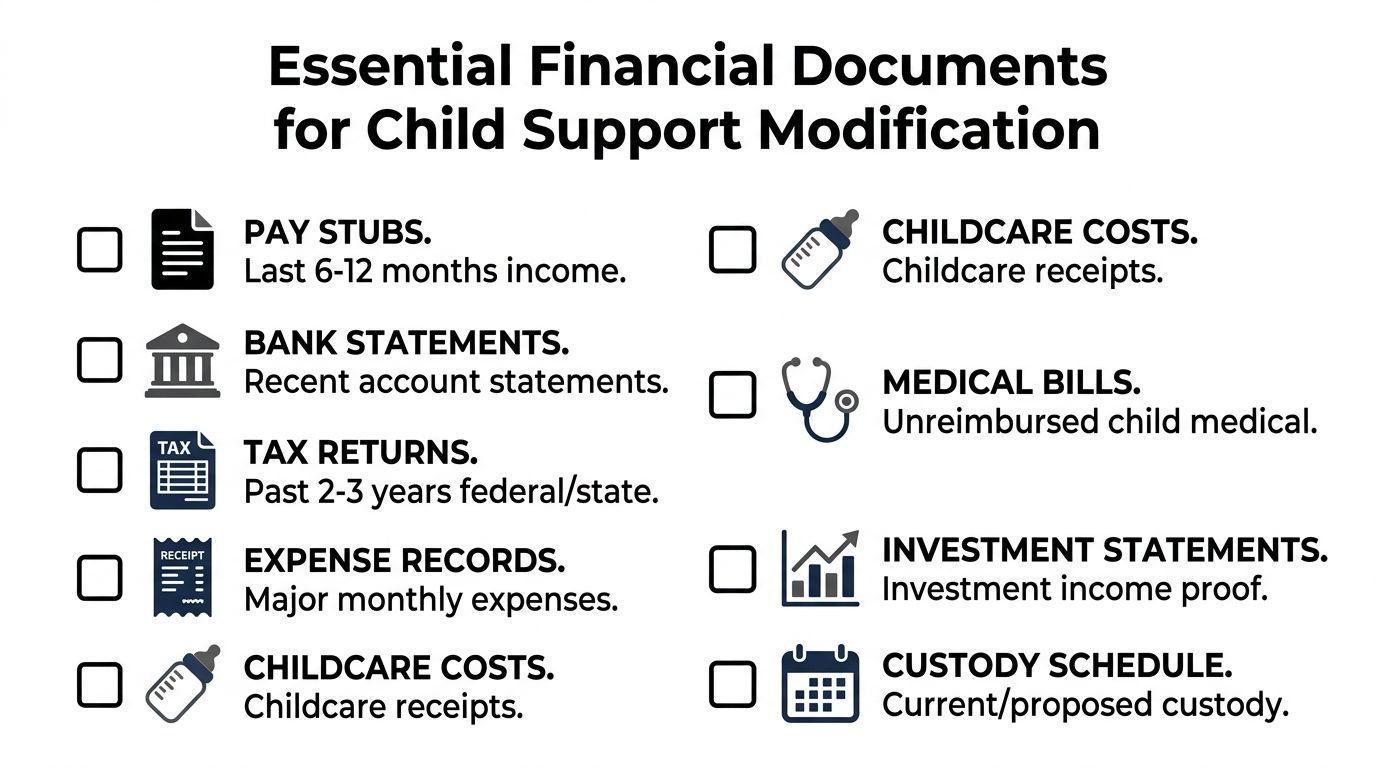
A practical evidence file often includes:
- Recent pay records that show current gross income and deductions
- Tax returns if your income varies or includes self-employment, contract work, or bonuses
- Bank statements to help trace deposits and recurring financial activity
- Proof of job change such as a termination notice, disability documentation, or new compensation terms
- Health insurance information showing premium cost and who carries the child
- Childcare invoices or receipts if work-related care costs changed
- Medical bills and reimbursement records for recurring child-related care not covered elsewhere
- School or activity expense records if the child’s needs have materially shifted
- A reliable custody calendar showing the overnight pattern
If the case involves a business owner, investment income, or compensation beyond salary, deeper financial review may be necessary. In those situations, records tied to valuation and income tracing can become central. For business-related financial analysis, some parents also review resources on business valuation issues in divorce and family law because the same financial questions often surface in support modifications.
Why each category matters
Not all documents serve the same purpose.
Income records answer one question: what does each parent earn, or have the ability to earn? Expense records answer another: what does the child need now? Custody records address a third issue: does the current parenting schedule match what the old order assumed?
That distinction matters because many parents bring stacks of paperwork that do not prove the point they need to prove. A clear file beats a thick file.
Forms and accuracy matter
North Carolina modification cases usually require a Motion to Modify Child Support and supporting financial disclosures. Parents often focus on the hearing and underestimate the importance of the initial filing.
The form itself is not the strategy. But mistakes in names, dates, prior order references, income entries, or requested relief can cause delay or create credibility issues later. If the other side disputes income, a rushed or incomplete affidavit gives them an opening.
Bring documents that tell a consistent story. If your testimony says one thing and your financial records suggest another, the records usually win.
Real-world example
Take a parent whose overtime disappeared after the original order. If that parent only brings a few recent pay stubs, the court may wonder whether the drop is temporary. If the parent instead brings a longer pay history, tax returns, employer records showing the schedule change, and updated expense records, the judge has a more reliable basis to act.
The same principle works in increase cases. If the receiving parent alleges the other parent’s income has risen but cannot show current earnings, business receipts, or spending patterns, the argument may stay too vague to carry much weight.
Navigating the Modification Process From Filing to Resolution
A common mistake happens right after a real change in income or custody. One parent assumes the numbers will sort themselves out, the other agrees informally for a few months, and both are surprised when the old order is still fully enforceable. In North Carolina, modification is a court process. Until a judge signs a new order, the prior amount usually controls.

Procedure decides a lot of these cases. A parent can have a legitimate basis to modify support and still lose time, money, and momentum by filing in the wrong county, serving the other side incorrectly, or asking for relief the court cannot grant on the record presented. That problem shows up even more often in cases that later turn out to involve interstate jurisdiction or higher earnings, where early procedural choices shape the entire case.
Filing starts the case, but service gives it traction
A modification request begins with a formal filing in the proper court, followed by proper service on the other parent. The filing fee is $20. Those steps are not paperwork for paperwork’s sake. They are what put the dispute in front of a judge with authority to act.
Service errors cause expensive delay. If service is defective, the hearing may be continued, challenged, or reset while support under the existing order keeps accruing. That is why timing matters. Clients often ask whether they should wait to see if things improve. In many situations, waiting creates arrears risk or weakens the argument that the change is ongoing rather than temporary.
What usually happens after filing
Most cases follow one of two tracks. They settle and become a consent order, or they proceed to a hearing.
Agreement and consent order
Settlement works well when the primary dispute is mathematical, not about credibility. If income records are current, the parenting schedule is stable, and both parents understand that any change must be approved by the court, a negotiated resolution can save months of conflict.
The key protection is the consent order. A text exchange is not enough. A side agreement is not enough. A judge-signed order is what makes the revised amount enforceable.
This route tends to work best when:
- Income information is current and easy to verify
- The custody schedule is settled
- Both parents are willing to disclose documents
- Neither side is using child support as pressure in another dispute
In higher-asset family cases, support issues can also overlap with compensation structures, bonuses, deferred income, and spending patterns that show up in high net worth divorce matters in North Carolina. In those cases, settlement can still work, but only after the financial picture is clear.
Hearing before a judge
A hearing is more likely when one parent disputes income, claims a job loss is temporary, argues the other parent is voluntarily underemployed, or contests the number of overnights. Judges want specifics. They want current financial records, a reliable explanation for the requested change, and a clean line from the old order to the new facts.
That is where strategy matters. For example, if the other parent is paid through a business, receives irregular bonuses, or reports income that does not match actual spending, broad accusations usually go nowhere. The better approach is targeted evidence, focused subpoenas when appropriate, and a presentation that gives the court a workable number to use.
A hearing usually becomes more likely in cases like these:
| Issue | Why hearings become more common |
|---|---|
| Self-employment or irregular compensation | Income is harder to calculate from ordinary pay records |
| Claimed underemployment | The court may need evidence about earning capacity and job history |
| Parenting time disputes | Overnight counts can directly affect support |
| Large child-related expenses | The court may need proof of necessity, amount, and how the expense should be allocated |
Here is a useful overview of how family courts address support issues in practice:
Informal changes create avoidable enforcement problems
Parents often try to handle support privately. One pays less for a while. The other agrees by text or email. Months later, one side files for enforcement and points to the signed order, not the side conversation.
Courts want support orders to be realistic and enforceable, as noted earlier in the practice guide already cited in this article. Informal arrangements usually fail because they leave too much room for dispute about amount, start date, duration, and whether the agreement was even final.
If a judge did not sign the new terms, assume the old order still applies.
Practical steps that help from the start
Several habits consistently improve the result:
- File soon after the change becomes established, not while it is still speculative
- Keep paying under the current order unless the court changes it
- Use records, calendars, and account statements instead of estimates
- Treat settlement as a legal process that ends with a signed order
- Check early for procedural issues that may signal a more technical case, including out-of-state orders or unusual income structures
Good modification work is rarely dramatic. It is disciplined. The goal is a support order the court can approve, enforce, and defend if the other side challenges it later.
Handling Complex Modifications Interstate and High-Income Cases
A parent moves to Raleigh after an out-of-state divorce, assumes North Carolina can update support, and files here first. Another parent earns a high salary, receives bonuses, stock compensation, and business distributions, then expects the standard worksheet to settle the case. Both situations can go sideways fast.
These are the modification cases where process and proof matter as much as the underlying change in circumstances. Generic advice about a "substantial change" is usually not enough.
Interstate cases under UIFSA
If another state entered the current child support order, the first legal question is jurisdiction. Before anyone argues about income, job loss, or parenting time, the court has to decide whether North Carolina has authority to modify the order at all.
Under the Uniform Interstate Family Support Act, the issuing state often keeps continuing exclusive jurisdiction unless the statutory conditions for transfer or modification elsewhere are met. A move to North Carolina does not automatically give a North Carolina court power to rewrite the order. In some cases, North Carolina can enforce an out-of-state order but still cannot modify it.
That distinction causes real problems. I often see parents focus on the facts they want the judge to hear and miss the threshold issue that decides whether the judge can hear the case in the first place.
Where interstate cases usually get complicated
Interstate modification work often turns on facts such as:
- the state that issued the current order
- where each parent lives now
- where the child lives now
- whether the order has been registered in North Carolina
- whether all parties have left the issuing state
- whether another state may still have the stronger jurisdictional claim
Military families run into this often because duty stations change, but the original order remains tied to a different state. So do parents who have relocated more than once since the order was entered.
The practical mistake is filing first and sorting out jurisdiction later. The better approach is to verify who still lives where, review the existing order, and determine whether North Carolina can modify, enforce, or only register the case before drafting the request for new support.
In interstate cases, jurisdiction controls the whole strategy.
High-income support modifications
High-income cases present a different problem. The dispute is usually not whether support should reflect more resources. The dispute is how those resources should be measured and which child-related expenses the court will treat as reasonable.
For parents with combined incomes over $30,000 per month, and the verified 2026 cap is higher at $40,000 per month, North Carolina courts do not treat the guidelines the same way they do in a more typical worksheet case. The court may look more closely at the child's reasonable needs, the parents' actual financial circumstances, and the standard of living the child would have experienced if the household had remained intact, as discussed in this analysis of child support modifications for high-income families.
That shifts the case from simple math to careful proof. A W-2 may tell part of the story, but not all of it.
A parent may receive compensation through salary, deferred bonuses, restricted stock, partnership income, business distributions, rental income, or irregular draws from a closely held company. On the other side, claimed expenses often need to be separated into actual child-related needs and adult lifestyle spending. That is where high earners and business owners tend to underestimate the amount of documentation the court will expect.
What usually makes the difference
In a higher-asset modification case, stronger preparation often includes:
- tracing all income streams, not just payroll income
- testing whether a claimed drop in income is temporary, voluntary, or offset by other resources
- documenting the child's real expenses with specifics instead of broad estimates
- reviewing business records when one parent controls the flow and timing of compensation
- using an accountant or financial expert when the numbers cannot be understood from basic pay records alone
These cases also overlap with broader wealth issues. Parents dealing with executive compensation, business ownership, or asset-based income may benefit from counsel familiar with high-net-worth divorce and complex financial issues in North Carolina, because the same financial structure often affects support modification strategy.
Interstate and high-income cases look different on paper, but they reward the same discipline. File in the right court. Prove the right numbers. Do both early enough to avoid spending months litigating the wrong issue.
The Final Order How New Support is Calculated and Applied
A parent loses income in January, waits until June to file, and expects the judge to correct support back to January. That expectation causes expensive mistakes.
The signed order controls. Until a judge enters a new child support order, the existing order stays enforceable under the current terms.
How courts calculate the updated amount
For many cases, the court starts with the North Carolina child support guidelines and the worksheet that fits the parenting schedule. The worksheet matters, but the core dispute often concerns the numbers entered into it.
Judges usually focus on:
- each parent’s actual income
- the number of overnights the court finds credible
- the child's health insurance cost
- work-related childcare
- other allowed child-related expenses
That sounds straightforward. In practice, final support numbers often turn on disputed facts, not math. A change in overtime treatment, a disagreement about recurring bonuses, or a different finding on overnights can shift the result in a meaningful way.
In higher-income cases, the final order may not fit neatly inside the guideline formula. The court may have to decide whether the guideline amount is reasonable or whether the child's needs and the parents' financial circumstances support a different figure. That is one reason final hearings in these cases require more than recent pay stubs.
When the new amount takes effect
North Carolina clients often ask the same question. Can the court make the new amount effective back to the date the underlying problem started?
Usually, the practical cutoff is the filing date for the motion to modify, not the date of the job loss, custody change, or increase in expenses. Waiting to file can leave months of support owed under the old order, even when everyone agrees the facts changed earlier.
That timing issue shapes strategy. A parent with a solid basis for modification usually should not delay just because negotiations are ongoing. Filing preserves the issue. Settlement can still happen afterward.
What the final order should address clearly
A good final order does more than state a monthly number. It should clearly identify the amount due, the start date, any arrears or credits, who carries health insurance, and how uninsured medical or childcare costs will be handled if those issues are part of the case.
Clarity matters. Vague language creates collection problems, enforcement disputes, and avoidable return trips to court.
Interstate problems do not disappear at the final stage
A signed order only helps if the court had authority to enter it. In interstate cases, that means confirming the right state and the right court before treating the order as final. UIFSA issues are easy to underestimate because the support calculation may look familiar even when the court lacks power to modify the order.
That is the trade-off many parents miss. Rushing to get a quick number can produce an order that faces challenge later. Taking the time to confirm jurisdiction and build a clean record usually costs less than fixing a defective order after entry.
Frequently Asked Questions About NC Child Support Modification
Can I change child support in North Carolina without going to court
You can reach an agreement with the other parent, but the agreement should be turned into a judge-signed consent order. Without that step, the existing order remains enforceable.
How do I know if my situation is a substantial change
The question is whether the change is meaningful and supported by evidence. Income changes, custody schedule changes, childcare changes, and new child-related medical or educational needs often trigger review. The key is whether the change materially affects support, not whether it feels unfair.
What if I lost my job but expect to work again soon
A temporary setback can be harder to use than a lasting change. Courts tend to focus on whether the reduced income is real, ongoing, and not voluntary. Documentation matters. A parent who waits too long or presents incomplete records can make a legitimate case look weak.
What if the other parent moved out of state
Do not assume North Carolina can automatically modify the order. Interstate cases can turn on jurisdiction under UIFSA before the court ever reaches the support amount. If the original order came from another state, that issue should be analyzed first.
Do I need a lawyer for a child support modification lawyer nc case if the filing fee is low
The filing fee being low does not make the case simple. Parents still have to meet the legal standard, serve the other party correctly, present reliable financial evidence, and secure an enforceable order. A lawyer is particularly useful when income is disputed, the parenting schedule is contested, the case crosses state lines, or the finances are more complex than ordinary wage income.
Conclusion When You Need a North Carolina Child Support Modification Lawyer
A child support order should reflect present reality, not old assumptions. When income changes, the child’s needs change, or the parenting schedule changes, North Carolina law provides a path to ask for a new order. The challenge is that modification cases are rarely just about fairness. They are about proof, procedure, timing, and strategy.
That is why many parents benefit from working with a child support modification lawyer nc, especially when the other side disputes the facts, the numbers are complicated, or the case involves another state. A well-prepared case can help you avoid procedural mistakes, unsupported requests, and informal agreements that create bigger problems later.
If you live in North Carolina and your current child support order no longer fits your situation, a consultation can help you determine whether modification is appropriate and what steps make sense next.
If you need guidance on modifying child support in North Carolina, the Law Office of Bryan Fagan can discuss your circumstances, review the existing order, and help you evaluate the next legal step.