Your custody order may have made sense when it was entered. Then life moved. A parent changed jobs. A child started struggling in school. Exchanges became tense. One parent stopped following the schedule. A planned move suddenly put school, friendships, and routines at risk.
That’s usually the point when parents start searching for custody modification nc and asking the same question: can the court change the order, or am I stuck with what’s already in place?
In North Carolina, a custody order can be changed, but not just because the arrangement feels frustrating or unfair. Judges value stability for children. If you want a new order, you have to show the court that something meaningful has changed and that the change affects the child, not just the adults.
Parents often lose ground when they approach modification as a complaint instead of a case. Courts respond to proof, preparation, and a child-focused plan. They also expect you to deal with the practical realities of the process, especially mandatory mediation and, in some situations, enforcement or contempt issues that may need immediate attention.
Is It Time to Change Your North Carolina Custody Order?
You may be at the point where the current order no longer fits your child’s daily life. Maybe the transportation schedule is hurting school attendance. Maybe the other parent’s behavior has changed in a way that creates instability. Maybe your child’s medical, educational, or emotional needs are different now than they were when the order was signed.

North Carolina doesn’t allow custody changes for minor tweaks. The key legal phrase is substantial change in circumstances. In plain English, that means something important has changed since the last order, and that change affects your child’s welfare.
What counts as a real legal problem
A lot of parents come in thinking the court will step in because the current arrangement is inconvenient. In most cases, inconvenience alone isn’t enough. Judges are looking for changes that matter to the child’s well-being, such as a serious relocation issue, safety concerns, repeated violations that disrupt the child’s routine, or a clear shift in the child’s needs.
A useful way to think about it is this:
- Minor frustration usually means the order is annoying, inefficient, or outdated.
- Legally significant change means the child is being affected in a meaningful way.
A custody modification case isn't about proving that life is harder for you. It's about proving that the current order no longer serves the child well.
Why timing matters
Parents sometimes wait too long because they hope things will improve. Others file too early, before they have enough proof. Both can hurt the case. If the change is serious, start documenting it right away. If the issue is still unfolding, gather records and watch for patterns instead of rushing in with general complaints.
That balance matters. A well-timed case is easier to explain, easier to support with records, and easier for a judge to take seriously.
Grounds for Modification The Substantial Change Standard
The legal foundation for any custody modification nc case is North Carolina General Statute § 50-13.7(a). North Carolina courts require more than a simple change in adult circumstances. As the UNC School of Government discussion of custody modification law explains, a custody order may be modified only after a showing of changed circumstances, and cases such as Shipman v. Shipman, 357 N.C. 471 (2003), interpret that change as needing to be substantial and tied directly to the child’s welfare.

That standard is why some parents walk into court with a sincere concern and still lose. The court isn’t asking whether life has changed. Life always changes. The court is asking whether the change is serious enough, and child-centered enough, to justify disturbing an existing order.
What judges usually view as substantial
Some situations tend to fit the legal standard better because the impact on the child is easier to show.
- Relocation that disrupts the child’s routine. If one parent’s move creates long commutes, school problems, or loss of regular contact with the other parent, the court may see a substantial change.
- Substance abuse or unsafe behavior. Evidence of impaired parenting, criminal conduct tied to safety, or repeated instability can support modification.
- Major changes in a child’s needs. A child may develop educational, medical, or emotional needs that the current schedule no longer supports.
- Serious non-compliance with the existing order. Repeated failures to follow exchanges or other custody terms can become more than a frustration if they are harming the child’s stability.
A practical example from Mecklenburg County involved a parent who documented attendance records, grades, and teacher statements showing that a long commute was contributing to academic decline. That kind of evidence ties the change to the child, which is exactly what courts want to see.
What often falls short
Parents are often surprised by what doesn’t carry much weight on its own.
- A new marriage by itself
- Ordinary scheduling conflict
- General belief that the child would be “better off” with more time
- A desire to punish the other parent for being difficult
North Carolina appellate decisions have reflected that difference. A major move may justify a change if the evidence shows a real benefit or harm to the child. On the other hand, remarriage and a move, without enough child-focused impact, may not be enough.
Practical rule: If you can't explain the problem without spending most of your time talking about the other parent, you're probably not framing the case the way a judge will analyze it.
The welfare connection matters most
The strongest modification arguments answer two questions clearly:
- What changed since the last order?
- How is that change affecting this child?
That second question is where many cases break down. A parent may prove a move, a new relationship, or a job change, but still fail because they don’t connect those facts to school performance, emotional stability, health, safety, or parent-child contact.
The court’s focus stays narrow. It wants a welfare connection, not a list of grievances.
A short overview may help if you want a visual summary before digging into records and strategy.
Proving Your Case The Best Interests of the Child Test
Once a parent clears the first hurdle, the court still has to decide whether the requested change serves the best interests of the child. That’s where many parents need to shift gears. It’s not enough to say the current order should end. You need to show why your proposed plan is better for the child’s day-to-day life.
North Carolina judges don’t award points for who is more upset, more offended, or more persuasive in conversation. They look at the child’s lived reality. Which home is stable. Which parent supports routines. Which arrangement protects school attendance, health care, and emotional development. Which parent is likely to encourage the child’s relationship with the other parent.
The factors that carry weight in real cases
Courts examine a broad set of best-interest considerations. In practice, several tend to matter repeatedly.
- Stability at home. A judge will care about consistency in housing, bedtime, school transportation, supervision, and basic routine.
- Ability to meet the child’s needs. This can include educational support, medical follow-through, and emotional responsiveness.
- Safety concerns. Domestic violence, unsafe supervision, or exposure to dangerous behavior can carry major weight.
- Parental cooperation. A parent who blocks communication, refuses exchanges, or undermines the child’s bond with the other parent can damage their own position.
- The child’s adjustment. How the child is functioning at school, at home, and in the community often matters more than either parent expects.
If you need broader context on how North Carolina courts approach custody generally, the North Carolina child custody laws overview can help frame the bigger picture.
How judges compare two imperfect options
Most custody cases don’t involve one perfect parent and one terrible parent. They involve trade-offs. One parent may have a more flexible schedule but less consistency with schoolwork. The other may provide stronger structure but struggle with communication. Judges have to compare real households, not ideal ones.
That’s why details matter. Consider these examples:
| Situation | How a judge may view it |
|---|---|
| One parent consistently gets the child to school, attends appointments, and follows routines | Strong evidence of stability and follow-through |
| One parent repeatedly withholds calls or makes exchanges difficult | May suggest poor co-parenting and harm to the child’s relationship |
| A parent requests more time but can't explain transportation, after-school care, or homework support | Weakens the proposal because the plan lacks practical support |
| A child is thriving under one schedule and the requested change would increase disruption | The court may favor preserving the more stable arrangement |
Framing your request the right way
Parents often make the mistake of asking for what feels fair to them. Judges focus on what works for the child. Those aren’t always the same thing.
A stronger request sounds like this:
The proposed schedule reduces school-night travel, keeps the child in the same routine, and gives each parent predictable parenting time.
A weaker request sounds like this:
I deserve equal time because the current order isn't fair.
The first is child-centered and practical. The second is adult-centered and abstract.
Child preference and other misunderstood issues
Parents frequently ask whether the child gets to choose. In North Carolina, a mature child’s views may matter, but they are not automatic control over the outcome. The judge decides how much weight to give that preference in light of the child’s age, maturity, and the full evidence.
Another common misconception is that being a “good parent” is enough. In modification cases, the issue is narrower. The court is deciding whether this specific change, at this specific time, better serves the child than the existing order.
The Step-by-Step Modification Process in NC Courts
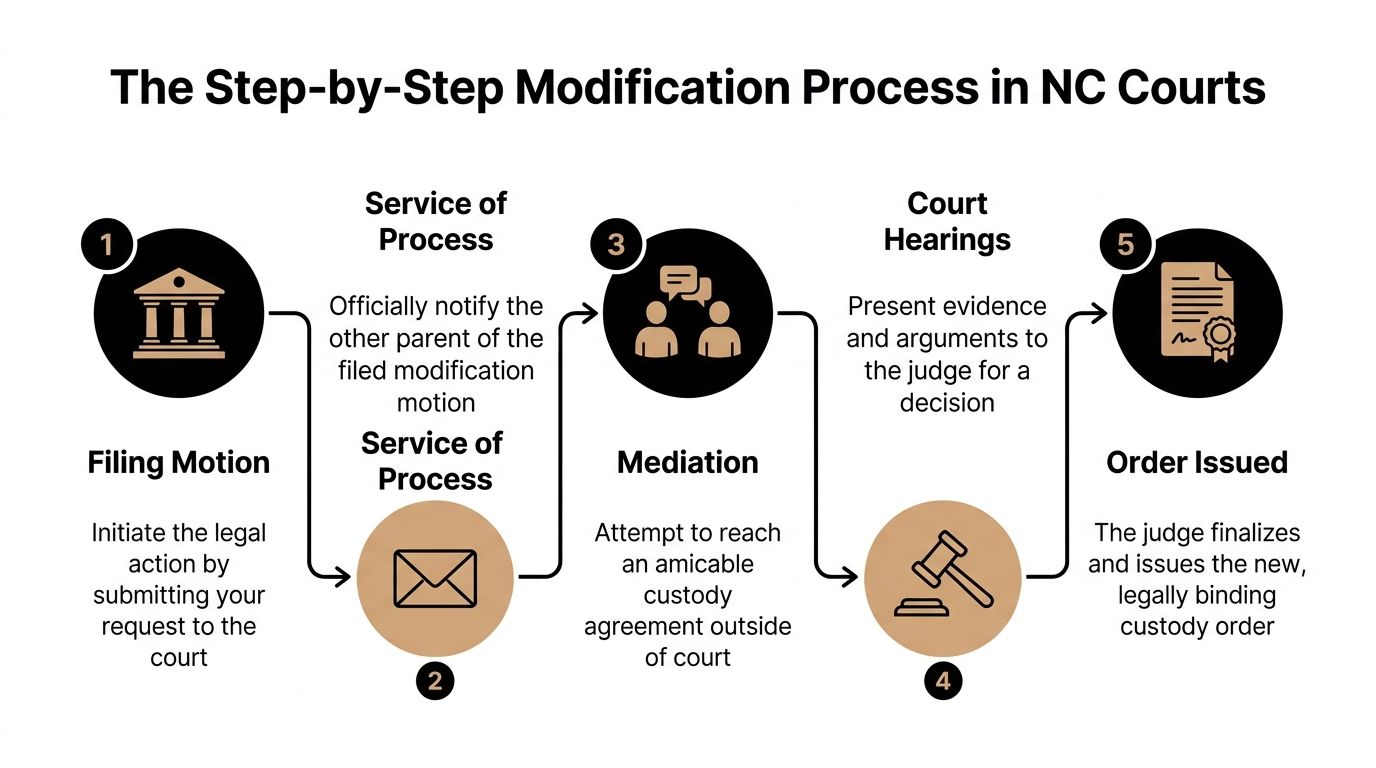
A custody case can feel less overwhelming when you treat it as a sequence of tasks instead of one giant legal problem. In North Carolina, the process starts with paperwork, but significant advantage often comes from what you do before mediation and before any hearing is scheduled.
The UNC materials on custody modification procedure explain that the process follows a two-step legal test under GS 50-13.7(a), begins with filing a motion to modify with forms such as AOC-CV-609, requires proper service, and in most counties leads to mandatory custody mediation. Those materials also note that mediation resolves an estimated 60-70% of custody disputes before a full hearing.
Filing the right motion in the right court
Most cases start in the court that issued the existing custody order. That sounds simple, but filing mistakes can slow things down quickly, especially when one or both parents have moved.
The basic filing package often includes:
- Motion to Modify Custody stating what has changed and what relief you want.
- Affidavit as to Status of Minor Child, commonly filed on AOC-CV-609.
- Any required local cover sheets or county-specific forms.
If you’re dealing with an urgent care issue involving temporary placement, a separate review of how temporary custody works in North Carolina may also be useful because emergency and temporary remedies do not operate exactly like ordinary modification requests.
Service is not a technicality
After filing, the other party has to be properly served under the North Carolina Rules of Civil Procedure. Parents sometimes assume texting a copy or emailing a motion is enough. It usually isn’t.
Poor service can delay the case or create an avoidable fight before the main issues are even addressed. This is one of those steps that feels clerical until it goes wrong.
File carefully, but also think beyond filing. The parent who arrives at mediation with organized records and a realistic proposal usually has more influence than the parent who treats mediation as a formality.
Mediation is where many cases are won
North Carolina’s mandatory custody mediation requirement deserves more attention than it usually gets. Too many parents see it as a box to check before “the court hearing.” That approach wastes one of the best opportunities in the case.
Mediation can work well because it gives parents more control over the result. A judge may impose a schedule neither side likes. In mediation, parents can build a plan around school calendars, work shifts, extracurricular activities, transportation, holidays, and communication methods.
How to prepare for mediation strategically
Don’t walk into mediation with a single demand and no backup options. Build a range.
Consider preparing these in advance:
- Your primary proposal. The schedule you believe best serves the child.
- A fallback position. A version that still protects the child’s main needs if your first option isn’t accepted.
- A document packet. School records, medical notes, communication logs, and calendars often speak more clearly than emotion.
- Decision points. Know what matters most. School-night stability, exchange location, transportation responsibility, holiday rotation, and phone contact are common sticking points.
A parent who says, “I want full custody,” without explaining logistics often loses credibility fast. A parent who can explain school transportation, homework supervision, exchange timing, and communication rules sounds prepared and child-focused.
What happens if mediation fails
If mediation doesn’t resolve the case, it moves toward a hearing. That doesn’t mean mediation failed in every sense. Sometimes it narrows issues, exposes weaknesses, or creates partial agreements that make the hearing more focused.
When the case reaches court, the judge will expect evidence, not just competing stories. The hearing is where your preparation gets tested. If the file is thin, if your records are disorganized, or if your proposal is vague, the court will notice.
Here is the practical sequence most parents should keep in mind:
- Start with the existing order and compare it to the child’s current reality.
- Document the change before filing whenever possible.
- File accurately with the required forms.
- Serve correctly so the case can move forward.
- Use mediation well because it may be the best chance to shape the outcome.
- Prepare for hearing anyway even if you hope to settle.
Building Your Case Evidence and Documentation to Gather
Modification cases are built with documents, timelines, and credible witnesses. They are rarely won by broad claims that the other parent is irresponsible or that the child “seems unhappy.” If you want the court to act, you need proof that is concrete and organized.
The challenge is not just gathering paper. It’s gathering the right paper. Judges want evidence that connects the change to the child’s welfare and supports the schedule or restrictions you are requesting.

The King Law discussion of modification proof issues notes that successful modification turns on evidence tied to best-interest factors, that contested motions are often difficult to win, and that pro se filers often struggle, with success rates under 10% compared with over 50% for those with legal counsel. Those figures reinforce a point practitioners see often. Cases are lost because the proof is thin, scattered, or poorly presented.
The categories of evidence that usually matter
Different cases call for different records, but these categories appear again and again.
- Communication records. Texts, emails, parenting app messages, and call logs can show denial of contact, repeated cancellations, or refusal to cooperate.
- School records. Attendance, tardies, grade reports, disciplinary notices, teacher emails, and school calendars are often powerful because they are neutral.
- Medical and counseling records. Appointment history, treatment recommendations, medication issues, and provider notes can matter when health or emotional functioning is part of the case.
- Calendars and parenting logs. A clean timeline of missed visits, late pickups, exchange problems, or caregiving patterns can be persuasive.
- Witness information. Teachers, counselors, coaches, daycare staff, and others with firsthand knowledge may be more helpful than relatives who only know part of the story.
- Financial and work-related records. If job schedules, housing instability, or inability to meet basic responsibilities are relevant, those documents can support the narrative.
Organization matters almost as much as content
Parents often collect useful evidence but present it badly. A stack of unsorted screenshots is better than nothing, but not by much.
Use a simple system:
| Evidence type | Best use |
|---|---|
| Timeline or log | Shows pattern over time |
| School records | Connects schedule issues to academic impact |
| Medical records | Supports health or safety concerns |
| Messages between parents | Shows communication problems or non-compliance |
| Witness list | Adds neutral third-party perspective |
Custody Modification Evidence Checklist
- Original order with the exact terms you say are no longer working
- Chronology of what changed and when it changed
- Texts and emails showing non-compliance, denied contact, or safety concerns
- Attendance and grade records if school impact is part of the case
- Medical or therapy records if health, medication, or emotional well-being is involved
- Photos or documents tied to housing, transportation, or living conditions when relevant
- Witness names and contact details for people with firsthand knowledge
- Your proposed parenting plan with practical details, not just general requests
What works and what usually doesn't
Judges generally respond well to neutral records, consistent timelines, and testimony from people who observed the child directly. They respond poorly to exaggeration, selective screenshots, and emotional claims without backup.
A common mistake is overloading the file with every disagreement the parents have ever had. That can bury the strongest points. Focus on proof that answers the two questions that matter most. What changed, and how is the child affected?
Common Hurdles Relocation, Parental Fitness, and Costs
Some modification issues are harder than others. Relocation disputes are a good example. A move can change transportation, school continuity, extracurricular participation, and the child’s relationship with the other parent all at once. That doesn’t mean every move justifies a new order, but it does mean relocation cases often turn into detailed factual battles.
When relocation is involved, the better argument usually comes from specifics. How long is the commute. What happens on school mornings. Who handles transportation. What activities will be affected. How will frequent contact with the other parent be preserved, if at all. Vague statements about “better opportunities” or “more fairness” usually don’t carry enough weight by themselves.
Parental fitness concerns need credible proof
Allegations involving substance abuse, neglect, untreated mental health issues, or dangerous home conditions can change the tone of a case quickly. They can also backfire if they are made loosely.
Courts tend to give more weight to:
- Objective records, such as treatment documents, criminal records, or professional reports
- Specific incidents with dates, witnesses, and follow-up
- Evidence of child impact, not just adult misconduct
- A practical safety request, such as supervised exchanges, testing, counseling compliance, or a revised schedule
Accusing the other parent of being “unfit” without records often hurts the accuser’s credibility. If safety is at stake, move carefully and document thoroughly.
Enforcement and contempt may be the faster tool
Parents often assume modification is the only answer when the other parent keeps violating the order. Sometimes that’s true. Sometimes it isn’t.
If the current order is clear and the problem is repeated non-compliance, contempt or enforcement may be the more immediate remedy. That approach focuses on getting the existing order obeyed. Modification focuses on changing the order going forward. In some cases, both can matter at the same time.
When a parent keeps violating pickup times, denying visits, or ignoring exchange terms, ask two separate questions. Do you need a different order, or do you need the current order enforced now?
That distinction is often overlooked, and it can save time.
The practical reality of cost and representation
Custody litigation costs money, time, and emotional energy. Mediation may reduce that burden if both sides are prepared. A contested hearing usually increases it.
Representation becomes more important when the case involves relocation, safety issues, multi-state questions, expert witnesses, or a pattern of non-compliance that needs to be documented and presented strategically. It also matters for parents who feel they are starting at a disadvantage. For example, one North Carolina-focused source reports that fathers in the state receive an average of 27.9% custody time, compared with a 35% national average, despite gender-neutral reforms dating back to 1977, according to Myers Legal’s discussion of custody disparities in North Carolina. Whatever side of that issue a parent is on, the practical lesson is the same. Assumptions don't win cases. Evidence and strategy do.
Your North Carolina Custody Modification Questions Answered
Parents usually have a few practical questions that don’t fit neatly into the legal test. These are some of the most common ones that come up in a custody modification nc case.
If you need direct guidance about your own facts, speaking with a North Carolina child custody lawyer can help you sort out whether you need modification, enforcement, emergency relief, or a combination of those options.
Short answers to common concerns
| Question | Answer |
|---|---|
| Can my child choose where to live? | Not automatically. A judge may consider a mature child’s preference, but the court decides how much weight to give it based on the child’s maturity and the full best-interests analysis. |
| Can we change custody without a full hearing? | Yes, if both parents reach an agreement. A consent order can often resolve the issue without litigating every disputed fact. |
| What if the other parent keeps violating the current order? | A modification may help if the order no longer fits the child’s needs, but enforcement or contempt may be the better immediate remedy when the order is clear and the problem is repeated non-compliance. |
| How long will the case take? | It depends on whether the case settles in mediation or proceeds to a contested hearing. Simpler agreements can move much faster than heavily disputed cases. |
| Can I file on my own? | You can, but self-represented parents often struggle with proof, procedure, and framing the case around the child rather than the conflict between adults. |
A final practical point
Parents often ask what they should do first. Usually, the answer is simple. Pull the current order, make a timeline of what changed, gather the records that support it, and avoid making accusations you can’t prove.
That first round of preparation often tells you whether you have a true modification case, an enforcement problem, or both.
If you're dealing with a custody order that no longer works for your child, the Law Office of Bryan Fagan can help you evaluate your options under North Carolina law. Whether your case involves relocation, repeated violations, mediation strategy, or a contested custody modification, a focused consultation can help you identify the strongest path forward and avoid costly mistakes. Schedule a consultation to discuss your circumstances, your evidence, and the practical next steps for protecting your child’s stability.