A lot of parents land on this issue the same way. A paycheck drops. A job ends. A bonus hits. A new position pays much more than the old one. Then the same question follows almost immediately: what happens to child support now?
If you're dealing with child support when income changes NC, the most important thing to understand is that your existing court order stays in place until a judge signs a new one. That surprises many people. They assume a layoff automatically lowers support, or that a raise automatically increases it. Neither is true.
North Carolina courts will modify support in the right circumstances, but they expect proof, timing, and proper procedure. They also look closely at whether the change is real, substantial, and likely to last. That matters whether you're the parent paying support or the parent receiving it.
A parent who loses a job may feel immediate panic about making the next payment. A parent who learns the other side got a major promotion may feel just as frustrated if support no longer reflects the family's current finances. Both situations are common. Both require careful action.
Your Income Changed Now What About Child Support
A common scenario goes like this. A parent has been making regular support payments for years, then gets hit with a sudden pay cut. Rent is still due. Utilities haven't dropped. The support order still says the same amount. Panic sets in because the court order doesn't adjust itself.

The opposite happens too. A parent receiving support finds out the other parent changed jobs, started earning more, or began receiving significant variable compensation. That parent often assumes the court will step in if the increase is obvious enough. It won't unless someone files and proves the basis for modification.
The first reality most parents need to hear
Child support orders are binding until changed by the court. An informal understanding between parents may help short term communication, but it doesn't replace a signed order. If payments are reduced without court approval, arrears can build even while everyone agrees the old amount no longer fits.
What usually works and what usually fails
Some responses tend to help. Others create bigger problems.
- What helps: getting current income documents together quickly, reviewing whether the income change appears lasting, and filing the proper modification request when the facts support it.
- What hurts: waiting too long, assuming the court will "understand later," or changing payments first and asking permission later.
- What also hurts: treating every income change as automatic grounds for a new amount. Courts don't react to ordinary fluctuation the same way they react to a major and material shift.
The legal system moves slower than your bills do. That gap is where many support problems start.
When clients ask about child support when income changes nc, they usually want a yes-or-no answer. In real cases, the better question is whether the change is substantial enough, documented enough, and stable enough to justify a modification.
The Legal Standard for Modifying NC Child Support
North Carolina doesn't modify child support just because life feels different. The court looks for a substantial change of circumstances. That phrase matters because it is the legal doorway to any modification request.
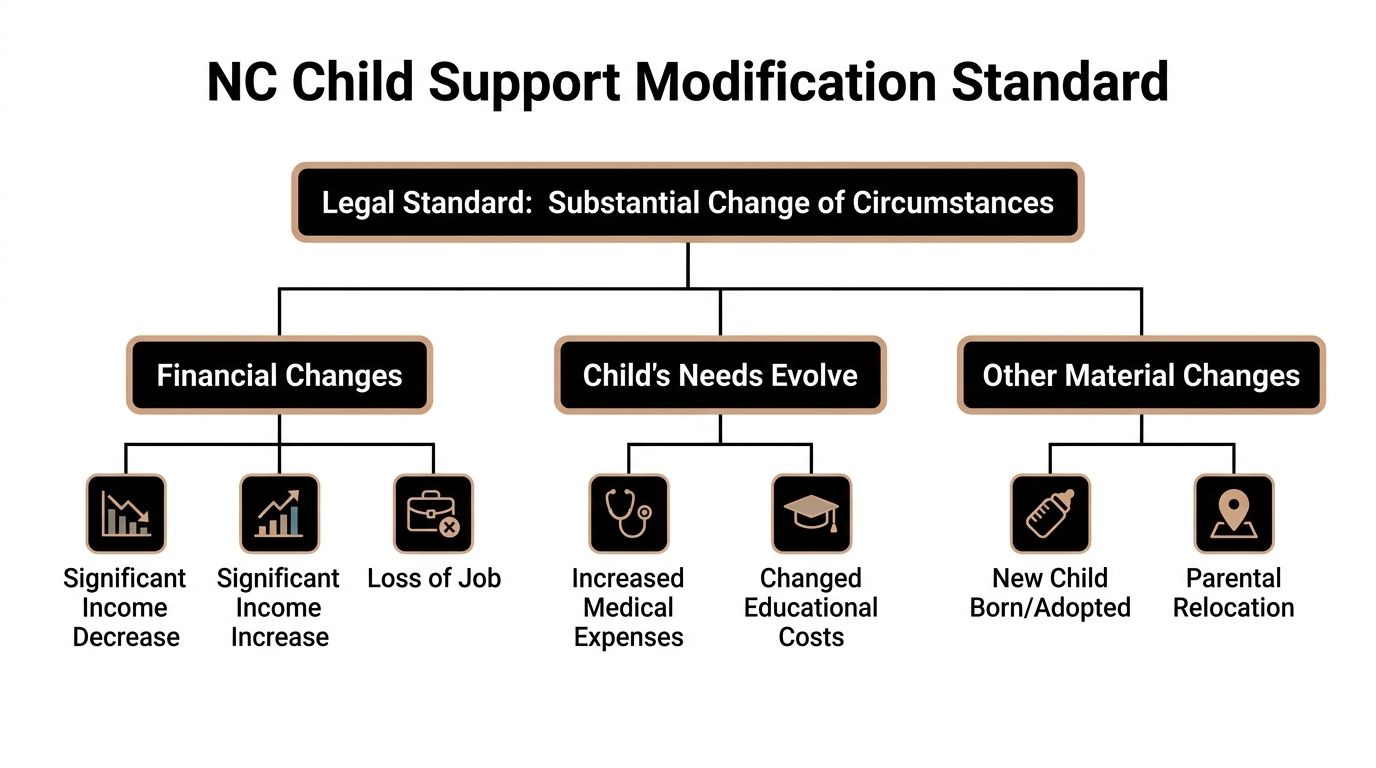
Under North Carolina law and practice, there is a legal presumption of substantial change if three years have passed since the last child support order and a new calculation would change the support amount by 15% or more, as discussed in this North Carolina child support modification overview. That doesn't mean every case turns on that benchmark, but it is a practical and important guide.
What substantial change means in plain English
A substantial change is not a minor swing in income or a brief rough patch. It is a change that materially affects a parent's ability to pay or the child's financial needs.
Examples often include:
- Involuntary job loss: a layoff or termination that wasn't planned and wasn't done to avoid support
- Significant income increase: a major promotion or lasting jump in compensation
- Material change in the child's needs: ongoing medical, educational, or care-related costs that are markedly different from before
- Meaningful shift in parenting time: custody changes that alter the financial balance between households
A small dip in hours for a short period usually won't carry the same weight. Courts tend to look for changes that are meaningful and not merely temporary.
The 15% benchmark and how lawyers use it
The 15% rule is one of the most useful screening tools in practice. If enough time has passed and the support amount under current guidelines would be different by that margin, the court has a recognized basis to treat the matter as substantial.
That doesn't mean you should file every time you think you can reach that number. The numbers still have to be supported by reliable financial information. It also doesn't mean a case under that benchmark automatically fails. Some cases still justify modification because the facts are compelling even if the arithmetic is less neat.
Practical rule: if your income changed in a serious way, don't guess whether it counts. Run the current numbers, compare them to the existing order, and evaluate the documentation before filing.
Courts look at whether the change is real and lasting
One issue I see often is a parent filing immediately after a disruption that may not last. A short gap between jobs, a temporary leave, or an uncertain commission dip may not persuade a judge that the order should change now.
That is why timing matters almost as much as the legal standard itself. A strong case usually shows not only that income changed, but that the new financial picture is established enough for the court to rely on it.
A simple decision guide
| Situation | Likely court view |
|---|---|
| Short-term, uncertain income drop | Often viewed cautiously |
| Involuntary layoff with supporting records | Often taken seriously |
| Major promotion with higher recurring pay | Often strong basis to review |
| Minor month-to-month fluctuation | Often not enough by itself |
What parents misunderstand most
The biggest misconception is that "unfair" automatically means "modifiable." It doesn't. You may feel squeezed. You may also be right that the old order no longer fits. But the court still requires proof that the change is substantial under North Carolina law.
The second misconception is that private agreement fixes the issue. It doesn't. Until the order changes, the old order controls.
How Child Support is Recalculated in North Carolina
A parent gets laid off, finds new work two months later, and assumes child support will drop by the same percentage as the paycheck. That is rarely how it works in court. Recalculation in North Carolina is a worksheet-driven process in many cases, but the numbers only matter if the inputs are accurate, the right worksheet is used, and the change is presented with the right evidence.
North Carolina uses the Income Shares Model. The court starts with the parents' combined income, estimates the support obligation under the guidelines, and then assigns each parent's share based on income, parenting time, and certain child-related expenses. For a fuller explanation of the worksheets and formula, this guide on how child support is calculated in NC is a good reference.
What goes into the recalculation
A recalculation usually turns on five categories of information:
- Gross income for each parent: wages, salary, commissions, bonuses, overtime, and other income recognized under the guidelines
- Parenting schedule: whether the facts fit sole, joint, or split custody for worksheet purposes
- Health insurance premium for the child: only the child-related portion counts
- Work-related childcare costs: daycare, after-school care, or similar expenses tied to employment
- Other guideline adjustments: depending on the worksheet and the facts of the case
The worksheet choice matters more than many parents expect. A case that fits Worksheet A can produce a very different number from a case that fits Worksheet B, even with the same incomes. Overnights matter. So do who pays insurance and daycare.
Why the new number is not always obvious
Parents often focus on one fact, usually the paying parent's income. Judges do not. The court looks at the whole picture.
A lower income may reduce support. A higher income for the other parent may also affect the result. If daycare ended, if the child moved into a different school arrangement, or if the parenting schedule now supports a different worksheet, the final number may go up, down, or stay closer to the current order than a parent expected.
This is one reason I tell clients not to rely on rough mental math. A quick estimate misses details that can swing the result.
The 15% rule of thumb and how lawyers use it
North Carolina practitioners often start with a practical screen. If the newly calculated amount differs from the current order by about 15% or more, the case may be worth serious review for modification. That is a rule of thumb, not an automatic right to relief, and it does not replace the requirement to prove a substantial change in circumstances.
Still, it is useful. It helps answer the first real-world question: is this a meaningful recalculation issue, or just a temporary squeeze that may not justify the cost and effort of filing?
The 2023 guideline changes still matter
The current guidelines changed several points that affect recalculation strategy. The high-income threshold rose from $30,000 to $40,000 per month in combined gross income. The guidelines also address minimum support in low-income situations and reflected an overall increase in support amounts in many formula-based cases, as summarized in this 2023 North Carolina child support guideline update.
For many families, the practical takeaway is straightforward. If the combined income falls within the guideline range, the worksheets usually control. If income is above that range, the case shifts from formula to proof.
Above-guidelines cases require a different presentation
High-income cases are less about plugging numbers into a calculator and more about building a persuasive record. The court may examine the child's actual expenses, the family's prior standard of living, and whether requested amounts are reasonable. Housing, education, activities, travel, food, and other recurring costs may all become exhibits instead of assumptions.
That changes strategy. In a worksheet case, pay records and daycare receipts may do most of the work. In an above-guidelines case, budgets, account statements, and a disciplined presentation of the child's needs matter far more.
Here is a short explainer that helps many parents understand the moving parts before they meet with counsel.
A practical recalculation checklist
| Question | Why it matters |
|---|---|
| What are both parents earning now? | The court recalculates from current figures, not assumptions |
| Which worksheet fits the present custody schedule? | The worksheet can materially change the outcome |
| Who pays the child's insurance and work-related childcare? | Those costs directly affect the calculation |
| Does the new number differ enough to justify filing? | A modest change may not support the time and expense of litigation |
| Is temporary relief needed while the case is pending? | Filing does not pause the current order, and arrears can build quickly |
Recalculation is where legal theory meets cash flow. If the numbers support a reduction, filing timing and a request for temporary relief can matter just as much as the worksheet itself.
Navigating Special Income Situations and Common Issues
Not every parent receives a regular paycheck. Some are self-employed. Some work on commission. Some receive bonuses or overtime that rise and fall. Others leave a job and say they had no choice, while the other parent argues the reduction was voluntary. These are the cases where child support when income changes nc becomes more than a worksheet issue.

If you are self-employed, your case usually requires closer document review than a standard wage-earner case. Business records, expense categories, deposits, and tax returns all matter. For a more focused discussion of those issues, this page on child support for self-employed parents in NC is directly relevant.
Voluntary versus involuntary income changes
Courts tend to treat these situations very differently.
If a parent loses employment because of a layoff, company closure, medical limitation, or another good-faith reason outside the parent's control, the request for modification is usually viewed more seriously. If a parent quits a stable job, cuts hours by choice, or shifts into lower-paying work without a convincing explanation, the court may be skeptical.
That is where imputed income can become an issue. Imputed income means the court may base support on what a parent is capable of earning rather than what the parent currently reports earning. This issue often appears when one side believes the other is underemployed on purpose.
Self-employment and fluctuating income
Self-employment cases often turn on credibility and documentation. A parent may say the business is struggling, but the tax return may show add-backs or deductions that don't reflect actual cash flow in a simple way. The other parent may point to business-paid personal expenses, irregular transfers, or unexplained drops in reported income.
A few recurring pressure points include:
- Expense classification: whether claimed business expenses are legitimate and necessary
- Irregular receipts: whether seasonal highs and lows require a broader view of income
- Cash-heavy work: whether reported earnings match the parent's actual lifestyle and spending
- Control over compensation: whether the parent can choose when and how to take income
Courts don't have to accept a parent's label for income. They look at records, patterns, and whether the explanation makes sense.
Bonuses, commissions, and overtime
Variable compensation creates two common disputes. First, whether the income is regular enough to include. Second, whether it should be averaged or treated differently because it is unusually volatile.
There is no single shortcut that fits every file. A recurring annual bonus may be handled differently from a one-time payment. A commission-based employee with a long history of variable income may need a more careful presentation than a salaried employee with stable monthly wages. What matters is building a record that shows whether the income is ongoing, sporadic, inflated, or temporary.
A comparison parents should keep in mind
| Income situation | Common issue in litigation |
|---|---|
| Laid-off employee | Whether the reduction is genuine and lasting |
| Parent who quit a job | Whether income should be imputed |
| Self-employed parent | Whether reported income reflects actual earning capacity |
| Commission earner | Whether recent earnings are stable enough to rely on |
What often backfires
Parents hurt their own cases when they oversimplify. A self-employed parent who walks into court with only a bare tax return may look unprepared. A salaried parent who assumes a temporary dip guarantees relief may be disappointed. A parent accusing the other side of hiding income without records may sound angry rather than persuasive.
Good modification work in these cases is usually about proof, not rhetoric.
Your Strategic Roadmap for Filing a Modification
The right legal theory can still fail if the case is filed badly. Timing, paperwork, and payment strategy matter. In practice, many modification cases are won or lost before the hearing date is ever set.
The first mistake is filing too early
After a job loss, many parents want to file immediately. That reaction is understandable, but it can create problems. A court may view the disruption as temporary if there hasn't been enough time to show that the income loss is real, documented, and continuing.
A more effective approach is often to file within 60 to 90 days of a documented income change, while also seeking temporary prospective relief so new arrears do not continue to build, as discussed in this article on modifying child support after income changes in North Carolina.
The second mistake is self-reducing payments
This is one of the most expensive errors parents make. They assume the court will later "credit" them because the old amount was no longer affordable. Usually, the safer assumption is the opposite. Until a new order is entered, the prior amount remains enforceable.
If you need specific help with the process, the North Carolina child support modification lawyer page explains the type of case support available in these matters.
If you pay less before the order changes, the unpaid difference can become arrears even if your reason for seeking modification is legitimate.
The two-track strategy that often makes sense
In many income-change cases, the strongest practical move is a two-track strategy.
File the motion for modification.
This puts the issue properly before the court and preserves your request for a new support amount.Request temporary prospective relief.
If the facts justify it, ask the court for a temporary suspension or reduction while the case is pending.
This approach addresses the problem parents face. The hearing process can take time, but support obligations continue in the meantime. A temporary request can help reduce the risk that arrears pile up while everyone waits for the full hearing.
What documents usually matter most
Don't show up with a vague story. Show up with a file.
- Current pay information: recent pay stubs or proof of current compensation if you're employed
- Tax records: recent returns and W-2s if they accurately reflect the relevant period
- Proof of involuntary loss: termination notice, layoff paperwork, or medical records if health affected earning ability
- Updated child-related costs: insurance, childcare, or other recurring expenses that affect the calculation
- Custody information: any meaningful change in the child's overnights or living schedule
The court wants a reliable snapshot of what changed and when it changed.
A practical filing sequence
| Step | Purpose |
|---|---|
| Gather proof of the income change | Establish credibility and timing |
| Review whether the change looks substantial | Avoid filing weak or premature motions |
| File the motion in the proper court | Put the case in front of the judge who can modify the order |
| Serve the other parent correctly | Prevent delay and procedural challenges |
| Prepare updated financial disclosures | Support the recalculation with real numbers |
| Consider temporary relief | Reduce the risk of ongoing arrears |
What works better than panic
A solid modification case usually has three traits. The timing is defensible. The documents are organized. The requested relief matches the facts.
By contrast, weak cases often share the same problems. The parent files before the income picture stabilizes, pays whatever amount feels manageable, and hopes the court fixes the gap later. That is not strategy. It is damage control after avoidable mistakes.
A realistic example
Assume a parent is laid off, receives separation paperwork, and spends the next several weeks searching for work. During that period, the parent gathers the termination documents, prior pay records, current bank information, and evidence of active job search efforts. Once the reduced income picture is clear enough to document, counsel files the modification motion and requests prospective temporary relief.
That is a much stronger presentation than filing immediately on day three with no meaningful proof and no developed record of what the new income is.
The difference is not technical. It is practical. Judges want evidence they can trust.
Common Questions on North Carolina Child Support Modifications
Can parents agree to change child support without going to court
They can agree, but they should not stop there. If parents want a different amount, the safer route is to turn that agreement into a court-approved order. An informal agreement may reduce conflict for the moment, but it does not replace the existing order. If enforcement begins later, the written messages between parents may not protect the person who paid less.
What if I think the other parent is hiding income
Treat that as an evidence problem, not just a fairness problem. Hidden income cases often require careful review of tax returns, pay records, bank statements, business records, and spending patterns. If the parent is self-employed or receives irregular compensation, the documents matter even more. General suspicion usually isn't enough by itself. The court needs a factual basis to question the income being presented.
How long does a modification case take in North Carolina
It depends on the county, the court calendar, whether the case is contested, and how organized the parties are. Some cases move more smoothly when both parents exchange current financial records early and narrow the issues. Others slow down because one side disputes income, custody facts, or the reason for the reduction. The practical answer is that you should act promptly once the facts justify filing rather than waiting for the pressure to become unmanageable.
Will the judge automatically lower support if I lost my job
No. Job loss is important, but it is not automatic relief. The court will look at why the job ended, whether the loss was involuntary, whether the reduction appears temporary or lasting, and what your current earning situation is. The court also expects you to continue following the existing order unless and until a new one is entered.
Can a raise lead to higher child support
Yes, it can. Modification is not only for parents who lost income. If a parent's income rises substantially and the legal standard is met, support may be reviewed and adjusted upward. That is one reason both paying and receiving parents should treat major compensation changes seriously.
Protecting Your Rights After an Income Change in NC
Income changes create pressure fast. The legal system asks for patience, documentation, and procedure at the exact moment most parents feel they have the least time and the least margin for error. That is why informal fixes often go badly.
A support order affects housing, food, insurance, and day-to-day stability for your child. It also affects your own ability to keep up financially. If you wait too long, file too early, or rely on a handshake agreement, you can make the situation harder to fix.
A lawyer's role in these cases is not just to fill out forms. It is to evaluate whether the income change is likely to meet the legal standard, identify weak points in proof, decide when the case is ripe to file, and present the request in a way the court can act on. That matters whether you are seeking a reduction, opposing one, or asking the court to increase support because the other parent's earnings have grown.
North Carolina parents dealing with child support when income changes nc usually need more than general information. They need advice tied to their order, their county, their documents, and their actual financial record. If the facts are serious enough to keep you up at night, they are serious enough to have reviewed carefully.
If your income has changed or you believe the other parent's income has changed, schedule a consultation with the Law Office of Bryan Fagan. A focused review of your order, financial records, and timing options can help you decide whether to file now, seek temporary relief, negotiate a consent order, or prepare for a contested modification hearing in North Carolina.